Advertisement
)

AT A GLANCE
- Concept: Passive Beamforming: Hydrophones listen to ocean noise without emitting detectable sonar pings.
- Concept: Directional Hydrophones: Orthogonal sensors calculate the exact compass bearing of an incoming acoustic wave.
- Concept: Acoustic Cross-Fixing: Software triangulates intersecting bearings from multiple buoys to pinpoint target coordinates.
- Concept: Asymmetric Economics: Disposable thousand-dollar sensors routinely neutralize multi-billion-dollar nuclear stealth platforms.
HOW IT WORKS
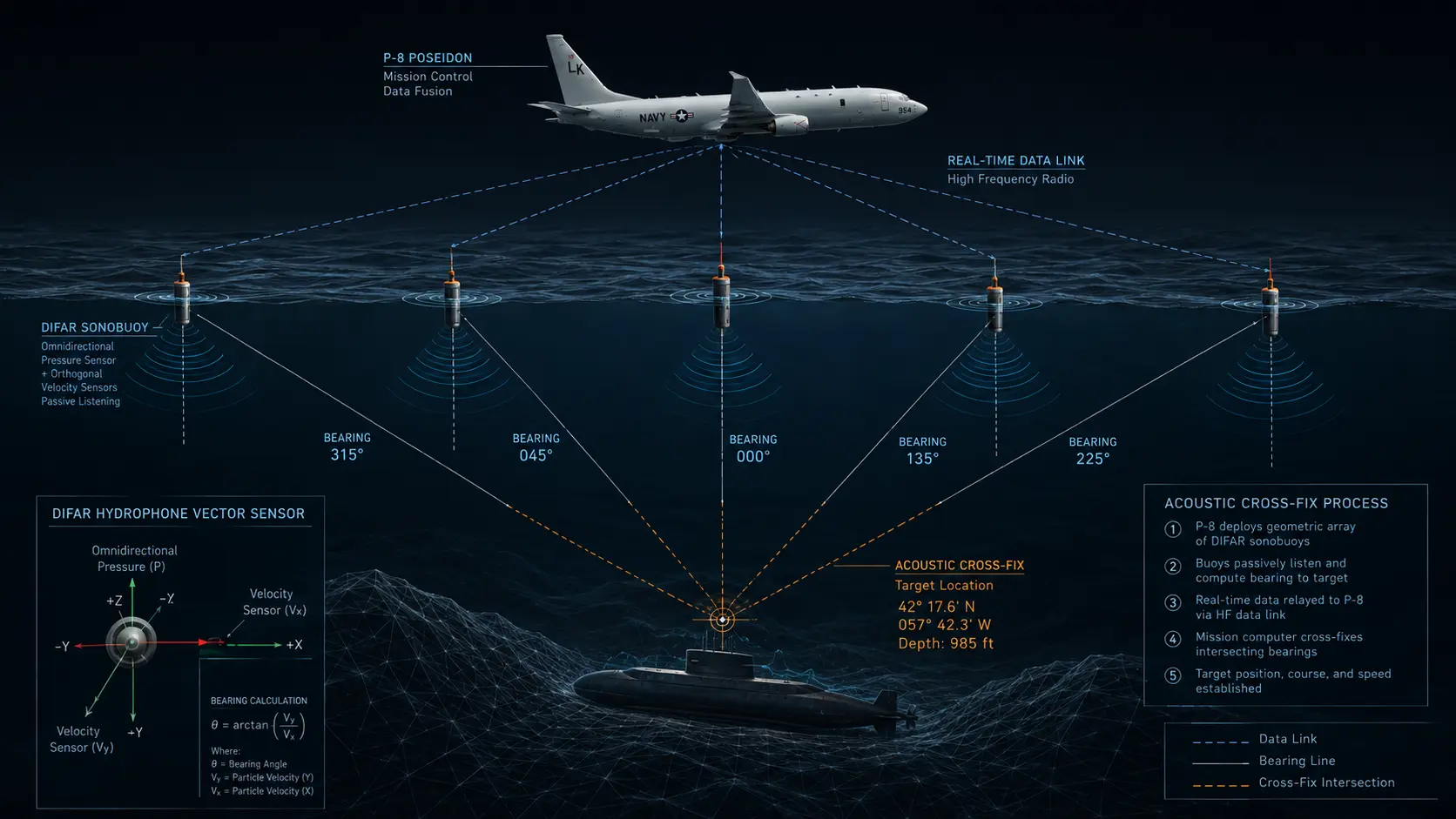
Submarines hide by blending into the natural acoustic background of the ocean. To find them without alerting them, maritime patrol aircraft drop Directional Frequency Analysis and Recording (DIFAR) sonobuoys into the water. Upon impact, the buoy deploys a surface radio transmitter and sinks a highly sensitive acoustic hydrophone array to a pre-programmed depth.
Unlike active sonar that loudly pings the ocean and waits for an echo, DIFAR buoys operate in strict passive mode. They listen continuously for the faint, low-frequency mechanical vibrations generated by a submarine’s nuclear reactor coolant pumps and spinning propeller blades.
The internal architecture of a DIFAR hydrophone consists of one omnidirectional pressure sensor and two orthogonal particle velocity sensors, typically oriented on X and Y axes. When a sound wave strikes the array, the system measures the microscopic phase differences between these specific sensors.
Engineers calculate the precise bearing angle to the target using a fundamental acoustic vector equation:
$$\theta = \arctan \left( \frac{V_y}{V_x} \right)$$
Where θ (theta) represents the bearing angle, and V_y and V_x represent the acoustic particle velocities measured by the orthogonal dipoles. This math provides a highly accurate compass heading pointing directly at the acoustic source.
The hydrophone array continuously samples these acoustic vectors and multiplexes the data into a high-frequency radio signal. The surface float beams this uncompressed telemetry directly up to the loitering patrol aircraft for immediate algorithmic processing.
A single buoy only provides a single line of bearing, meaning the submarine could be one mile or fifty miles away along that specific vector. To achieve a firing solution, the aircraft drops a geometric array of multiple buoys.
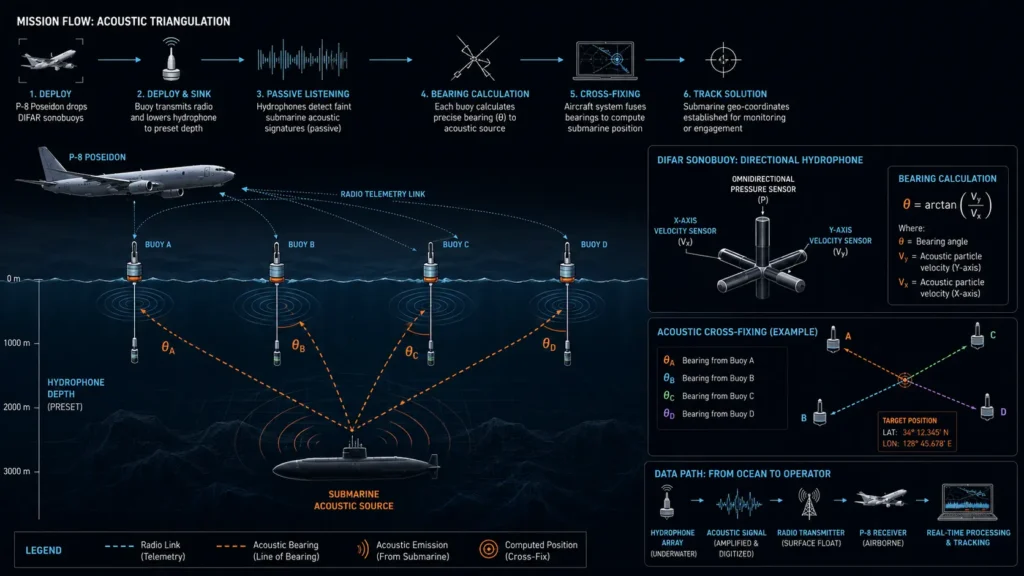
The onboard computers aggregate the continuous data streams in real-time. By mapping the exact geographic point where multiple bearing lines intersect, the software establishes a definitive, targetable track across the ocean floor.
WHY IT MATTERS NOW
The bedrock of global nuclear deterrence rests on the uninterrupted stealth of ballistic missile submarines. Nations spend tens of billions of dollars engineering ultra-quiet hulls and anechoic coatings to ensure their second-strike capabilities remain invisible. The airborne sonobuoy array represents the primary mechanism capable of penetrating this extreme stealth architecture.
Subsurface warfare functions fundamentally as an information asymmetry game. A single P-8 Poseidon aircraft can blanket hundreds of square miles of contested ocean with a disposable sensor grid in a matter of minutes. This rapid deployment instantly transforms a vast, opaque water column into a highly monitored acoustic panopticon.
Geopolitical rivals continuously expand their submarine fleets to project power through strategic maritime chokepoints like the South China Sea and the Greenland-Iceland-United Kingdom (GIUK) gap. Controlling these transit corridors requires continuous subsurface surveillance. Expendable DIFAR networks allow navies to monitor these immense geographic areas without permanently committing highly vulnerable surface warships to the zone.
The economics of this interdiction heavily favor the airborne hunter. A modern nuclear attack submarine costs over three billion dollars and requires years to build. Conversely, a standard DIFAR sonobuoy costs less than a thousand dollars, forcing submarine commanders to operate under constant asymmetric financial and tactical pressure.
WHAT MOST PEOPLE MISS
Defense analysis frequently fixates on the raw sensitivity of the hydrophones, assuming better microphones automatically detect quieter submarines. They miss the severe computational bottleneck of the marine acoustic environment. The ocean acts as a chaotic acoustic mirror, constantly bending sound waves across thermal layers and bouncing signals off the sea floor, creating a deafening background roar of shipping traffic and seismic activity.
The true advantage lies in the airborne signal processing algorithms, not just the physical water sensors. Military software executes real-time fast Fourier transforms to isolate the highly specific, narrowband frequency spikes generated by a submarine’s internal reduction gears. Stripping away the broadband ocean noise to reveal a faint mechanical signature requires massive computational processing power, which dictates the actual effectiveness of the sonobuoy grid.
Physical layer vulnerabilities also dictate tactical failure. If a sonobuoy deploys into a severe oceanic thermal gradient, the temperature shift physically refracts the sound waves downward into the seabed, rendering the hydrophone completely deaf to targets cruising just a few hundred feet above it.
THE TRAJECTORY
Next 12–36 Months: Airborne anti-submarine crews will universally transition from pure passive tracking to multistatic active coherence. Specialized buoys will emit carefully shaped acoustic pings while dozens of silent DIFAR buoys listen for the scattered echoes, illuminating stealth hulls without revealing the location of the primary hunting aircraft.
Next Five Years: Unmanned surface vessels and autonomous underwater gliders will assume the primary role of sonobuoy deployment and monitoring. These persistent drone fleets will seed acoustic barriers across vast oceanic fronts, lingering for months and beaming localized contact telemetry directly to overhead satellite constellations.
Next Ten Years: Deep learning algorithms will replace legacy acoustic signal processing. Neural networks trained on decades of classified ocean acoustic data will autonomously classify distinct submarine classes by identifying microscopic variations in their hydrodynamic flow noise, completely bypassing the need for human sonar operators.
What Could Go Wrong: A sophisticated adversary could deploy localized acoustic spoofing drones that mimic the exact frequency signatures of specific nuclear submarines. Saturating a sonobuoy field with dozens of these cheap, false targets would mathematically overwhelm the tracking algorithms, forcing the patrol aircraft to waste limited torpedo inventory on empty water.
Most Likely Outcome: The disposable sonobuoy array will remain the absolute backbone of tactical anti-submarine warfare. While submarines will continue to achieve extreme mechanical silence, the continuous exponential growth in algorithmic signal processing will systematically erode the physical sanctuary of the deep ocean.
KEY TERMS
- Directional Frequency Analysis and Recording (DIFAR): A specialized passive sonobuoy that calculates the precise compass bearing of underwater acoustic emissions.
- Acoustic Cross-Fixing: The geometric process of triangulating the exact geographic position of a target by plotting intersecting lines of bearing from multiple sensors.
- Beamforming: A signal processing technique used in sensor arrays for directional signal reception, enhancing target signatures while suppressing background noise.
- Fast Fourier Transform (FFT): A mathematical algorithm that converts complex acoustic waveforms into individual spectral frequencies, allowing computers to isolate specific mechanical noises.
- Multistatic Sonar: An acoustic tracking network where multiple geographically separated receiver buoys listen for the echoes generated by a single active emitter.
SOURCES
- United States Navy — Anti-Submarine Warfare Systems and Sonobuoy Operational Parameters
- Journal of the Acoustical Society of America — Vector Sensor Array Processing and Passive Bearing Estimation
- Defense Advanced Research Projects Agency (DARPA) — Multistatic Active Coherent Sonar and Autonomous Acoustic Networks
- Office of Naval Research (ONR) — Ocean Acoustic Propagation and Subsurface Target Tracking Algorithms