Advertisement
)

AT A GLANCE
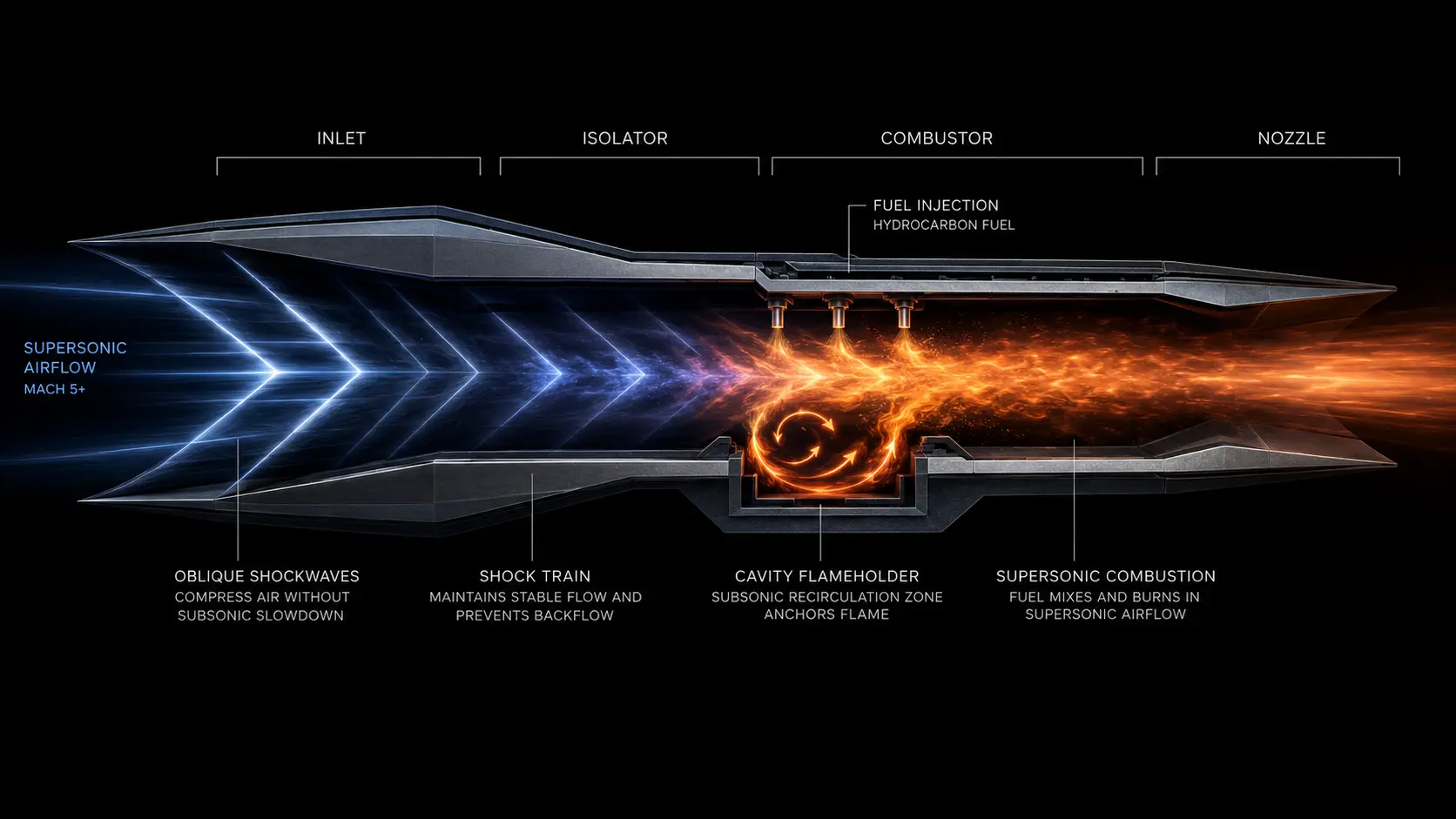
- Concept: Supersonic Flow: Air passes completely through the engine faster than the speed of sound, preventing structural melting.
- Concept: The Isolator: A specific geometric duct manages internal shockwaves to prevent high-pressure combustion from blowing back out the front.
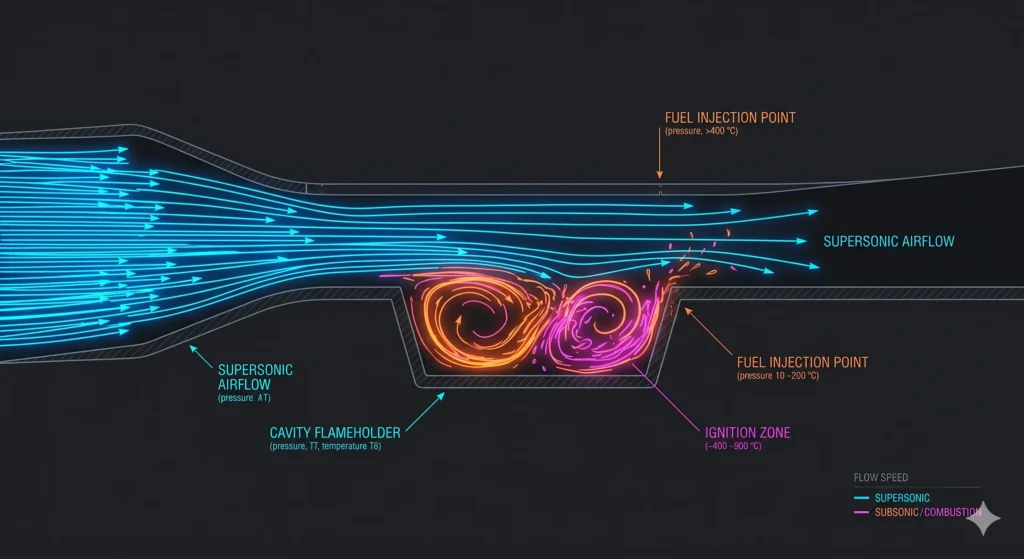
- Concept: Cavity Flameholders: Recessed pockets in the engine wall create localized subsonic vortexes to anchor continuous ignition.
- Concept: Air-Breathing Range: Utilizing atmospheric oxygen eliminates heavy liquid oxidizer tanks, radically shrinking missile mass.
HOW IT WORKS
Traditional jet engines use spinning metal compressor blades to slow incoming air to subsonic speeds before mixing it with fuel. If a fighter jet flies past Mach 3, the incoming air rams into these blades with so much kinetic friction that the titanium physically melts. Ramjets remove the blades, using the shape of the engine inlet to slow the air, but they still require subsonic combustion to function.
A Supersonic Combustion Ramjet (scramjet) eliminates this subsonic limitation entirely. The vehicle flies at Mach 5 or higher, scooping up atmospheric oxygen and forcing it through a converging inlet. This inlet geometry compresses the air using a series of precisely angled oblique shockwaves, heavily pressurizing the flow without ever slowing it below the speed of sound.
Injecting and burning liquid hydrocarbon fuel inside a supersonic airstream is mechanically equivalent to keeping a match lit inside a hurricane. The fuel has roughly one millisecond to atomize, mix with the oxygen, and burn before blowing out the exhaust nozzle. This physical constraint is defined by the Damköhler number:
$$Da = \frac{\tau_m}{\tau_c}$$
Where Da is the dimensionless Damköhler number, τ_m (tau_m) is the characteristic fluid mixing time, and τ_c (tau_c) is the chemical reaction time. A viable scramjet must maintain a Damköhler number significantly greater than one to sustain continuous forward thrust.
To achieve this, engineers carve geometric recesses into the combustor wall known as cavity flameholders. [Image Request: A minimalist dark-mode technical diagram showing supersonic airflow compressing through an isolator and mixing with hydrocarbon fuel inside a cavity flameholder.] As the supersonic air rushes past these cavities, it creates a localized, recirculating subsonic vortex. Fuel injected into this specific vortex safely ignites, acting as a continuous pilot light that anchors the primary supersonic combustion wave across the rest of the engine chamber.
WHY IT MATTERS NOW
The geopolitical race for hypersonic strike capability heavily favors maneuverability over pure speed. Traditional intercontinental ballistic missiles fly at Mach 20, but their parabolic trajectories are mathematically predictable, allowing advanced radar networks to calculate exact intercept geometries. Air-breathing scramjet missiles fly lower in the atmosphere, executing unpredictable aerodynamic turns that defeat legacy tracking systems.
Because a scramjet breathes atmospheric oxygen, it completely discards the massive liquid oxidizer tanks required by standard rocket engines. This shifts the mass fraction entirely toward high-density aviation fuel and explosive payloads.
This volumetric efficiency allows defense contractors like Raytheon to design hypersonic cruise missiles small enough to fit directly under the wing of standard F-15 fighter jets. The United States Air Force Hypersonic Attack Cruise Missile (HACM) program relies entirely on this specific size reduction.
By deploying scramjet missiles on existing tactical aircraft, a military can launch overwhelming hypersonic swarms from decentralized, mobile platforms. This operational flexibility nullifies the requirement for massive, easily targeted ground silos, distributing strategic deterrence across the entire theater of combat.
WHAT MOST PEOPLE MISS
Aviation reporting often assumes once a scramjet reaches Mach 5, it operates in a steady, unbreakable thermodynamic state. They miss the extreme fluid fragility of the engine isolator, a duct section that separates the inlet from the combustor. If the internal combustion pressure spikes unexpectedly, it forces the shockwave train forward against the incoming airflow.
This pressure reversal physically pushes the incoming air back out the front of the inlet, triggering a violent aerodynamic event known as an unstart. An unstart instantly kills the engine thrust, induces massive asymmetric drag, and physically rips the missile apart under extreme high-Mach aerodynamic stress in fractions of a second.
THE TRAJECTORY
Next 12–36 Months: Defense programs will finalize the integration of additively manufactured, actively cooled combustor walls. These 3D-printed superalloys will circulate cold hydrocarbon fuel directly through the engine casing before ignition, absorbing the extreme thermal loads required to sustain Mach 6 flight profiles.
Next Five Years: Scramjet technology will transition from disposable kinetic weapons to reusable reconnaissance drones. These high-altitude, air-breathing platforms will execute rapid intelligence-gathering missions across contested airspace, outrunning surface-to-air missiles while capturing optical data.
Next Ten Years: Aerospace consortiums will scale scramjet architectures for the first stages of orbital launch vehicles. Using atmospheric oxygen for the initial acceleration phase will drastically cut the launch mass of heavy spaceplanes, redefining the logistics of military space deployment.
What Could Go Wrong: The extreme thermal environment inside the combustor heavily degrades advanced protective coatings. If continuous Mach 7 friction delaminates the thermal barrier coating inside the flameholder, the exposed metal will instantly ignite, destroying the engine from the inside out.
Most Likely Outcome: The hydrocarbon scramjet will become the undisputed standard for tactical hypersonic cruise missiles. While rocket-boosted glide vehicles remain the choice for strategic nuclear delivery, air-breathing architectures will dominate the conventional, high-volume precision strike inventory.
KEY TERMS
- Supersonic Combustion Ramjet (Scramjet): An air-breathing jet engine in which incoming airflow, fuel mixing, and combustion all occur at supersonic velocities.
- Isolator: A specifically designed duct section located between the inlet and the combustor that contains a train of shockwaves to prevent combustion pressure from reversing flow.
- Cavity Flameholder: A recessed geometric shape built into the engine wall that creates a localized subsonic recirculation zone to stabilize continuous fuel ignition.
- Engine Unstart: A catastrophic aerodynamic failure where internal engine pressure forces the intake shockwaves forward, violently expelling incoming air out the front of the vehicle.
- Damköhler Number: A dimensionless mathematical ratio relating the chemical reaction timescale to the fluid dynamic mixing timescale within an engine.
SOURCES
- Defense Advanced Research Projects Agency (DARPA) — Hypersonic Air-breathing Weapon Concept (HAWC) Flight Test Parameters
- Journal of Propulsion and Power — Supersonic Combustion and Cavity Flameholder Fluid Dynamics
- United States Air Force Research Laboratory (AFRL) — Scramjet Isolator Shock Train Modeling and Unstart Prevention
- American Institute of Aeronautics and Astronautics (AIAA) — Thermal Management and Hydrocarbon Fuel Cooling in Scramjet Engines