Advertisement
)

AT A GLANCE
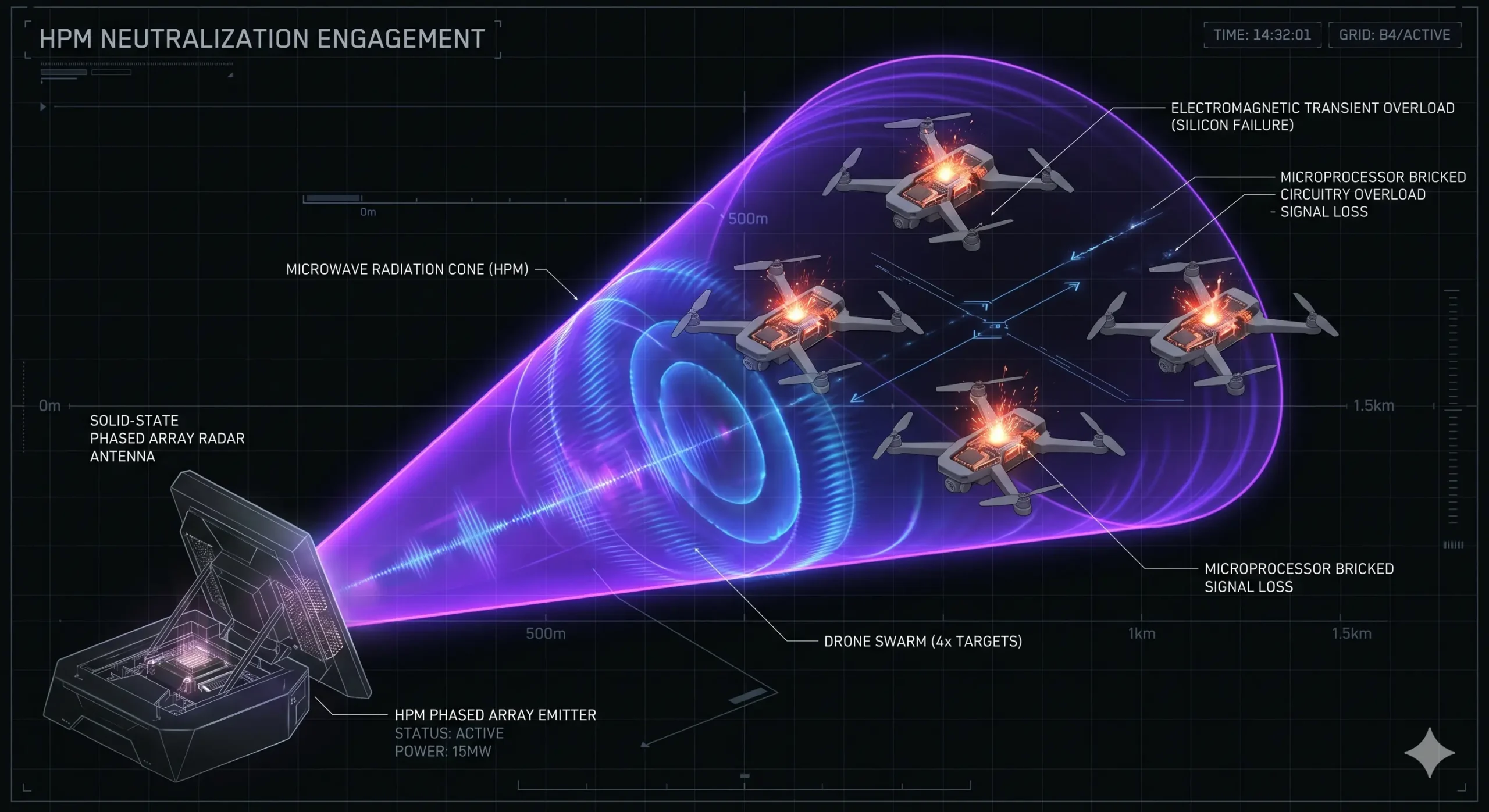
- Concept: Front-Door Coupling: Microwave radiation enters the drone through its own radio antennas and navigation sensors.
- Concept: Back-Door Coupling: Electromagnetic waves penetrate physical gaps in the drone casing to induce destructive electrical currents.
- Concept: Transient Overload: A gigawatt-scale energy spike melts microscopic silicon transistors in fractions of a second.
- Concept: Cone of Effect: Unlike lasers that target single objects, microwaves radiate outward to disable dozens of targets simultaneously.
HOW IT WORKS
Lasers burn through physical material using intense, focused heat. High-power microwave (HPM) systems ignore the physical chassis entirely. They attack the fragile logic circuits that keep the autonomous machine in the air.
The system generates a massive burst of electromagnetic energy using either a specialized vacuum tube called a magnetron or a solid-state gallium nitride amplifier. These components convert electrical power from a standard diesel generator into an extreme radio-frequency spike.
An advanced antenna shapes this gigawatt-scale pulse into a wide, invisible cone. The deflector projects this cone at the speed of light toward an incoming swarm.
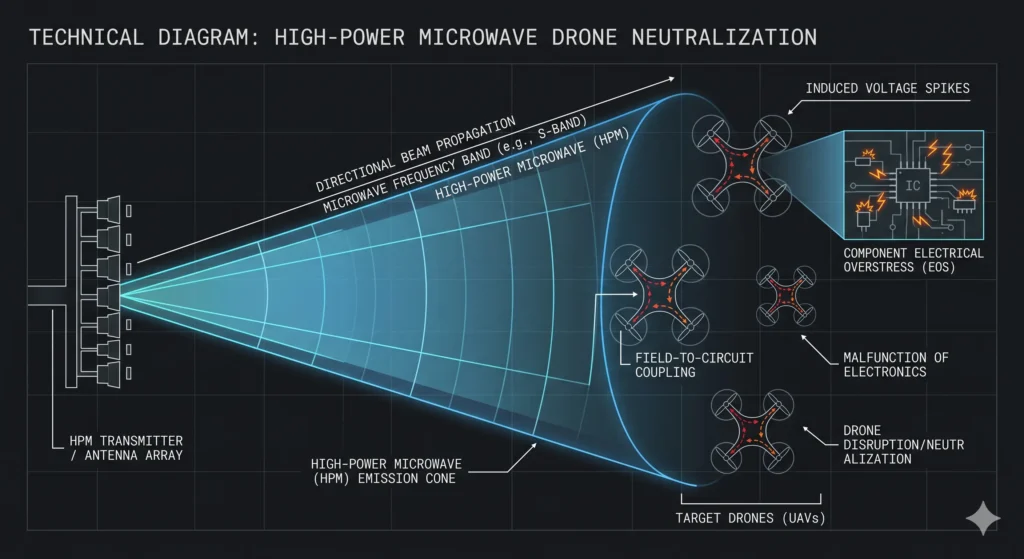
When this electromagnetic wave strikes a drone, it exploits the vehicle’s physical geometry. Through front-door coupling, the wave enters directly through the GPS antennas and communication receivers specifically designed to absorb radio frequencies. Through back-door coupling, the wave forces its way through tiny seams in the plastic chassis, inducing massive stray currents in the internal copper wiring.
Modern microprocessors operate on tightly controlled, ultra-low micro-voltages. When the HPM wave induces a massive electrical transient across the drone’s circuit board, it vastly exceeds the physical tolerances of the silicon transistors. This surge instantly shorts out the flight controller, causing the rotors to stop and the drone to drop from the sky like a stone.
WHY IT MATTERS NOW
Asymmetric warfare permanently altered the economics of air defense. Non-state actors and near-peer adversaries routinely deploy thousand-dollar commercial drones armed with explosives. They use these cheap swarms to destroy multi-million-dollar radar installations and armored vehicles.
Traditional kinetic defense relies on firing physical interceptors like the Patriot or Stinger missile. Firing a three-million-dollar missile to shoot down a disposable quadcopter mathematically bankrupts the defending nation’s military budget within days. The defense simply runs out of ammunition before the enemy runs out of cheap drones.
High-power microwaves decouple defense capabilities from the physical ammunition supply chain. Because the weapon requires only diesel fuel to generate electricity, it features an infinitely deep magazine. It completely removes the logistical burden of transporting and reloading heavy explosive warheads.
Defense contractors like Epirus and Raytheon now field operational HPM systems that can fire continuously. Systems like the Leonidas or THOR can engage thousands of targets for pennies per shot. This alters the attrition math, making it financially viable to defend against overwhelming mass.
This capability provides the absolute baseline defense for critical sovereign infrastructure. Forward operating bases, nuclear power plants, and naval carriers require a wide-area defensive perimeter. Only an HPM deflector can instantly neutralize a highly coordinated, multi-axis autonomous drone swarm simultaneously.
WHAT MOST PEOPLE MISS
General defense commentary routinely lumps all directed energy weapons into a single category. Observers assume lasers and microwaves perform the exact same tactical function. They miss the severe tracking limitations of optical lasers during complex swarm engagements.
A laser must maintain a perfect, uninterrupted physical burn on a single drone for several seconds to destroy it. If a swarm of fifty drones attacks simultaneously, a laser simply runs out of time to burn through each one individually.
An HPM system operates fundamentally differently. It fires a wide, expanding beam that floods a massive volume of airspace. The microwave burst instantly bricks every single electronic device caught within its cone, clearing the sky of dozens of threats in a fraction of a second.
THE TRAJECTORY
Next 12–36 Months: Militaries will mount solid-state HPM modules directly onto armored personnel carriers. This mobile integration will protect mechanized infantry columns from localized loitering munition ambushes while on the move.
Next Five Years: Base defense systems will integrate HPM arrays directly with artificial intelligence tracking radars. These networks will automatically shift frequency bands in real-time to match the exact resonant vulnerabilities of newly detected commercial drone models.
Next Ten Years: HPM miniaturization will allow defense contractors to mount offensive microwave emitters onto fighter aircraft. These aerial platforms will fly over enemy territory and project downward energy bursts to disable hostile air defense radars and command centers without dropping explosives.
What Could Go Wrong: Adversaries will begin wrapping drone flight controllers in heavy Faraday cages to physically block electromagnetic radiation. This shielding adds significant weight to the drone, reducing payload capacity, but forces defending HPM systems to generate exponentially higher power levels to achieve the same kill probability.
Most Likely Outcome: High-power microwaves will become the mandatory short-range air defense standard for all tier-one militaries. Traditional kinetic missiles will be reserved strictly for high-altitude ballistic threats, leaving HPM systems to manage the highly saturated, low-altitude drone airspace.
KEY TERMS
- High-Power Microwave (HPM): A directed energy weapon that uses pulsed electromagnetic radiation to disrupt or destroy electronic components.
- Front-Door Coupling: The process where destructive electromagnetic energy enters a target through intended radio frequency pathways like antennas.
- Back-Door Coupling: The phenomenon where electromagnetic waves penetrate physical gaps in a target’s casing to induce unauthorized currents in internal wiring.
- Electromagnetic Transient: A sudden, massive spike in electrical voltage or current that rapidly overloads and melts sensitive microprocessors.
- Faraday Cage: A physical enclosure made of conductive material designed to block external electromagnetic fields from reaching internal electronics.
SOURCES
- Department of Defense (DoD) — Directed Energy Strategy and Counter-UAS Implementation
- Air Force Research Laboratory (AFRL) — Tactical High Power Operational Responder (THOR) Development Parameters
- IEEE Transactions on Electromagnetic Compatibility — Susceptibility of Unmanned Aerial Vehicles to High-Power Microwave Pulses
- Epirus Inc. — Solid-State Directed Energy and Leonidas System Architecture