Advertisement
)
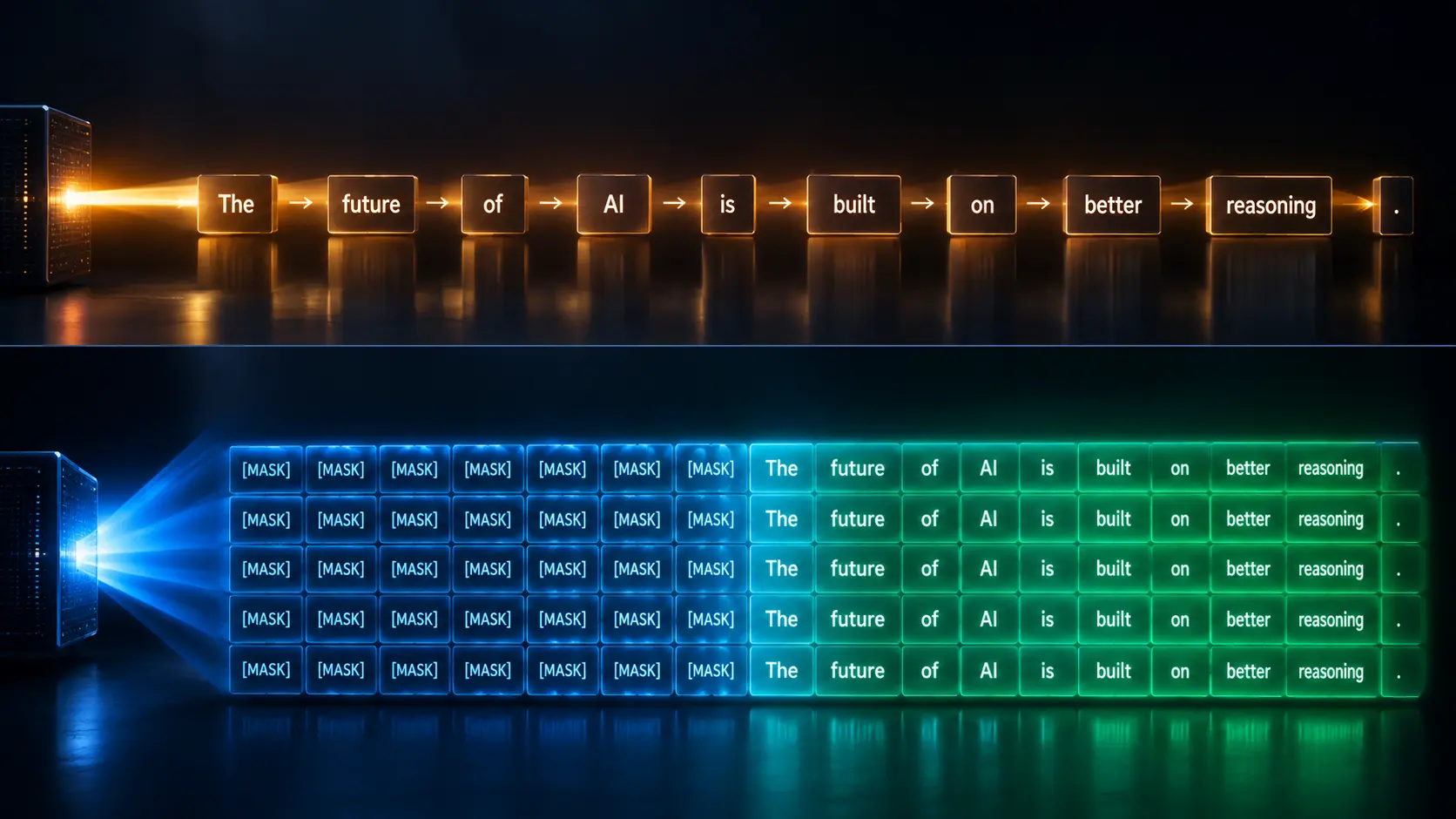

Imagine typing a complex, 50-page legal contract on a typewriter where the backspace key has been permanently removed. You are physically barred from jumping back to edit a previous paragraph. You must type perfectly, word by word, from left to right. If you make a logical error on page two, you cannot fix it; you must spend the next 48 pages desperately trying to justify the mistake. This is exactly how every modern AI model works. Autoregressive LLMs like GPT-4 are trapped in a strict left-to-right temporal prison, which fundamentally caps their ability to perform complex, holistic reasoning.
Why should you care right now? Because AI researchers are officially breaking the autoregressive monopoly. Enter Discrete Diffusion Language Models (dLLMs). Instead of predicting the next word sequentially, dLLMs write text the way a human paints a canvas. They sketch a rough outline of the entire document simultaneously using blank placeholders, and then iteratively refine the details everywhere at once. This breakthrough unlocks bidirectional reasoning, true text infilling, and arbitrary-order generation, redefining how artificial intelligence constructs logic and rewriting the rules of the $100 billion generative AI industry.
What is Discrete Diffusion Language Models (dLLMs)?
Discrete Diffusion Language Models (dLLMs) are artificial intelligence systems that generate text bidirectionally through iterative denoising. Unlike autoregressive models that predict words strictly left-to-right, dLLMs start with a sequence of fully masked, random tokens and progressively unmask them simultaneously, refining the entire text in parallel to enable complex reasoning.
At a Glance
- Concept: Teaching AI to write a rough draft of a whole paragraph at once and iteratively fill in the blanks, rather than writing word-by-word.
- Why it matters: It solves the “planning” problem in AI. Because the model sees the end of the sentence while it is generating the beginning of the sentence, it can construct infinitely more complex logical arguments without hallucinating.
- Who uses it: Vanguard AI research labs (ByteDance, UIUC, Stanford) pioneering models like LLaDA and Plaid.
- Biggest takeaway: Autoregressive models write in ink; discrete diffusion models write in pencil. Diffusion models can effectively “change their mind” about a word early in a sentence based on what they want to say at the end of the sentence.
In Simple Words
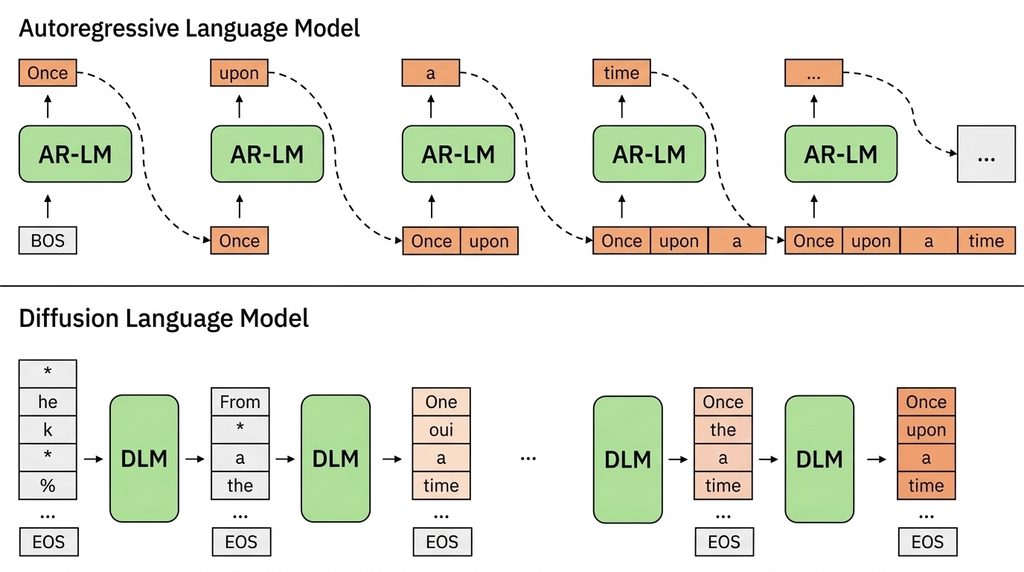
An autoregressive model (like ChatGPT) is a highly advanced autocomplete. It looks at the words you typed, guesses the next word, and then guesses the word after that. It only ever looks backward. It has no idea how its sentence is going to end when it begins typing.
A Discrete Diffusion Language Model (dLLM) looks at the whole page at once.
If you ask it to write a 10-word sentence, it doesn’t start with the first word. It starts by writing 10 blank spaces: [ _ ] [ _ ] [ _ ] [ _ ] [ _ ] [ _ ] [ _ ] [ _ ] [ _ ] [ _ ].
Then, it makes a rough guess at a few important words: [ _ ] dog [ _ ] [ _ ] [ _ ] chased [ _ ] [ _ ] cat [ _ ].
Then, it does another pass to fill in more blanks: The dog [ _ ] [ _ ] angrily chased [ _ ] small cat [ _ ].
It repeats this process until every blank is filled perfectly. Because it works on the whole sentence at once, it can make sure the beginning and the end make perfect sense together.
Why This Matters
For AI Researchers, MLOps Engineers, and Tech Investors, dLLMs solve the Infilling Bottleneck.
In the real world, coding and writing are rarely sequential. Software engineers do not write code strictly from line 1 to line 1,000. They write a function signature, skip down to write a return statement, and then jump back to the middle to fill in the logic.
Autoregressive models are terrible at this “Fill-in-the-Middle” (FIM) task. If you give an autoregressive model the beginning of a codebase and the end of a codebase and ask it to write the middle, it struggles immensely because its fundamental math only flows in one direction.
dLLMs are natively built for infilling. Because they refine tokens globally and bidirectionally, you can pin a specific prefix and suffix in place, and the model will seamlessly diffuse the exact logical bridge required to connect them. This makes dLLMs the holy grail for autonomous coding agents, genomic sequence design, and precise document editing.
Micro-Insight: The transition from Autoregressive to Diffusion text generation is the transition from predicting the future to refining the present.
The Convergence of Visual and Textual Diffusion
We are witnessing the Convergence of Visual and Textual AI Physics.
In 2022, AI image generation experienced a massive leap forward when it abandoned GANs (Generative Adversarial Networks) in favor of Diffusion models (like Midjourney and Stable Diffusion). Diffusion models proved that iterative refinement—starting with pure noise and slowly denoising it into a picture—was vastly superior for generating complex spatial data.
However, text generation stubbornly remained autoregressive. dLLMs represent the moment the text modality finally adopts the superior physics of diffusion. By translating the concept of “visual noise” into “textual masks,” researchers are unifying the mathematical foundation of how AI generates both art and logic.
How dLLMs Use Iterative Denoising and Masking
Applying diffusion mathematics to human language requires overcoming a brutal structural mismatch. Here is the first-principles breakdown of the architecture.
1. The Fundamental Problem: Text is Discrete, Not Continuous
In an image diffusion model, you can add 1% noise to a pixel by changing its color slightly from dark blue to medium blue. Pixel values are continuous.
Words are discrete. You cannot add 1% noise to the word “Apple.” There is no word halfway between “Apple” and “Dog.” Because text lacks this smooth mathematical gradient, standard Gaussian noise diffusion simply destroys the data.
2. The Core Mechanism: Masking as Noise
To solve this, dLLMs use categorical corruption. Instead of tweaking the value of a word, the “noise” is the act of replacing the word with a [MASK] token.
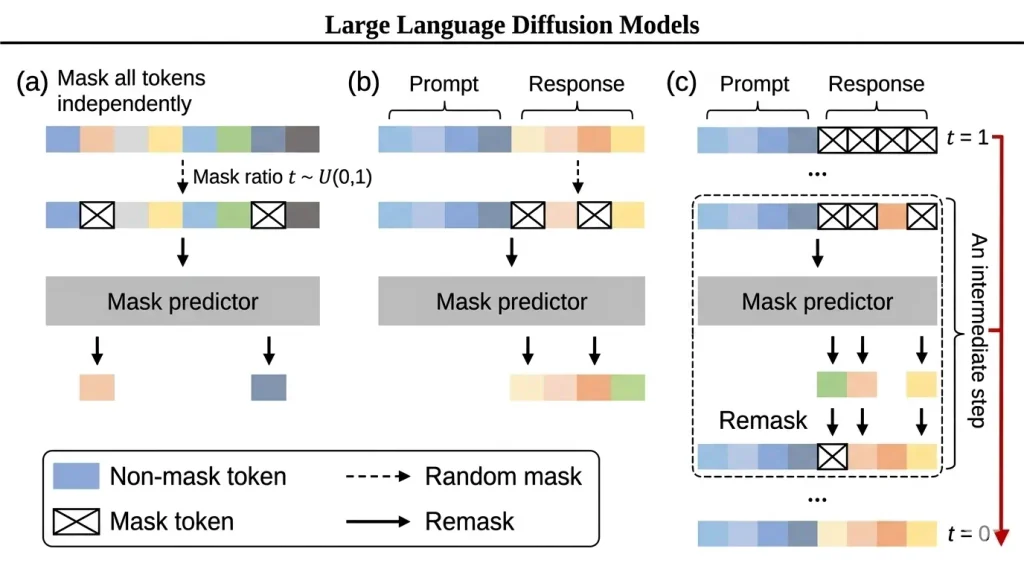
During the Forward Process (adding noise), the model takes a pristine sentence and randomly replaces words with [MASK] until the entire sentence is just a string of masks.
3. Technical Depth: The Reverse Process (Denoising)
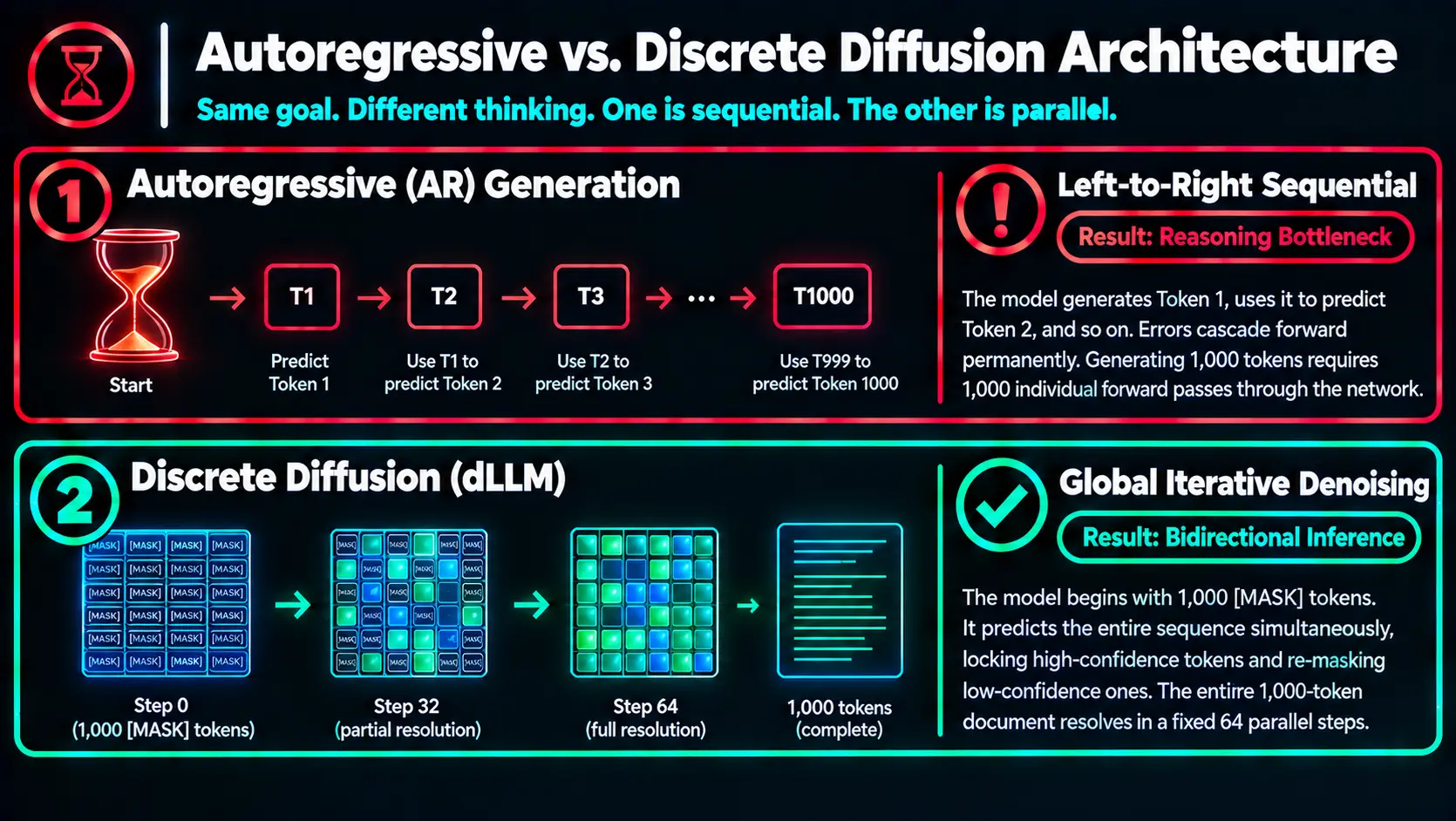
During inference (generation), the model executes the Reverse Process. It starts with a sequence of 100% [MASK] tokens. The neural network predicts the actual words for every single mask simultaneously.
But it doesn’t trust its first guess. It uses a Masking Schedule.
4. Technical Depth: Confidence-Based Adaptive Remasking
In the first pass, the model might guess 100 words. It looks at the mathematical probability (confidence) of each guess. It permanently keeps the 10 words it is most confident about (usually simple structural words like “The” or “And”). It throws away the other 90 words, turning them back into [MASK] tokens.
On the next pass, the model tries to guess the remaining 90 masks, but now it has those 10 locked-in words as context. It repeats this process—predict, lock high-confidence tokens, remask low-confidence tokens—until the text crystallizes into a perfect, cohesive thought.
5. Real-World Consequences: Constant-Time Parallel Decoding
An autoregressive model generating a 1,000-word essay requires 1,000 consecutive forward passes through the neural network. A dLLM can generate that same 1,000-word essay in a fixed number of steps (e.g., 64 or 128 steps), regardless of the length of the document. This parallel decoding capability means that as documents get larger, dLLMs hold the potential to generate massive blocks of text significantly faster than traditional models.
Token Generation: AR vs. Diffusion
Simulating Left-to-Right Prediction vs. Bidirectional Iterative Unmasking
Target Sequence Length
60 Tokens
AI Architecture
Autoregressive (AR)
Discrete Diffusion (dLLM)
Compute Steps (Passes)
0
Tokens Generated
0 / 60
Decoding Strategy
Sequential
Token Matrix Resolution Visualization
IDLE
Compute Steps vs. Tokens Generated
Enterprise Use Cases for Bidirectional Text Generation
Discrete Diffusion Language Models are actively expanding beyond academic papers into specialized enterprise workloads.
Zero-Shot Genomic and Protein Design: Biology is not left-to-right. A protein folds in 3D space, meaning the first amino acid in a sequence heavily interacts with the last amino acid. Autoregressive models struggle to design stable proteins because they lack this bidirectional context. dLLMs are being deployed to generate synthetic DNA and protein sequences, using iterative unmasking to ensure global structural stability across the entire biological molecule.
Controllable Text Generation (Guardrails): If a bank wants an AI to generate a financial report, it must strictly adhere to compliance rules. With autoregressive models, you just have to prompt it and hope it doesn’t violate the rules at the end of the paragraph. With dLLMs, engineers can “clamp” specific tokens. They can force the model to end the sentence with a specific legal disclaimer, and the diffusion process will mathematically ensure the preceding text bridges smoothly and safely to that required ending.
Advanced Code Infilling (Copilots): Modern coding assistants (like GitHub Copilot) use complex hacks to force left-to-right models to fill in the middle of a script. By migrating to dLLMs, IDEs (Integrated Development Environments) can analyze a developer’s entire codebase simultaneously, filling in missing logic blocks with complete awareness of the functions defined both above and below the cursor.
Bypassing the KV Cache Memory Wall
The core strategic consequence of dLLMs is Bypassing the KV Cache Memory Wall.
In autoregressive models, generating text requires storing the context of every previous word in a massive memory block called the Key-Value (KV) Cache. As context windows grow to 128K or 1 Million tokens, the KV cache becomes so massive that it literally exhausts the High-Bandwidth Memory (HBM) of a $30,000 Nvidia H100 GPU. Data centers are spending billions of dollars on memory just to keep the KV cache alive.
dLLMs do not rely on the standard causal KV cache architecture in the same way. Because they process all tokens in parallel during the iterative steps, they offer a fundamentally different memory utilization profile. While they require intense compute per step, the ability to escape the strict sequential memory bloat of the KV cache presents a massive hardware cost-reduction opportunity for hyperscale cloud providers running massive-context workloads.
Advantages
- Bidirectional Context: Every word generated is aware of both the words preceding it and the words following it, drastically reducing logical hallucinations.
- Constant-Time Generation: The number of generation steps is fixed. Producing a 10-word sentence and a 1,000-word paragraph can theoretically take the exact same number of neural network passes.
- Seamless Infilling: Natively excels at Fill-in-the-Middle (FIM) tasks without requiring clunky prompt engineering hacks.
- Token Clamping: Developers can force specific words to appear at specific locations in the text, guaranteeing strict compliance and formatting.
Limitations
- Inference Compute Overhead: While the number of steps is fixed, each step requires a forward pass of the entire sequence length. For short sentences, an autoregressive model is computationally cheaper and much faster.
- Exact Length Requirement: A dLLM needs to know exactly how long the canvas is before it starts painting. You must specify the sequence length (e.g., exactly 256 tokens) before generation, whereas an autoregressive model can simply stop whenever it feels like it.
- The Hardware Optimization Deficit: The entire global AI hardware stack—from Nvidia’s TensorRT-LLM to vLLM—has been ruthlessly optimized for autoregressive left-to-right generation for the past 6 years. dLLMs currently lack this specialized software infrastructure, running slower in practice despite their theoretical advantages.
Takeaway: dLLMs win decisively on reasoning and control, but they are currently losing the brute-force speed war simply because the world’s semiconductor infrastructure was custom-built for their left-to-right rivals.
Common Misconceptions
Misconception: dLLMs use Gaussian noise just like Midjourney.
Reality: Standard diffusion uses continuous Gaussian noise (blurring pixels). dLLMs use discrete noise (replacing distinct words with [MASK] tokens). You cannot mathematically blur the word “Cat.”
Misconception: They are slower than ChatGPT.
Reality: It depends on the length. For a 5-word response, ChatGPT is faster. For a 5,000-word response, a highly optimized dLLM can generate the text significantly faster due to its parallel decoding architecture.
Misconception: dLLMs are just BERT models.
Reality: While BERT introduced the concept of Masked Language Modeling (MLM) for understanding text, BERT is terrible at generating long text. dLLMs combine MLM with advanced diffusion scheduling (remasking and iterative denoising) specifically to scale generation.
What Most People Miss
The disruptive capability of Thought-Time Scaling.
Recently, the AI industry pivoted to “Test-Time Compute” (as seen in OpenAI’s o1 model), where the AI “thinks” for a long time before answering. In an autoregressive model, this requires generating a massive, invisible “chain of thought” left-to-right before spitting out the final answer.
dLLMs achieve test-time compute elegantly simply by increasing the number of diffusion steps. If you want a quick answer, you run the dLLM for 16 denoising steps. If you want a Nobel-level reasoning answer, you run the exact same dLLM for 1,024 denoising steps. The model spends exponentially more compute cycles iteratively refining, erasing, and rewriting its internal draft before presenting the final text to the user.
Comparison Table
| Feature | Autoregressive LLM (GPT-4) | Discrete Diffusion LLM (LLaDA) |
| Generation Direction | Strictly Left-to-Right | Global / Bidirectional |
| Decoding Process | Sequential (Token-by-Token) | Parallel (All tokens at once) |
| Context Awareness | Only sees preceding tokens | Sees past and future tokens simultaneously |
| Infilling Capability | Poor (Requires prompt hacks) | Native and Flawless |
| Generation Speed | Scales linearly with output length | Fixed steps regardless of output length |
Future Outlook
Next 12–24 Months
The era of Infrastructure Parity. Through 2027, the primary focus of the open-source AI community will be building the missing MLOps infrastructure for dLLMs. We will see the release of custom inference engines (similar to vLLM) specifically optimized for parallel masking operations. Models like LLaDA will be deployed aggressively into coding assistant pipelines where their native infilling capabilities provide an immediate ROI over legacy autoregressive models.
Next 3–5 Years
The scaling of Dynamic Length Diffusion. By 2030, researchers will solve the “exact length requirement” limitation. Next-generation dLLMs will feature dynamic padding—allowing the model to organically expand or shrink the canvas size during the denoising process if it realizes its current logical argument requires more space. This will bring the flexibility of autoregressive generation into the bidirectional paradigm.
Next 10 Years
The Multimodal Unified Physics Standard. By the mid-2030s, the distinction between text models and image models will dissolve. Because dLLMs bring text into the diffusion framework, the industry will build true, natively multimodal “Any-to-Any” models. A single diffusion backbone will simultaneously denoise discrete text tokens, continuous audio waveforms, and spatial image pixels in the exact same forward pass, eradicating the fragmented architecture of the early 2020s.
Most Likely Scenario
The autoregressive paradigm has carried the AI industry to unprecedented heights, but its strict left-to-right temporal prison is a hard mathematical ceiling on logical reasoning. Discrete Diffusion Language Models (dLLMs) provide the necessary escape velocity. While the transition will be delayed by the sheer gravity of existing hardware optimization, the fundamental ability to draft, critique, and globally refine text bidirectionally ensures that dLLMs will eventually become the standard architecture for high-stakes, reasoning-heavy enterprise AI.
Key Takeaways
- Autoregressive models (like ChatGPT) generate text strictly from left to right. If they make a logical error early in a sentence, they cannot go back and fix it.
- Discrete Diffusion Language Models (dLLMs) solve this by drafting the entire sequence simultaneously. They start with a string of blank
[MASK]tokens and iteratively fill them in. - By generating text bidirectionally, dLLMs can ensure the beginning of a paragraph aligns perfectly with the end of a paragraph, enabling vastly superior logical reasoning.
- In the “Reverse Process,” the model predicts the missing words, locks in the ones it is highly confident about, and re-masks the low-confidence words for the next refinement pass.
- Because dLLMs predict all tokens in parallel, they can theoretically generate a massive 1,000-word document in the same number of compute steps it takes to generate a 10-word sentence.
Glossary
Autoregressive Model: An AI architecture that generates data sequentially, predicting the next word based exclusively on the sequence of words that came before it.
Bidirectional Generation: Generating text where the prediction of a word is influenced by both the context before it and the context after it.
Discrete Diffusion: A variation of diffusion physics designed for categorical data (like words). Instead of adding continuous Gaussian noise (blurring), it adds discrete noise by replacing words with mask tokens.
Fill-in-the-Middle (FIM): A task where an AI is given a prefix (the beginning of a text) and a suffix (the end) and is asked to generate the seamless logical bridge between them.
Iterative Denoising: The process of taking a completely corrupted (masked) sequence and running it through the neural network multiple times, cleaning up the data step-by-step until the final output is pristine.
KV Cache (Key-Value Cache): A massive memory bottleneck in autoregressive models used to store the context of previously generated tokens so the model doesn’t have to recalculate them on every step.
Sources
Tsinghua University & ByteDance: Large Language Diffusion Models (LLaDA)
Stanford University AI Lab: Discrete Diffusion Modeling by Estimating the Ratios of the Data Distribution
arXiv Preprints: Autoregressive vs. Diffusion: The Battle for Text Generation
Hugging Face Research: Progressive Masking Schedules in Discrete Diffusion
Machine Learning Compilation (MLC): Parallel Decoding Efficiency in dLLMs