Advertisement
)


Imagine a self-driving car traveling 70 miles per hour down a highway. Suddenly, a tire blows out on the truck ahead. The autonomous vehicle relies on standard cameras recording at 60 frames per second. Between frame one and frame two, a critical 16 milliseconds pass. In those 16 milliseconds, the car travels over five feet completely blind. Worse, the vehicle’s AI processor is forced to mathematically analyze the entire high-definition image—including the static blue sky, the immobile guardrails, and the stationary pavement—just to realize that a single piece of rubber has exploded. This architectural flaw is the root cause of autonomous driving lag.
Why should you care right now? Because robotics engineers have realized that frame-based vision is fundamentally broken for high-speed autonomy. To fix it, they are turning to Neuromorphic Event-Based Sensors (EVS). By mirroring the biological architecture of the human retina, EVS pixels operate entirely independently. They do not record static frames; they only fire when they detect a physical change in light. This brain-inspired hardware grants robots microsecond reaction times, total immunity to blinding sun glare, and deletes up to 90% of the useless background data that currently chokes modern AI processors.
What are Neuromorphic Event-Based Sensors (EVS)?
Neuromorphic Event-Based Sensors (EVS) are brain-inspired vision chips that operate without standard frames. Instead of capturing a complete image at set intervals, every individual pixel in an EVS operates independently and asynchronously, firing a data signal in microseconds only when it detects a specific change in light intensity.
At a Glance
- Concept: A camera that doesn’t take pictures. It only tracks the exact pixels where light is actively moving or changing.
- Why it matters: Standard cameras waste massive amounts of electricity and computing power processing background pixels that haven’t changed. EVS filters out the noise at the hardware level, creating an incredibly lean, ultra-fast data stream.
- Who uses it: Vanguard autonomous vehicle startups, industrial automation giants, and edge-robotics companies specializing in high-speed drones.
- Biggest takeaway: Because every pixel adjusts to light on its own, an EVS cannot be blinded by the sun or confused by dark shadows. It can look directly into oncoming headlights and still perfectly track the outline of a pedestrian.
In Simple Words
A standard camera is like a security guard who is forced to draw a highly detailed picture of an entire empty room every single second, just in case someone walks in. When a thief finally runs through the room, the guard is too busy drawing the ceiling and the walls to draw the thief clearly, resulting in a blurry mess.
A Neuromorphic Event-Based Sensor (EVS) is like a security guard equipped with tripwires. The guard ignores the empty room entirely. They only look at the exact doorway where the tripwire was triggered.
If nothing is moving, the EVS sensor generates absolutely zero data. It stays silent. The exact microsecond a ball bounces into the frame, only the pixels touching the edge of the ball fire off a signal. This allows the computer brain of a robot to react instantly, because it doesn’t have to search through millions of useless pixels to find the object.
Why Robotics Relies on Asynchronous Vision
For Robotics Engineers, AV Startups, and Semiconductor VCs, EVS solves the Data Deluge and Latency Bottleneck.
Modern Artificial Intelligence is starving for compute power. When an autonomous drone flies through a forest using standard 4K cameras running at 60 frames per second, it is piping gigabytes of redundant visual data into its processor. The drone’s battery is largely consumed just running the GPU required to filter out the static trees.
EVS performs this filtration at the silicon level. By generating data only at the edges of moving objects, EVS outputs a “sparse” data stream. A sparse data stream requires exponentially less bandwidth and almost zero computing power to process. This allows hardware engineers to build smaller, cheaper, battery-powered robots that can track objects moving at bullet-like speeds without needing a supercomputer strapped to their back.
Micro-Insight: In neuromorphic engineering, the absence of data is just as valuable as the presence of data. If a pixel doesn’t fire, the AI instantly knows it is safe to ignore that space.
Synchronous vs. Asynchronous Machine Vision
We are witnessing the pivot from Synchronous to Asynchronous Computing.
Since the invention of the microchip, computing has been ruled by the global clock. Every operation waits for the “tick” of a central clock, just like a camera waits for the tick of a shutter.
Biology does not use a clock. The human optic nerve does not process reality at 60 frames per second; neurons fire asynchronously, immediately routing critical motion data to the brain. EVS represents the moment digital hardware abandons the artificial constraints of the clock, shifting toward the organic, continuous, and event-driven physics of biological life.
How Do Event-Based Sensors (EVS) Work?
Building a sensor that mimics the human eye requires completely redesigning the pixel circuit from the ground up. Here is the first-principles breakdown of the architecture.
1. The Fundamental Problem: The Global Shutter Trap
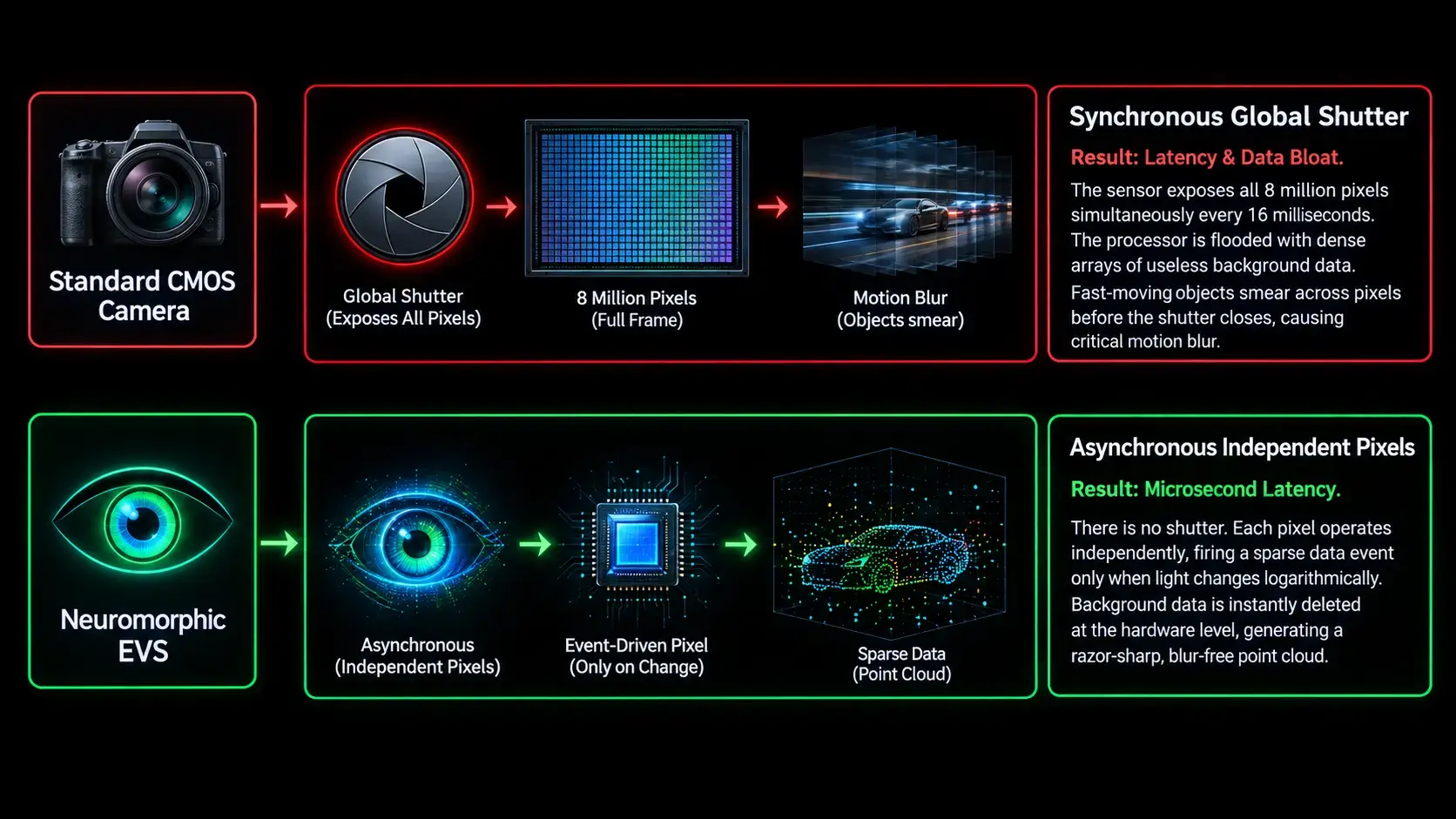
In standard vision systems, a “global shutter” exposes every single pixel on the sensor to light at the exact same time, for the exact same duration. If the shutter speed is too slow, fast-moving objects smear across multiple pixels, creating motion blur. If you attempt to fix this by increasing the frame rate (e.g., to 1000 fps), you overwhelm the data cable and the AI processor with billions of identical, useless pixels.
2. The Core Mechanism: Independent Asynchronous Pixels
To break the shutter trap, neuromorphic engineers gave every individual pixel its own independent circuit. There is no global clock controlling them. Instead, each pixel constantly monitors the light hitting it. If the light intensity changes logarithmically (e.g., it gets a specific percentage brighter or darker), the pixel instantly fires a single “Event.”
3. Technical Depth: Spatiotemporal Point Clouds
An Event is not an image. It is a tiny packet of data containing four things: the X coordinate of the pixel, the Y coordinate, the exact microsecond timestamp, and the Polarity (did it get brighter or darker?).
Because the pixels fire continuously and independently, the output of an EVS is not a flat 2D photograph. It is a continuous, 3D “spatiotemporal point cloud” that perfectly traces the outline of moving objects in real-time.
Plain-English Takeaway: An event-based sensor doesn’t take pictures of objects; it generates a living, moving connect-the-dots outline of anything that moves across its vision.
4. Technical Depth: >120 dB High Dynamic Range (HDR)
Because a standard camera exposes all pixels together, a bright light (like the sun) will over-expose the whole image, rendering shadows pitch black.
Because EVS pixels operate entirely alone, they are immune to this. A pixel looking directly at the sun adapts to the sun. A pixel looking into a dark shadow adapts to the shadow. This grants EVS a staggering Dynamic Range exceeding 120 decibels (dB), allowing autonomous vehicles to see perfectly when driving out of a dark tunnel into blinding sunlight.
5. Real-World Consequences: Microsecond Reflexes
Because an EVS does not have to wait 16 milliseconds to package a “frame,” its latency is virtually zero. When a baseball is thrown, the leading edge of the ball triggers a cascade of pixel events as it travels. A robot arm equipped with an EVS receives this location data in microseconds, allowing it to easily track and catch objects moving at supersonic speeds that standard cameras literally cannot see.
Neuromorphic Event Sensor vs. Standard Camera
Simulating Motion Blur, HDR Glare Immunity, and Data Bandwidth Efficiency
Target Object Speed
Medium
Sensor Architecture
Standard 30fps (CMOS)
Asynchronous EVS
Data Bandwidth (MB/s)
120.0
Sensor Latency (ms)
33.3
Visual Clarity / HDR
Nominal
AI Sensor Feed Visualization
SYNC GLOBAL SHUTTER ACTIVE
Data Payload (MB/s) vs. Time
Real-World Applications of Event Cameras
EVS technology is rapidly migrating from highly classified defense applications into commercial industrial hardware.
High-Speed Industrial Machine Vision: On advanced manufacturing lines, counting pills or inspecting microchips moving at 50 miles per hour on a conveyor belt is incredibly difficult. Standard cameras require blindingly bright strobe lights to freeze the motion without blur. EVS sensors can track these high-speed items with perfect clarity under normal lighting, calculating dimensions and defects in real-time by analyzing the continuous stream of edge events.
Driver Monitoring Systems (DMS): Inside modern vehicles, AI must monitor the driver's eyes to ensure they are paying attention. Standard cameras struggle when the driver's face goes in and out of harsh sunlight and deep shadows. Furthermore, constantly processing high-res video of a driver requires a heavy, power-hungry ECU. EVS sensors easily track the micro-saccades (rapid movements) of the driver's eye regardless of lighting, processing the data locally on a microscopic chip.
Autonomous Drone Navigation: For military and commercial drones navigating dense forests at high speeds, dodging branches requires sub-millisecond reflexes. Because EVS deletes the static background, the drone's processor is only fed data regarding the rapidly approaching obstacles. This allows small, lightweight drones to execute aggressive evasion maneuvers using a fraction of the battery power required by heavy LiDAR systems.
The Hardware Shift: Neuromorphic Processors & Edge AI
The core strategic consequence of EVS is the Acceleration of Edge AI hardware.
Event-based data is not compatible with standard AI chips. GPUs (Graphics Processing Units) are specifically designed to perform matrix math on dense blocks of frame data. Feeding sparse, asynchronous EVS data into a standard GPU is highly inefficient.
This sensor shift is triggering a massive hardware evolution toward Neuromorphic Processors (like Intel's Loihi or IBM's TrueNorth). These processors utilize Spiking Neural Networks (SNNs), which mirror human synapses. They only consume electricity when a specific event "spikes," perfectly matching the output of the EVS sensor. For semiconductor VCs, the widespread adoption of EVS necessitates the creation of an entirely new, multi-billion-dollar ecosystem of non-Von Neumann computing architecture at the edge.
Advantages of Neuromorphic Event Cameras
- Microsecond Latency: Reacts to motion instantly without waiting for a global clock to compile a "frame."
- Extreme Dynamic Range (>120 dB): Independent pixel exposure makes the sensor immune to blinding light, deep shadows, and flashing strobe effects.
- Zero Motion Blur: Tracks objects moving at supersonic speeds with absolute edge clarity.
- Ultra-Low Power & Bandwidth: By ignoring static backgrounds, EVS cuts data transmission by up to 90%, drastically lowering the power required for the AI processor.
Limitations of Event-Based Sensors
- Blind to Static Objects: Because an EVS only records changes in light, if an object stops moving perfectly, it completely disappears from the sensor's view. EVS cannot be used to read a stationary stop sign or recognize a parked car unless the camera itself is moving.
- Algorithm Friction: The entire global AI ecosystem is trained on frame-based images (CNNs, Transformers). Spatiotemporal point cloud data requires completely new algorithms, creating a massive software engineering bottleneck for adoption.
- Spatial Resolution: Currently, EVS sensors have lower megapixel counts compared to traditional CMOS sensors, making them less ideal for fine detail recognition at extreme distances.
Takeaway: An EVS is not a replacement for a standard camera; it is a replacement for a biological reflex. You still need a standard camera to read the text on a billboard, but you need an EVS to dodge the baseball flying toward your windshield.
Common Misconceptions
Misconception: EVS just takes pictures much faster (like a 10,000 fps camera).
Reality: EVS takes no pictures at all. There is no shutter and no frame. It is a continuous, asynchronous stream of individual pixel triggers.
Misconception: EVS replaces LiDAR in self-driving cars.
Reality: EVS and LiDAR do different things. LiDAR gives you absolute 3D depth and distance to an object. EVS gives you the ultra-fast 2D outline of movement. They are complementary; EVS solves the latency problem, while LiDAR solves the depth problem.
Misconception: You can plug an EVS directly into ChatGPT or standard computer vision models.
Reality: Standard vision models (like YOLO) expect a 2D matrix of pixels. EVS outputs a timeline of coordinates. You either have to accumulate the events into "fake frames" (which ruins the latency advantage) or build entirely new Spiking Neural Networks to process the raw data.
What Most People Miss
The disruptive capability of Sensor Fusion via Hybrid CMOS.
Because an EVS goes blind when things stop moving, and a standard camera goes blind when things move too fast, vanguard semiconductor companies are fusing them together.
Next-generation vision chips interleave standard RGB frame pixels directly alongside asynchronous EVS pixels on the exact same piece of silicon. This hybrid architecture gives the AI processor the best of both worlds: the standard camera provides high-resolution color and texture data of the stationary environment, while the EVS pixels provide an invisible, high-speed tripwire grid that instantly flags sudden motion, allowing the AI to optimize its attention flawlessly.
EVS vs. Standard Frame Cameras (CMOS)
| Feature | Standard Frame Camera (CMOS) | Event-Based Sensor (EVS) |
| Output Type | Synchronous 2D Frames | Asynchronous Point Cloud |
| Latency | High (Limited by frame rate, ~16ms) | Ultra-Low (Microseconds, ~1µs) |
| Data Volume | Massive (Redundant background data) | Minimal (Only records changes) |
| Dynamic Range | Low (~60-80 dB) | Extreme (>120 dB) |
| Motion Blur | Severe at high speeds | Non-existent |
| Static Objects | Sees them perfectly | Invisible (Unless the camera moves) |
Future Outlook
Next 12–24 Months
The era of Industrial Validation and AR/VR Tracking. Through 2027, the primary commercial success for EVS will be inside Augmented Reality (AR) headsets. To project holograms seamlessly, AR headsets must track the user's eye movements with zero latency. Traditional cameras drain the headset's battery too quickly. EVS will become the gold standard for eye-tracking, operating on milliwatts of power while perfectly tracking the pupil's micro-movements.
Next 3–5 Years
The scaling of Automotive ADAS Fusion. By 2030, Tier-1 automotive suppliers (like Bosch and Continental) will integrate hybrid EVS/CMOS sensors into the front-facing camera suites of consumer vehicles. The EVS layer will act as the ultimate Automatic Emergency Braking (AEB) trigger. By spotting a pedestrian stepping into the road in microseconds—and completely ignoring the blinding headlights of oncoming traffic—EVS will drastically reduce nighttime pedestrian fatalities.
Next 10 Years
The Spiking Neural Network Ecosystem. By the mid-2030s, the software ecosystem will finally catch up to the hardware. Major AI frameworks (like PyTorch and TensorFlow) will feature native, highly optimized libraries for Spiking Neural Networks (SNNs). This software standardization will unlock the true potential of Neuromorphic chips, allowing edge robotics (from humanoid robots to delivery drones) to operate continuously in complex, dynamic environments using less electricity than a standard lightbulb.
Most Likely Scenario
The physical limitations of synchronous, frame-based vision have been exhausted; you cannot fix motion blur by simply making the processor hotter. Neuromorphic Event-Based Sensors represent the fundamental biological upgrade to machine vision. While the requirement to rewrite decades of frame-based AI algorithms creates temporary market friction, the staggering advantages in latency, dynamic range, and power consumption guarantee that EVS will become the mandatory foundational layer for all high-speed autonomous robotics in the coming decade.
Key Takeaways
- Standard cameras capture complete frames at fixed intervals, wasting massive computing power processing empty backgrounds and creating severe motion blur for fast objects.
- Neuromorphic Event-Based Sensors (EVS) mimic the human eye. Each pixel operates independently and only fires when it detects a change in light.
- Because pixels act alone, the sensor possesses an ultra-high Dynamic Range (>120 dB), meaning it can look into dark shadows and blinding sun glare simultaneously without failing.
- EVS produces a "sparse" data stream. By only transmitting moving edge data, it reduces data bandwidth by up to 90%, freeing up the AI processor to act in microseconds.
- Because EVS only sees changes, perfectly stationary objects are invisible. To solve this, the industry is building hybrid chips that fuse EVS pixels with standard camera pixels.
Glossary
Asynchronous: Operating independently without a central clock coordinating actions. In EVS, pixels fire whenever they need to, not when a shutter tells them to.
Dynamic Range (HDR): The ratio between the brightest and darkest parts of an image that a sensor can capture simultaneously without washing out or turning black.
Event: The fundamental unit of data in an EVS. It contains the X/Y location of the pixel, the exact microsecond timestamp, and whether the light got brighter or darker (polarity).
Motion Blur: The smearing of a moving object in a standard camera, caused by the object moving across multiple pixels while the global shutter is open.
Neuromorphic Engineering: Designing computer chips and sensors inspired by the architecture and physics of the biological brain and nervous system.
Spiking Neural Network (SNN): A type of AI architecture that mimics biological neurons. Instead of processing dense matrix math continuously, artificial neurons only consume power when they "spike" in response to an event.
Sources
IEEE Solid-State Circuits Magazine: Event-Based Vision Sensors: An Overview and Applications
Prophesee: Metavision® Intelligence Architecture and Asynchronous Pixel Sensor Physics
University of Zurich (Robotics and Perception Group): Event-Based Vision: A Survey
Nature Electronics: Neuromorphic computing and event-driven vision for edge AI
Intel Labs: Loihi 2 and the Scaling of Spiking Neural Networks for Event Data