Advertisement
)
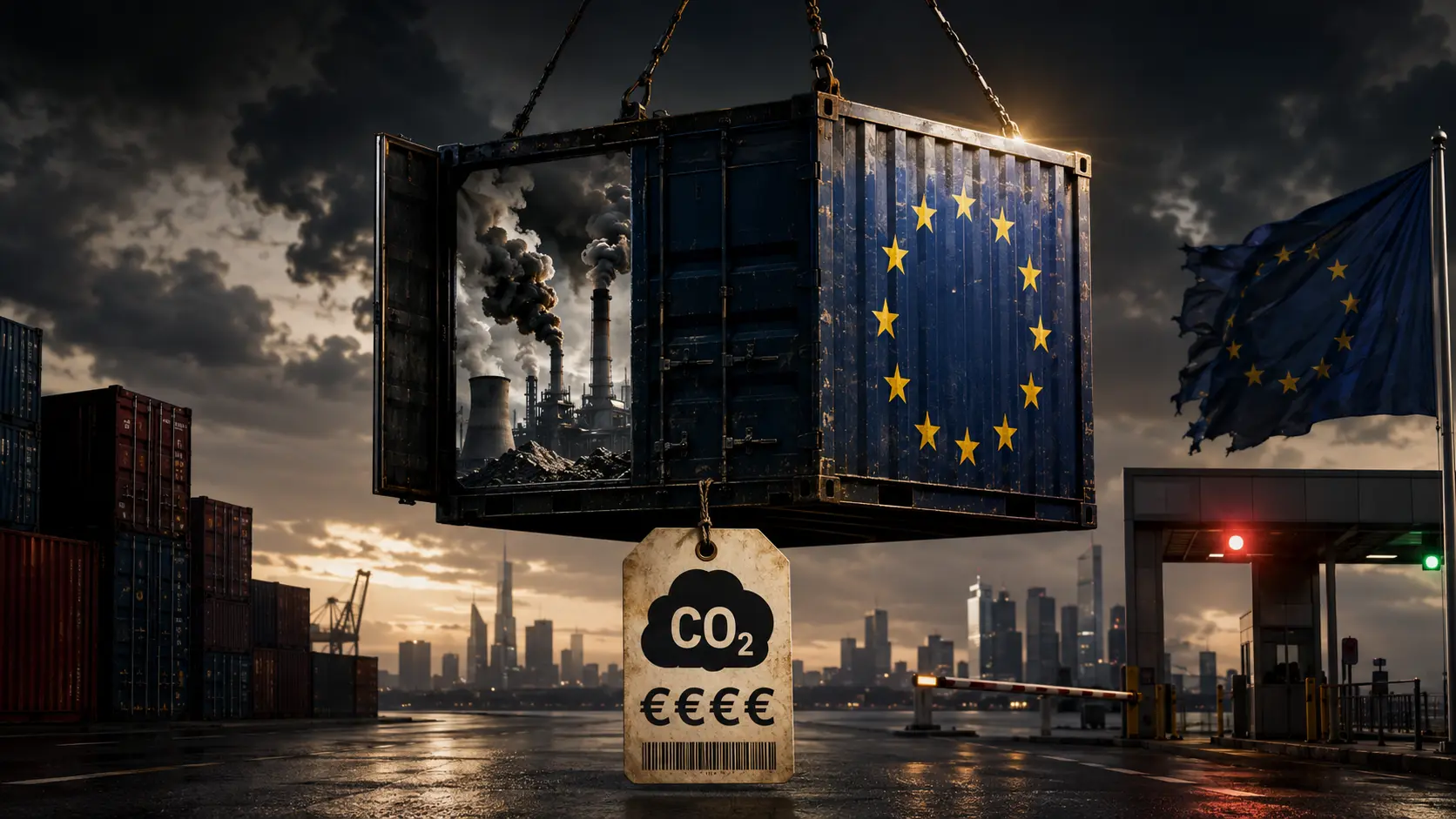

For the past twenty years, global trade operated on a glaring environmental loophole. If a European steel manufacturer was forced by local laws to install expensive, green technology, the cost of their steel went up. A competitor in Asia, operating under zero environmental regulations, could burn cheap coal, produce massive amounts of pollution, and sell their cheap steel right back into Europe, entirely undercutting the local manufacturer. This dynamic, known as “carbon leakage,” practically guaranteed that aggressive climate laws would simply force industrial factories to pack up and move to countries that didn’t care about the environment.
On January 1, 2026, the European Union permanently closed that loophole. By activating the definitive regime of the Carbon Border Adjustment Mechanism (CBAM), the EU has officially weaponized access to the world’s largest single market. If a factory in India or China wants to sell steel, aluminum, or fertilizer into Europe, they must now mathematically prove exactly how much carbon they emitted to make it. If it is dirtier than European standards, the importer is slapped with a massive financial penalty at the border. Why should you care right now? Because this is no longer a theoretical climate pledge; it is a hard, financial reality. CBAM is actively forcing every industrial supply chain on Earth to track its microscopic carbon footprint, triggering the most profound geopolitical trade shock of the 21st century.
What is the EU Carbon Border Adjustment Mechanism (CBAM)?
The EU Carbon Border Adjustment Mechanism (CBAM) is an environmental trade policy that places a price on the carbon emissions embedded in specific carbon-intensive goods imported into the European Union. It aims to prevent carbon leakage by ensuring that imported products face the same financial carbon costs as domestic products regulated under the EU Emissions Trading System (ETS).
At a Glance
- Concept: Charging a border fee on imports that perfectly mirrors the internal carbon tax paid by domestic European factories, creating absolute financial symmetry regardless of where a product was manufactured.
- Why it matters: It forces foreign manufacturers to adopt green technology. If a foreign factory reduces its emissions, its CBAM tax drops. It uses market capitalism to incentivize global decarbonization.
- Who uses it: The European Union is the pioneer, but the United Kingdom is launching its own CBAM in 2027, and countries like Australia and Canada are actively designing similar mechanisms.
- Biggest takeaway: CBAM liability rests legally on the EU importer, not the foreign factory. However, if the foreign factory cannot provide certified, third-party verified emissions data, the EU applies punitive “default values” that dramatically increase the importer’s tax burden.
In Simple Words
Imagine you own a bakery in Europe. The government passes a “Clean Air Law” that forces you to use expensive, smoke-free ovens. Your bread now costs $5 a loaf.
A rival bakery opens right across the border in a neighboring country that has no environmental laws. They use cheap, heavily polluting coal ovens. Their bread costs $2 a loaf. They ship their bread across the border into your city, and you instantly go out of business. The government’s clean air law didn’t stop pollution; it just moved the pollution to the neighboring country. This is Carbon Leakage.
To stop this, the European Union created CBAM.
Now, when that $2 loaf of dirty bread crosses the border, the customs agent looks at how much coal smoke was created to bake it. Because the foreign bakery didn’t pay a pollution tax in their home country, the customs agent slaps a $3 “Carbon Adjustment” fee on the bread. By the time the bread hits the European supermarket shelf, it costs exactly $5—the same price as your clean, domestic bread. CBAM levels the playing field, ensuring that cheating the environment no longer provides a competitive economic advantage.
Why This Matters
The global industrial economy is deeply intertwined. You cannot build a wind turbine, an electric vehicle, or a skyscraper without steel, aluminum, and cement.
For Supply Chain Directors and Macro Economists, the 2026 activation of CBAM’s definitive regime fundamentally alters the math of global procurement. Sourcing raw materials from a hyper-polluting factory in a developing nation might save 10% on the invoice price, but the ensuing CBAM certificates could add 20% in border tariffs, destroying the profit margin entirely.
Furthermore, CBAM creates a profound data crisis. To calculate the tariff, importers must map the entire lifecycle of a product. If you import an aluminum car door into Germany, you don’t just need to know the emissions of the factory that stamped the door; you need the verified emissions data from the smelter that melted the aluminum, and the power plant that provided the electricity to the smelter. This unprecedented demand for deep-tier “embedded emissions” visibility is forcing global manufacturers to build entirely new software architectures just to track carbon molecules across international borders.
The Geopolitics of the EU Carbon Border Adjustment Mechanism
The European Union engineered CBAM not just as a defensive shield, but as an aggressive diplomatic weapon.
If a foreign country implements its own domestic carbon tax, the EU will deduct that amount from the CBAM tariff. For example, if a South Korean steel mill already pays a $20-per-ton carbon tax to the South Korean government, the EU importer receives a $20 credit at the border.
This creates a massive geopolitical incentive. Governments in Asia, Africa, and the Americas realize that if they do not implement their own domestic carbon taxes, their local industries will simply pay that tax directly to Brussels. To keep that tax revenue inside their own borders, countries worldwide are now frantically rushing to establish their own domestic Emissions Trading Systems. Through CBAM, Europe is successfully dictating environmental tax policy to the rest of the planet.
How CBAM Calculates Embedded Emissions and Certificates
Translating abstract greenhouse gas emissions into a hard, enforceable financial tariff at the border requires immense regulatory machinery. Here is the first-principles breakdown of the CBAM definitive regime.
1. The Fundamental Problem: Domestic Disadvantage
The EU Emissions Trading System (EU ETS) forces European heavy industries to buy allowances for every ton of carbon they emit. To prevent these industries from fleeing Europe (carbon leakage), the EU previously gave them “free” allowances. However, free allowances removed the financial incentive to actually clean up the factories. To reach Net Zero, the EU had to phase out the free allowances, which meant they desperately needed a new way to protect domestic industries from cheap, dirty imports.
2. The Insufficiency of Traditional Tariffs
A standard import tariff (e.g., a flat 10% tax on all foreign steel) violates the World Trade Organization (WTO) rules against protectionism because it discriminates based on geography rather than the product itself. The EU needed a mechanism that taxed the pollution, not the origin.
3. The Core Mechanism: The CBAM Certificate
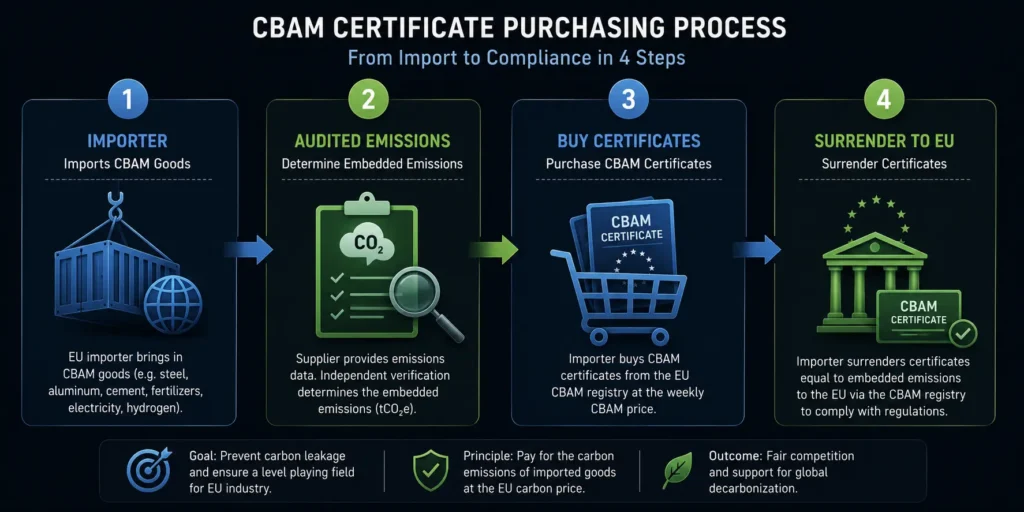
Beginning January 1, 2026, any company bringing covered goods into the EU must be an “Authorized CBAM Declarant.” For every ton of embedded $CO_2$ in their imported goods, they must purchase a “CBAM Certificate.” The price of this certificate perfectly mirrors the current weekly auction price of carbon allowances inside the EU ETS. If the internal EU carbon price goes up, the border tax goes up equally.
4. Technical Depth: Embedded Emissions and Verification
To determine how many certificates are required, the importer must calculate the “embedded emissions” of the product.
- Direct Emissions: The pollution coming out of the actual factory’s smokestack during the manufacturing process.
- Indirect Emissions: The pollution created by the power plant that generated the electricity used by the factory. (Currently, indirect emissions are factored into the CBAM price for cement and fertilizers, but excluded for iron, steel, and aluminum).Crucially, as of 2026, this data cannot be estimated. It must be audited and verified by an accredited, independent third-party verifier.
5. Real-World Consequences: The Default Value Penalty
If a foreign factory refuses to share its internal carbon data, or if the data cannot be verified by an auditor, the EU does not simply block the import. Instead, they apply a “Default Value.” This default value assumes the factory is among the most heavily polluting facilities in the world for that specific product category. Applying the default value results in a devastatingly high CBAM tax, effectively pricing the uncooperative supplier completely out of the European market.
Real-World Impact of CBAM on Global Supply Chains
The 2026 definitive phase immediately impacts the foundational building blocks of the global economy.
The Global Steel and Aluminum Trade: Iron, steel, and aluminum represent the most heavily impacted sectors. A massive percentage of the EU’s steel is imported from countries with highly carbon-intensive grids (like China and India, which rely heavily on coal). European automotive manufacturers (like Volkswagen and BMW) are frantically restructuring their supply chains, ripping up contracts with dirty foreign smelters and pivoting toward “Green Steel” manufacturers in Scandinavia and North America who use hydroelectric power, simply because the CBAM tax makes dirty steel financially unviable.
Fertilizers and Global Agriculture: Nitrogen fertilizers require immense amounts of natural gas to produce, making them highly carbon-intensive. Under CBAM, imported fertilizers must account for both direct and indirect (electricity) emissions. Because the EU heavily imports fertilizers from Russia (historically) and North Africa, the agricultural sector faces severe price shocks as the carbon tariff is priced into the cost of crop production.
The 50-Tonne Exemption (The Omnibus Package): To prevent an administrative nightmare for small businesses, the EU passed the 2025 Omnibus simplification package. This replaced the old €150 monetary exemption with a mass-based threshold. If a company imports less than 50 tonnes of covered goods (excluding electricity and hydrogen) cumulatively over the calendar year, they are entirely exempt from CBAM declarations and certificate costs, shielding over 180,000 European SMEs from the regulatory burden.
Economic & Strategic Impact
CBAM represents the end of the “Free Allocation” era for European heavy industry.
For years, EU factories were given free carbon credits to prevent them from going bankrupt against cheap foreign imports. With CBAM now actively taxing foreign imports at the border, the EU no longer needs to artificially protect its own industries.
Therefore, the EU is rapidly phasing out these free domestic allowances. Between 2026 and 2034, the free allocations given to European steel and cement plants will drop to zero. This introduces immense strategic pressure. While European factories applaud CBAM for taxing their foreign rivals, they are simultaneously facing the brutal reality that their own internal operational costs are about to skyrocket as their free pollution passes are permanently revoked.
Advantages
- Levels the Economic Playing Field: Ensures that foreign manufacturers cannot undercut domestic producers simply by ignoring environmental regulations and burning cheap, dirty fuels.
- Global Decarbonization Catalyst: Because foreign factories want to keep selling to the massive European consumer market, they are forced to invest in renewable energy and green manufacturing upgrades to lower their CBAM tariffs.
- Incentivizes Foreign Carbon Taxes: Allows importers to deduct carbon prices already paid in the country of origin, directly encouraging developing nations to launch their own domestic carbon pricing systems.
Limitations
- Supply Chain Data Black Holes: CBAM requires “Scope 3” level visibility. An EU importer often buys a finished steel component from a middleman in Vietnam, who bought the raw steel from a mill in India. Forcing the Indian mill to share proprietary, verified energy data with a European auditor is a logistical nightmare that frequently breaks down.
- Downstream Loopholes: Currently, CBAM only targets base materials (e.g., raw steel and aluminum). If a foreign factory imports raw steel into Europe, it pays the tax. However, if the foreign factory uses that dirty steel to build a completed refrigerator and imports the refrigerator, the product currently bypasses the CBAM tariff, incentivizing companies to move manufacturing of finished goods outside the EU.
- Geopolitical Retaliation: Developing nations argue that CBAM is thinly veiled “eco-imperialism” that unfairly punishes countries that cannot afford expensive green infrastructure. There is a severe risk of retaliatory tariffs on European exports (like luxury cars and aerospace components) if trade wars escalate.
Common Misconceptions
Misconception: CBAM is a flat tax on all imports from a specific country.
Reality: It is not a flat tax, and it does not discriminate by country. The tariff is calculated strictly on the verified emissions of the specific factory that produced the goods. A hyper-efficient, solar-powered steel mill in China will pay virtually zero CBAM tax, while a coal-powered steel mill in the USA will pay a massive tax.
Misconception: The foreign factory pays the bill to the EU.
Reality: The legal and financial liability rests entirely on the “Authorized CBAM Declarant”—the company bringing the goods into the European Union. The foreign factory never writes a check to Brussels; they simply suffer because the EU importer refuses to buy from them due to the high embedded tax.
Misconception: You can just estimate your emissions to save time.
Reality: During the 2023–2025 transitional phase, estimates were allowed. As of January 1, 2026, the definitive regime mandates that actual emissions data must be verified by an accredited, independent third-party auditor. If you guess, you are penalized with the highest possible default values.
What Most People Miss
The quiet integration of Resource Shuffling.
Resource shuffling is the primary strategy foreign conglomerates are using to game the CBAM system.
Imagine a massive multinational corporation in Asia owns two aluminum smelters: one runs on clean hydroelectric power, and the other runs on dirty coal. What most people miss is that the corporation does not actually decarbonize its operations. Instead, it simply “shuffles” its logistics. It exports 100% of the clean, hydro-powered aluminum to the European Union (avoiding the CBAM tax entirely) and sells 100% of the dirty, coal-powered aluminum to unregulated markets in Southeast Asia or the Middle East. The corporation’s total global pollution has not dropped by a single molecule, yet they perfectly bypass the European carbon tariff. Regulators are currently struggling to design legal frameworks to detect and penalize this behavior.
Comparison Table
| Feature | Traditional Import Tariff | EU Emissions Trading System (ETS) | EU Carbon Border Adjustment Mechanism (CBAM) |
| Primary Goal | Protect domestic jobs / Raise revenue | Reduce internal domestic emissions | Prevent carbon leakage / Equalize costs |
| Basis of Charge | Value or classification of the good | Total tons of $CO_2$ emitted by a factory | Total tons of $CO_2$ embedded in an imported good |
| Who Pays? | The Importer | Domestic EU Industrial Plants | The EU Importer (Authorized Declarant) |
| Price Stability | Fixed percentage (e.g., 10%) | Fluctuates daily based on carbon market | Fluctuates weekly, pegged directly to EU ETS price |
| WTO Compliance | Highly debated (often violates rules) | Internal mechanism (Fully compliant) | Designed to mimic ETS to ensure legal compliance |
Case Study
Situation: An automotive parts supplier headquartered in Germany relied entirely on a supply chain of raw aluminum imported from heavily industrialized, coal-dependent regions in Asia. For years, this strategy kept their raw material costs 15% lower than purchasing from domestic European smelters.
Challenge: On January 1, 2026, the CBAM definitive regime activated. The German importer was now legally required to purchase CBAM certificates for every ton of embedded carbon in their Asian aluminum.
Solution (The Compliance Shock): The German company requested verified emissions data from their Asian supplier. The supplier refused to undergo a European environmental audit. Under CBAM law, the German importer was forced to apply the “Default Value”—an intensely punitive mathematical assumption that the aluminum was produced using the dirtiest possible methods.
Outcome: Because the default values were heavily penalized, the required CBAM certificates added an effective 35% surcharge to the cost of the imported aluminum. The massive cost spike instantly wiped out the 15% geographical discount. By the end of Q1 2026, the German importer terminated the Asian contract and signed a long-term supply agreement with a slightly more expensive, but hydro-powered, “green aluminum” smelter in Norway, reducing their CBAM liability to near zero.
Lessons Learned: The case study perfectly demonstrated the intended mechanics of the regulation. CBAM does not physically block dirty goods from entering Europe; it simply leverages mathematical transparency to make high-pollution supply chains economically suicidal, forcing domestic capital to pivot toward green infrastructure.
Future Outlook
Next 12–24 Months
The era of Scope Expansion and Downstream Integration. Throughout 2026 and 2027, the European Commission will gather hard data from the first wave of financial compliance. By the end of 2027, they will formally propose expanding the scope of CBAM. This will likely include the integration of organic chemicals and polymers, and critically, the inclusion of “downstream” finished goods. Instead of just taxing raw steel, the EU will begin taxing finished automobiles and heavy machinery based on the cumulative carbon footprint of their parts, closing the most glaring loophole in the current legislation.
Next 3–5 Years
The rise of Global Carbon Clubs. The EU will not remain the only player. The United Kingdom is legally bound to launch its own CBAM in 2027. We will see the formation of “Carbon Clubs”—alliances between regions like the EU, the UK, and potentially Canada and Australia. These clubs will synchronize their carbon prices and mutually exempt each other from border tariffs, while collectively erecting a massive, unified tariff wall against the rest of the world. This will permanently fracture global trade into two distinct blocs: the high-cost “green” market and the low-cost “dirty” market.
Next 10 Years
The Automated Supply Chain Ledger. By the mid-2030s, the manual auditing of embedded emissions will be entirely obsolete. Because CBAM makes verified carbon data as valuable as currency, global supply chains will run on automated, blockchain-based environmental ledgers. Every gram of iron ore pulled from the ground will be tagged with a digital token tracking its energy consumption through the smelter, the cargo ship, and the final factory, allowing customs software to instantly calculate border tariffs with perfect, cryptographic accuracy.
Most Likely Scenario
Despite aggressive lobbying and threats of WTO litigation from developing nations, CBAM is here to stay. It is the only mathematical mechanism that allows Europe to aggressively decarbonize its own economy without utterly destroying its industrial base. The burden of proof has permanently shifted to the manufacturer; in the global economy of the 2030s, if you cannot prove your product is clean, you simply cannot sell it.
Key Takeaways
- The EU Carbon Border Adjustment Mechanism (CBAM) entered its definitive financial compliance phase on January 1, 2026, forcing EU importers to pay a tariff based on the carbon footprint of their goods.
- The system currently targets the heaviest polluters: iron, steel, aluminum, cement, fertilizers, electricity, and hydrogen.
- CBAM is designed to prevent “carbon leakage”—stopping European companies from moving their factories to unregulated countries to escape domestic environmental taxes.
- Importers must buy “CBAM certificates,” whose price fluctuates weekly to perfectly match the internal carbon price paid by European factories under the EU ETS.
- To calculate the tax, foreign factories must provide independent, third-party audited data proving their embedded emissions. If they fail to provide data, punitive “default values” are applied that drastically increase the tax.
- If a foreign country implements its own domestic carbon tax, that cost is deducted from the CBAM tariff, creating a massive global incentive for other nations to launch their own climate regulations.
Glossary
Authorized CBAM Declarant: The legal status required for any EU entity importing covered goods; they are financially responsible for filing annual reports and surrendering CBAM certificates.
Carbon Leakage: The phenomenon where strict climate policies in one country cause industrial production (and its associated pollution) to simply relocate to countries with weaker environmental rules.
Default Values: Highly punitive, pre-calculated emissions estimates applied by the EU when an importer cannot provide independently verified, accurate carbon data from the foreign manufacturer.
Embedded Emissions: The total amount of greenhouse gases ($CO_2$) released into the atmosphere during the manufacturing of a specific product (Direct) and the electricity used to power that manufacturing (Indirect).
EU Emissions Trading System (EU ETS): The world’s largest “cap-and-trade” carbon market, which forces domestic European factories to buy allowances for the pollution they generate.
Resource Shuffling: A strategy where a global corporation sends all its clean, low-emission products to Europe to avoid CBAM, while selling its dirty, high-emission products to the rest of the world, avoiding any real overall decarbonization.
Frequently Asked Questions
Does the EU keep the money from the CBAM tax?
Yes. The revenue generated from selling CBAM certificates flows into the central EU budget. Much of this capital is earmarked for reinvestment into green technology subsidies and to fund the broader European Green Deal initiatives.
If a US factory makes green steel with zero emissions, do they pay CBAM?
No. They still have to file the paperwork to prove it, but if the verified embedded emissions are zero, the mathematical calculation results in a tariff of zero euros. CBAM penalizes pollution, not the act of importing.
Are small businesses affected by this?
The EU passed the “Omnibus package” to protect small businesses. If you import less than 50 tonnes of CBAM-covered goods (like steel or aluminum) per year, you are completely exempt from the regulations and the financial tariffs.
Can a country sue the EU over this at the WTO?
Yes, and many have threatened to. However, the EU designed CBAM specifically to comply with World Trade Organization rules by ensuring that the border tax perfectly matches the internal tax. Under WTO rules, you are allowed to tax imports as long as you do not treat them worse than your own domestic products.
Why doesn’t the US have a CBAM?
The United States does not have a federal, nationwide carbon tax or cap-and-trade system. Because there is no internal “price on carbon” for domestic US factories, it is legally very difficult under WTO rules to justify slapping a carbon tariff on foreign imports without it being flagged as illegal protectionism.
Sources
[1] British Standards Institution (BSI): Preparing for EU CBAM: The 2026–2027 Transition Explained (2026 Analysis)
[2] International Institute for Sustainable Development (IISD): The State of Border Carbon Adjustments 2026 (July 2026)
[3] European Commission, Taxation and Customs Union: CBAM successfully entered into force on 1 January 2026
[4] International Carbon Action Partnership (ICAP): EU CBAM enters compliance phase and outlines path ahead (January 2026)
[5] UK Parliament Research Briefings: Carbon Border Adjustment Mechanism Implementation Timelines (April 2026)