Advertisement
)

AT A GLANCE
- Concept: Fast Neutrons: The core operates without water moderation, allowing neutrons to travel at maximum kinetic velocity.
- Concept: Isotope Transmutation: High-speed neutrons strike inert Uranium-238, forcing a nuclear decay chain creating fissile Plutonium-239.
- Concept: Liquid Sodium Cooling: Engineers use molten metal to extract heat rapidly without slowing down the reactive neutron flux.
- Concept: Fuel Breeding: The algorithmic physics of the core mathematically produce more combustible nuclear material than they burn.
HOW A FAST BREEDER REACTOR WORKS
Standard nuclear reactors burn Uranium-235, which makes up less than one percent of natural uranium. They submerge the fuel in water to slow down the neutrons, making it easier to split the U-235 atoms.
A fast breeder reactor entirely abandons this moderation phase. It removes the water, allowing the neutrons to violently exit the fission event at extreme kinetic velocities.
The reactor surrounds a central core of highly enriched fissile material with a physical “blanket” of Uranium-238 (U-238). This heavy, inert isotope constitutes roughly 99 percent of all mined uranium.
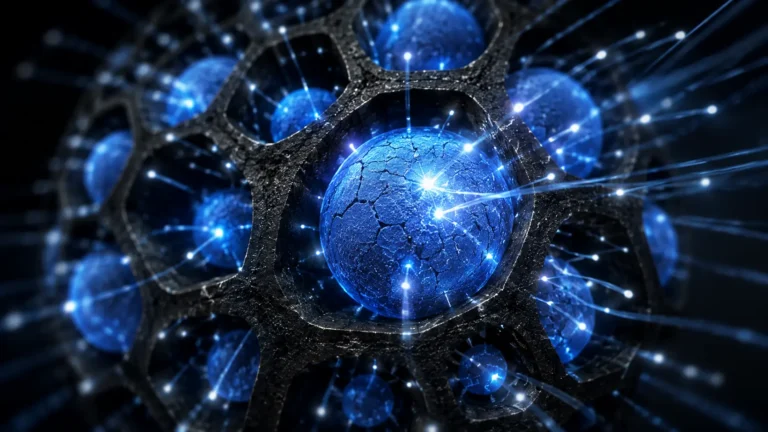
When a high-velocity neutron escapes the primary core and strikes the U-238 blanket, the atom absorbs the neutron. The atom physically transitions into the heavier isotope Uranium-239 (U-239).
This unstable isotope rapidly executes two successive beta decays. It transmutes first into Neptunium-239 (Np-239), and then permanently stabilizes as Plutonium-239 (Pu-239).
This newly forged Pu-239 is a highly fissile, weapons-grade isotope. It is physically capable of sustaining its own chain reaction when processed and placed back into the primary core.
Because water slows neutrons, engineers must cool this extreme thermodynamic reaction using liquid sodium. Molten sodium extracts heat from the core at massive densities while remaining completely transparent to the fast-moving neutron flux.
WHY IT MATTERS NOW
The global shift to zero-carbon baseload energy places impossible mathematical strain on the uranium supply chain. If the world relies exclusively on standard light-water reactors, known reserves of extractable Uranium-235 will face severe depletion within a century.
Fast breeder reactors completely rewrite this thermodynamic timeline. By transmuting the massive, globally accumulated stockpiles of inert U-238 into burnable plutonium, breeder technology aggressively expands fuel efficiency.
The system mathematically extracts sixty times more energy from the exact same volume of raw uranium ore. This mechanism physically converts nuclear waste from a geological liability into a strategic energy asset.
Spent fuel rods from legacy reactors still contain roughly 95 percent of their original energy potential. This latent energy remains trapped entirely as non-fissile U-238 and heavy actinides, waiting to be bombarded by fast neutrons.
Nations that master the fast breeder cycle achieve absolute, permanent energy sovereignty. Russia currently leads this race with its BN-800 reactor.
Moscow uses this facility to systematically convert its legacy Cold War nuclear waste into a closed-loop, infinite electrical grid architecture. This operational success completely bypasses the Western uranium mining monopoly.
WHAT MOST PEOPLE MISS
Energy commentators frequently highlight the extreme thermal efficiency of liquid sodium cooling. They completely ignore its catastrophic chemical volatility.
Molten sodium physically combusts upon contact with ambient oxygen and explodes violently upon contact with water. Because the sodium coolant loop remains entirely opaque, engineers cannot use optical cameras to inspect the internal reactor components for stress fractures.
Operators must rely exclusively on acoustic sonar mapping to navigate the submerged hardware. A single micro-fracture in the heat exchanger can trigger a massive sodium-water fire, forcing multi-year shutdowns and bankrupting the operating utility.
THE TRAJECTORY
Next 12–36 Months: Commercial deployment of smaller, pool-type sodium fast reactors in China and Russia, aggressively demonstrating the closed-fuel cycle to international regulators.
Next Five Years: The integration of advanced pyroprocessing facilities directly adjacent to breeder sites. This allows operators to extract the newly bred plutonium and immediately manufacture fresh fuel pins without transporting radioactive material across civilian infrastructure.
Next Ten Years: The proliferation of lead-cooled fast reactors (LFRs). Engineers will begin replacing highly reactive liquid sodium with molten lead, which offers the same fast-neutron transparency but mathematically eliminates the risk of explosive chemical reactions with air or water.
What Could Go Wrong: The International Atomic Energy Agency (IAEA) loses visibility into the plutonium loop. Because breeder reactors constantly manufacture pure Pu-239, a rogue state can effortlessly divert this fissile material from the civilian electrical grid directly into a covert nuclear weapons program.
Most Likely Outcome: Fast breeder technology will bifurcate global energy infrastructure. Eastern powers will aggressively adopt closed-loop transmutation to achieve absolute fuel independence, while Western nations hesitate, paralyzed by the extreme capital costs and nuclear proliferation risks of the plutonium economy.
KEY TERMS
- Fast Neutron Spectrum: A nuclear reactor environment lacking a moderator, where neutrons maintain their initial high kinetic energy to facilitate specific heavy-isotope reactions.
- Transmutation: The physical process of converting one chemical element or isotope into another through nuclear reactions, specifically turning inert uranium into fissile plutonium.
- Liquid Sodium Coolant: A highly efficient, low-pressure molten metal used to transfer heat away from a fast reactor core without slowing down the neutron flux.
- Closed Fuel Cycle: A nuclear infrastructure architecture where spent fuel is chemically reprocessed, and the newly bred isotopes are continuously recycled back into the reactor.
- Beta Decay: A radioactive process where an unstable atomic nucleus transforms a neutron into a proton, emitting an electron and altering the element’s fundamental identity.
SOURCES
- International Atomic Energy Agency (IAEA) — Fast Reactor Knowledge Preservation System and Liquid Metal Technologies
- Argonne National Laboratory — The Integral Fast Reactor Concept and Pyroprocessing Mechanics
- World Nuclear Association — Fast Neutron Reactors and the Physics of the Closed Fuel Cycle
- Massachusetts Institute of Technology (MIT) Energy Initiative — The Future of the Nuclear Fuel Cycle