Advertisement
)


AT A GLANCE
- Concept: The Memory Wall: Processors perform math much faster than they can physically retrieve data from storage.
- Concept: SRAM vs HBM: A graphics processor contains a tiny sliver of hyper-fast internal memory (SRAM) and a massive pool of slower external memory (HBM).
- Concept: Tiling: The algorithm breaks the attention matrix into blocks small enough to fit entirely inside the limited SRAM.
- Concept: Recomputation: Instead of saving intermediate math steps to slow memory, the algorithm intentionally recalculates them on the fly.
HOW FLASHATTENTION WORKS
Standard artificial intelligence models rely on the attention mechanism to understand context. This mechanism mathematically compares every single word in a document against every other word. This creates an enormous N-by-N matrix of data, known as the attention score.
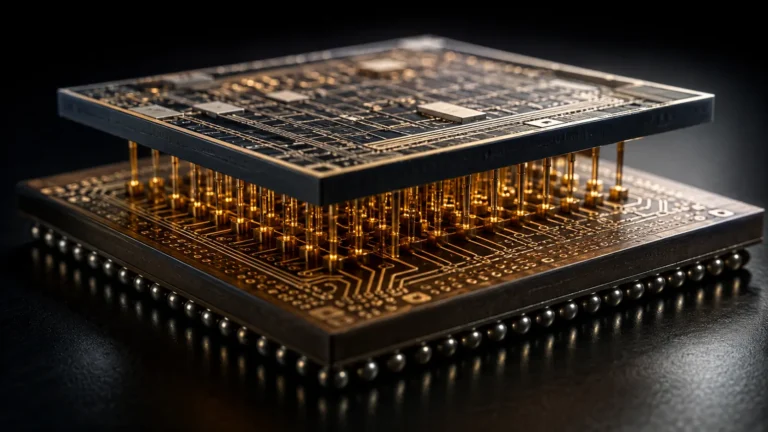
To calculate this score, a standard Graphics Processing Unit (GPU) executes a sequence of mathematical operations. It reads the raw data from its massive High-Bandwidth Memory (HBM), moves it into its microscopic, hyper-fast Static Random-Access Memory (SRAM) to perform the math, and then writes the intermediate answer back to the HBM. It repeats this slow read-write cycle for every step of the attention equation.
FlashAttention physically breaks this cycle using a technique called tiling. Engineers reprogrammed the algorithm to divide the massive attention matrix into distinct, manageable blocks. The GPU loads one block of queries and keys from the HBM directly into the SRAM.
Once inside the SRAM, the processor completely finishes the attention calculation for that specific block before ejecting it. The algorithm fuses multiple mathematical operations into a single continuous loop. This traps the data inside the fastest part of the silicon, drastically reducing the total number of times the processor must wait for the physical HBM connections to deliver information.
WHY IT MATTERS NOW
The generative artificial intelligence industry faces a severe structural physics problem. While companies manufacture GPUs capable of executing trillions of calculations per second, the copper pathways connecting the processor to the memory physically bottleneck the entire system. This phenomenon creates the “memory wall.”
When an AI company trains a massive language model, the GPUs spend up to fifty percent of their time sitting completely idle. The processors wait for intermediate mathematical matrices to travel back and forth across the HBM interface. This idling physically burns electricity and time, driving the cost of training a frontier model into the billions of dollars.
FlashAttention directly addresses this hardware inefficiency. By forcing the calculations to execute entirely within the SRAM, the algorithm accelerates model training speeds by two to four times. This software optimization instantly doubles the physical efficiency of a $30,000 Nvidia H100 chip without requiring any actual changes to the physical silicon.
This architectural efficiency dictates the economic viability of long-context models. Processing a book-length prompt generates an attention matrix too large to fit in standard memory structures. FlashAttention compresses the memory requirements from quadratic to linear, allowing standard cloud clusters to read and analyze massive corporate datasets without instantly crashing from memory overflow.
WHAT MOST PEOPLE MISS
Software engineers naturally assume that performing a calculation twice wastes time. FlashAttention intentionally violates this core assumption through a process called recomputation. During the training phase, the algorithm refuses to save its intermediate mathematical steps to the slow HBM.
When the system runs the backward pass to update the neural network, it mathematically reconstructs those intermediate steps on the fly inside the SRAM. It is physically faster for a modern GPU to blindly recalculate complex algebra than it is to retrieve the pre-calculated answer from the external memory bank. This paradox defines modern chip optimization.
THE TRAJECTORY
Next 12–36 Months: The standard integration of FlashAttention-3 into all major deep learning frameworks. The software will fully automate hardware-specific tuning, allowing developers to write generic PyTorch code that automatically compiles into perfectly tiled SRAM operations optimized for specific AMD or Nvidia architectures.
Next Five Years: The rise of dynamic block sizing. Future attention algorithms will abandon rigid, static tiles. The software will use predictive heuristics to instantly adjust the size of the memory blocks on the fly, matching the exact sparsity and context weight of the input data to maximize SRAM occupancy at every microsecond.
Next Ten Years: The physical restructuring of GPU memory hierarchies. Silicon foundries will dramatically expand the physical footprint of SRAM directly on the processor die. This will allow complete, unified attention matrices to reside permanently inside the fastest memory tier, functionally eliminating the HBM bottleneck for all mid-sized language models.
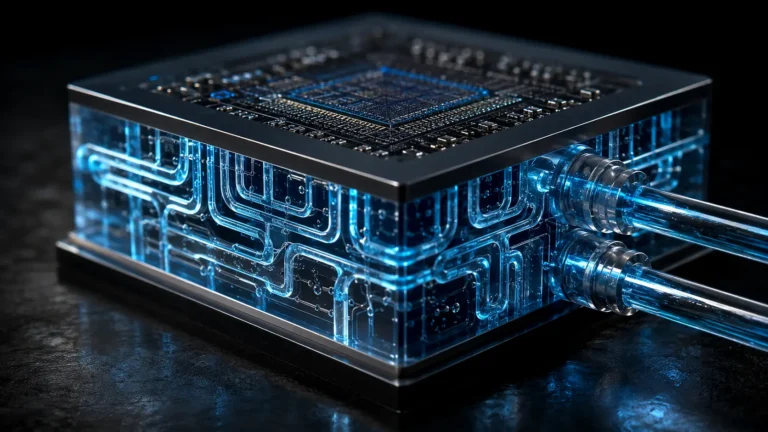
What Could Go Wrong: Severe thermal throttling localized entirely on the SRAM cache. By forcing the processor to run continuous, uninterrupted mathematical loops without the natural cooling pauses of memory retrieval, the physical silicon containing the SRAM will generate catastrophic heat spikes. If the liquid cooling manifold fails to dissipate this concentrated thermal energy, the chip will instantly throttle its clock speed, erasing the algorithmic gains.
Most Likely Outcome: Hardware-aware algorithmic design will replace pure mathematical theory as the primary driver of AI scaling. The ability to perfectly map software logic to the physical geography of silicon memory will determine the winners of the hyperscale computing race.
KEY TERMS
- Static Random-Access Memory (SRAM): Extremely fast, highly expensive memory physically embedded directly on the processor die, used for immediate calculations.
- High-Bandwidth Memory (HBM): Massive, slower memory modules stacked physically adjacent to the processor, acting as the primary storage pool for the active neural network.
- Tiling: A memory optimization technique that divides a massive dataset into smaller blocks to fit perfectly inside a limited cache memory space.
- Memory Wall: The widening performance gap between the speed of a processor and the physical speed at which data can be transferred to it from main storage.
- Recomputation: The strategy of recalculating intermediate mathematical values on the fly to avoid the severe time penalty of reading them from slow external storage.
SOURCES
- Stanford University Department of Computer Science — FlashAttention: Fast and Memory-Efficient Exact Attention with IO-Awareness
- Nvidia Technical Blog — Optimizing Standard Attention Mechanics on Hopper Architecture
- Institute of Electrical and Electronics Engineers (IEEE) — Overcoming the Memory Wall in Deep Learning Acceleration
- Meta AI Research — Scaling Laws and Hardware-Aware Algorithms in Large Language Models