Advertisement
)

AT A GLANCE
- Concept: The Wheatstone Bridge: A fundamental electrical circuit that translates microscopic physical metal deformation into a measurable voltage spike.
- Concept: Six Degrees of Freedom: True robotic manipulation requires measuring physical forces along three directional axes (X, Y, Z) and three rotational axes (Roll, Pitch, Yaw) simultaneously.
- Concept: Kinematic Decoupling: A complex mathematical matrix used to isolate specific directional forces, preventing the pressure on the Z-axis from artificially corrupting the reading on the X-axis.
- Concept: Closed-Loop Feedback: The sensor data routes directly into the robot’s motor controllers in microseconds, preventing the steel arm from crushing delicate components.
HOW IT WORKS
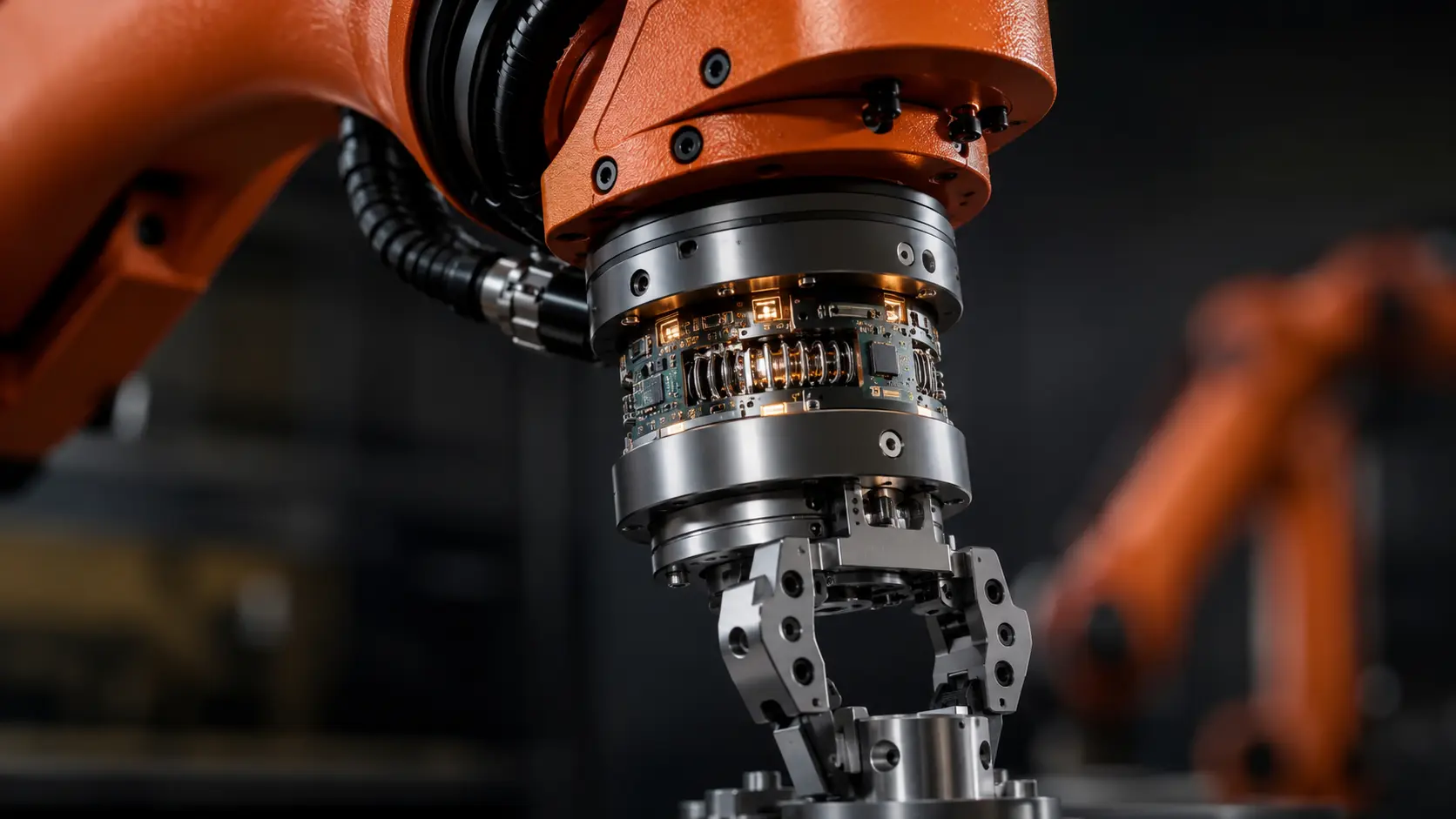
A standard industrial robotic arm, such as those manufactured by Fanuc or KUKA, operates primarily on positional data. The robot knows precisely where its joints are located in 3D space, but it has no inherent sense of touch. If it is programmed to move five inches downward, it will move exactly five inches downward, regardless of whether it is moving through empty air or crushing a solid titanium engine block.
To grant the robot tactile awareness, engineers mount a multi-axis Force-Torque (F/T) sensor directly between the robot’s wrist and its end-effector (the gripping tool). Inside this hockey-puck-shaped sensor is a highly engineered metal flexure. Glued to specific geometric stress points on this flexure are microscopic zigzag patterns of metallic foil called strain gauges.
When the robot presses a tool against a surface, the sensor’s metal chassis physically deforms by fractions of a millimeter. This microscopic bending stretches or compresses the glued strain gauges. According to basic electrical physics, stretching a wire makes it thinner and longer, which increases its electrical resistance.
These strain gauges are wired into a circuit called a Wheatstone bridge. The bridge converts this tiny change in electrical resistance into a measurable voltage signal. However, a single gauge cannot distinguish between a downward push and a sideways twist. To capture six degrees of freedom, engineers glue multiple gauges across complex, spoke-like metal geometries.
The most difficult engineering hurdle is “cross-talk.” If the robot pushes straight down (Z-axis force), the physical bending of the metal might accidentally stretch the gauges intended to measure twisting (Z-axis torque). To solve this, the sensor uses a proprietary mathematical decoupling matrix. The raw voltage signals from all the gauges are fed into this matrix, which algebraically subtracts the structural interference, outputting the pure, isolated force and torque values for all six axes simultaneously in under a millisecond.
WHY IT MATTERS NOW
The global manufacturing sector is aggressively attempting to automate high-variance, tactile tasks. While robots have dominated rigid tasks like spot welding for decades, they have historically failed at tasks requiring human-like touch, such as polishing curved aerospace turbine blades, inserting complex electronic connectors, or executing automated surgical incisions.
These delicate tasks are impossible using traditional positional programming. They require continuous compliance—the ability of the robot to actively feel the surface and instantly adjust its pressure based on friction and resistance. The Force-Torque sensor matrix is the absolute physical prerequisite for this capability. It transitions the robot from a blindly executing machine into a continuously reacting agent.
This hardware dictates the economic viability of next-generation collaborative robots (cobots). Cobots are designed to work directly alongside human operators without heavy safety cages. If a cobot accidentally swings its steel arm into a human worker, the F/T sensor instantly registers an unexpected force spike on the X or Y axis. The sensor triggers a hardware-level interrupt within the motor controller, violently braking the heavy servomotors in less than two milliseconds to prevent lethal crush injuries.
Companies like ATI Industrial Automation dominate this highly specialized niche. They effectively act as the gatekeepers for advanced manipulation. Without a perfectly calibrated, low-latency F/T sensor, the most advanced artificial intelligence software in the world cannot safely command a physical robot to perform a task outside of a highly structured, rigid laboratory environment.
WHAT MOST PEOPLE MISS
Software engineers attempting to program robotics often assume that a sensor outputs a perfectly clean, ready-to-use digital number. They completely miss the brutal reality of mechanical noise and thermal drift.
Because strain gauges measure microscopic electrical resistance, they are highly sensitive to ambient temperature changes. If the factory floor heats up by five degrees, the metal flexure expands naturally, stretching the gauges and tricking the robot into thinking it is applying force when it is touching nothing. Furthermore, the massive electromagnetic fields generated by the robot’s own heavy servomotors frequently induce severe electrical noise directly into the fragile analog strain gauge wiring. Managing this system requires executing aggressive software low-pass filters and continuous hardware-level temperature compensation equations just to keep the baseline data mathematically stable.
THE TRAJECTORY
Next 12–36 Months: F/T sensors will transition from bulky wrist-mounted pucks to highly miniaturized, joint-level arrays. By embedding strain gauges directly into the harmonic drive gearboxes of every single robotic joint, the robot will achieve full-body proprioception, allowing it to sense collisions along its entire physical length rather than just at its fingertips.
Next Five Years: The integration of embedded edge-AI directly onto the sensor’s internal circuit board. Instead of streaming raw force data back to the main robot controller for processing, the sensor itself will utilize local machine learning to instantly classify tactile events—such as identifying a stripped screw or a misaligned gear—and execute localized corrective actions with zero network latency.
Next Ten Years: The physical limitation of metallic strain gauges will force a transition to optical force sensing. Engineers will replace metal flexures and electrical wiring with fiber-optic Bragg gratings. These optical sensors will measure force by calculating shifts in the wavelength of light passing through the fiber, providing extreme sensitivity while remaining completely immune to the heavy electromagnetic interference of factory environments.
What Could Go Wrong: The mathematical decoupling matrix relies on strict physical calibration. If the robotic tool attached to the sensor is subjected to a severe, unintended shock—such as dropping a heavy engine block—the internal metal flexure can suffer microscopic plastic deformation. The sensor will physically warp just enough to permanently corrupt the decoupling matrix, causing the robot to violently miscalculate its applied force and potentially destroy critical aerospace or medical payloads before operators notice the calibration drift.
Most Likely Outcome: Multi-axis Force-Torque sensing will shift from an expensive optional accessory to a mandatory, fully integrated component of all robotic actuators. The ability to physically measure high-fidelity tactile feedback will become the primary physical constraint governing the real-world deployment of advanced autonomous manipulation models.
KEY TERMS
- Strain Gauge: A highly sensitive, foil-based electrical sensor that measures mechanical stress by translating microscopic physical stretching into a change in electrical resistance.
- Six Degrees of Freedom (6DoF): The ability to measure physical movement or force along three translational axes (up/down, left/right, forward/backward) and three rotational axes (pitch, yaw, roll).
- Cross-Talk: The unwanted physical or electrical interference where a force applied to one specific axis artificially alters the sensor readings of a different axis.
- Wheatstone Bridge: A specific electrical circuit topology used to measure minute changes in electrical resistance with extreme accuracy, forming the foundation of all strain gauge measurements.
- Kinematic Decoupling: The complex mathematical matrix used to isolate and correct the raw sensor data, removing mechanical cross-talk to provide pure, independent force measurements.
SOURCES
- IEEE Robotics and Automation Magazine — Calibration and Decoupling Matrices of Six-Axis Force/Torque Sensors
- International Federation of Robotics (IFR) — Tactile Sensing and Compliance in Collaborative Industrial Robotics
- Journal of Sensors and Actuators — Thermal Drift Compensation and Noise Filtering in Strain Gauge Arrays
- ATI Industrial Automation — Multi-Axis Force/Torque Sensor Architecture and Transducer Mechanics