Advertisement
)

AT A GLANCE
- Concept: Gallium Nitride (GaN): A synthetic crystal that conducts high-voltage electricity significantly better than legacy silicon.
- Concept: AESA Radar: A flat antenna composed of thousands of independent, microscopic transmit-and-receive radar modules.
- Concept: Thermal Dissipation: The physical process of rapidly moving destructive heat away from the semiconductor circuitry.
- Concept: Burn-Through Range: The specific distance where a radar’s broadcast energy completely overpowers enemy jamming static.
HOW GALLIUM NITRIDE EMPOWERS MODERN RADAR
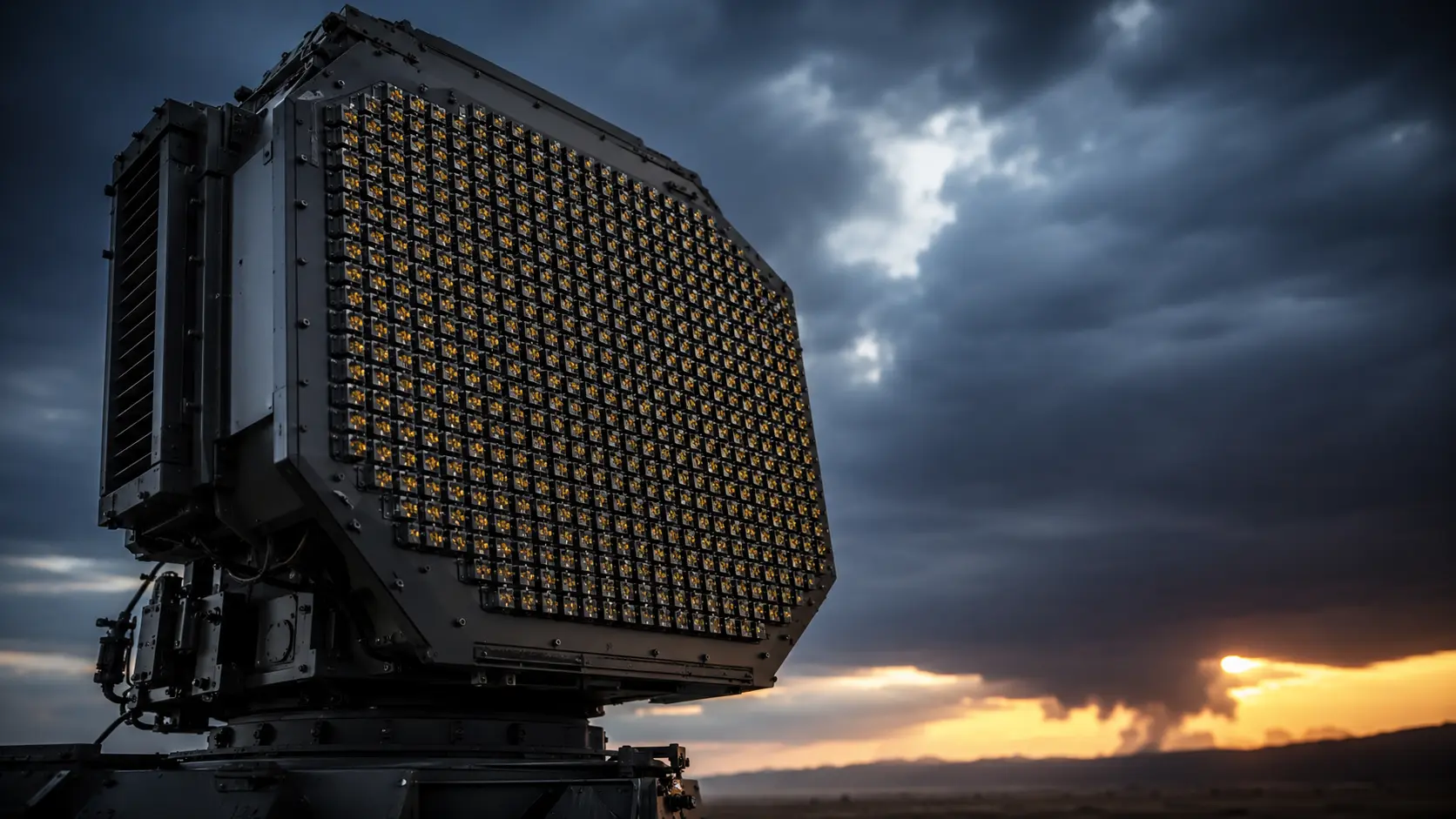
Modern military radars do not physically spin. They use a flat panel covered in thousands of tiny, independent antennas called Transmit/Receive Modules. By individually adjusting the timing of the radio waves emitting from each module, the radar steers its beam electronically in milliseconds.
For decades, defense contractors built these modules using Gallium Arsenide. This legacy material possessed a strict physical limitation. If operators pumped extreme electrical voltage through the chip to increase the radar’s tracking range, the electrical resistance generated massive heat. The chip would physically melt before it could broadcast a stronger signal.
Materials scientists solved this bottleneck by transitioning to Gallium Nitride (GaN). GaN is a wide-bandgap semiconductor. Its atomic structure allows electrons to move freely at significantly higher voltages while experiencing far less mechanical friction.
This structural efficiency allows a GaN amplifier to handle five to ten times the electrical energy density of legacy materials without immediately destroying itself. Even with high efficiency, pumping extreme wattage through a microscopic chip generates intense thermal loads.
To prevent failure, engineers mount the GaN amplifiers directly onto specialized synthetic diamond or silicon carbide heat sinks. These advanced thermal dissipation backplanes physically pull the heat away from the amplifier at a molecular level. This thermal management allows the radar to broadcast continuous, high-intensity radio frequency pulses without triggering a thermal shutdown.
WHY IT MATTERS NOW
Adversarial nations now deploy advanced Electronic Warfare (EW) platforms designed to blind standard airspace tracking systems. When a hostile aircraft detects an incoming radar wave, its onboard jammers instantly broadcast massive amounts of radio static back at the source. This noise mathematically drowns out the genuine radar echo, breaking the tracking lock.
To defeat this jamming, air defense systems must achieve a state called “burn-through.” The defending radar must broadcast a signal so intense that its returning echo remains louder than the enemy’s artificial static.
Because GaN amplifiers handle significantly higher voltages, they project an exponentially stronger radio wave. This raw energy extends the burn-through range, allowing systems to track stealth targets hundreds of miles further than legacy hardware.
The United States Army is currently executing this hardware transition through the Lower Tier Air and Missile Defense Sensor (LTAMDS) program. This next-generation Patriot radar replacement relies entirely on a GaN-based AESA array. By utilizing GaN, the system achieves 360-degree threat tracking and defeats hypersonic glide vehicles, a physical impossibility for older silicon-based structures.
This hardware transition dictates the flow of billions in defense capital. Sovereign governments are actively funding domestic GaN foundries to eliminate supply chain reliance on foreign microelectronics. The ability to manufacture pure, defect-free GaN wafers now serves as a strict national security chokepoint, separating tier-one militaries from vulnerable secondary powers.
WHAT MOST PEOPLE MISS
Defense commentators consistently measure radar capability by tracking pure broadcast wattage. They entirely miss the mathematical relationship between thermal stability and pulse-doppler phase coding. A hot, unstable amplifier physically distorts the shape of the radio wave it emits.
Modern AESA radars defeat jammers by rapidly shifting their broadcast frequencies and cryptographically altering their pulse shapes millions of times per second. If the amplifier overheats, this precise phase coding breaks down. The heat turns the complex, highly structured signal into a smeared, easily intercepted wall of static.
GaN’s extreme thermal resilience keeps the amplifier cold and structurally stable even under maximum load. This physical stability ensures the complex mathematical encoding remains perfectly sharp as it leaves the antenna, allowing the radar’s computers to perfectly identify its own returning echoes amidst a chaotic electronic battlefield.
THE TRAJECTORY
Next 12–36 Months: Defense contractors will retrofit existing fourth-generation fighter jets, such as the F-16 and F/A-18, with GaN-based AESA radars. This relatively cheap hardware swap instantly upgrades legacy airframes to counter modern electronic warfare threats.
Next Five Years: The integration of ultra-wideband digital arrays. GaN amplifiers will combine with direct digital synthesis architectures, allowing a single radar panel to simultaneously act as an air defense tracker, a high-bandwidth communications relay, and an offensive electronic jamming weapon.
Next Ten Years: The commercialization of aluminum nitride (AlN) substrates. Foundries will replace silicon carbide heat sinks with aluminum nitride, pushing thermal dissipation efficiency even higher. This will enable continuous-wave radar operations capable of tracking swarming autonomous drones across entire continents.
What Could Go Wrong: Severe epitaxial defect rates. Growing GaN crystals on foreign substrates like silicon carbide frequently causes microscopic atomic misalignments. If commercial foundries fail to reduce these epitaxial defects, the manufacturing yield of military-grade amplifiers will plummet, drastically inflating the cost of new air defense batteries.
Most Likely Outcome: Gallium Nitride will firmly establish itself as the undisputed foundation of global radio frequency engineering. The physical limits of electronic warfare mathematically demand the exact thermal and electrical efficiency that only wide-bandgap semiconductors can provide.
KEY TERMS
- Active Electronically Scanned Array (AESA): A computerized radar system composed of thousands of individual antenna modules that steer radio beams digitally without physically moving.
- Gallium Nitride (GaN): A highly durable, wide-bandgap semiconductor material capable of processing immense electrical voltages without breaking down.
- Burn-Through Range: The precise physical distance at which a radar’s transmission energy overcomes the artificial static generated by an enemy jammer.
- Pulse-Doppler: A radar processing technique that measures the shift in returning radio frequencies to perfectly calculate a target’s speed and direction.
- Monolithic Microwave Integrated Circuit (MMIC): A microscopic silicon or GaN chip that contains the complete circuitry required to amplify high-frequency radio signals.
SOURCES
- Department of Defense (DoD) — Advanced Radar Technologies and Gallium Nitride Supply Chain Vulnerabilities
- Institute of Electrical and Electronics Engineers (IEEE) — Thermal Management and RF Performance in GaN-on-SiC Amplifiers
- Raytheon Missiles & Defense — LTAMDS Architecture and the Evolution of AESA Radar Systems
- Journal of Electronic Defense — Pulse-Doppler Phase Coding and Electronic Counter-Countermeasures