Advertisement
)

AT A GLANCE
- Concept: Pulse Repetition Interval: The exact microsecond gap between two successive radar energy emissions.
- Concept: Signal Interleaving: Multiple different radar systems firing simultaneously, creating a chaotic wall of noise.
- Concept: Deinterleaving Algorithm: The mathematical filter separating overlapping pulses into distinct, individual threat profiles.
- Concept: Time of Arrival: The precise atomic timestamp recorded the moment a pulse hits the antenna.
HOW PULSE DEINTERLEAVING WORKS
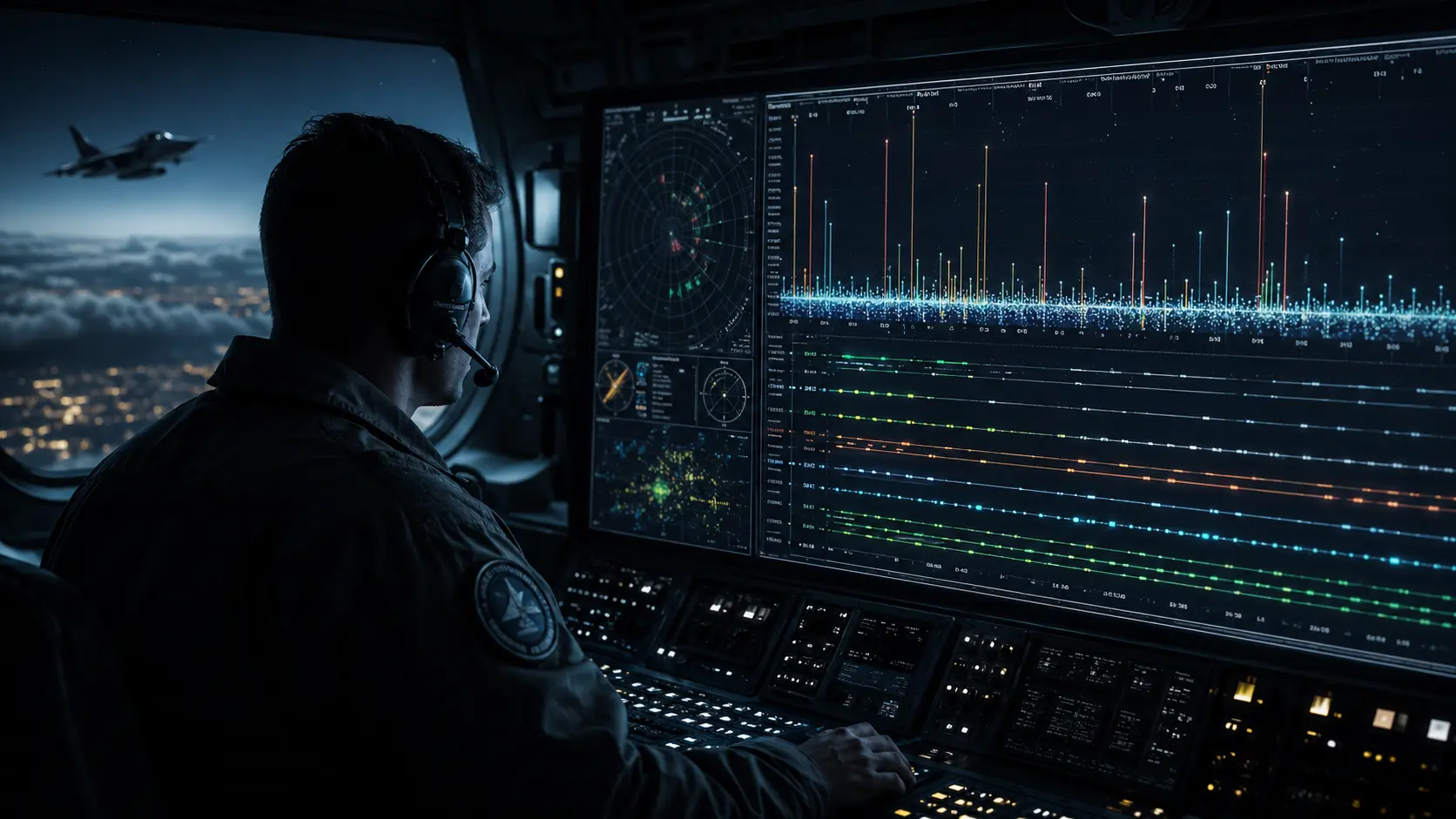
Modern airspace is flooded with electromagnetic energy. A military Electronic Intelligence (ELINT) aircraft flying near a contested border intercepts millions of individual radar pulses every second. These pulses originate from civilian air traffic control, commercial weather stations, adversary fighter jets, and ground-based surface-to-air missile batteries.
Because these pulses arrive at the antenna simultaneously, the receiver records a completely interleaved data stream. The signal processor faces a chaotic wall of noise. To identify a specific threat, the aircraft’s onboard computers must execute a pulse train deinterleaving pipeline to mathematically isolate each individual emitter.
The algorithm first groups incoming pulses by their spatial and physical characteristics. It bins the energy spikes based on their Angle of Arrival (AOA), carrier frequency, and pulse width. However, advanced military radars frequently shift their frequencies to evade detection, forcing the system to rely heavily on Time of Arrival (TOA) mechanics.
By plotting the exact TOA of every pulse, sequence search algorithms calculate the physical time difference between them. This establishes the Pulse Repetition Interval (PRI). Even if a radar uses a highly complex staggered or jittered timing pattern, the deinterleaving matrix mathematically correlates the repeating gaps, pulling the isolated threat signature out of the background static.
WHY IT MATTERS NOW
Advanced air defense networks define modern territorial denial. Ground-based systems operate as mobile, decentralized nodes that utilize low probability of intercept radar techniques. These arrays aggressively manipulate their pulse intervals to mimic civilian background noise, attempting to blind hostile intelligence platforms.
If an electronic warfare aircraft cannot deinterleave these highly staggered pulses in real time, the pilot remains entirely unaware of the incoming threat. The deinterleaving pipeline translates raw, disconnected electromagnetic energy into concrete, actionable situational awareness. It tells the pilot exactly when a distant search radar suddenly transitions into a high-frequency targeting lock.
During active operations over contested straits or borders, automated ELINT platforms rely entirely on these mathematical pipelines. The algorithms process the intercepted data, separate the hostile missile battery from the commercial airport radar, and instantly datalink the isolated coordinates to a loitering stealth fighter.
This mathematical isolation directly dictates modern kinetic engagement parameters. By separating the specific PRI sequence of an adversary’s active electronically scanned array (AESA) radar, the pipeline allows defense systems to program dedicated anti-radiation missiles. These specialized weapons lock onto the mathematically isolated pulse train and follow the energy straight down to the physical transmitter.
WHAT MOST PEOPLE MISS
Military analysts frequently assume that identifying a radar simply requires matching its frequency to a known database. They entirely miss the mathematical complexity of multipath interference. When an enemy radar pulse bounces off a mountain or the ocean surface before hitting the ELINT receiver, it arrives as a slightly delayed, duplicate ghost pulse.
The deinterleaving algorithm must actively identify and discard these ghost pulses. If the sequence search matrix accepts a reflected pulse as a genuine new emission, it miscalculates the Pulse Repetition Interval entirely. This math error tricks the threat library into misidentifying a lethal air defense battery as an innocuous civilian transmitter, stripping the aircraft of its primary early warning mechanism.
THE TRAJECTORY
Next 12–36 Months: Defense contractors will transition deinterleaving logic from centralized processors to the extreme edge. Individual antenna modules will embed field-programmable gate arrays (FPGAs) to sort pulses at the exact moment of physical intercept, drastically reducing the data bandwidth sent to the main central computer.
Next Five Years: The integration of unsupervised machine learning clustering. Algorithms will abandon static threat libraries entirely. Neural networks will autonomously group unknown pulse trains based on multidimensional feature density, identifying entirely new, previously unseen radar systems within seconds of their first broadcast.
Next Ten Years: Quantum-assisted pulse sorting. As adversaries deploy highly chaotic, cryptographically randomized pulse repetition intervals, traditional sequence search mathematics will fail. Electronic intelligence platforms will utilize quantum processing units to instantly calculate the statistical probabilities of completely unstructured pulse streams.
What Could Go Wrong: Intentional pulse flooding. A sophisticated adversary can deploy fleets of cheap, disposable drones emitting millions of randomized, high-amplitude fake radar pulses. This coordinated electronic attack mathematically overwhelms the memory buffer of the deinterleaving pipeline, causing the processing matrix to drop genuine targeting signals.
Most Likely Outcome: Pulse train deinterleaving will remain the absolute foundation of electronic warfare. The ability to mathematically isolate and track individual electromagnetic emitters in a highly congested spectrum dictates the physical survival of all air and naval assets in modern conflicts.
KEY TERMS
- Pulse Repetition Interval (PRI): The exact mathematical duration of time between two consecutive pulses transmitted by a radar system.
- Time of Arrival (TOA): The precise atomic timestamp recorded by an electronic intelligence receiver the exact microsecond an electromagnetic pulse strikes the antenna.
- Deinterleaving: The algorithmic process of separating a chaotic mixture of overlapping radar pulses into distinct, individual signal streams.
- Angle of Arrival (AOA): The specific physical direction from which an incoming radar pulse strikes the receiving antenna array.
- Electronic Intelligence (ELINT): The systematic collection and analysis of intercepted non-communications electromagnetic radiation, primarily radar systems.
SOURCES
- Institute of Electrical and Electronics Engineers (IEEE) — Radar Pulse Train Deinterleaving Using Sequential Search Algorithms
- Defense Technical Information Center (DTIC) — Signal Processing Techniques for Electronic Intelligence Receivers
- United States Air Force Research Laboratory (AFRL) — Advanced Emitter Identification and Time-of-Arrival Mechanics
- Journal of Electronic Defense — Machine Learning Applications in Dense Signal Environment Deinterleaving