Advertisement
)

AT A GLANCE
- Concept: Laser-Produced Plasma: Heating a material until its electrons strip away, releasing high-energy photons.
- Concept: Tin-Droplet Generator: A pressurized nozzle firing 50,000 microscopic liquid metal spheres per second.
- Concept: Double-Pulse Shock: Using a weak laser to flatten the droplet before a massive laser vaporizes it.
- Concept: 13.5 Nanometers: The exact physical wavelength of light required to carve sub-2nm silicon logic.
HOW A TIN-DROPLET GENERATOR WORKS
Extreme Ultraviolet (EUV) light does not exist naturally on Earth. To print transistors the size of a few atoms, engineers must artificially generate light with a wavelength of exactly 13.5 nanometers. They achieve this through a highly synchronized thermodynamic process known as laser-produced plasma.
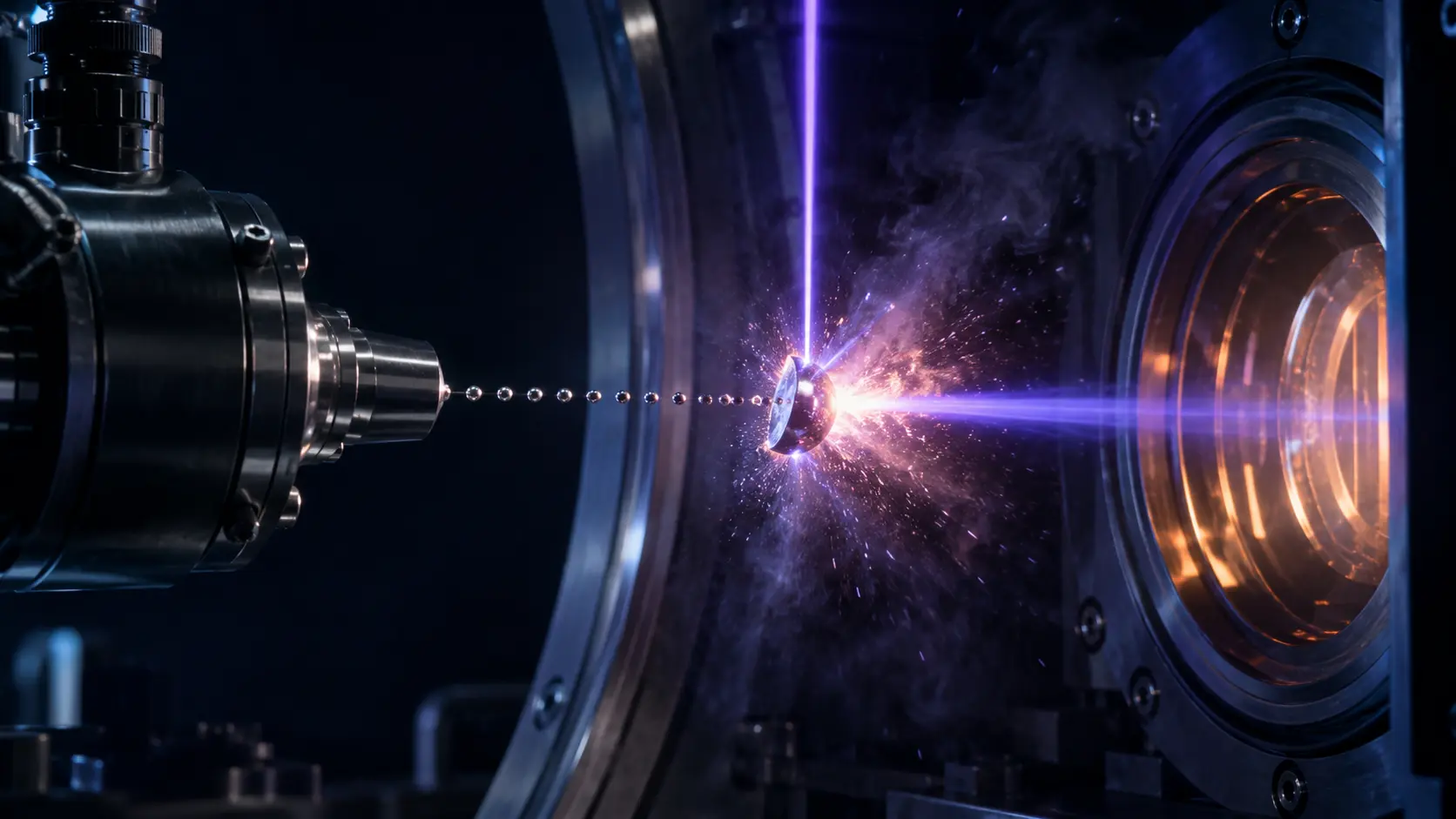
The system relies on a tin-droplet generator operating inside a total vacuum. A pressurized mechanical nozzle fires microscopic droplets of molten tin—each a fraction of the thickness of a human hair—dropping them at speeds exceeding 70 meters per second.
As each droplet falls through the vacuum chamber, a high-power carbon dioxide (CO2) laser system targets it. This laser fires two distinct shots. The first is a low-energy pre-pulse that strikes the falling sphere, mechanically flattening it into a microscopic metallic pancake.
Microseconds later, the main laser pulse strikes the flattened tin target with massive thermal energy. This shockwave instantly vaporizes the metal into a highly charged plasma state. As the plasma cools, the agitated tin ions release photons at exactly 13.5 nanometers, which collector mirrors then gather and focus onto the silicon wafer.
WHY IT MATTERS NOW
The physical limitations of this plasma generation process dictate the absolute ceiling of global computing power. Training frontier artificial intelligence models requires tens of thousands of advanced graphics processing units (GPUs). Foundries can only manufacture these chips by successfully stabilizing the 13.5nm light stream inside an ASML EUV scanner.
Geopolitical supremacy currently rests on controlling the supply chain for these specific droplet generators and their paired laser systems. The United States enforces strict export controls preventing ASML from shipping EUV technology to Chinese foundries. This blockade specifically targets the adversary’s inability to organically replicate the dual-pulse laser timing required to achieve a stable plasma state.
Generating EUV light requires extreme energy conversion inefficiency. The massive CO2 drive laser consumes roughly a megawatt of electricity, yet the tin plasma converts only a few percent of that energy into usable 13.5nm light. The rest of the energy dissipates as waste heat and debris.
Operating this light source dictates the financial unit economics of sovereign semiconductor fabrication plants. If the droplet generator misfires or the laser timing drifts by a single microsecond, the machine fails to produce the required 250 watts of EUV power. The entire 300-million-dollar lithography tool immediately throttles its output, destroying the factory’s wafer throughput and daily profitability.
WHAT MOST PEOPLE MISS
Diplomatic analysts frequently view the EUV scanner as a single, uniform machine manufactured entirely in the Netherlands. They completely miss the deeply fragmented, highly specialized sub-tier supply chain holding the machine together. The high-power CO2 drive lasers required to vaporize the tin do not come from ASML; they originate from TRUMPF, a privately held industrial laser manufacturer in Germany.
Furthermore, vaporizing 50,000 tin droplets per second creates a massive physical contamination problem inside the vacuum chamber. The plasma explosion scatters microscopic tin shrapnel in all directions. Engineers must inject a constant, high-speed flow of hydrogen gas into the chamber to chemically bind with the tin debris and sweep it away, preventing the metal from permanently coating and blinding the ultra-expensive collector mirrors.
THE TRAJECTORY
Next 12–36 Months: Machine learning optimization of droplet telemetry. Manufacturers will deploy edge AI directly into the light source control loop. The algorithms will analyze the acoustic and optical signature of every single plasma explosion, adjusting the timing of the CO2 laser pulses in real time to maximize EUV conversion efficiency.
Next Five Years: The integration of higher-velocity droplet generators. To support High-NA EUV scanners requiring 500 watts of light, engineers will increase the droplet firing rate to 100,000 spheres per second. This requires drastically increasing the hydraulic pressure within the tin nozzle to force the molten metal into the path of the drive laser at double the current speed.
Next Ten Years: The realization of Free-Electron Lasers (FEL). The physical mechanics of vaporizing tin will eventually hit an absolute thermal limit. Sovereign consortiums will transition to building massive, stadium-sized particle accelerators that generate EUV light by passing high-speed electrons through undulating magnetic fields, completely abandoning tin plasma chemistry.
What Could Go Wrong: Severe tin nozzle clogging. The liquid metal must exit a microscopic aperture under extreme pressure. If microscopic impurities exist in the raw tin supply, the nozzle will physically jam, instantly halting the droplet stream, extinguishing the EUV plasma, and forcing a costly, multi-day factory maintenance shutdown.
Most Likely Outcome: The laser-produced tin plasma architecture will remain the mandatory light source for all advanced computing for the next decade. The extreme engineering difficulty of synchronizing lasers and liquid metal creates an insurmountable moat that locks global chip production to a handful of allied Western corporations.
KEY TERMS
- Laser-Produced Plasma (LPP): A state of highly charged matter created by firing an intense laser pulse into a target material, causing it to vaporize and emit high-energy light.
- Extreme Ultraviolet (EUV): An electromagnetic wavelength of 13.5 nanometers used exclusively in advanced semiconductor manufacturing to print microscopic features.
- Tin-Droplet Generator: A precision mechanical device that melts pure tin and forces it through a microscopic nozzle to create a continuous, high-speed stream of identical liquid spheres.
- Drive Laser: The massive industrial laser system, typically utilizing carbon dioxide, designed to deliver the exact thermal energy required to vaporize a metallic target.
- Conversion Efficiency: The mathematical ratio measuring how much of the original drive laser’s energy successfully transforms into usable 13.5nm EUV light.
SOURCES
- SPIE (International Society for Optics and Photonics) — Laser-Produced Plasma Light Sources for EUV Lithography
- ASML — EUV Source Architecture and Tin-Droplet Generator Dynamics
- TRUMPF — High-Power CO2 Laser Systems in Semiconductor Manufacturing
- Journal of Applied Physics — Fluid Dynamics and Laser Shock Physics of Liquid Metal Droplets