Advertisement
)

At a Glance
- Concept: Enriching uranium far beyond traditional commercial limits to power advanced, compact nuclear reactors.
- Why it matters: The global transition to clean, firm baseload energy relies on SMRs, but these reactors are physically useless without HALEU. Until recent Western investments, the United States and Europe lacked the commercial infrastructure to manufacture this fuel.
- Who uses it: Advanced nuclear developers (TerraPower, X-energy), the U.S. Department of Energy, and nuclear fuel cycle integrators (Centrus, Orano, Urenco).
- Biggest takeaway: Generating HALEU is not simply a matter of running existing centrifuges longer. It requires entirely new, highly secure production facilities, immense amounts of electrical power (measured in Separative Work Units, or SWU), and specialized “deconversion” facilities to turn the enriched gas into solid fuel.
In Simple Words
Traditional nuclear power plants are massive, multi-billion dollar concrete behemoths. They are designed to burn standard fuel, which contains about 5% of the reactive uranium-235 isotope.
The next generation of nuclear plants—Small Modular Reactors (SMRs)—are designed to be built in factories, shipped on trucks, and assembled quickly. Because they are physically much smaller, their fuel needs to be vastly more powerful. They require High-Assay Low-Enriched Uranium (HALEU), which is enriched to 19.75%.
Think of traditional nuclear fuel like standard unleaded gasoline, and HALEU like high-octane racing fuel.
For decades, the West did not manufacture this racing fuel commercially because there was no market for it; only research reactors used it. The only country with the commercial infrastructure to sell it cheaply was Russia. When the geopolitical landscape fractured, the West realized its entire multi-trillion dollar clean energy roadmap relied on a fuel it could not produce. Now, the U.S. and Europe are racing to build massive new centrifuge facilities to spin uranium gas fast enough to reach that critical 19.75% threshold, desperately trying to rebuild a sovereign nuclear supply chain from scratch.
Why This Matters
The global energy transition has hit a physics constraint. Wind and solar power are intermittent; the grid still requires continuous, 24/7 “baseload” power. As coal and natural gas plants are decommissioned to meet net-zero emissions targets, advanced nuclear power is the only mathematically viable replacement that does not emit carbon.
However, advanced nuclear relies on a fragile, highly consolidated supply chain.
Without HALEU, highly touted SMR projects simply cannot turn on. In the early 2020s, major nuclear startups were forced to delay their deployment timelines by years specifically because they could not secure the required fuel. Recognizing this catastrophic bottleneck, the U.S. and European governments intervened.
By 2026, the market has violently shifted from a Russian monopoly to a subsidized Western industrial mobilization. The U.S. Department of Energy (DOE) launched the HALEU Availability Program, allocating USD 2.7 billion to build domestic capacity. European governments issued massive loans to companies like Urenco and Orano to expand their enrichment cascades. For commodity investors and grid planners, tracking the physical output of these HALEU enrichment facilities is the ultimate leading indicator of when next-generation nuclear power will actually connect to the grid.
The Big Picture
To understand the nuclear supply chain, one must understand the absolute limit of non-proliferation law.
Uranium enrichment is globally regulated to prevent the creation of nuclear weapons.
- LEU (Low-Enriched Uranium): Enriched up to 5% U-235. Used in traditional commercial reactors.
- HEU (Highly Enriched Uranium): Enriched above 20% U-235. This is weapons-grade material, used in naval submarines and nuclear warheads.
HALEU is deliberately capped at 19.75% U-235. It is pushed to the absolute mathematical limit of what is legally considered “low-enriched” material by the International Atomic Energy Agency (IAEA). This allows SMR operators to maximize energy density and run their reactors for a decade without refueling, while strictly remaining under the 20% threshold that would trigger severe international weapons proliferation protocols.
How It Works
Creating HALEU is a triumph of fluid dynamics, materials science, and chemistry. Here is the first-principles breakdown of the fuel cycle.
1. The Fundamental Problem: Natural Uranium
When uranium is mined from the ground, it is 99.3% Uranium-238 (which does not easily split) and only 0.7% Uranium-235 (the fissile isotope that creates nuclear energy). To make the fuel burn in an advanced reactor, you must physically separate the U-235 from the U-238 and concentrate it up to 19.75%.
2. The Insufficiency of Traditional Enrichment
Historically, uranium is turned into a gas (Uranium Hexafluoride, or UF6) and spun in massive centrifuges. The heavier U-238 is thrown to the outside wall, while the lighter U-235 stays near the center. Standard enrichment plants are tuned to stop at 5%. Modifying these legacy plants to push past 5% alters the criticality safety margins—meaning the concentrated gas could theoretically start a nuclear chain reaction inside the pipes. Legacy facilities are not legally or physically licensed to handle this risk.
3. The Core Mechanism: The HALEU Cascade
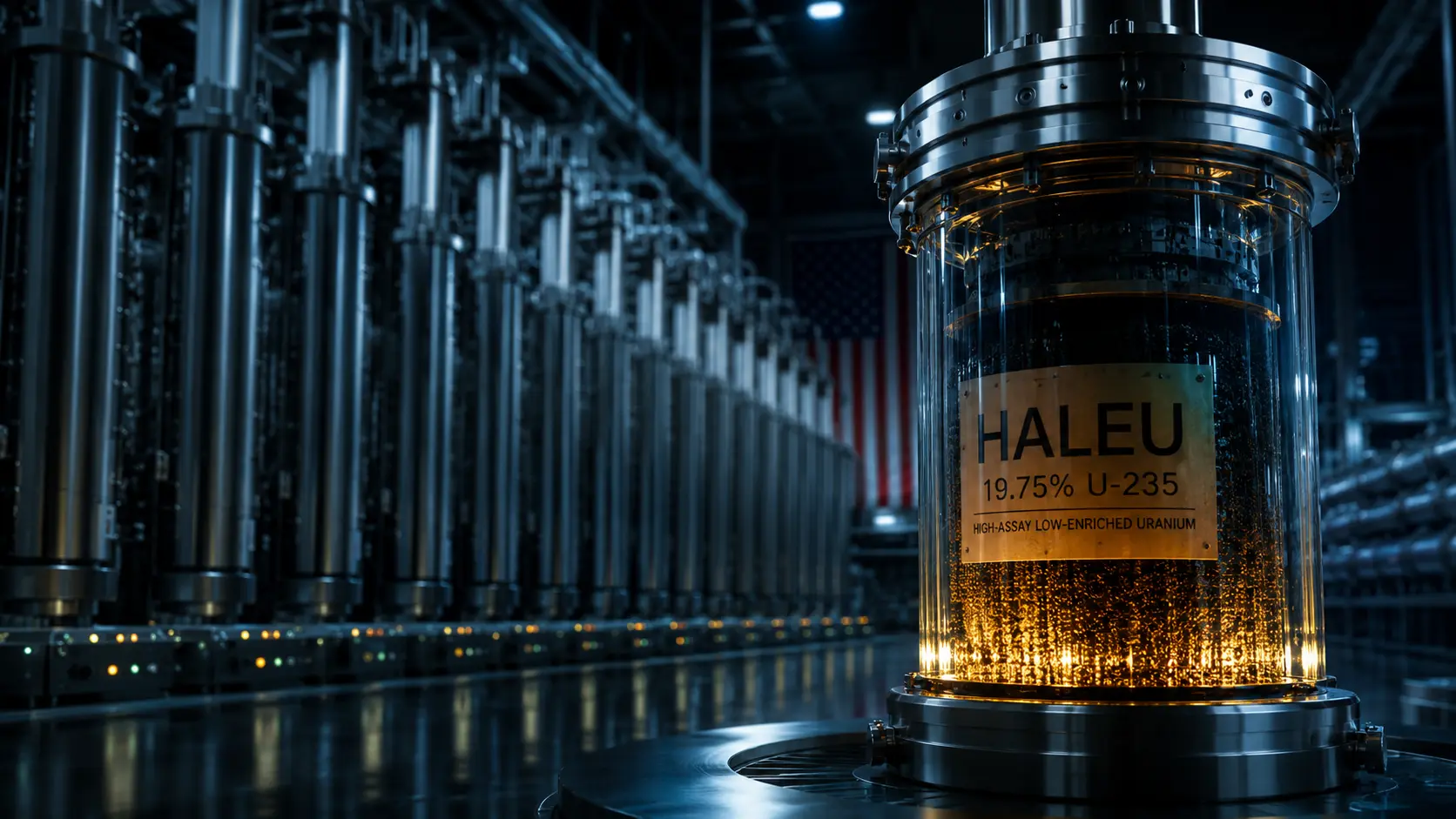
To produce HALEU, companies like Centrus Energy build dedicated, advanced centrifuge cascades. A cascade is thousands of tall, carbon-fiber centrifuges connected in a massive web. The gas is passed sequentially from one machine to the next. The effort required to enrich uranium is measured in Separative Work Units (SWU). Because enrichment gets exponentially harder as purity increases, pushing from 5% to 19.75% requires an immense amount of localized electrical power and highly specialized, critically-safe piping infrastructure.
4. Technical Depth: The Deconversion Bottleneck
Enriching the uranium is only half the battle. Once the HALEU emerges from the cascade, it is still a highly toxic, corrosive gas (UF6). A nuclear reactor cannot burn gas. The gas must be sent to a “deconversion” facility, where complex chemical processes turn the UF6 into a solid metal, an oxide powder, or a molten salt, depending on the specific SMR design. Developing these custom deconversion facilities has proven to be an equally difficult bottleneck in the supply chain.
5. Real-World Consequences: TRISO Fuel Fabrication
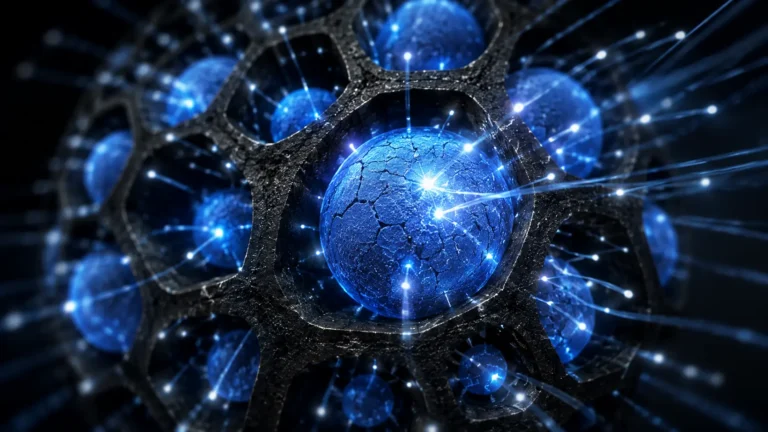
Once deconverted, the HALEU is fabricated into advanced fuel forms. The most famous is TRISO (TRi-structural ISOtropic) particle fuel. Tiny kernels of HALEU are wrapped in layers of carbon and silicon carbide. These microscopic spheres are structurally indestructible; they can withstand temperatures over 1,600 degrees Celsius without melting. This physically guarantees that the reactor cannot melt down, but manufacturing these microscopic shells requires a pristine, highly specialized HALEU supply chain that did not exist in the West prior to 2023.
Real-World Applications
The deployment of HALEU unlocks entirely new categories of nuclear physics.
Sodium-Cooled Fast Reactors: Companies like TerraPower (backed by Bill Gates) utilize liquid sodium instead of water to cool their advanced reactors. These designs require HALEU to sustain a fast-neutron spectrum. Because HALEU is so dense, the reactor core is significantly smaller, allowing the plant to rapidly ramp its power output up and down to perfectly balance the intermittent dips of wind and solar grids.
High-Temperature Gas Reactors (HTGR): Companies like X-energy use helium gas to cool their reactors, burning TRISO HALEU fuel. These reactors operate at immense temperatures, generating high-quality industrial steam. This allows heavy industries (like chemical manufacturing and steel smelting) to use the reactor’s heat directly to replace coal and natural gas furnaces, decarbonizing sectors that traditional electricity cannot reach.
Space Nuclear Propulsion: NASA and the Department of Defense are developing nuclear thermal propulsion (NTP) engines for deep space travel. Because spacecraft cannot afford excess weight, they require the absolute highest energy density legally available. HALEU provides the immense thermal thrust required to cut the travel time to Mars in half without crossing the HEU weapons-grade threshold.
Economic & Strategic Impact
The economics of the HALEU supply chain are heavily driven by state intervention.
Because advanced reactors are still in the demonstration phase, commercial fuel manufacturers faced a “chicken-and-egg” problem. Companies like Orano and Urenco could not justify spending billions of dollars to build a HALEU plant if the reactor companies had not yet built any reactors. Conversely, the reactor companies could not attract investors if there was no fuel to power them.
The government stepped in as the ultimate market-maker. By mid-2026, the U.S. DOE had aggressively executed its mandate. In July 2026, Centrus Energy signed a massive USD 900 million task order with the DOE to transition its Piketon, Ohio demonstration cascade into full commercial-scale production. This matched heavy European investments, where Orano expanded its Georges Besse II facility in France, and Urenco broke ground on a massive HALEU plant in the UK (slated for 2031).
Strategically, this capital injection effectively reshores the nuclear fuel cycle. The ban on Russian uranium imports enacted by the United States and aligned European roadmaps forced the West to physically decouple from the Russian state nuclear corporation (Rosatom). Securing a sovereign HALEU supply chain is now viewed identically to securing domestic semiconductor manufacturing: it is a non-negotiable pillar of national security.
Advantages
- Extreme Energy Density: Allows SMRs to be built in smaller physical footprints, significantly reducing the massive capital costs associated with pouring concrete for traditional nuclear plants.
- Longer Core Life: A reactor fueled by HALEU can operate for 5 to 20 years without needing to be shut down and refueled, vastly improving grid reliability and lowering operational costs.
- Reduced Nuclear Waste: Because the fuel is burned more efficiently over a longer period, advanced reactors utilizing HALEU generate a significantly smaller volume of highly radioactive spent fuel.
Limitations
- Severe SWU Costs: Producing 19.75% HALEU requires a massive amount of Separative Work Units (SWU). This requires more centrifuges, more electricity, and drives the cost of the fuel exponentially higher than standard 5% LEU.
- Transportation and Logistics: Moving HALEU requires specialized, heavily shielded Type B shipping casks certified to prevent criticality accidents. There is a severe global shortage of these specialized transportation cylinders.
- Regulatory Friction: Handling uranium enriched to near 20% requires drastically higher physical security, safeguards, and regulatory oversight from agencies like the Nuclear Regulatory Commission (NRC) than standard commercial fuel.
Common Misconceptions
Misconception: HALEU is weapons-grade uranium.
Reality: HALEU is strictly classified as Low-Enriched Uranium. Weapons-grade uranium (HEU) requires enrichment above 90%. It is mathematically impossible to build a nuclear bomb out of 19.75% HALEU.
Misconception: The world is running out of raw uranium.
Reality: There is abundant natural uranium in allied nations (Canada, Australia, USA). The bottleneck is not mining the rock; the bottleneck is the high-tech industrial process of turning that rock into gas and spinning it in centrifuges.
Misconception: All SMRs need HALEU.
Reality: While many advanced non-water designs (gas, molten salt) require HALEU, several prominent SMR designs (like those based on traditional pressurized water technology) simply use standard 5% LEU to avoid the supply chain bottleneck entirely.
What Most People Miss
The hidden vulnerability in the HALEU supply chain is the deconversion and assay variety problem.
Standard nuclear fuel is highly uniform; almost every commercial plant in the world uses the exact same uranium dioxide pellets. Advanced SMRs are not uniform. One startup needs HALEU in a metallic alloy form; another needs it as a molten fluoride salt; another needs it as an oxide powder for TRISO.
Building a single centrifuge plant to enrich the gas is difficult, but building five different, highly customized chemical deconversion facilities to turn that gas into five different physical forms destroys the economies of scale. The true challenge of the late 2020s is standardizing these advanced fuel forms so that fuel fabricators do not go bankrupt serving a highly fragmented reactor market.
Comparison Table
| Feature | Low-Enriched Uranium (LEU) | High-Assay Low-Enriched Uranium (HALEU) | Highly Enriched Uranium (HEU) |
| U-235 Enrichment Level | 3% to 5% | 5% to 19.75% | > 20% (Often > 90% for weapons) |
| Primary Use Case | Traditional Light Water Reactors | Advanced Small Modular Reactors (SMRs) | Naval Submarines, Nuclear Weapons |
| Global Supply Chain | Abundant, globally distributed | Severely bottlenecked, currently scaling | Strictly controlled by military states |
| Energy Density | Standard | High (Allows longer fuel cycles) | Extreme |
| Proliferation Risk | Negligible | Low (Below the legal IAEA threshold) | Extremely High |
Case Study
Situation: To meet the aggressive deployment schedules of next-generation SMRs, the United States urgently needed to demonstrate domestic HALEU production capability, entirely free from Russian reliance.
Challenge: No commercial facility in the U.S. was licensed or physically equipped to enrich uranium up to 19.75%. Building a facility from scratch required overcoming immense regulatory hurdles, securing specialized Type B transport cylinders, and funding the extreme SWU requirements.
Solution (The Scale-Up): The U.S. DOE partnered with Centrus Energy. In late 2023, Centrus successfully demonstrated the first production of 20 kg of HALEU at its American Centrifuge Plant in Piketon, Ohio. Driven by intense government funding, Centrus accelerated Phase II of its contract.
Outcome: By mid-June 2026, Centrus completed the production of an additional 900 kg of HALEU UF6 ahead of schedule, bringing cumulative production to over 1,900 kg. On July 1, 2026, the success of this demonstration phase culminated in a USD 900 million contract award from the DOE to fully transition the Piketon cascade into a large-scale commercial operation.
Lessons Learned: The Centrus case study proved that public-private partnerships (the DOE acting as an anchor buyer) are the only viable mechanism to de-risk the massive capital expenditures required to establish a sovereign nuclear supply chain.
Future Outlook
Next 12–24 Months
The focus will heavily shift toward the “Deconversion” bottleneck. With enrichment contracts secured by Centrus and Orano, the DOE will begin issuing massive grants to specialized chemical firms to build facilities capable of turning HALEU UF6 gas into solid metal and oxide forms. Furthermore, the supply of specialized HALEU transport cylinders—a critical logistical choke point—will see expedited manufacturing priority.
Next 3–5 Years
European enrichment giants will come online. Orano’s expansion at the Georges Besse II plant in France and Urenco’s massive Capenhurst facility in the UK (slated for 2031) will begin supplying the global market. This period will witness the first true commercial fuel loadings of advanced SMRs (like the Natrium and Xe-100 reactors), proving the viability of the end-to-end Western supply chain.
Next 10 Years
As HALEU production achieves economies of scale, the cost per kilogram will drop, making advanced nuclear highly competitive with natural gas and offshore wind. We will see the rise of “micro-reactors” (1 to 10 Megawatts) deployed to remote mining sites, military bases, and hyperscale AI data centers. These micro-reactors will be entirely dependent on highly dense HALEU cores, running autonomously for 10 years before the entire sealed unit is shipped back to a factory for refueling.
Most Likely Scenario
The geopolitical decoupling is permanent. The West will successfully break the Russian monopoly on HALEU by the early 2030s. The immense capital deployed by the U.S. DOE and European governments ensures that a sovereign, secure nuclear fuel cycle will exist. HALEU will become a heavily guarded, premium global commodity, serving as the foundational energy source for the most advanced, high-density industrial applications of the 21st century.
Key Takeaways
- HALEU is uranium enriched to nearly 20% (19.75%), providing the extreme energy density required by next-generation Small Modular Reactors (SMRs).
- It is deliberately kept just below the 20% threshold to comply with international non-proliferation laws, avoiding classification as weapons-grade HEU.
- The global supply chain was historically dominated by Russia, leading to a massive, multi-billion dollar push by the U.S. and Europe to build domestic enrichment cascades.
- Enriching HALEU requires advanced centrifuges and immense amounts of energy (Separative Work Units, or SWU), making it significantly more expensive than standard nuclear fuel.
- In mid-2026, the U.S. DOE awarded Centrus Energy a USD 900 million contract to transition its Ohio demonstration cascade into commercial-scale HALEU production.
- The most critical upcoming bottleneck is “deconversion”—the complex chemical process of turning enriched uranium gas into the specialized solid fuel forms required by diverse reactor startups.
Glossary
Deconversion: The chemical process of transforming enriched uranium hexafluoride gas (UF6) into a solid form, such as uranium metal or uranium dioxide, usable for fuel fabrication.
Enrichment Cascade: A highly complex arrangement of thousands of centrifuges connected in series and parallel, used to incrementally separate U-235 from U-238.
High-Assay Low-Enriched Uranium (HALEU): Uranium enriched so that the concentration of the fissile U-235 isotope is between 5% and 19.75%.
Low-Enriched Uranium (LEU): Standard nuclear fuel enriched up to 5% U-235, used in the vast majority of current commercial light water reactors.
Separative Work Unit (SWU): The standard measure of the effort required to separate isotopes of uranium during the enrichment process. Higher enrichment levels require exponentially more SWU.
Small Modular Reactor (SMR): Advanced nuclear reactors with a capacity of up to 300 MW, designed to be factory-built and transported to sites, often relying on HALEU for high energy density.
TRISO Fuel: TRi-structural ISOtropic particle fuel. Microscopic kernels of HALEU wrapped in ceramic and carbon layers, capable of withstanding extreme temperatures without melting.
Frequently Asked Questions
Why can’t we just use normal nuclear fuel in SMRs?
Some SMRs do. However, advanced designs (like molten salt or gas-cooled reactors) are physically much smaller. To generate massive power from a small physical footprint, the fuel must be vastly more concentrated. Normal 5% LEU simply does not have the energy density required to sustain a chain reaction in these advanced, compact core designs.
Is HALEU dangerous to transport?
Yes, but the danger is heavily mitigated by physics and regulation. Because it is highly concentrated, it must be transported in specially designed Type B shipping casks that ensure the material cannot accidentally achieve criticality (start a chain reaction) even if the truck crashes or catches fire.
Does HALEU produce more nuclear waste?
Volume-wise, it produces less. Because the fuel is highly enriched and used in advanced reactors that burn fuel more efficiently over a longer period, the total physical volume of highly radioactive spent fuel generated per megawatt of energy is reduced.
Who owns the HALEU produced by Centrus in the U.S.?
Under the current contracts as of 2026, the HALEU produced by Centrus at the Piketon facility belongs to the U.S. Department of Energy. The DOE acts as a “HALEU Bank,” holding the material and distributing it to private reactor developers to support testing and initial commercial deployments.
Why is exactly 19.75% the limit?
Under international law (the IAEA), anything 20% or above is classified as Highly Enriched Uranium (HEU) and is considered a proliferation risk for weapons development. 19.75% provides the maximum possible energy density while leaving a tiny safety margin to legally remain classified as Low-Enriched Uranium (LEU).
Sources
- World Nuclear Association: High-Assay Low-Enriched Uranium (HALEU) Supply Chain
- U.S. Department of Energy (DOE): HALEU Availability Program and Enrichment Contracts
- Centrus Energy Corp.: PR Newswire – Centrus Signs $900 Million Award; Intends to Transition HALEU Cascade to Commercial Operation (July 1, 2026)
- Orano Group: HALEU Market and Advanced Reactor Supply Chain Strategy
- Urenco: Advanced Fuels Market and Capenhurst Commercial HALEU Plant (2026/2031)