Advertisement
)

AT A GLANCE
- Concept: Dynamic Positioning: Using computer-controlled thrusters to keep a ship perfectly stationary above a wellhole.
- Concept: Blowout Preventer (BOP): A massive subsea valve system designed to physically crush and seal a pipe during emergencies.
- Concept: Drilling Mud: A heavy chemical fluid pumped into the well to counter the extreme pressure of the earth.
- Concept: HPHT Reservoirs: High-Pressure, High-Temperature oil fields that push engineering materials to their absolute physical limits.
IN SIMPLE WORDS
Imagine trying to drink a highly pressurized soda through a straw that is three miles long, all while floating on a raft in the middle of a hurricane.
If the soda is under too much pressure, it shoots up the straw and explodes. If your straw breaks, the soda spills everywhere. Deepwater drilling requires controlling that exact chaos.
Drillships float thousands of feet above the ocean floor, holding a spinning steel pipe that digs miles into the earth. The rocks down there hold oil and gas under crushing pressure. To keep the oil from shooting up to the surface and destroying the ship, engineers pump heavy artificial mud down the pipe to hold the pressure back. It is a constant, incredibly dangerous balancing act between the physical weight of the mud and the explosive force of the earth.
HOW IT WORKS
Operating an ultra-deepwater drillship requires managing two distinct physical environments simultaneously: the turbulent surface of the ocean and the crushing hydrostatic pressure of the subterranean rock.
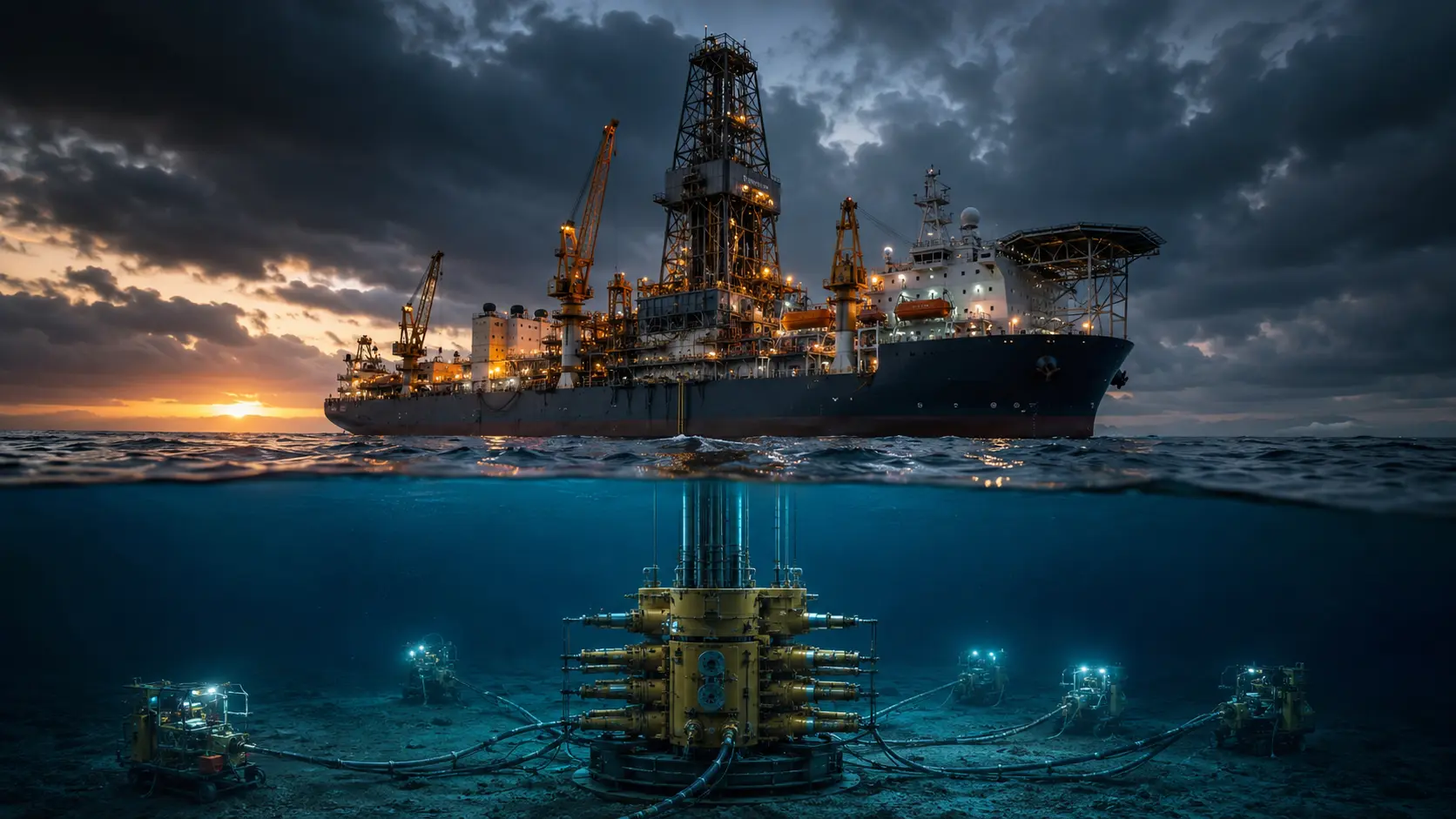
First, the vessel must remain completely stationary. Because the ocean is thousands of feet deep, the ship cannot drop an anchor. It relies entirely on a Dynamic Positioning (DP) system.
This system uses military-grade GPS, acoustic seabed sensors, and gyroscopes to track the ship’s exact location. A central computer instantly fires dozens of multidirectional thrusters on the hull to counteract wind, waves, and ocean currents. This keeps the ship locked in place with sub-meter accuracy directly above the well.
Once stabilized, the ship lowers a drill string—a continuously assembled steel pipe—down to the seabed and into the earth. At the end of the string, a diamond-studded bit grinds through the rock.
To safely manage the subterranean pressure, engineers pump a heavy synthetic fluid, called drilling mud, down the center of the pipe. The mud cools the drill bit, carries the crushed rock back up the outside of the pipe, and most importantly, provides hydrostatic pressure.
The downward weight of the mud must perfectly counteract the upward pressure of the oil reservoir. If the mud is too heavy, it fractures the surrounding rock and leaks away into the earth. If the mud is too light, the reservoir pressure overpowers it, forcing explosive gas up the pipe in an event called a “kick.”
The following interactive model demonstrates this delicate hydrostatic balance, showing how mud weight dictates the safety of the entire drilling operation.
If a kick escalates uncontrollably, the final line of defense is the Blowout Preventer (BOP). This is a five-story, 400-ton stack of hydraulic valves sitting directly on the ocean floor.
If explosive gas rushes up the well, the BOP activates its blind shear rams. These massive hydraulic blades physically cut through the heavy steel drill pipe, crushing it flat and permanently sealing the wellhole to prevent a catastrophic environmental disaster.
REAL WORLD EXAMPLE
The Deepwater Horizon disaster in 2010 perfectly illustrates the catastrophic failure of these precise systems. The Macondo well was an ultra-deep, high-pressure reservoir in the Gulf of Mexico.
During the final sealing process, the balance of hydrostatic pressure failed. Explosive methane gas bypassed the cement barriers and rushed up the drill string.
The blowout preventer on the ocean floor failed to shear the pipe and seal the well. The gas reached the surface rig, ignited, and caused the largest marine oil spill in history. This single event forced the entire offshore industry to fundamentally redesign BOP hydraulics, add secondary acoustic triggers, and mandate real-time subsea telemetry.
WHY IT MATTERS NOW
The era of easy, shallow oil is permanently over. The global economy still consumes over 100 million barrels of petroleum every day, and onshore shale basins are beginning to show signs of rapid depletion.
To meet this baseline demand, multinational energy corporations are forced into deeper, more hostile waters. Regions like the pre-salt basins of offshore Brazil and the Stabroek block in Guyana contain massive, untapped reservoirs holding billions of barrels of crude oil.
Extracting these reserves requires ultra-deepwater drillships capable of operating in 10,000 feet of water and drilling another 20,000 feet into the earth. These vessels are floating billion-dollar assets. Renting a tier-one drillship costs an energy company over $500,000 per day.
The financial unit economics of the global energy market depend entirely on the operational efficiency of these ships. If a drillship hits a high-pressure zone and must halt operations to adjust mud weights, the delays cost millions of dollars a week. This immense capital expenditure directly impacts the final commodity price of crude oil.
COMMON MISCONCEPTIONS
- “Drillships suck oil straight out of the ocean floor.” Drillships only bore the initial hole and seal it with steel casing. They rarely extract the commercial oil themselves; they cap the well and move on, allowing specialized production platforms to handle the actual extraction later.
- “Anchors hold oil rigs in place.” In shallow water, rigs use physical legs or anchors. In ultra-deep water, the ocean floor is miles away, making anchors impossible. The ships use computer-controlled thrusters to hover in place.
- “Blowout preventers are just simple valves.” A modern BOP is a colossal piece of subsea architecture weighing hundreds of tons. It is equipped with multiple redundant hydraulic shearing blades capable of cutting through solid titanium and heavy steel piping.
WHAT MOST PEOPLE MISS
Public attention focuses heavily on the massive steel structures, but the true engineering chokepoint is elastomer chemistry.
In High-Pressure, High-Temperature (HPHT) wells, the oil and gas can reach 400°F (200°C) at pressures exceeding 20,000 pounds per square inch. At these extremes, the rubber and synthetic seals used inside the blowout preventers and pipe joints physically melt or degrade.
If a single rubber O-ring fails miles underwater, the entire pressure containment system collapses. Energy companies spend billions developing advanced polymers simply to ensure a microscopic seal survives the brutal thermodynamics of the Earth’s crust.
THE ECONOMIC AND STRATEGIC IMPACT
The offshore drilling market is dominated by a tight oligopoly of marine contractors like Transocean, Valaris, and Noble Corporation. These companies own the physical ships and hold absolute pricing power over the state-owned oil companies that hire them.
Geopolitically, deepwater extraction alters sovereign alliances. Discoveries off the coast of Guyana have transformed a small South American nation into one of the fastest-growing economies on Earth. This newly accessible wealth instantly draws intense security interest from the United States and aggressive military posturing from neighboring Venezuela.
Furthermore, the technology developed for ultra-deepwater oil extraction directly subsidizes the green energy transition. The dynamic positioning systems and subsea robotics invented for drillships are now exactly what maritime engineers use to install massive offshore wind turbines in turbulent deep-sea environments.
THE TRAJECTORY
Next 12–36 Months: The deployment of 20K BOP systems. Regulatory bodies and energy majors will finalize the installation of blowout preventers rated for 20,000 psi. This allows companies to access extremely deep, high-pressure reservoirs in the Gulf of Mexico that were previously considered too dangerous to drill.
Next Five Years: The integration of digital twin telemetry. Drillships will stream thousands of gigabytes of real-time sensor data via low-Earth orbit satellites to onshore supercomputers. AI models will predict pressure kicks milliseconds before they happen, adjusting mud pumps automatically without human intervention.
Next Ten Years: The transition to autonomous subsea factories. Instead of relying on massive surface ships, engineers will build robotic drilling and separation facilities directly on the ocean floor. These modules will be powered by subsea cables and operated entirely by remote edge-computing algorithms.
What Could Go Wrong: A severe cyber-physical attack. Drillships rely completely on GPS for their dynamic positioning. If an adversary spoofs the GPS signal, the ship’s thrusters will incorrectly move the vessel off the well center. This would physically snap the drill pipe and trigger an uncontainable subsea blowout.
Most Likely Outcome: Ultra-deepwater drilling will remain a critical pillar of global energy security for the next two decades. The sheer volume of untapped offshore reserves guarantees that marine contractors will continue pushing the extreme limits of metallurgical and hydrostatic engineering.
KEY TERMS
- Dynamic Positioning (DP): A computer-controlled system that uses multiple thrusters to automatically maintain a ship’s position and heading without the use of anchors.
- Blowout Preventer (BOP): A massive subsea safety device that uses hydraulic rams to seal, control, and monitor oil and gas wells to prevent explosive blowouts.
- Drilling Mud: A highly engineered chemical fluid pumped into a wellbore to cool the drill bit, carry away rock cuttings, and provide hydrostatic pressure.
- HPHT Reservoir: High-Pressure, High-Temperature oil and gas fields located deep within the Earth that push drilling equipment to its physical limits.
- Drill String: The continuously assembled column of steel pipe that transmits spinning fluid and rotational power to the drill bit miles below the surface.
- Blind Shear Ram: A specific component inside a blowout preventer equipped with heavy steel blades designed to physically cut the drill pipe and seal the wellhole.
BEGINNER FAQ
How does a drillship stay in one place? It uses dynamic positioning. Computers read GPS and seabed sensors to calculate exactly where the ship is, then automatically fire propellers all around the hull to fight the wind and waves.
What stops the oil from exploding upward? The primary defense is drilling mud. Engineers pump this heavy liquid down the pipe, and its physical weight holds the highly pressurized oil and gas down inside the earth.
What is a blowout preventer? It is a massive, robotic valve system sitting on the ocean floor. If the drilling mud fails and oil shoots upward, the BOP activates hydraulic blades to crush the pipe shut and seal the well.
How deep can these ships drill? Modern drillships can operate in water that is 12,000 feet deep. From the ocean floor, they can drill another 30,000 feet deep into the rock.
Why is offshore drilling so expensive? The equipment must survive saltwater corrosion, hurricane-force winds, and crushing underwater pressure simultaneously. Renting the ship, paying the crew, and moving the logistics costs over half a million dollars a day.
Do the drillships extract the oil permanently? No. A drillship only creates the initial hole and installs the protective steel casing. Once the well is finished and capped, a different, specialized production platform takes over the actual long-term extraction.
What happens if the GPS fails? If the GPS drops, the dynamic positioning system relies on backup acoustic sensors placed on the seafloor and internal gyroscopes to keep the ship stable until the satellite connection returns.
Why drill in the ocean instead of on land? Onshore oil fields are aging and producing less crude. The largest remaining untapped reservoirs of oil and natural gas are hidden miles beneath the deep ocean floor.
SOURCES
- Bureau of Safety and Environmental Enforcement (BSEE) — Blowout Preventer Systems and Well Control Regulations
- Society of Petroleum Engineers (SPE) — HPHT Drilling Challenges and Fluid Mechanics
- Center for Strategic and International Studies (CSIS) — The Geopolitics of Deepwater Energy Extraction
- International Association of Drilling Contractors (IADC) — Dynamic Positioning and Marine Logistics Operations