Advertisement
)
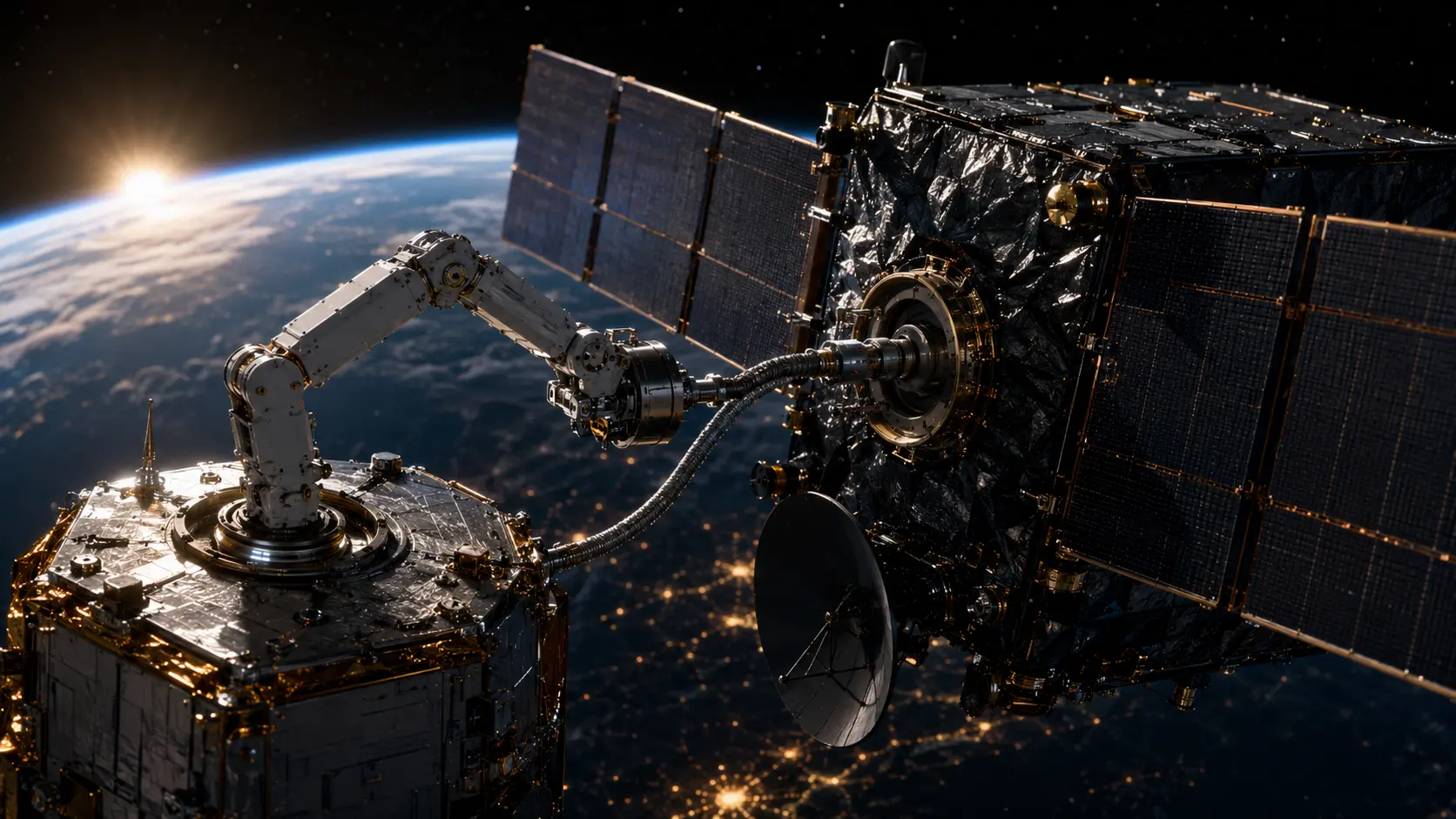

For sixty years, humanity has treated space like a multi-billion-dollar disposable graveyard. When a $500 million communications satellite runs out of fuel or suffers a minor mechanical glitch, it isn’t repaired. It is simply abandoned, left to drift as dangerous orbital debris while its owners spend another half-billion dollars to launch a replacement. Imagine buying a brand-new car every time it ran out of gas. That is the absurd economic reality of the modern space industry.
But the era of disposable satellites is ending. A new sector known as In-Space Servicing, Assembly, and Manufacturing (ISAM) is actively deploying robotic “tow trucks,” orbital gas stations, and zero-gravity repair bays. Why should you care right now? Because the ability to refuel, fix, and physically upgrade satellites while they are moving at 17,500 miles per hour represents a total paradigm shift. For defense strategists and space investors, mastering this orbital supply chain dictates who controls the future architecture of the cosmos—shifting space from a static theater of operations into a dynamic, industrial economy.
What is In-Space Servicing, Assembly, and Manufacturing (ISAM)?
In-Space Servicing, Assembly, and Manufacturing (ISAM) is an emerging aerospace sector dedicated to repairing, refueling, and upgrading satellites directly in orbit. Instead of abandoning spacecraft when they break or run out of propellant, ISAM utilizes autonomous robotics to extend their lifespans and construct massive new structures in a zero-gravity environment.
At a Glance
- Concept: Treating satellites as upgradeable platforms rather than single-use appliances, utilizing robotic servicing vehicles to perform orbital maintenance and assembly.
- Why it matters: It fundamentally changes satellite economics. A $50 million refueling mission can extend the life of a $500 million asset by a decade, drastically improving the Return on Invested Capital (ROIC).
- Who uses it: Defense agencies (DARPA, Space Force), prime contractors (Northrop Grumman, Lockheed Martin), and specialized commercial startups (Astroscale, Orbit Fab).
- Biggest takeaway: ISAM enables the construction of structures too massive to fit inside a single rocket fairing, allowing colossal antennas and solar arrays to be launched in pieces and assembled in space.
In Simple Words
Normally, satellites are built on Earth, folded up like origami to fit inside a rocket, and shot into space. Once there, they unfold and work until they break or run out of fuel. If a single solar panel fails to open, or a thruster runs dry, the entire mission is ruined. The satellite becomes a piece of incredibly expensive floating junk.
ISAM changes this by putting mechanics and factories in space.
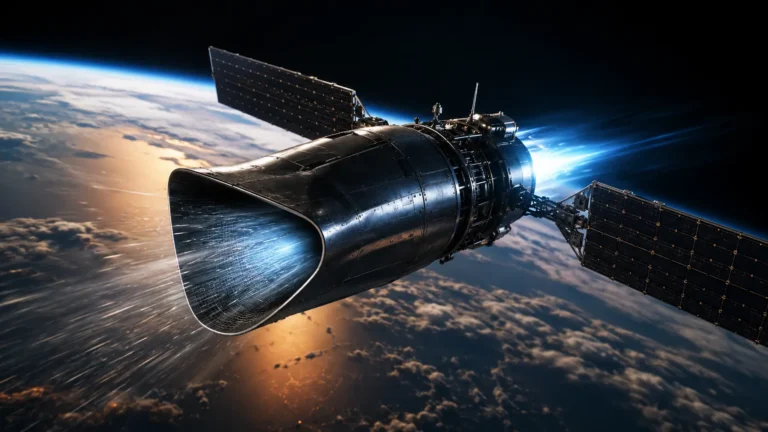
Instead of sending a satellite up and hoping it survives for 15 years, a company can send up a robotic “servicer” spacecraft. This servicer can fly up to the broken satellite, grab it with a robotic arm, and physically pry open the stuck solar panel. Or, if the satellite is out of fuel, the servicer can plug into a fuel port and pump in fresh propellant, like an aerial refueling tanker. By fixing mistakes, refueling empty tanks, and snapping new parts together, ISAM treats the orbital environment like a functioning highway system rather than a landfill.
Why This Matters
The strategic implications of ISAM extend far beyond commercial cost savings.
For geopolitical defense analysts, the ability to maneuver in space without exhausting finite fuel reserves is the holy grail of “Space Domain Awareness.” In traditional operations, a military spy satellite only carries a specific amount of propellant. Every time it changes its orbit to look at a new target, it burns fuel, shortening its lifespan.
If a military satellite can be refueled indefinitely by an ISAM tanker, it can constantly change its orbit to evade enemy tracking missiles or closely inspect suspicious adversary spacecraft without sacrificing its primary mission lifespan. The U.S. Space Force considers orbital refueling a critical tactical requirement to maintain supremacy in the cislunar (Earth-Moon) domain, turning ISAM from a commercial luxury into a mandatory national security capability.
The Three Pillars of ISAM Technology
The ISAM taxonomy comprises three distinct, yet interconnected, pillars:
- Servicing: The repair, refueling, and relocation of existing spacecraft. This includes “life extension” missions where a tow-truck satellite latches onto a dying satellite and uses its own thrusters to keep the dying satellite in orbit.
- Assembly: Launching modular components and snapping them together in orbit. This circumvents the volume limits of rocket fairings, allowing for the construction of massive space stations or deep-space telescopes.
- Manufacturing: Using the vacuum and microgravity of space to build things. This includes 3D-printing massive trusses directly in orbit, or manufacturing ultra-pure materials that are impossible to create on Earth due to gravity-induced defects.
How In-Space Servicing and Assembly Works
Executing physical repairs in a frictionless, zero-gravity vacuum requires mastering complex orbital mechanics. Here is the first-principles breakdown of an ISAM mission.
1. The Fundamental Problem: The Tyranny of the Rocket Equation
Spaceflight is governed by the Tsiolkovsky rocket equation:
Δv = v_e ln(m_0 / m_f)
To change a satellite’s velocity (Δv), you must expel mass (m). Because fuel is incredibly heavy, every ounce of propellant a satellite carries to stay in orbit means less payload capacity for profitable sensors or antennas. When the fuel runs out, the satellite is dead, even if its electronics still work perfectly.
2. The Insufficiency of Traditional Design
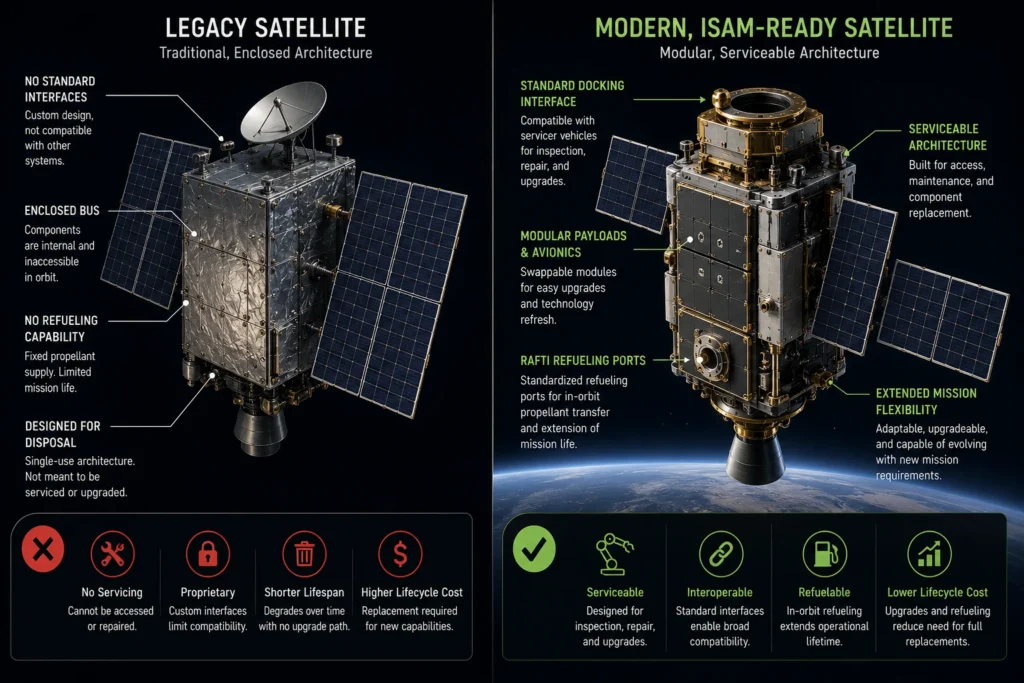
Historically, the only solution to the rocket equation was to over-engineer satellites with massive fuel tanks and redundant systems, making them astronomically heavy and expensive to launch. Furthermore, legacy satellites were explicitly built not to be opened or refueled; their fuel valves were welded shut on Earth.
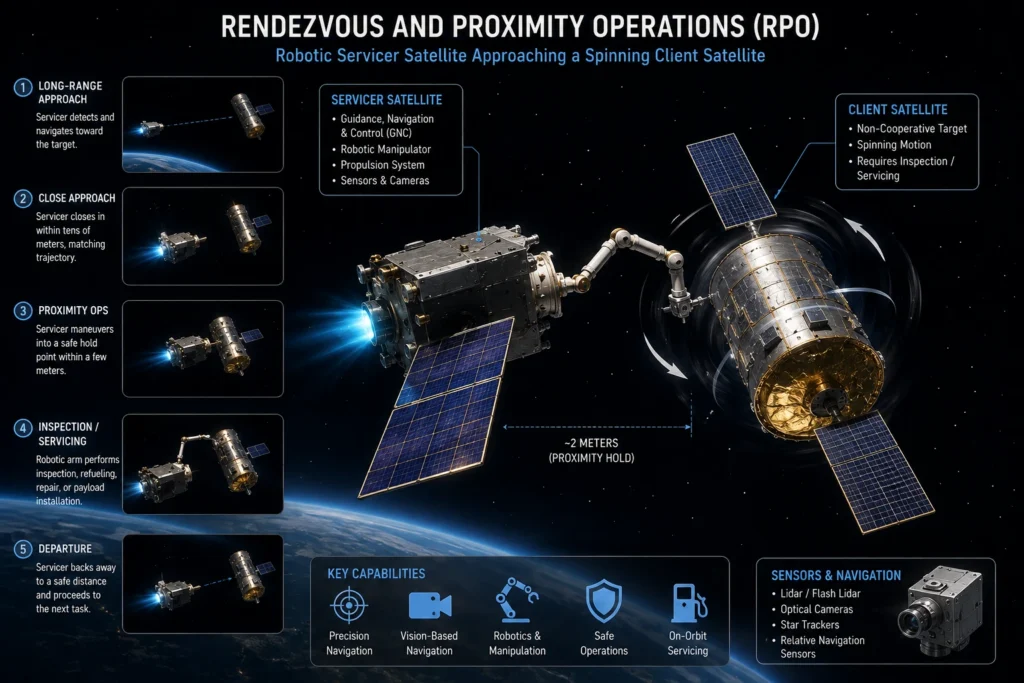
3. The Core Mechanism: Rendezvous and Proximity Operations (RPO)
To service a satellite, a robotic spacecraft must first find it. ISAM relies on RPO. Traveling at 17,500 mph, the servicer spacecraft uses star trackers to find the target. As it gets closer, it relies on active LiDAR and machine vision to map the target’s shape in 3D. The servicer must autonomously match the exact speed and rotation of the “client” satellite—which may be tumbling out of control—before extending a robotic arm to capture it.
4. Technical Depth: Fluid Transfer in Microgravity
If the mission is refueling, the physics become incredibly hostile. Pumping fuel in space isn’t like pumping gas on Earth. Without gravity to pull the liquid to the bottom of the tank, the highly toxic propellant (like hydrazine) forms floating, chaotic bubbles. If gas bubbles enter the thrusters, they can explode. ISAM engineers use specialized bladders and surface-tension-driven fluid management systems to perfectly force pure liquid propellant across the docking umbilical without leaks.
5. Real-World Consequences: Modular Orbital Architectures
By mastering RPO and fluid transfer, the space industry is transitioning to modular architectures. Instead of welding valves shut, modern satellites are being built with standardized “docking plates” and universal fueling ports. If a robotic arm can successfully plug in a fuel hose, it can also plug in a new camera, an upgraded processor, or a larger solar array, allowing satellites to be physically upgraded piece-by-piece over decades.
Commercial ISAM Applications and Orbital Refueling
ISAM is actively transitioning from theoretical whitepapers to deployed orbital hardware.
Northrop Grumman’s MEV (Mission Extension Vehicle): The definitive proof of concept for the servicing industry. In 2020 and 2021, Northrop Grumman successfully launched MEV-1 and MEV-2. These robotic tow trucks hunted down aging commercial telecommunications satellites in Geosynchronous Earth Orbit (GEO) that had run out of fuel. The MEVs physically latched onto the exhaust nozzles of the dying satellites and took over their steering, instantly adding five years of highly profitable life to assets that were destined for the graveyard.
Orbit Fab’s “Gas Stations in Space”: Orbit Fab is actively launching uncrewed fuel depots into orbit. Their business model relies on the Rapid Attachable Fluid Transfer Interface (RAFTI)—an open-source, standardized fueling port. By encouraging all satellite manufacturers to install a RAFTI port on their new spacecraft, Orbit Fab aims to create a universal standard, allowing their orbital tankers to refuel any satellite, regardless of who manufactured it.
Varda Space Industries and Microgravity Manufacturing: ISAM isn’t just about satellites; it is about terrestrial supply chains. Varda launches automated orbital factories that manufacture pharmaceuticals (like the HIV drug Ritonavir). Because microgravity eliminates convection currents and sedimentation, drug crystals form perfectly, resulting in highly stable, highly soluble formulations that are physically impossible to synthesize under the crushing weight of Earth’s gravity. The factory then re-enters the atmosphere, parachuting the finished drugs back to the surface.
Economic & Strategic Impact
The ultimate friction point in the ISAM economy is the Replacement Cost Arbitrage.
SpaceX has radically disrupted the launch industry. The advent of the Falcon 9 and the upcoming Starship has caused the cost of launching a kilogram of payload to plummet. This introduces a severe economic dilemma for ISAM providers.
If it costs $50 million to send a robotic servicer to refuel an aging, 10-year-old satellite, but SpaceX can launch a brand-new, technologically superior replacement satellite for only $30 million, the ISAM mission makes no economic sense. Therefore, the future of orbital servicing relies heavily on servicing exquisite, multi-billion-dollar assets (like the James Webb Space Telescope or classified defense satellites) in high orbits (GEO), where launch costs remain high and the asset is simply too expensive to replace.
Advantages
- Asset Life Extension: Transforms a catastrophic failure (e.g., running out of propellant) into a routine maintenance event, preserving hundreds of millions of dollars in capital expenditure.
- Overcoming Launch Volume Constraints: By launching components separately and assembling them in space, organizations can build massive structures—such as kilometer-wide solar power arrays or deep-space habitats—that would never fit inside a single rocket fairing.
- Space Debris Mitigation: Active Debris Removal (ADR) relies entirely on ISAM technology. The exact same robotic arms used to refuel a satellite can be used to grapple a dead satellite and drag it into the atmosphere to burn up, preventing the disastrous Kessler Syndrome.
Limitations
- Hostile Physics: The zero-gravity environment makes seemingly simple tasks incredibly difficult. If a robotic arm tries to turn a wrench to unscrew a bolt on a satellite, the lack of gravity means the force of turning the wrench will simply cause the robotic servicer to spin wildly in the opposite direction (Newton’s Third Law) unless it is perfectly clamped down.
- The Uncooperative Target Problem: Thousands of legacy satellites currently in orbit were never designed to be serviced. They lack standardized docking rings, visual tracking markers, and accessible fuel valves. Servicing them requires aggressive, highly risky robotic surgery to cut through thermal blankets and snip wires.
- Latency in Teleoperations: For satellites in higher orbits, the communication delay (latency) between a human operator on Earth and the robotic arm in space can be significant. This forces ISAM vehicles to rely heavily on autonomous, AI-driven machine vision, which is prone to failure in harsh, glaring sunlight.
Common Misconceptions
Misconception: Astronauts perform most ISAM servicing missions.
Reality: While NASA’s Space Shuttle astronauts famously repaired the Hubble Space Telescope in the 1990s, human servicing is astronomically expensive and dangerous. Modern ISAM is almost entirely uncrewed and robotic, relying on autonomous machines to perform the dangerous orbital surgeries.
Misconception: We can recycle old satellites to build new ones right now.
Reality: Orbital recycling is still science fiction. Breaking down the complex aerospace-grade alloys and composites of a dead satellite in the vacuum of space to forge new parts is currently beyond our metallurgical capabilities. Current ISAM focuses on refueling and swapping distinct, pre-built modules.
Misconception: ISAM is only used for Earth-orbiting satellites.
Reality: ISAM is the foundational prerequisite for deep space exploration. The NASA Artemis program relies heavily on assembling the Lunar Gateway space station piece-by-piece in lunar orbit, serving as a staging ground and refueling depot for missions to Mars.
What Most People Miss
The strategic shift from Servicing to In-Space Manufacturing (ISM) for Earth’s Benefit.
When most people think of ISAM, they envision fixing broken satellites. What they miss is the staggering economic potential of microgravity manufacturing for terrestrial industries.
Beyond pharmaceuticals, the manufacturing of ZBLAN fiber optics in space is a prime example. On Earth, gravity causes microscopic crystals to form as the glass cools, degrading the fiber’s ability to transmit light over long distances. In microgravity, the glass solidifies flawlessly. A single spool of space-manufactured ZBLAN fiber can transmit data across the Pacific Ocean with vastly fewer signal repeaters than traditional silica fiber. The true gold rush of ISAM is not fixing space hardware; it is manufacturing ultra-premium materials in orbit and selling them to Earth-bound telecommunications and medical companies.
Comparison Table
| Feature | Legacy Space Ecosystem | ISAM Ecosystem |
| Asset Lifespan | Strictly limited by onboard propellant | Extendable indefinitely via refueling |
| Design Architecture | Highly integrated, welded, closed | Modular, standardized docking ports |
| Response to Failure | Asset is abandoned (becomes space junk) | Robotic repair or component swap |
| Size Constraint | Limited by the rocket’s payload fairing | Virtually unlimited (Assembled in orbit) |
| Economic Focus | Optimize for launch weight | Optimize for modularity and upgradeability |
Case Study
Situation: Intelsat 901, a commercial communications satellite operating in Geosynchronous Earth Orbit (GEO), was fully functional electronically but had run out of the propellant required to maintain its precise orbital slot. Historically, this meant the multi-million-dollar asset had to be retired to a “graveyard orbit.”
Challenge: Intelsat 901 was launched in 2001. It was never designed to be serviced, lacked any specialized docking ports, and possessed no visual markers to guide an autonomous robot.
Solution (The MEV-1 Mission): In 2020, Northrop Grumman launched the Mission Extension Vehicle-1 (MEV-1). Utilizing advanced Rendezvous and Proximity Operations (RPO), MEV-1 tracked Intelsat 901 and carefully approached the uncooperative target. Instead of looking for a docking ring, MEV-1 inserted a specialized robotic probe directly into the Liquid Apogee Engine (the main exhaust thruster) of Intelsat 901, physically clamping the two spacecraft together.
Outcome: MEV-1 essentially became the new “engine” for Intelsat 901. Utilizing its own fresh propellant and thrusters, MEV-1 pushed the satellite back into its correct operational orbit and took over all station-keeping duties.
Lessons Learned: The historic docking proved that ISAM is commercially viable even for uncooperative, legacy assets. It demonstrated that precision robotics can overcome the lack of standardized interfaces, instantly unlocking years of highly profitable revenue from satellites that the industry previously considered entirely dead.
Future Outlook
Next 12–24 Months
The era of Interface Standardization. To make ISAM economically scalable, the industry must stop performing bespoke, customized surgeries on every satellite. Over the next two years, organizations like the CONFERS consortium will push for the aggressive adoption of universal standards. We will see the widespread implementation of standard refueling ports (like RAFTI) and standardized magnetic docking plates on all newly manufactured commercial and military satellites, shifting ISAM from a specialized emergency service into a routine utility.
Next 3–5 Years
The deployment of Orbital Propellant Depots. Rather than launching a heavy refueling tanker from Earth every time a satellite needs gas, companies will launch massive, centralized fuel depots into orbit. Smaller, highly agile robotic “shuttles” will dock with the depot, load up on a few hundred kilograms of hydrazine, and fly out to service multiple client satellites in a single trip. These “gas stations in space” will serve as the critical logistics hubs for military space maneuvering and deep space transit.
Next 10 Years
The transition to Autonomous In-Space Assembly. By the mid-2030s, the focus will shift entirely from refueling to construction. Robotic spider-arms (like those proposed by Tethers Unlimited or Made In Space) will receive raw spools of carbon fiber and 3D-print massive, kilometer-long antenna trusses directly in the vacuum of space. This will permanently sever the constraints of the rocket fairing, allowing humanity to build solar power satellites and deep-space habitats that dwarf the International Space Station in both size and capability.
Most Likely Scenario
As the cost of launching mass to orbit drops asymptotically due to heavy-lift reusable rockets, the ISAM industry will pivot away from merely extending the life of old, cheap satellites in Low Earth Orbit (LEO). Instead, the sector will monopolize the construction of massive, high-value infrastructure in GEO and cislunar space, establishing the first permanent, robotic industrial supply chains required to support humanity’s expansion to the Moon and Mars.
Key Takeaways
- In-Space Servicing, Assembly, and Manufacturing (ISAM) replaces the disposable satellite paradigm by using robotics to repair, refuel, and build structures directly in orbit.
- Rendezvous and Proximity Operations (RPO) are the foundation of ISAM, requiring immense precision to safely dock two spacecraft traveling at orbital speeds.
- Servicing missions (like Northrop Grumman’s MEV) have successfully latched onto dying satellites to take over their engines, extending their profitable lives by years.
- Pumping fluid in microgravity is extremely difficult; it requires specialized surface-tension management to prevent dangerous gas bubbles from entering the fuel lines.
- The primary economic threat to ISAM is the falling cost of rocket launches; if launching a new satellite is cheaper than sending a robotic mechanic, the business model collapses.
- The ultimate financial prize of ISAM is microgravity manufacturing—creating flawless fiber optics and pharmaceuticals in space to sell back to industries on Earth.
Glossary
Active Debris Removal (ADR): The process of using ISAM robotic technologies to capture and intentionally de-orbit dangerous space junk to prevent collisions.
Cislunar Space: The vast volume of space between the Earth and the Moon, expected to become the primary logistical hub for future deep-space exploration.
Kessler Syndrome: A theoretical scenario where the density of space debris in LEO becomes so high that collisions create a cascading chain reaction, rendering spaceflight impossible.
Microgravity: The condition of near-weightlessness experienced in orbit, which allows for the perfect crystallization of materials without the interference of Earth’s gravity.
Rendezvous and Proximity Operations (RPO): The complex orbital maneuvers and sensor technologies required for two spacecraft to intentionally find, approach, and interact with each other.
Tsiolkovsky Rocket Equation: The fundamental mathematical equation of astronautics that dictates how much fuel a rocket needs to move, highlighting the extreme penalty of carrying dead weight into space.
Frequently Asked Questions
Can an ISAM robot grab a satellite that is spinning out of control?
This is exceptionally dangerous but possible. Advanced robotic servicers use high-speed machine vision to calculate the exact tumble rate of the target. The servicer must match the tumbling rotation perfectly before extending the robotic arm, requiring immense computational power and reaction control thrusters.
Who owns the space junk if a company wants to recycle it?
Under the Outer Space Treaty of 1967, the country that launched the satellite legally retains ownership of it forever. An ISAM company cannot legally grab or recycle a dead Russian or Chinese satellite without explicit permission, creating a massive diplomatic hurdle for orbital cleanup.
Are there weapons in space disguised as ISAM robots?
This is a severe geopolitical concern. A robotic arm designed to gently dock and refuel a satellite can easily be used to crush an enemy satellite’s solar panels or snip its communication wires. Defense agencies treat any unauthorized RPO approach by a foreign satellite as a highly aggressive act.
Do satellites need to be turned off while being refueled?
Typically, yes. Due to the extreme risks of fluid transfer and the potential for the robotic arm to interfere with delicate antennas, the client satellite is usually placed into a safe “standby” mode during the physical docking and refueling process.
Why not just use the Space Shuttle?
The Space Shuttle program was retired in 2011. Even when active, using a multi-billion-dollar crewed vehicle to fix a single satellite was economically unjustifiable for anything less valuable than the Hubble Space Telescope. Uncrewed, robotic ISAM vehicles are infinitely cheaper and don’t risk human lives.
Sources
[1] U.S. Office of Science and Technology Policy: In-Space Servicing, Assembly, and Manufacturing National Strategy (2022/2026 Analysis)
[2] Northrop Grumman: Mission Extension Vehicle (MEV) Operational Data and Life Extension Economics
[3] Orbit Fab: RAFTI Open-Source Refueling Architecture and Orbital Depot Infrastructure
[4] Varda Space Industries: Microgravity Manufacturing of Pharmaceuticals and Re-entry Logistics (2026 Briefs)
[5] Journal of Spacecraft and Rockets: Advances in Rendezvous and Proximity Operations for Uncooperative Targets