Advertisement
)

The global transition to renewable energy is actively colliding with the strict laws of planetary rotation. Solar power is the cheapest energy source in human history, but its production crashes to absolute zero the moment the sun sets. Unfortunately, this is precisely the moment when humanity turns on its lights, televisions, and electric vehicle chargers. This aggressive mismatch between solar supply and human demand—known to grid planners as the “duck curve”—forces utilities to burn expensive, heavy-polluting natural gas just to keep the lights on after dark.
For the past decade, the only solution to this problem was spending trillions of dollars to build massive, highly volatile lithium-ion battery banks to store midday solar power for nighttime use. Why should you care right now? Because aerospace engineers have designed a radical alternative: if we cannot store the sun’s energy, we will simply refuse to let the sun set. By launching fleets of massive, robotic mirrors into space, companies are actively preparing to bounce sunlight around the curvature of the Earth, beaming daylight directly onto existing solar farms in the dead of night. This shift from chemical battery storage to orbital optical relays is poised to shatter the financial bottlenecks of the global energy grid.
What are Orbiting Solar Reflectors?
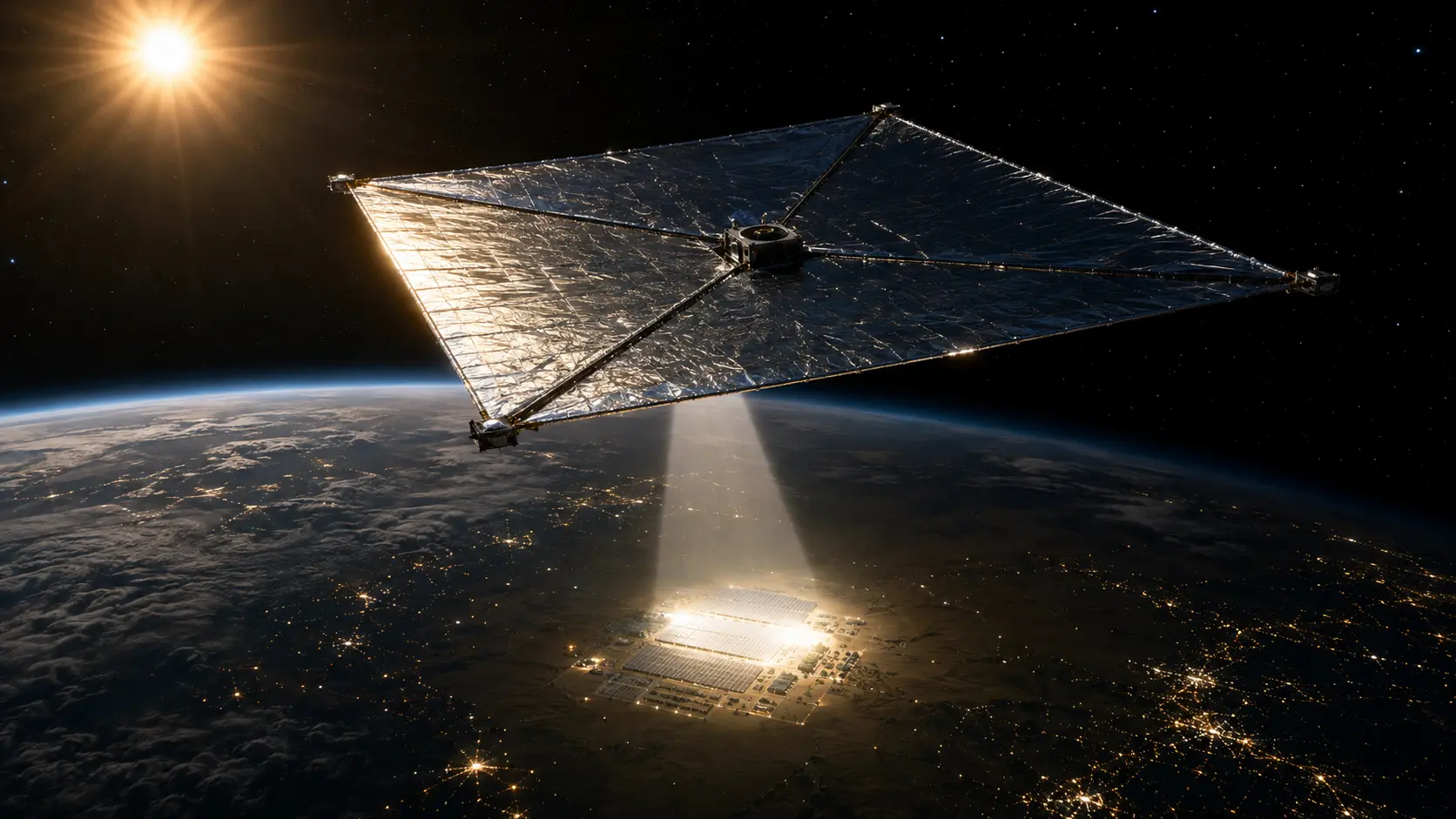
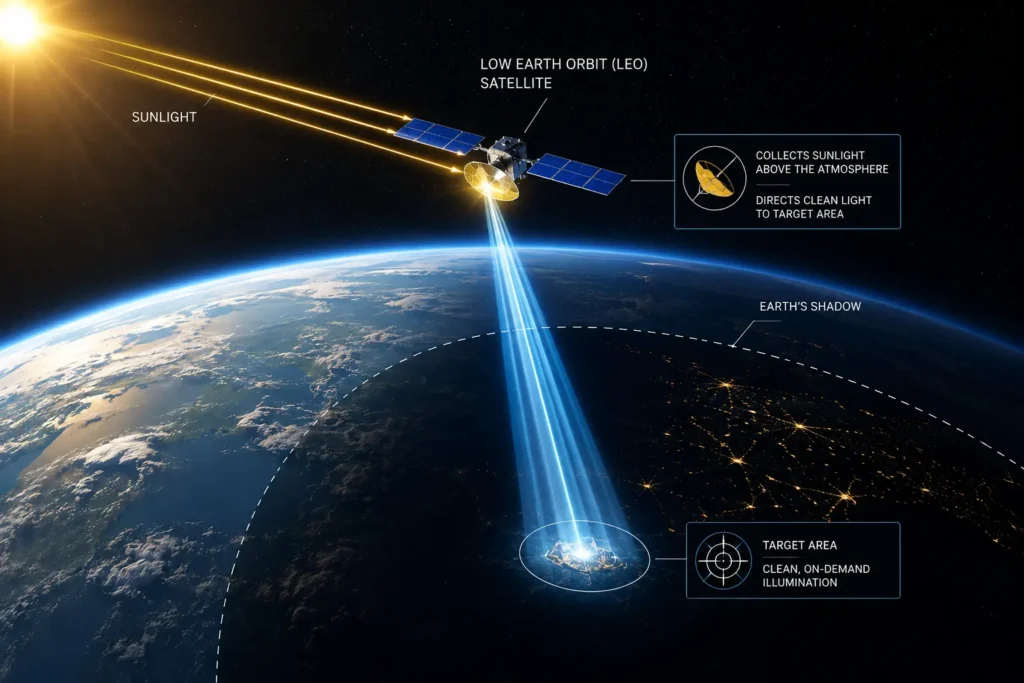
Orbiting Solar Reflectors (OSRs) are massive, ultra-lightweight mirrors deployed in low Earth orbit designed to redirect sunlight down to existing terrestrial solar farms during the night or twilight. By extending the operational hours of solar panels, OSRs increase renewable energy output during peak evening demand without requiring complex microwave power transmission.
At a Glance
- Concept: Utilizing 100-meter to kilometer-wide aluminized polymer membranes in space to reflect the sun’s rays onto specific, targeted geographic coordinates on Earth.
- Why it matters: It mathematically alters the Levelized Cost of Energy (LCOE) for solar farms. By delivering sunlight right at dusk when wholesale electricity prices are peaking, solar farms can double their daily revenue without buying a single battery.
- Who uses it: Aerospace startups (Reflect Orbital), academic consortiums (SOLSPACE), and grid-scale terrestrial solar developers seeking to maximize infrastructure yield.
- Biggest takeaway: OSRs do not generate electricity in space. They have no solar panels and no microwave transmitters. They are simply highly precise, steerable mirrors, making them vastly lighter, cheaper, and closer to commercial reality than traditional Space-Based Solar Power (SBSP) concepts.
In Simple Words
Imagine you have a magnifying glass and a flashlight. If you stand in a dark room and shine the flashlight at the magnifying glass, you can angle the glass to bounce a bright spotlight onto a solar-powered toy car on the floor, making it run even though the room is dark.
Orbiting Solar Reflectors do this on a planetary scale.
Because the Earth is a sphere, when it is 8:00 PM and dark on the ground, the sun is still shining brightly in outer space just a few hundred miles above your head. Aerospace engineers launch massive, flat mirrors (the size of football fields) into space. As the mirror flies over a dark solar farm in Texas or Australia, robotic gyroscopes tilt the mirror to catch the sunlight from space and bounce a wide, soft beam of light straight down. To someone on the ground, it looks like a localized, incredibly bright full moon. The solar panels on the ground absorb this bounced light and continue churning out electricity long after the sun has set.
Why This Matters
The capital expenditure (CapEx) required to build utility-scale battery storage is throttling the energy transition. Lithium-ion batteries degrade over time, require toxic mining supply chains, and can only discharge energy for roughly four to eight hours.
For Grid Planners and Space Investors, OSR constellations offer a disruptive financial arbitrage. Instead of spending $500 million to build a battery facility next to a solar farm, a utility can simply purchase a “sunlight subscription” from an OSR operator. The OSR constellation beams sunlight to the farm exactly during the lucrative evening peak. This allows terrestrial developers to monetize their existing photovoltaic (PV) hardware for 18 hours a day instead of 10, drastically accelerating the payback period of terrestrial solar infrastructure.
The History and Future of Orbiting Solar Reflectors
The idea of space mirrors is not new. In 1993, the Soviet Union successfully deployed Znamya 2, a 20-meter mylar reflector launched from the Mir space station that briefly cast a 5-kilometer-wide spot of light across Europe. The technology was abandoned shortly after due to deployment errors and a lack of commercial funding.
However, the commercial spaceflight revolution has resurrected the concept. In 2026, companies like Reflect Orbital are capitalizing on the collapsing cost of launch access (driven by SpaceX’s reusable Falcon 9 and Starship platforms) and advancements in ultra-thin metamaterials. By launching massive constellations into Dawn-Dusk Sun-Synchronous Orbits (SSO), these companies aim to create a continuous, overlapping network of mirrors capable of servicing dozens of massive solar installations (like the Sun Cable project in Australia) throughout a single orbital cycle.
How Orbiting Solar Reflectors Work in Space
Bouncing photons across thousands of kilometers of space requires absolute mastery over orbital mechanics and spatial geometry. Here is the first-principles breakdown of the architecture.
1. The Fundamental Problem: The Duck Curve
Solar panels are useless precisely when power grids need them the most. When people return home from work at dusk and turn on their appliances, the sun sets. The grid demand spikes up, and solar generation crashes down. This resulting chart is known as the “Duck Curve,” and it forces grids to rely on high-cost, high-emission “peaker” gas plants.
2. The Insufficiency of Space-Based Solar Power (SBSP)
Engineers initially proposed Space-Based Solar Power: putting massive solar panels in space, converting the electricity into microwaves, beaming the microwaves to Earth, and converting them back to electricity. SBSP requires thousands of tons of heavy hardware in space and massive, dedicated “rectennas” on Earth. The multi-billion-dollar CapEx and extreme technological immaturity make it unviable for near-term deployment.
3. The Core Mechanism: The Aluminized Membrane
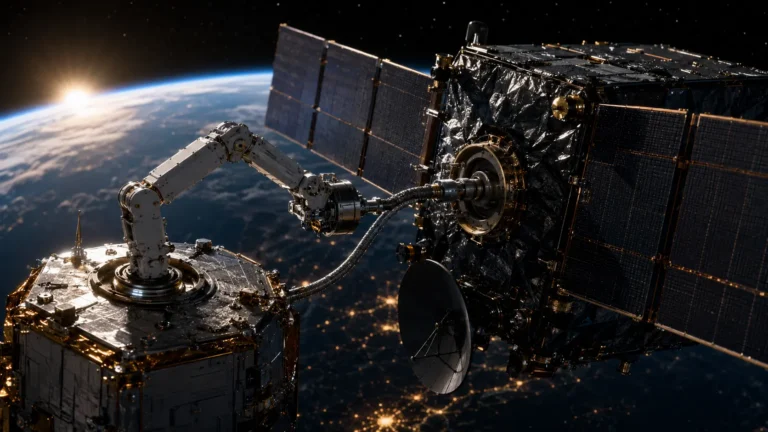
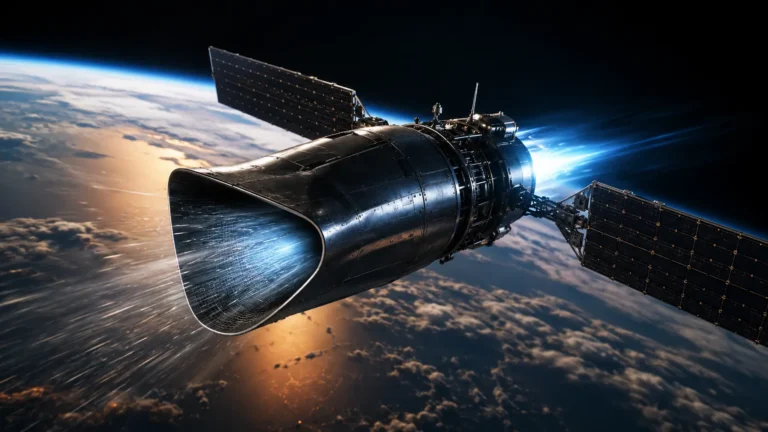
OSRs abandon the energy conversion process entirely. The satellite consists of a central hub attached to telescoping booms that stretch out a massive, ultra-thin membrane of aluminized Kapton (a highly resilient polyimide film). The mirror acts strictly as an optical relay.
4. Technical Depth: Attitude Control and Constellation Flying
To aim the sunlight, the mirror must physically tilt. Using chemical thrusters would quickly deplete the satellite’s fuel. Instead, the satellite uses Control Moment Gyros (CMGs)—spinning flywheels that exchange angular momentum with the spacecraft. By speeding up or slowing down the internal flywheels, the entire mirror smoothly rotates in the vacuum of space to track a specific 10-square-kilometer solar farm on Earth as it flies overhead.
Because a single satellite in Low Earth Orbit (LEO) only remains visible to a ground station for about 10 to 15 minutes, OSRs rely on Constellation Formation Flying. As Mirror A approaches the horizon and loses its angle on the solar farm, Mirror B emerges over the opposite horizon, perfectly timed to take over the illumination.
5. Real-World Consequences: Managing Solar Radiation Pressure
The physical footprint of a space mirror creates a massive aerospace nightmare: Solar Radiation Pressure (SRP). Photons carrying momentum physically push against the mirror.
The force exerted by SRP is defined as:
F_SRP = P_⊙ · A · (1 + η) · cos²(θ)
(Where P_⊙ is the solar radiation pressure constant, A is the area, η is the reflectivity, and θ is the angle of incidence)
Because the mirror has a massive area (A) and very low mass, the SRP acts as a massive solar sail, violently pushing the satellite out of its intended orbit. To counteract this constant drag and maintain the precise constellation formation, OSRs must utilize high specific impulse (I_sp) electric propulsion (ion thrusters) to continuously fire and correct their altitude, or expertly use the SRP itself to perform fuel-less orbital maneuvers.
Commercial Applications of Space Mirrors
The deployment of OSRs represents a hard pivot from academic physics to aggressive commercial aerospace business models.
Dawn/Dusk Power Extension: This is the primary commercial use case. By positioning mirrors in a polar sun-synchronous dawn-to-dusk orbit (approx. 900–1,000 km altitude), operators like Reflect Orbital intend to target existing massive solar arrays during the twilight hours. A single pass delivering ~200 to 500 W/m² of illumination (comparable to overcast daylight) allows terrestrial solar plants to capture high-margin revenue during the evening grid spike, vastly improving the economics of the ground installation.
Arctic and High-Latitude Energy Grids: Regions above the Arctic Circle suffer from extreme energy poverty during the winter months, often experiencing weeks of total darkness. Relying on diesel fuel flown in by helicopter is astronomically expensive. By altering the orbital inclination of an OSR constellation, space mirrors can continuously reflect light over the polar horizon, providing baseline solar generation to off-grid communities and military radar installations that would otherwise freeze.
Disaster Relief and Nighttime Operations: The application of OSRs is not strictly limited to photovoltaics. A mirror capable of illuminating a 10 km radius can be steered to provide literal daylight to emergency responders in the wake of an earthquake or to illuminate massive, 24/7 civil engineering projects, bypassing the massive carbon emissions and logistical friction of deploying hundreds of diesel-powered floodlights.
Economic & Strategic Impact
The core commercial vulnerability of OSRs is the Atmospheric Drag vs. Area-to-Mass Ratio Limit.
If an aerospace company puts a mirror in a high orbit (like Geostationary orbit at 35,000 km), it stays overhead continuously, but the mirror must be absurdly massive (several kilometers wide) to ensure the light beam does not scatter and dilute before reaching Earth.
If they put it in Low Earth Orbit (LEO) at 500 km, the mirror can be smaller and cheaper, but the thin wisp of Earth’s upper atmosphere creates severe aerodynamic drag on the massive, flat surface of the mirror. This drag will rip the satellite out of orbit and burn it up in the atmosphere within months unless it carries heavy fuel tanks to fight the drag. Navigating this economic tightrope—finding the exact orbital altitude that balances launch costs, mirror size, and fuel lifespan—is the definitive filter separating viable space startups from bankruptcies.
Advantages
- Low Orbital Complexity: Unlike Space-Based Solar Power (SBSP), OSRs do not generate electricity, manage extreme thermal loads in space, or require heavy microwave phase arrays. They simply bounce light.
- Utilizes Existing Infrastructure: The multi-billion-dollar solar farms required to capture the energy already exist on Earth. OSR operators only need to launch the space segment to begin generating revenue.
- Decouples Geography from Time: Allows grid operators to purchase “sunlight on demand,” transforming solar energy from a rigid, uncontrollable weather phenomenon into a dispatchable, predictable utility.
Limitations
- Space Debris Risk: A constellation of 50,000 massive mirrors, each the size of a football field, creates a colossal cross-sectional hazard in Low Earth Orbit. If a piece of space junk tears through an aluminized membrane, the resulting debris cloud could threaten the International Space Station and global satellite communications.
- Degradation of Reflectivity: The space environment is highly corrosive. Atomic oxygen, micrometeorite impacts, and ultraviolet radiation blistering will steadily degrade the reflectivity of the Kapton membrane, permanently lowering the efficiency of the mirror over its 5-to-10-year lifespan.
- Light Pollution: Astronomers heavily protest OSRs. Bouncing massive pillars of sunlight into the night sky severely disrupts deep-space optical telescopes and alters the natural nocturnal environment, sparking fierce regulatory battles regarding the commercial “ownership” of the night sky.
Common Misconceptions
Misconception: The mirror will burn ants on the ground like a magnifying glass.
Reality: The mirrors are perfectly flat, not convex. They do not concentrate or focus the light into a lethal death ray. The light reaching the ground is widely dispersed and cannot physically exceed the natural intensity of the sun at high noon; it generally resembles a cloudy day or bright moonlight.
Misconception: Orbiting Solar Reflectors are the same as Space-Based Solar Power (SBSP).
Reality: They are structurally opposite. SBSP generates electricity in space using heavy solar panels and beams it down via invisible microwaves to a special antenna. OSRs have no solar panels; they just bounce raw visual sunlight down to standard solar panels already sitting on the ground.
Misconception: The mirrors sit stationary above the solar farm.
Reality: In LEO, satellites must travel at roughly 17,500 mph to stay in orbit. A mirror only flies over a specific farm for about 10 to 15 minutes before zooming over the horizon. Continuous power requires a “constellation” of hundreds of mirrors flying in a continuous train.
What Most People Miss
The strategic loophole of Jurisdictional Regulation.
When a utility builds a power plant on Earth, it takes a decade to secure environmental impact reports, land rights, and municipal zoning permits.
What most energy investors miss is that space is largely unregulated regarding optical illumination. In 2026, when the U.S. Federal Communications Commission (FCC) granted Reflect Orbital its authorization, it explicitly noted that the effects of the mirror on optical astronomy and nocturnal ecosystems fell outside its regulatory jurisdiction, as the FCC primarily regulates radio frequencies, not light. This massive regulatory vacuum allows aerospace companies to rapidly deploy infrastructure capable of physically altering the environment of sovereign nations without passing through traditional terrestrial energy regulators.
Comparison Table
| Feature | Terrestrial Solar + Batteries | Space-Based Solar Power (SBSP) | Orbiting Solar Reflectors (OSRs) |
| Energy Source | Ground-based sunlight | Space-based sunlight | Space-based sunlight |
| Transmission Method | Ground transmission lines | Microwave/Laser beams | Reflected Photons (Visual Light) |
| Orbital Hardware Required | None | Massive PV arrays + Transmitters | Lightweight Polyimide Membranes |
| Ground Hardware Required | Massive Lithium-ion battery banks | Highly specialized Rectennas | Standard, existing Solar Farms |
| Technological Readiness | Commercially Mature | Decades away (Prohibitive CapEx) | Near-Term (Prototypes in 2026) |
Case Study
Situation: The global push to decarbonize grid infrastructure resulted in massive overbuilds of terrestrial solar capacity. However, regions heavily dependent on solar faced the severe limitations of the “duck curve.” As the sun set, energy generation collapsed exactly when evening demand spiked, forcing utilities to burn high-priced, highly polluting natural gas to bridge the gap.
Challenge: Implementing utility-scale lithium-ion battery storage to capture midday solar for evening use was financially devastating, nearly doubling the Levelized Cost of Energy (LCOE) for the solar installations.
Solution (The OSR Pivot): Aerospace startups, most notably Reflect Orbital, proposed a paradigm shift. Rather than storing the energy chemically on Earth, they proposed altering the celestial geometry. Founded by ex-SpaceX and Zipline engineers, the company engineered deployable, 50-meter-wide aluminized mirrors designed to ride-share on SpaceX Falcon 9 launches.
Outcome: In early testing, Reflect Orbital demonstrated the capacity to deliver over 500 W/m² of illumination to targeted ground sensors. By successfully securing FCC licensing for their Eärendil-1 demonstration satellite in mid-2026, they validated the regulatory and launch pathways. Their economic models demonstrated that bouncing just 30 minutes of extra sunlight onto a massive terrestrial solar farm during peak evening pricing hours could radically alter the farm’s profitability.
Lessons Learned: The initiative proved that solving the terrestrial energy crisis does not strictly require better chemical batteries; it can be solved through orbital mechanics. By utilizing the collapsing cost of launch access, the aerospace sector is successfully transforming itself into an active, dispatchable utility provider for the terrestrial power grid.
Future Outlook
Next 12–24 Months
The era of Orbital Prototyping and Regulatory Backlash. Between 2026 and 2028, the first dedicated OSR demonstration satellites (like Reflect Orbital’s Eärendil-1) will deploy. We will see the first commercial tests of robotic CMG targeting, verifying if a membrane mirror can hold a stable target on the ground while flying at Mach 22. Simultaneously, as the first artificial sunbeams hit the Earth, astronomical societies and environmental groups will launch massive international lawsuits, forcing the United Nations to frantically debate the first-ever treaties regarding the commercial weaponization and ownership of nighttime skies.
Next 3–5 Years
The scaling of Dawn-Dusk Constellations. By the end of the decade, the technology will graduate from single demonstration mirrors to functioning commercial constellations. Operators will deploy localized trains of 30 to 50 mirrors into 1,000 km polar Sun-Synchronous Orbits. These early constellations will execute “Sunlight as a Service” contracts, actively bidding to illuminate specific megawatt-scale solar farms in Australia, Texas, and the Middle East precisely during the high-margin 6:00 PM to 8:00 PM grid demand spike.
Next 10 Years
The Automated Solar Sail Megastructures. By the mid-2030s, maintaining the orbit of tens of thousands of mirrors using chemical or electric thrusters will prove too expensive. The industry will transition to fully automated Solar Sailing. Algorithms will perfectly angle the mirrors to “tack” against the solar radiation pressure, using the sun’s photons not just to illuminate the Earth, but to physically push and propel the satellites, entirely eliminating the need for onboard propellant and extending the constellation’s lifespan indefinitely.
Most Likely Scenario
Orbiting Solar Reflectors will establish a highly lucrative, niche dominance over the energy market. While they face severe regulatory and light-pollution pushback, the simple physics of bouncing photons is vastly cheaper and technologically closer than microwave-beaming Space-Based Solar Power. As launch costs approach zero, the sky will inevitably become a commercially managed optical network.
Key Takeaways
- Orbiting Solar Reflectors (OSRs) are massive, lightweight space mirrors that bounce sunlight onto dark terrestrial solar farms, generating electricity when the sun has naturally set.
- They solve the “duck curve” energy crisis, allowing solar farms to produce power during peak evening demand without relying on expensive, heavy lithium-ion batteries.
- Unlike Space-Based Solar Power (SBSP), OSRs do not generate electricity in space or use microwaves; they simply redirect visual light to existing solar panels on Earth.
- Because the mirrors are massive and lightweight, they act as solar sails. They must constantly fight Solar Radiation Pressure (SRP) and atmospheric drag to avoid being pushed out of orbit.
- To aim the reflected light accurately while moving at 17,500 mph, OSRs use internal spinning flywheels (Control Moment Gyros) to silently tilt the mirror in the vacuum of space.
- The technology faces intense backlash from astronomers and environmentalists due to the potential creation of massive light pollution and space debris hazards in Low Earth Orbit.
Glossary
Control Moment Gyro (CMG): A heavy, spinning flywheel inside a spacecraft. By changing the speed or angle of the flywheel, the spacecraft physically rotates in the opposite direction without using any rocket fuel.
Duck Curve: A graph showing the severe mismatch in the energy grid where solar power generation drops to zero exactly when human electricity demand spikes at dusk.
Levelized Cost of Energy (LCOE): A metric used to compare the overall lifetime cost of building and operating a power plant against the total amount of energy it produces.
Polyimide Film (Kapton): An advanced, lightweight polymer material that remains stable across extreme temperature changes. When coated in a thin layer of aluminum, it acts as the primary mirror surface for OSRs.
Solar Radiation Pressure (SRP): The physical force exerted by photons (light) hitting an object. In space, this pressure acts as a constant wind that can physically push large mirrors out of their intended orbit.
Sun-Synchronous Orbit (SSO): A specific polar orbit where the satellite passes over any given point of the planet’s surface at the exact same local solar time, ensuring consistent lighting conditions for the mirrors.
Frequently Asked Questions
Will these mirrors blind airplane pilots or cause fires?
No. Because the mirrors are located hundreds of kilometers away in space, the light disperses significantly before hitting Earth. At maximum intensity, the beam hitting the ground is comparable to an overcast day or extremely bright moonlight. It cannot physically focus light tight enough to burn anything.
Why don’t they just put the mirrors higher up so they don’t have to fly so fast?
If you put a mirror in Geostationary Orbit (35,000 km high) where it stays perfectly still over one spot, the mirror would have to be several kilometers wide just to bounce a cohesive beam of light back to Earth. The launch cost for a mirror that massive is currently economically impossible.
If the mirror gets hit by a meteor, does it shatter like glass?
No. OSRs are not made of glass. They are made of an ultra-thin, flexible plastic-like membrane (polyimide) coated in a microscopic layer of aluminum. If a micro-meteorite hits it, it simply punches a tiny hole straight through the plastic, and the rest of the mirror continues functioning normally.
Does this mean the night sky will be constantly bright?
If deployed at the scale of 50,000 satellites, it would significantly alter the night sky. While the beam is targeted at a specific solar farm, the light scattering through the atmosphere and the reflection of the satellite itself as it flies overhead would create significant light pollution, severely impacting ground-based astronomy.
Who is actually paying to launch these?
Currently, aerospace startups (backed by venture capital firms like Sequoia and Lux Capital) are funding the demonstration missions. In the future, the revenue will come directly from large terrestrial utility companies paying subscription fees to have their solar arrays illuminated at night.
Sources
[1] University of Glasgow: SOLSPACE Project: Orbiting Solar Reflectors for Terrestrial Solar Power Enhancement (2024/2026 Updates)
[2] New Atlas: Orbital reflectors could boost solar energy around dusk and dawn (January 2024)
[3] ResearchGate: End-of-Life Considerations for Orbital Solar Reflectors and Solar Radiation Pressure Dynamics (2025 Analysis)
[4] Dezeen / European Southern Observatory: US approves deployment of giant space mirror to illuminate Earth after dark (July 2026)
[5] Reflect Orbital Inc.: Eärendil-1 FCC Authorization and Dawn-Dusk Constellation Architecture (2026 Press Filings)