Advertisement
)
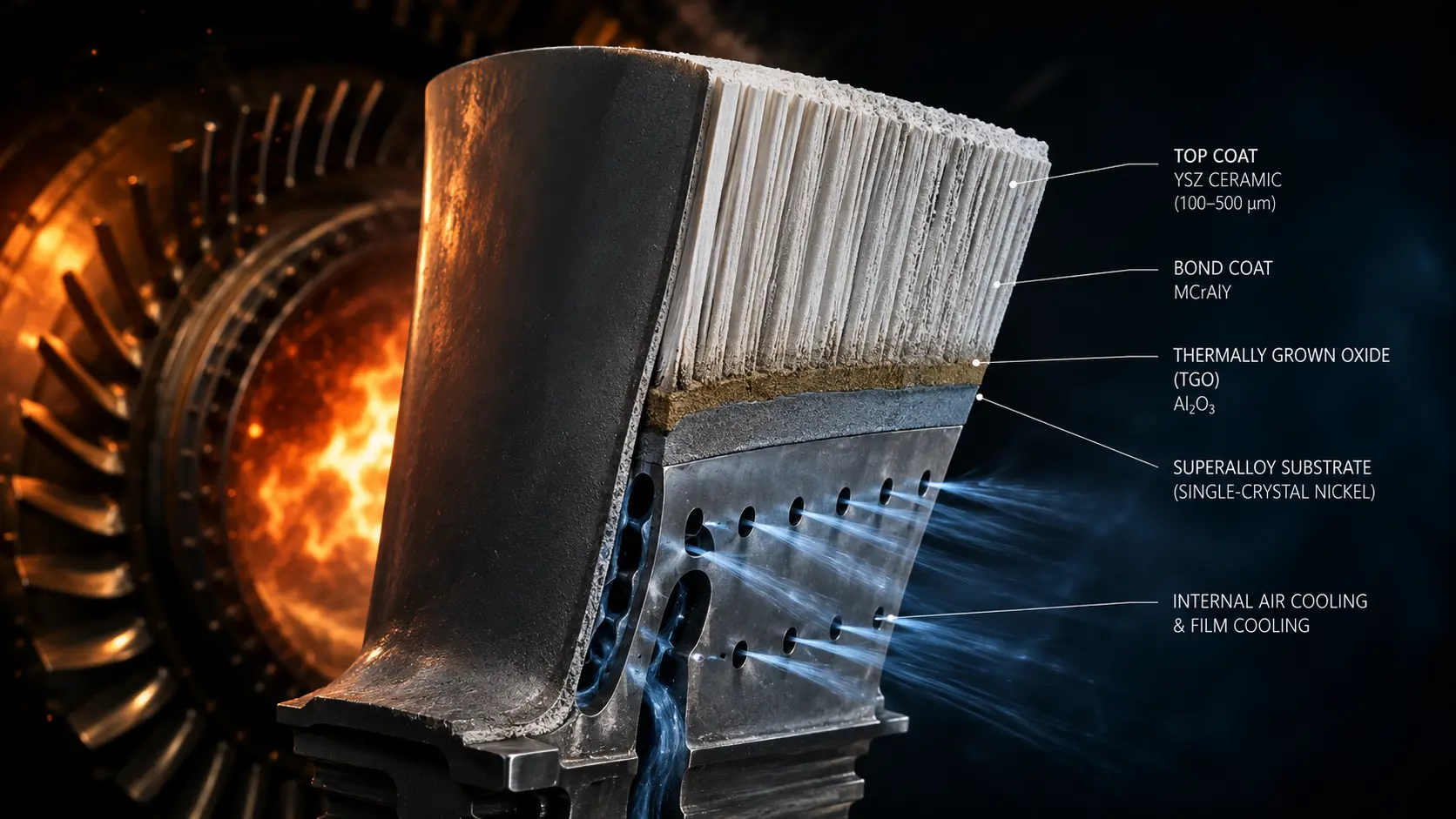

The core of a modern jet engine operates in a state of physical impossibility. To extract the maximum amount of thrust and fuel efficiency required to fly a 300-ton airliner across the Pacific Ocean, the engine must burn jet fuel at temperatures approaching 1,600°C. This creates a catastrophic engineering paradox: the absolute best aerospace metals humanity has ever forged—single-crystal nickel superalloys—begin to physically melt at roughly 1,300°C. If you put a naked turbine blade into a modern jet engine and apply full thrust, the blade will instantly liquefy, and the engine will explode.
Yet, thousands of commercial flights take off every hour. To solve this thermodynamic crisis, materials scientists do not make better metal; they paint the metal with a microscopic shield of rock. Why should you care right now? Because as global airlines and militaries push for faster, vastly more fuel-efficient engines, the limiting factor is no longer aerodynamics—it is heat. The entire future of the $900 billion aerospace industry relies on Thermal Barrier Coatings (TBCs). By mastering the ability to bond heat-rejecting ceramics directly to violently spinning titanium and nickel, engineers have achieved a metallurgical miracle that keeps global aviation safely in the sky.
What are Thermal Barrier Coatings (TBCs)?
Thermal Barrier Coatings (TBCs) are highly advanced ceramic layers applied to the metallic surfaces of gas turbine engines. Measuring only a fraction of a millimeter thick, these insulating coatings create a massive temperature drop, allowing the underlying metal components to operate in environments far above their natural melting points.
At a Glance
- Concept: Applying an ultra-thin layer of ceramic (which does not conduct heat well) over engine parts to shield them from the incinerating heat of the combustion chamber.
- Why it matters: Higher engine temperatures equal higher fuel efficiency. TBCs allow engines to run hundreds of degrees hotter, saving airlines billions of dollars in jet fuel and drastically reducing carbon emissions.
- Who uses it: Jet engine manufacturers (GE Aerospace, Rolls-Royce, Pratt & Whitney) and massive terrestrial power grid companies operating gas turbines (Siemens, Mitsubishi).
- Biggest takeaway: A TBC is not a single layer; it is a complex, multi-layered system. If the ceramic coating simply cracked when the metal underneath expanded from the heat, the engine would fail. The true engineering genius is how the ceramic is bonded to the metal so it can stretch without shattering.
In Simple Words
Imagine taking an ice cube and blasting it with a blowtorch. It will melt instantly.
Now, imagine taking that same ice cube, wrapping it in a thick winter coat, and blasting it with the blowtorch again. The winter coat doesn’t stop the heat completely, but it slows the heat down so much that the ice cube survives significantly longer.
A Thermal Barrier Coating (TBC) is that winter coat for a jet engine.
The engine’s metal blades are the ice cube. The burning jet fuel is the blowtorch. Engineers spray a microscopic layer of specialized ceramic (a material similar to pottery or coffee mugs, which doesn’t transfer heat easily) directly onto the metal blades. Even though the ceramic layer is roughly the thickness of a few sheets of paper, it creates an extreme thermal drop. By the time the 1,600°C heat from the fire passes through the ceramic coat, it has dropped to a safe 1,200°C, ensuring the metal blade underneath stays solid while spinning at 10,000 revolutions per minute.
Why This Matters
For Aerospace Engineers and Supply Chain Executives, TBCs dictate the economic lifecycle of a jet engine.
Jet engines are sold on a “power-by-the-hour” model. Airlines do not just buy an engine; they pay the manufacturer for every hour the engine operates flawlessly. If a TBC flakes off (spalls) prematurely, the exposed metal blade degrades rapidly due to oxidation and thermal fatigue, forcing the airplane into an unscheduled, multi-million-dollar maintenance overhaul. The exact chemical composition of these coatings—and their ability to resist runway dust and volcanic ash—is the most heavily guarded intellectual property in the aerospace sector, directly defining the profitability of global engine service contracts.
The Thermodynamic Physics of Thermal Barrier Coatings
The evolution of TBCs is a continuous race against the laws of thermodynamics.
In the 1970s, TBCs were primarily used to extend the life of parts. Today, TBCs are structurally required just to start the engine. Modern engines are utterly dependent on the “thermal gradient”—the 200°C to 300°C temperature drop provided by the coating.
This reliance creates immense systemic risk. If a modern TBC fails during mid-flight, the cooling systems cannot compensate fast enough, leading to rapid, catastrophic engine failure. Therefore, the application of TBCs has shifted from simple plasma spraying to atomic-level vapor deposition in vacuum chambers, representing one of the most sophisticated, high-precision manufacturing processes on the planet.
How Thermal Barrier Coatings Protect Jet Engines
Bonding brittle ceramic to rapidly expanding metal requires a sophisticated, multi-layered architectural approach. Here is the first-principles breakdown of a TBC system.
1. The Fundamental Problem: Thermal Expansion Mismatch
When metal heats up, it expands significantly. When ceramic heats up, it expands very little. If you simply paint a rigid ceramic layer onto a metal jet engine blade, the moment the engine fires up, the metal will swell, and the ceramic will instantly crack and shatter off the blade like eggshells.
2. The Insufficiency of Single-Layer Solutions
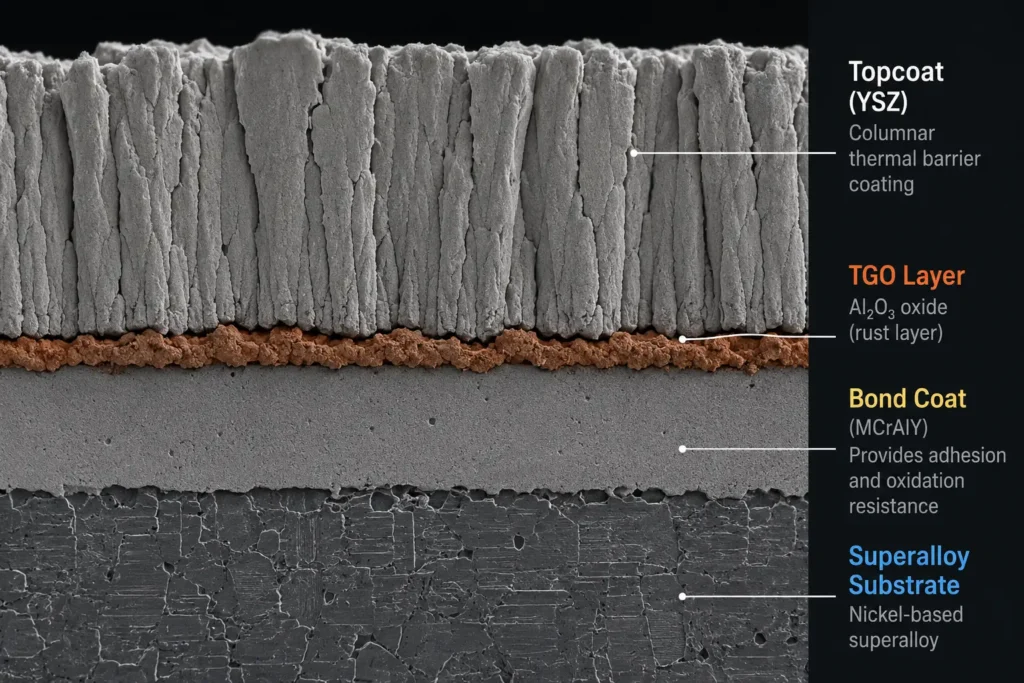
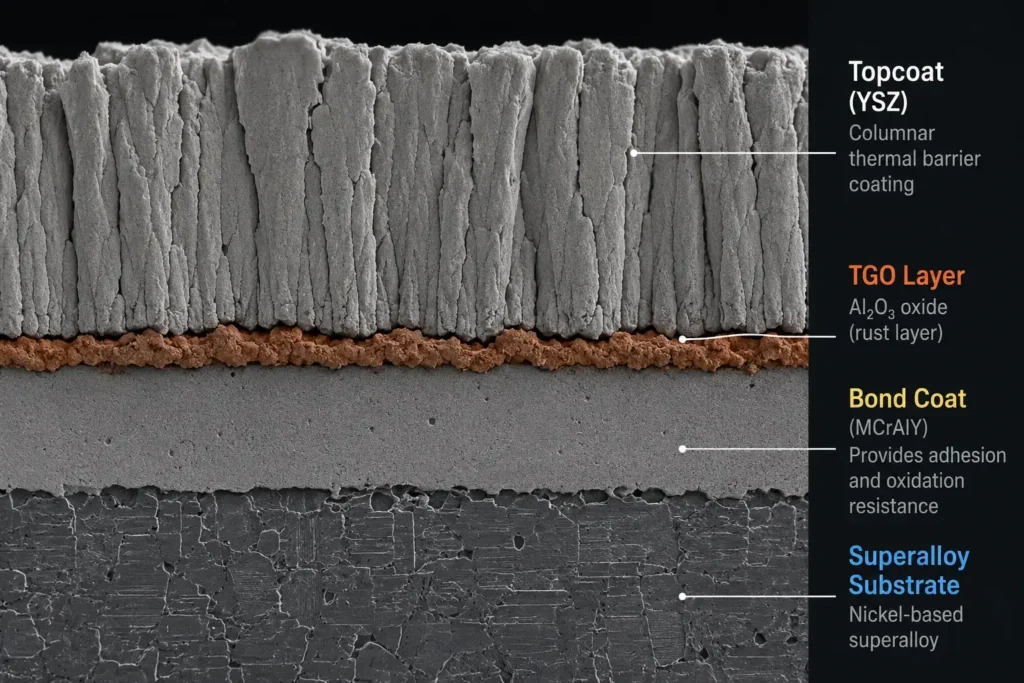
To fix this, engineers cannot use a single material. They must create a graded transition zone that acts as a shock absorber between the volatile metal substrate (the single-crystal nickel superalloy) and the rigid ceramic topcoat.
3. The Core Mechanism: The Bond Coat and the TGO
Engineers apply a metallic “Bond Coat” (usually an MCrAlY alloy—Metal, Chromium, Aluminum, Yttrium) directly to the blade.
As the engine runs and reaches extreme heat, the aluminum in this bond coat intentionally reacts with oxygen to form a microscopic, protective rust layer called the Thermally Grown Oxide (TGO), composed of pure alpha-alumina (α-Al2O3). The TGO is the “glue.” It adheres incredibly well to both the metal below it and the ceramic above it, acting as the ultimate chemical anchor.
4. Technical Depth: YSZ and EB-PVD
The topcoat—the actual thermal barrier—is made of Yttria-Stabilized Zirconia (YSZ). YSZ has one of the lowest thermal conductivities of any known material.
To prevent the YSZ from shattering when the metal expands, it is applied using Electron-Beam Physical Vapor Deposition (EB-PVD). In a vacuum chamber, an electron beam vaporizes a solid block of YSZ. The ceramic vapor condenses onto the rotating engine blade, growing upward in microscopic, individual columns (like the bristles of a toothbrush). Because the ceramic is composed of millions of independent columns with microscopic gaps between them, the metal blade can expand and bend freely, and the ceramic “bristles” simply spread apart without cracking the overall coating.
5. Real-World Consequences: Active Film Cooling
The TBC does not work alone. While the ceramic blocks the heat from the outside, the engine simultaneously pumps cold air from the compressor directly through hollow channels inside the metal blade. This cold air bleeds out of tiny laser-drilled holes on the surface of the blade, creating a thin film of cold air over the ceramic. The combination of the TBC and internal air cooling allows the engine to survive environments 300°C above its physical melting point.
Commercial Applications of TBCs in Aerospace
TBCs are strictly reserved for the most extreme, high-stress environments in industrial engineering.
Commercial and Military Aviation: The high-pressure turbine (HPT) blades located immediately behind the combustion chamber of a jet engine experience the highest heat and centrifugal forces. Every single HPT blade in modern engines (such as the GE9X on the Boeing 777X or the F135 engine on the F-35 fighter jet) is coated in advanced TBCs. This allows the engines to achieve massive thrust-to-weight ratios and high bypass efficiencies that define modern air travel.
Utility-Scale Power Generation: Massive terrestrial gas turbines used to generate city-wide electricity operate continuously for tens of thousands of hours. Applying thicker, highly durable TBCs (often via Air Plasma Spray) to the stationary stators and rotating blades of these massive turbines drastically reduces the amount of parasitic cooling air required from the compressor, increasing the total megawatt output and electrical efficiency of the power plant.
High-Performance Motorsports: In Formula 1 and advanced endurance racing, exhaust headers and turbocharger housings are frequently coated with specialized ceramic thermal barriers. This keeps the exhaust gas temperatures exceptionally high (improving turbo spooling efficiency) while protecting the surrounding carbon-fiber chassis and sensitive electronic wiring from melting due to radiant heat.
Economic & Strategic Impact
The primary operational constraint on global aviation fleets is TBC Spallation due to CMAS Attack.
CMAS stands for Calcium-Magnesium-Alumino-Silicate—the exact chemical composition of desert sand, runway dust, and volcanic ash. When an airplane flies through a dusty environment (like the Middle East), the engine ingests this dust. The 1,500°C heat of the engine instantly melts the sand into a liquid glass.
This liquid glass coats the turbine blades, seeps into the microscopic gaps between the ceramic EB-PVD columns, and solidifies as the engine cools down upon landing. When the glass hardens, the flexible “toothbrush bristles” of the ceramic are suddenly glued together. The next time the engine heats up and the metal expands, the ceramic is no longer flexible; it violently rips off the blade (spallation), exposing the bare metal. Mitigating CMAS degradation is the single most expensive ongoing maintenance variable for commercial airlines operating in arid regions.
Advantages
- Extreme Thermodynamic Efficiency: Allows combustion temperatures to significantly exceed the melting point of the engine hardware, vastly improving fuel burn efficiency.
- Component Lifespan Extension: By reducing the base temperature of the metal by up to 300°C, the coating drastically slows down metal creep, oxidation, and thermal fatigue, keeping engines in the air longer between teardowns.
- Reduced Cooling Penalties: Without a TBC, the engine would have to bleed massive amounts of compressed air to cool the blades. TBCs reduce the need for this cooling air, directing more air toward generating actual thrust.
Limitations
- Susceptibility to CMAS: Liquid sand/glass infiltration destroys the strain tolerance of the coating, leading to rapid, catastrophic failure of the thermal barrier in dusty environments.
- High Temperature Sintering: At temperatures above 1,200°C, the standard YSZ ceramic material begins to “sinter” (the microscopic columns fuse together on their own). This destroys the flexibility of the coating, causing it to crack and flake off.
- Thermally Grown Oxide (TGO) Failure: While the TGO “rust” layer is necessary for bonding, it grows thicker over thousands of hours of engine operation. Eventually, the TGO becomes too thick, generates massive internal stress, and physically pushes the ceramic topcoat off the blade.
Common Misconceptions
Misconception: The ceramic coating completely stops heat from reaching the metal.
Reality: TBCs are thermal barriers, not thermal blockers. They merely slow down the transfer of heat. If an engine blade lacked internal air cooling, the heat would eventually soak entirely through the ceramic, and the metal blade would still melt. The TBC only works because internal air cooling constantly pulls the heat away from the back of the metal.
Misconception: TBCs are painted on with a brush or standard industrial sprayer.
Reality: While some thick terrestrial coatings are plasma sprayed, aerospace TBCs require vaporizing a solid block of ceramic with an electron beam in a high-vacuum chamber, allowing the ceramic to build up atom by atom. It is a slow, intensely complex, and highly expensive metallurgical process.
Misconception: More ceramic coating makes the engine infinitely safer.
Reality: You cannot simply spray a thicker layer of ceramic. If the coating is too thick, the centrifugal force of the spinning blade (which experiences thousands of Gs of force) will literally rip the heavy ceramic off the metal substrate. The thickness is a delicate mathematical balance between insulation and weight.
What Most People Miss
The transition to Rare-Earth Zirconate Sacrificial Layers.
As manufacturers push engine temperatures beyond 1,500°C, the standard YSZ ceramic is reaching its absolute chemical limit. What most observers miss is the massive R&D shift toward rare-earth zirconates, specifically Gadolinium Zirconate (Gd2Zr2O7).
Gadolinium Zirconate has an incredibly unique property: when molten CMAS (liquid sand) hits it, the ceramic chemically reacts with the glass to instantly crystallize it. Instead of the liquid sand seeping deep into the microscopic columns, it is frozen instantly on the surface, creating a protective scab. While this sacrifices a tiny layer of the coating, it permanently halts the CMAS infiltration, drastically extending the life of the engine in hostile, dusty environments.
Comparison Table
| Feature | Naked Superalloy | Air Plasma Spray (APS) TBC | Electron-Beam PVD (EB-PVD) TBC |
| Microstructure | Dense Metal | Splat/Porous structure | Columnar (Bristle-like) |
| Max Temperature | ~1,300°C | Insulates well, poor strain tolerance | Exceptional strain tolerance in extreme heat |
| Primary Application | Low-heat components | Stationary components (Combustors) | High-stress rotating components (Turbine Blades) |
| Application Cost | Baseline | Moderate | Extremely High (Vacuum required) |
| CMAS Vulnerability | High (Rapid Oxidation) | High (Penetrates pores) | Extreme (Penetrates columns, causes spallation) |
Case Study
Situation: During the 2010s, commercial airlines operating heavily in the Middle East and North Africa (MENA) noticed a severe discrepancy in their engine lifecycles. High-pressure turbine blades that normally lasted 15,000 flight hours in European airspace were rapidly failing after only 3,000 hours in the Middle East.
Challenge: The engines were ingesting high volumes of microscopic desert dust containing calcium, magnesium, aluminum, and silicon. The extreme heat of the combustion chamber melted this dust into liquid glass (CMAS), which infiltrated the YSZ thermal barrier coatings. Upon cooling, the glass hardened, destroying the coating’s flexibility and causing massive spallation, leaving the underlying nickel superalloy exposed to incinerating temperatures.
Solution (The CMAS-Resistant Evolution): Engine manufacturers like Rolls-Royce and GE Aerospace accelerated the deployment of advanced, multi-layered TBC architectures. Instead of relying solely on YSZ, they applied outer layers of advanced rare-earth zirconates capable of reacting with the molten CMAS.
Outcome: When the new engines ingested dust, the advanced topcoat chemically reacted with the molten silicate, instantly crystallizing the melt and preventing it from penetrating the deeper columnar structure of the EB-PVD coating.
Lessons Learned: The crisis proved that thermal protection is heavily dependent on geographic environment. It forced the aerospace industry to view TBCs not just as static thermal insulators, but as highly active chemical defense systems designed to combat airborne geological threats in real-time.
Future Outlook
Next 12–24 Months
The era of Multi-Layered Architectures. The industry is shifting away from single-material YSZ coatings. Over the next two years, standard production engines will increasingly feature complex, dual-layer systems. An inner layer of highly robust, traditional YSZ will provide mechanical toughness and crack resistance, covered by a thinner outer layer of rare-earth zirconates (like Gadolinium or Yttrium-rich compounds) to provide lower thermal conductivity and aggressive chemical resistance to CMAS infiltration.
Next 3–5 Years
The optimization of Suspension Plasma Spraying (SPS). While EB-PVD produces the best columnar structure for rotating blades, it requires an incredibly expensive vacuum chamber. Suspension Plasma Spraying is emerging as a disruptive alternative. By suspending microscopic ceramic nanoparticles in a liquid alcohol or water solution and injecting it directly into a plasma jet, SPS can create the coveted columnar “bristle” structure without the need for a vacuum chamber, potentially drastically lowering the manufacturing cost of high-end turbine blades.
Next 10 Years
The Ceramic Matrix Composite (CMC) Transition. By the mid-2030s, the reliance on nickel superalloys will begin to fade. Manufacturers are heavily investing in Ceramic Matrix Composites (CMCs)—engine blades made entirely out of silicon carbide ceramic fibers. Because CMCs can naturally withstand 1,300°C+ without heavy air cooling and weigh a fraction of nickel, they represent the next leap in engine design. However, CMCs degrade violently when exposed to high-pressure steam in the engine exhaust, meaning they will still require a specialized variation of TBCs (known as Environmental Barrier Coatings, or EBCs) to survive.
Most Likely Scenario
Thermal Barrier Coatings will remain the invisible, non-negotiable bottleneck of global aviation. As aerospace engineers push thermodynamic limits to extract the last single-digit efficiency gains from the jet engine, the reliance on these microscopic, vapor-deposited ceramic layers will only intensify, making advanced materials science the ultimate decider of aviation dominance.
Key Takeaways
- Thermal Barrier Coatings (TBCs) are microscopic ceramic layers applied to jet engine blades, creating a 200°C to 300°C temperature drop to prevent the metal from melting.
- Jet engines run at 1,500°C+, but the nickel superalloys they are made of melt at 1,300°C. TBCs and internal air cooling are physically mandatory for the engine to survive.
- The primary material used is Yttria-Stabilized Zirconia (YSZ), applied via Electron-Beam Physical Vapor Deposition (EB-PVD) to create a flexible, bristle-like structure that won’t crack when the metal expands.
- The coating is glued to the metal by a microscopic “rust” layer called the Thermally Grown Oxide (TGO), which acts as a chemical anchor.
- The biggest threat to TBCs is CMAS (airborne sand/dust) that melts into glass inside the engine, seeps into the ceramic, and violently rips the coating off when it cools and hardens.
- The future of aerospace relies on applying rare-earth chemical topcoats to crystallize and block CMAS, and eventually transitioning from metal blades to pure Ceramic Matrix Composites (CMCs).
Glossary
CMAS (Calcium-Magnesium-Alumino-Silicate): Airborne debris (sand, dust, volcanic ash) that melts into liquid glass inside a jet engine, penetrating and violently destroying thermal barrier coatings.
Electron-Beam Physical Vapor Deposition (EB-PVD): A high-vacuum manufacturing process that vaporizes ceramic blocks with an electron beam, allowing the vapor to condense on engine blades in a flexible, columnar structure.
Spallation: The catastrophic failure of a coating where the ceramic layer physically flakes, cracks, or rips off the underlying metal substrate, exposing the blade to melting temperatures.
Superalloy: A high-performance metal alloy (usually nickel-based in aerospace) that exhibits excellent mechanical strength, resistance to thermal creep deformation, and surface stability at extreme temperatures.
Thermally Grown Oxide (TGO): A microscopic layer of aluminum oxide (rust) that naturally forms between the metal blade and the ceramic coating, acting as the critical chemical glue holding the system together.
Yttria-Stabilized Zirconia (YSZ): The industry-standard ceramic material for TBCs, prized for its exceptionally low thermal conductivity and stable crystal structure at high temperatures.
Frequently Asked Questions
Why not just make the entire engine blade out of ceramic?
Traditional ceramics are incredibly brittle (like a coffee mug). If a bird or a piece of ice hit a pure ceramic blade spinning at 10,000 RPM, it would shatter instantly, destroying the engine. Metals bend and dent without shattering, providing the necessary mechanical toughness.
How thick is the ceramic coating?
It is incredibly thin, typically ranging between 100 and 500 micrometers (roughly the thickness of a few sheets of paper or a thick human hair).
What happens if the coating falls off mid-flight?
If a piece of the TBC spalls off, the localized area of the metal blade will begin to overheat rapidly. However, the internal cold air bleeding out of the blade’s hollow cooling channels provides a secondary layer of defense, usually preventing instantaneous melting but requiring immediate maintenance upon landing.
Do car engines use TBCs?
Standard passenger cars do not get hot enough to require true aerospace-grade TBCs. However, high-performance motorsports, heavily modified turbocharged cars, and heavy-duty diesel engines frequently use ceramic coatings on pistons and exhaust headers to manage heat and improve efficiency.
How do they know when the coating is wearing out?
Airlines use advanced borescope inspections (inserting a tiny camera into the engine) during routine maintenance. Additionally, modern engines have sensors monitoring the exhaust gas temperatures and vibration signatures; a significant shift can indicate that the thermal efficiency is degrading and a blade may be losing its coating.
Sources
[1] Materials Science and Engineering: A: Thermal barrier coatings for gas-turbine engine applications
[2] Journal of the European Ceramic Society: Failure mechanisms of thermal barrier coatings
[3] Surface and Coatings Technology: CMAS degradation of thermal barrier coatings: A review
[4] NASA Technical Reports Server (NTRS): Evolution of Thermal Barrier Coatings in Aerospace Applications
[5] Progress in Materials Science: Advanced rare-earth zirconate ceramics for thermal barrier coatings