Advertisement
)

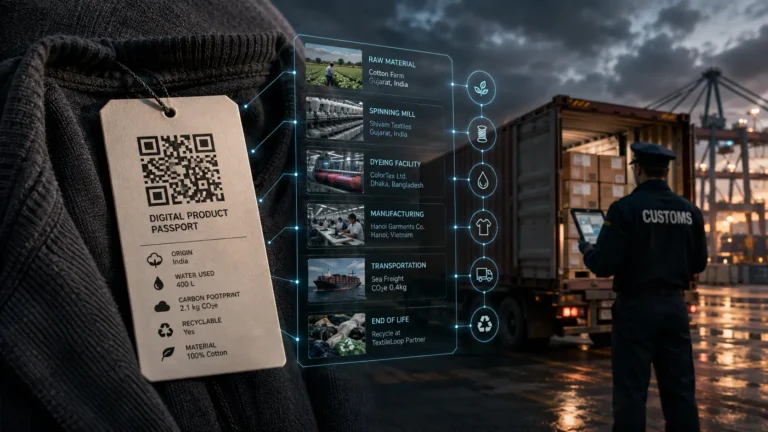
For decades, international trade operated on an honor system written on paper. If a massive apparel brand bought a shipment of cotton t-shirts from a factory in Vietnam, they relied on a piece of paper—a Certificate of Origin—to prove the cotton wasn’t harvested using forced labor. The fundamental flaw in global logistics is that paper is effortlessly easy to fake. Bad actors routinely harvest cotton in prohibited regions, ship it across borders, launder it through intermediary textile mills, and print fraudulent documents claiming the cotton grew somewhere else. Customs agents were paralyzed; they could read the fake manifest, but they couldn’t interview the t-shirt to find out where it was actually born.
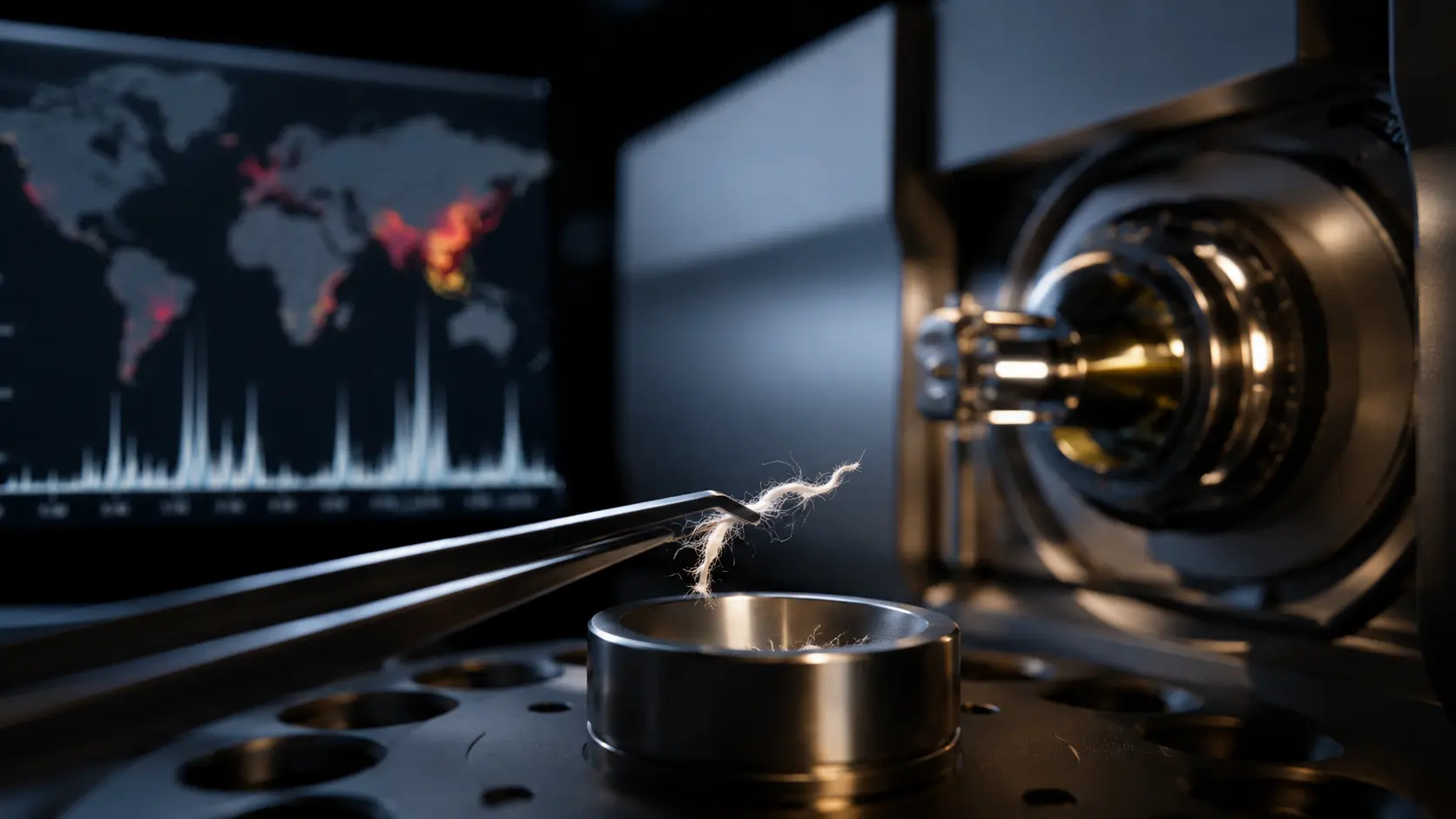
Why should you care right now? Because the era of paper compliance is dead. Empowered by the sweeping legal mandate of the Uyghur Forced Labor Prevention Act (UFLPA), the United States government has abandoned paperwork in favor of physical chemistry. Customs agents are now extracting microscopic threads from imported clothing and running them through mass spectrometers. This technology, known as Isotopic Tracing, proves that the soil and rainfall of the exact farm where a cotton plant grew leaves a permanent, unbreakable chemical barcode locked inside the plant’s cells. You can fake a shipping manifest, but you cannot fake dirt. By weaponizing forensic science against fast fashion, governments are permanently destroying the loopholes of global transshipment and holding multi-billion-dollar supply chains accountable to the atomic level.
What is Isotopic Supply Chain Tracing?
Isotopic Supply Chain Tracing is a forensic methodology that analyzes the ratio of stable isotopes (such as carbon, oxygen, and hydrogen) within a physical product. Because these ratios uniquely reflect the local climate, water, and soil where the raw material grew, they create a permanent geographical fingerprint used to verify the product’s true origin.
At a Glance
- Concept: Testing the physical chemistry of a product (like a cotton shirt) to prove exactly where on Earth it was grown, effectively bypassing any fake shipping paperwork.
- Why it matters: The U.S. has banned all products originating from the Xinjiang region of China due to forced labor concerns. Bad actors try to sneak this cotton into the U.S. by claiming it comes from Vietnam or India. Isotopic testing catches the lie.
- Who uses it: U.S. Customs and Border Protection (CBP), forensic testing laboratories (like Oritain and Applied DNA Sciences), and ESG auditors at massive global retail brands.
- Biggest takeaway: The environment permanently alters the plant. The specific ratio of heavy-to-light oxygen in a rainstorm in China is physically different than a rainstorm in Texas. That specific rain gets locked inside the cotton fiber forever and cannot be washed out in the factory.
In Simple Words
Imagine you have two identical apples. One grew in a rainy valley in Washington State, and the other grew in a high, dry desert in Chile.
If someone swaps the price tags on the apples, you wouldn’t know the difference just by looking at them.
However, the rain in Washington and the rain in Chile have slightly different weights at a microscopic, atomic level. As the apple tree drinks the water, that specific, weighted water gets permanently locked into the apple’s cells.
Isotopic Tracing is like taking a tiny bite of the apple, putting it in a high-tech oven, and analyzing the weight of the water inside. The machine instantly tells you, “This apple drank high-desert Chilean water.” It doesn’t matter what the fake price tag says; the physical chemistry of the apple proves exactly where it was born. Governments use this exact same logic on the cotton in t-shirts to prove whether it was grown legally or harvested using forced labor.
Why This Matters
For Supply Chain Executives, Trade Lawyers, and ESG Auditors, the weaponization of isotopic testing introduces Strict Liability to Procurement.
Historically, a brand could claim plausible deniability. If a supplier provided them with a falsified audit claiming the cotton was clean, the brand was largely protected from legal backlash. The UFLPA destroyed this shield by instituting a “rebuttable presumption” of guilt. If a container of apparel arrives at a U.S. port, CBP presumes it is illegal until the importer physically proves otherwise. If CBP runs an isotopic test and finds traces of Xinjiang cotton, the shipment is seized, the brand’s reputation is decimated, and executives face severe federal trade penalties. Ignorance of your deep, Tier-4 supply chain is no longer a legal defense; it is an uninsurable liability.
The Evolution of Supply Chain Compliance: Paper to Forensics
The integration of mass spectrometry into trade enforcement represents the transition from Documentary Verification to Forensic Verification.
Global trade has relied on the bill of lading since the 1500s. In the 21st century, complex, multi-nation transshipment (shipping raw cotton to Bangladesh to be spun into yarn, then to Vietnam to be sewn into a shirt, then to Los Angeles) rendered documents useless. By discarding the paperwork and interrogating the physical product itself, customs enforcement has neutralized the primary tool of international smugglers: geographic obfuscation.
How Isotopic Supply Chain Tracing Works
Extracting a geographic barcode from a piece of dyed, bleached, and heavily processed fabric requires manipulating atomic mass. Here is the first-principles breakdown of the architecture.
1. The Fundamental Problem: Origin Laundering
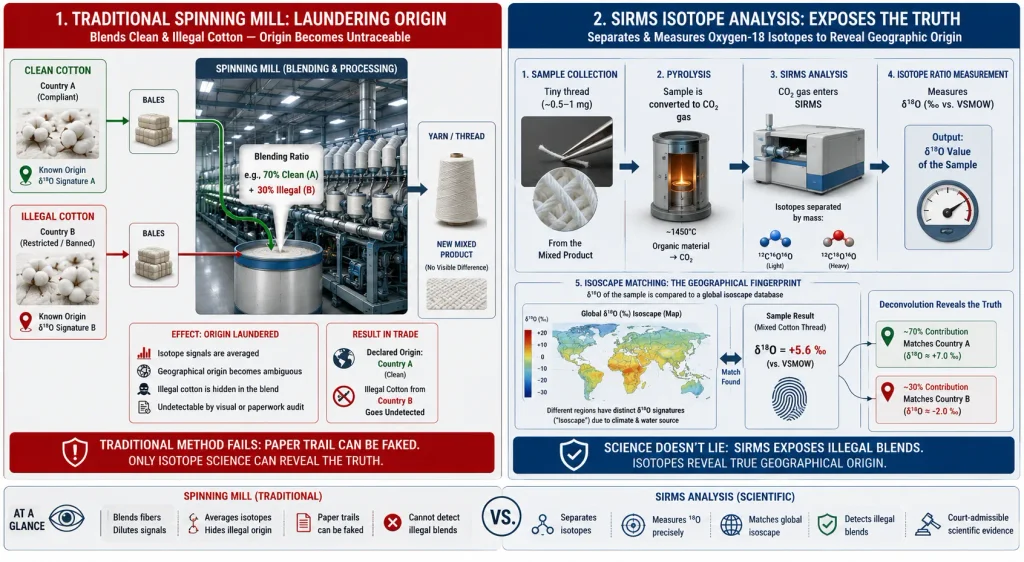
Textile supply chains are designed to blend. A single spinning mill in Vietnam might take clean cotton from the US and mix it with illegal cotton from Xinjiang to create a cheaper yarn. Once blended, visually separating the illegal cotton from the legal cotton is impossible. The origin is “laundered.”
2. The Core Mechanism: Stable Isotopes
Elements like Oxygen, Hydrogen, and Carbon exist in slightly different weights, known as “stable isotopes.” For example, standard Oxygen has 8 protons and 8 neutrons (Oxygen-16). But a rare version has 8 protons and 10 neutrons (Oxygen-18). It behaves exactly like normal oxygen, but it is slightly heavier.
3. Technical Depth: Spatial-Chemical Footprinting (Isoscapes)
The ratio of heavy Oxygen-18 to light Oxygen-16 in rainfall is strictly dictated by geography. Rain falling near the equator has a different isotopic ratio than rain falling inland in a cold, arid basin (like Xinjiang).
When a cotton plant grows, it absorbs the local water, soil nutrients, and carbon dioxide. The plant incorporates these specific local isotopic ratios directly into the cellulose of the cotton fiber. This creates a geographical chemical fingerprint known as an “isoscape.”
4. Technical Depth: Stable Isotope Ratio Mass Spectrometry (SIRMS)
To catch the launderers, CBP agents cut a microscopic thread from the imported t-shirt. The thread is placed into an elemental analyzer and incinerated at over 1,000°C. The resulting gases are fired through a Stable Isotope Ratio Mass Spectrometer (SIRMS).
A powerful magnet bends the flying gas ions. Because Oxygen-18 is heavier than Oxygen-16, it doesn’t bend as easily. The machine counts exactly how many heavy isotopes hit the detector versus light isotopes, calculating the precise ratio to the decimal.
5. Real-World Consequences: The Reference Database
The machine outputs the isotopic fingerprint of the t-shirt. This fingerprint is cross-referenced against a massive, proprietary database of known global soil and cotton samples (often maintained by forensic firms like Oritain). If the t-shirt’s fingerprint overlaps with the statistical model of the Xinjiang basin, the mathematical match is undeniable. The shipment is immediately detained under the UFLPA, overriding all documentary evidence presented by the importer.
UFLPA Enforcement and Commercial Traceability
The deployment of isotopic tracing has expanded aggressively from high-value commodities into massive, high-volume consumer goods.
The Uyghur Forced Labor Prevention Act (UFLPA): The UFLPA is the most aggressive trade restriction enacted by the United States in decades. Since its enforcement began in 2022, CBP has detained billions of dollars worth of electronics, apparel, and industrial materials. Apparel importers are the primary target of isotopic auditing. Massive brands (like Uniqlo, Shein, and H&M) have faced intense scrutiny, forcing the entire fast-fashion industry to independently contract forensic labs to isotopically map their own supply chains before their goods reach the U.S. border to avoid catastrophic port seizures.
Agricultural Fraud and Food Authenticity: Beyond textiles, isotopic tracing defends agricultural markets. Premium products like Manuka honey from New Zealand, Kona coffee, or authentic Italian olive oil carry massive price premiums. Smugglers routinely dilute these premium products with cheap alternatives. SIRMS analysis maps the specific soil trace elements of a jar of honey, allowing regulators to definitively prove whether a product claiming to be “100% New Zealand Manuka” is actually diluted with cheap corn syrup from Eastern Europe.
Conflict Minerals and Battery Supply Chains: The technology is scaling into heavy industry. The origins of cobalt, lithium, and tantalite are heavily scrutinized due to human rights abuses in the Democratic Republic of Congo (DRC). By analyzing the trace isotopic impurities locked inside the crystalline structure of the refined metal, auditors can trace the geographical origin of the raw ore used in a smartphone battery, preventing conflict minerals from quietly entering the global electric vehicle supply chain.
Economic & Strategic Impact
The core strategic consequence of forensic tracing is the Destruction of the De Minimis Loophole.
Historically, trade law struggled to regulate “De Minimis” shipments—packages valued under $800 that are shipped directly to consumers (the business model of mega-retailers like Shein and Temu). Because these packages bypass standard customs duties, they effectively created a massive blind spot for illicit textiles to flood into the United States.
However, the Department of Homeland Security and CBP are actively adapting isotopic testing to operate at high speeds. By randomly pulling individual $10 t-shirts from De Minimis cargo flights and subjecting them to rapid mass spectrometry, customs officials project an umbrella of forensic deterrence. The mere threat that a single $10 shirt could be forensically proven to contain Xinjiang cotton—triggering a massive, brand-destroying federal investigation into the retailer—forces ultra-fast-fashion giants to self-regulate and scrub their deep-tier suppliers, closing the largest tariff loophole in modern retail.
Advantages
- Immutable Evidence: Unlike a paper audit or a factory inspection (which can be faked or bribed), the isotopic signature is baked into the atomic structure of the material itself. It cannot be altered, bleached, dyed, or washed out.
- Supplier Agnostic: The brand buying the final t-shirt doesn’t need to trust their Tier-3 spinning mill. They simply test the final product. If the test passes, the origin is safe, regardless of how many opaque middlemen touched the product.
- Scalable Deterrence: You don’t need to test every single shirt. By heavily testing randomized shipments at the port of entry, CBP forces the financial risk of a seizure back onto the importer, compelling the private market to fund its own compliance clean-up.
Limitations
- Database Dependency: An isotopic footprint is useless if you don’t know what it matches. Forensic companies must physically travel to Xinjiang, India, the US, and Brazil to collect thousands of physical soil and cotton samples to build the “Reference Database.” If a specific micro-climate isn’t in the database, the machine cannot confidently identify the origin.
- Blending Dilution: If a spinning mill blends 5% illegal cotton with 95% legal cotton, the isotopic signature of the illegal cotton becomes heavily diluted. Finding the statistical “signal in the noise” of heavily blended textiles pushes the absolute sensitivity limits of modern mass spectrometers.
- High CapEx for Auditing: Running SIRMS analysis requires million-dollar laboratory equipment and highly trained chemists. It is an expensive compliance tax forced upon brands, creating a significant cost barrier for smaller, legitimate apparel companies trying to prove their innocence.
Common Misconceptions
Misconception: The test looks for “forced labor” in the fabric.
Reality: A mass spectrometer cannot detect human rights abuses. It only detects geography. The test proves where the cotton grew. If it grew in Xinjiang, U.S. law automatically presumes it was made with forced labor, and the goods are seized.
Misconception: Dyeing or washing the clothes ruins the test.
Reality: Downstream processing (dyeing, bleaching, weaving) only affects the surface chemistry. Isotopic tracing incinerates the core cellulose structure of the cotton fiber itself, which remains completely unchanged from the day the plant was harvested.
Misconception: Companies can just use blockchain to prove origin instead.
Reality: Blockchain is a highly secure digital ledger, but it suffers from the “Garbage In, Garbage Out” problem. If a corrupt farmer types a lie into the blockchain, the blockchain perfectly secures a lie. Isotopic testing verifies the physical truth before it is entered into the digital ledger.
What Most People Miss
The disruptive intelligence value of Trace Element Profiling (TEP).
When discussing forensic tracing, the focus is almost always on light stable isotopes (Oxygen, Carbon, Hydrogen). What most analysts miss is that advanced laboratories combine this with Trace Element Profiling.
While isotopes trace the water and air, TEP traces the exact mineral composition of the dirt. Using Inductively Coupled Plasma Mass Spectrometry (ICP-MS), labs can detect microscopic concentrations of rare earth metals (like Strontium or Neodymium) absorbed by the plant. Because the geology of the Xinjiang basin has a highly specific rare-earth mineral footprint that is distinctly different from the volcanic soils of India or the alluvial plains of Vietnam, combining TEP with isotopic ratios creates a dual-layered, mathematically undeniable matrix of geographic certainty.
Comparison Table
| Feature | Paper Audits / Cert. of Origin | Blockchain Ledgers | Isotopic Tracing (SIRMS) |
| Verification Method | Document review | Cryptographic digital tracking | Physical chemical analysis |
| Vulnerability to Fraud | Extremely High (Easily faked) | High (“Garbage In, Garbage Out”) | Near Zero (Cannot fake atomic structure) |
| Transshipment Risk | Blind to mid-supply chain blending | Excellent tracking, if data is honest | Detects blending physically |
| Implementation Cost | Low | Moderate | High (Requires lab analysis) |
| Legal Weight (UFLPA) | Weak (CBP frequently overrides) | Weak without physical proof | Definitive (Used for CBP seizures) |
Case Study
Situation: In the early enforcement days of the UFLPA, U.S. Customs faced a massive influx of cotton apparel originating from Vietnam. Vietnam is a massive textile manufacturing hub, but it grows very little of its own cotton. Intelligence indicated that Vietnamese spinning mills were importing massive quantities of Xinjiang cotton, spinning it into yarn, weaving it into shirts, and exporting them to the U.S. with “Made in Vietnam” labels.
Challenge: CBP needed a definitive way to prove that the raw cotton inside a “Made in Vietnam” t-shirt was actually grown in Xinjiang, allowing them to seize the illegal shipments without paralyzing legitimate trade.
Solution (The Oritain Partnership): The U.S. government and major apparel brands partnered with forensic tracing firms like Oritain. CBP agents began pulling random textile samples from shipping containers arriving from high-risk Vietnamese ports. The fibers were subjected to SIRMS and Trace Element Profiling, and the data was mapped against the known global isoscape of the cotton industry.
Outcome: The mass spectrometers revealed that a significant percentage of the “Vietnamese” apparel possessed the exact isotopic and trace mineral footprint of the Xinjiang basin. CBP detained the shipments. When the importers presented their Vietnamese Certificates of Origin, CBP rejected the documents, citing the definitive forensic evidence.
Lessons Learned: The enforcement action triggered a massive shockwave through the global apparel industry. It proved that geographic transshipment could no longer successfully launder forced-labor materials. Massive brands were forced to instantly terminate their opaque Tier-3 Vietnamese spinning suppliers, realizing that chemical accountability had permanently replaced paper-based plausible deniability.
Future Outlook
Next 12–24 Months
The era of Synthetic DNA Tagging. As isotopic testing becomes standard, the industry will push for even faster, cheaper validation. Bioengineering firms (like Applied DNA Sciences) are commercializing synthetic DNA tags. These microscopic, harmless DNA barcodes are sprayed directly onto the raw cotton at the farm in safe regions (like the U.S. or Australia). When the final t-shirt reaches the U.S. port, an agent simply uses a rapid PCR swab test to check for the DNA tag. If the DNA is present, the shirt is cleared instantly, providing a rapid, pre-emptive alternative to complex mass spectrometry.
Next 3–5 Years
The scaling of Polysilicon and Solar Panel Auditing. The UFLPA does not just target cotton; it heavily targets the raw polysilicon used to make solar panels (of which Xinjiang produces a massive global share). The Department of Energy and CBP will scale isotopic and trace-mineral profiling beyond soft textiles into hard metallurgy. By vaporizing microscopic shards of imported solar panels and tracking the specific metallurgical impurities, the U.S. will aggressively enforce the UFLPA against the renewable energy supply chain, fundamentally restructuring global solar procurement.
Next 10 Years
The Automated Forensic Border. By the mid-2030s, forensic testing will leave the centralized laboratory and move directly onto the customs inspection floor. Handheld, laser-induced breakdown spectroscopy (LIBS) scanners will allow customs agents to instantly zap a cargo container of goods on the dock and receive a geographic origin probability score in real-time. This automated, forensic border wall will make it physically impossible for illicit, sanctioned, or environmentally destructive raw materials to enter the consumer markets of the developed world.
Most Likely Scenario
Isotopic supply chain tracing represents the ultimate triumph of physics over fraud. The global logistics network was built on a foundation of blind trust and opaque intermediaries. By weaponizing mass spectrometry, regulators have forced the burden of proof back onto the corporations. You can no longer claim you didn’t know where your products came from, because the atomic structure of the product is now the only witness the court will believe.
Key Takeaways
- The U.S. government bans all products from the Xinjiang region of China due to forced labor laws (UFLPA). Smugglers try to bypass this by faking paperwork to claim the cotton was grown elsewhere.
- Isotopic Supply Chain Tracing catches the fraud by ignoring the paperwork and testing the physical chemistry of the clothing itself.
- The exact ratio of elements (like oxygen and carbon) in a cotton fiber is permanently determined by the local rain and soil where the plant grew. This “chemical barcode” cannot be washed out or bleached.
- Customs agents use a machine called a mass spectrometer to read this barcode. If the barcode matches the soil profile of Xinjiang, the shipment is seized.
- This technology completely destroys the “plausible deniability” of massive fashion brands. A company can no longer blame a corrupt middleman for fake paperwork; they are held strictly accountable for the physical chemistry of their products.
Glossary
Certificate of Origin: A standard international shipping document claiming where a product was made. Historically relied upon, but now considered highly vulnerable to fraud.
De Minimis: A trade rule that allows cheap packages (under $800) to enter the U.S. without standard customs checks. Regulators are now using rapid forensic testing to close this massive loophole.
Isoscape: A “geographic map” of chemical isotopes. It shows exactly how the ratio of heavy-to-light water and soil elements changes across different regions of the globe.
Stable Isotope Ratio Mass Spectrometry (SIRMS): The advanced scientific technique used to vaporize a material and perfectly count the weight of the atoms inside it to determine its geographical origin.
Trace Element Profiling (TEP): A complementary test that looks for microscopic amounts of rare earth metals (like Strontium) absorbed by the plant from the dirt, acting as a second layer of geographic proof.
Uyghur Forced Labor Prevention Act (UFLPA): The U.S. law that assumes any product touching the Xinjiang region of China is made with forced labor and is banned from importation.
Sources
U.S. Customs and Border Protection (CBP): Uyghur Forced Labor Prevention Act (UFLPA) Operational Guidance
Oritain: Forensic Traceability: How Stable Isotopes Verify Origin
Applied DNA Sciences: DNA Tagging and Supply Chain Traceability
Reuters: Customs Uses Isotope Testing to Block Xinjiang Cotton
Sourcing Journal: The Death of Paper Audits in Global Textile Supply Chains