Advertisement
)
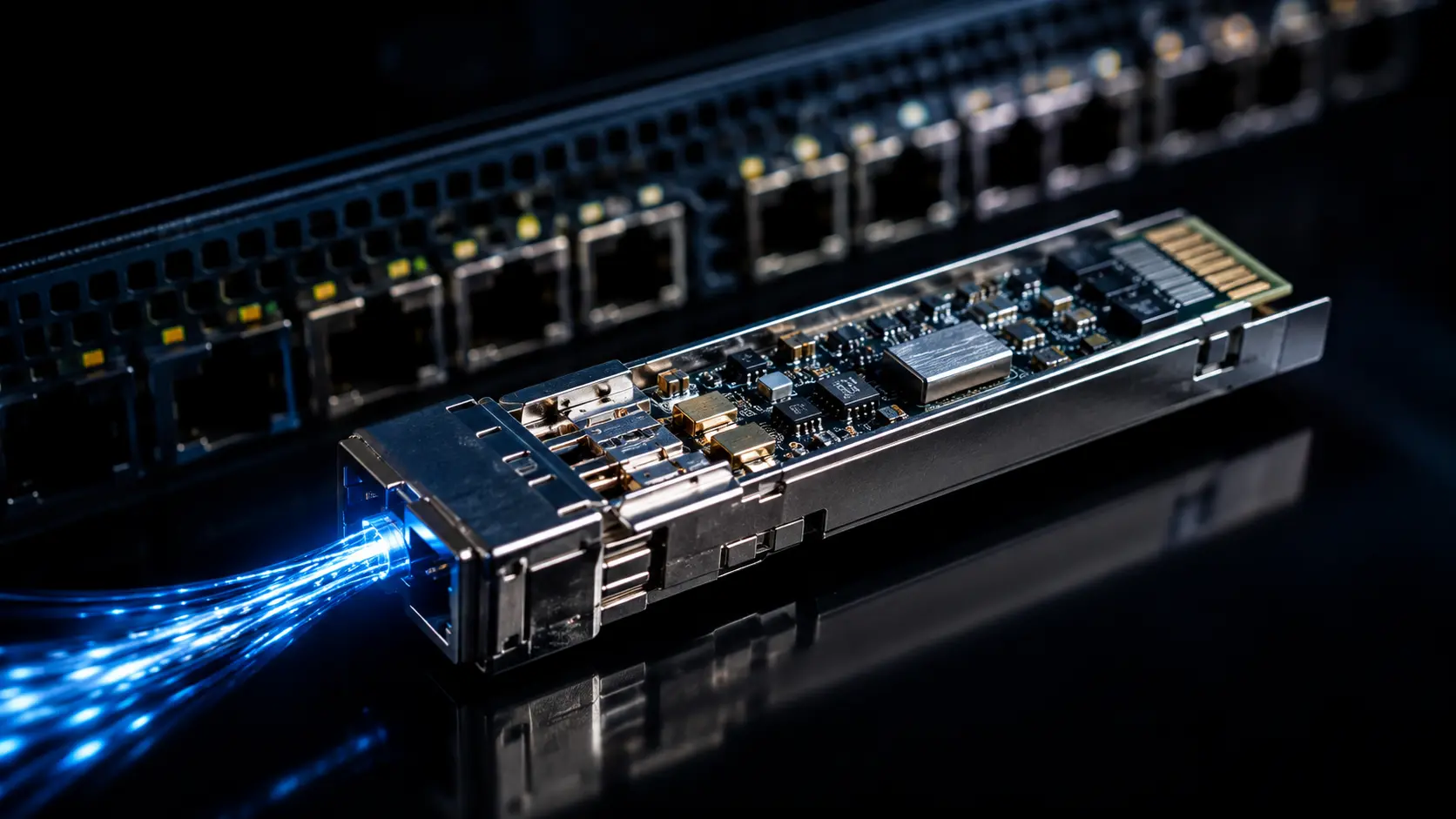

Artificial intelligence is facing a catastrophic physical bottleneck: the cost of moving data is eclipsing the cost of computing it. To train massive frontier models, technology giants wire tens of thousands of GPUs together into single, continent-sized supercomputers. This requires millions of high-speed fiber optic cables. At the end of every single one of those cables is a small, metal plug called an optical transceiver. As networking speeds have surged to 800 gigabits per second to keep the GPUs fed, the tiny computer chips inside these plugs—Digital Signal Processors (DSPs)—have become dangerously hot and incredibly power-hungry. In a modern AI cluster, simply keeping these microscopic chips powered and cooled consumes megawatts of electricity that should be going to the GPUs.
Why should you care right now? Because hardware engineers have decided to rip the digital brains right out of the cables. By shifting to a “dumb” plug that uses purely analog physics, hyperscalers are eliminating the DSP entirely. This architecture, known as Linear Pluggable Optics (LPO), cuts the power consumption of data center networking in half and drops communication latency to near-zero. It is a ruthless exercise in thermodynamic optimization, and it is actively triggering a multi-billion-dollar supply chain war over who controls the physical plumbing of the AI revolution.
What is Linear Pluggable Optics (LPO)?
Linear Pluggable Optics (LPO) is an optical transceiver architecture that eliminates the Digital Signal Processor (DSP) from the module. By relying exclusively on analog components to transmit unretimed optical signals, LPO shifts the burden of signal equalization to the host switch, drastically reducing power consumption, heat dissipation, and latency in high-speed data center networks.
At a Glance
- Concept: Removing the heavy, power-hungry digital computer chip from the ends of fiber optic cables and replacing it with a highly efficient, pure analog circuit.
- Why it matters: AI clusters are starving for power. A standard 800G DSP-based plug consumes roughly 16 watts. An LPO plug consumes about 8 watts. Multiply that 8-watt saving by a million cables in a data center, and you save enough power to run thousands of additional GPUs.
- Who uses it: Hyperscale cloud providers (Meta, AWS, Google), AI supercomputer architects, and high-frequency trading firms demanding sub-nanosecond latency.
- Biggest takeaway: LPO trades power efficiency for interoperability. Because the plug no longer “cleans” the signal digitally, the networking switch it plugs into has to do the heavy lifting, meaning the plug and the switch must be perfectly, meticulously tuned to each other.
In Simple Words
Imagine you are playing a game of telephone across a massive, noisy sports stadium.
Because the stadium is so loud, the message gets distorted. To fix this, you hire a professional translator to stand in the middle of the stadium. The translator listens to the distorted message, uses their brain to figure out what was originally said, cleans it up, and yells the perfect message to the other side. This works flawlessly, but the translator demands a massive salary (power) and takes a few seconds to think (latency). This translator is the Digital Signal Processor (DSP).
Linear Pluggable Optics (LPO) fires the translator.
Instead of putting a brain in the middle of the stadium, LPO just hands the first person a megaphone (an analog amplifier). The megaphone doesn’t “think” or “clean” the message; it just takes whatever the person says, noise and all, and makes it louder. The person on the receiving end has to listen a bit harder to understand the noisy message, but because there is no translator stopping to think, the message arrives instantly, and you don’t have to pay the translator’s massive salary.
Why This Matters
The capital expenditure (CapEx) and operational expenditure (OpEx) of AI networking have spiraled out of control. As the industry transitions from 400G to 800G, and rapidly approaches 1.6 Terabits per second (1.6T), the physics of traditional DSPs break down. The chips run so hot that data center engineers are forced to design elaborate, expensive liquid-cooling systems just to keep the networking switches from melting.
For Cloud Architects and Tech Investors, LPO is the most pragmatic thermodynamic release valve available. It avoids the immense architectural complexity of Co-Packaged Optics (CPO)—which permanently glues the optics to the switch processor—retaining the beloved “hot-swappable” nature of standard plugs. By stripping out the DSP, LPO physically removes the primary source of heat from the front panel of the server rack, ensuring that 1.6T AI networking remains thermally and financially viable.
The Shift to Linear Pluggable Optics in AI
The rise of LPO is a direct attack on the hegemony of the DSP manufacturers.
For the past decade, a few semiconductor giants (most notably Marvell and Broadcom) held an absolute monopoly over data center optics because they controlled the immensely complex silicon intellectual property required to build 400G and 800G DSPs.
LPO effectively bypasses this monopoly. By commoditizing the optical plug and shifting the intelligence entirely onto the host switch ASIC, the market has swung wide open. A new wave of pure-play analog semiconductor companies (like Macom, Semtech, and MaxLinear) are surging in value. They provide the highly specialized, linear analog amplifiers that make LPO possible, triggering a massive realignment in the multi-billion-dollar optical networking supply chain.
How Linear Pluggable Optics (LPO) Works
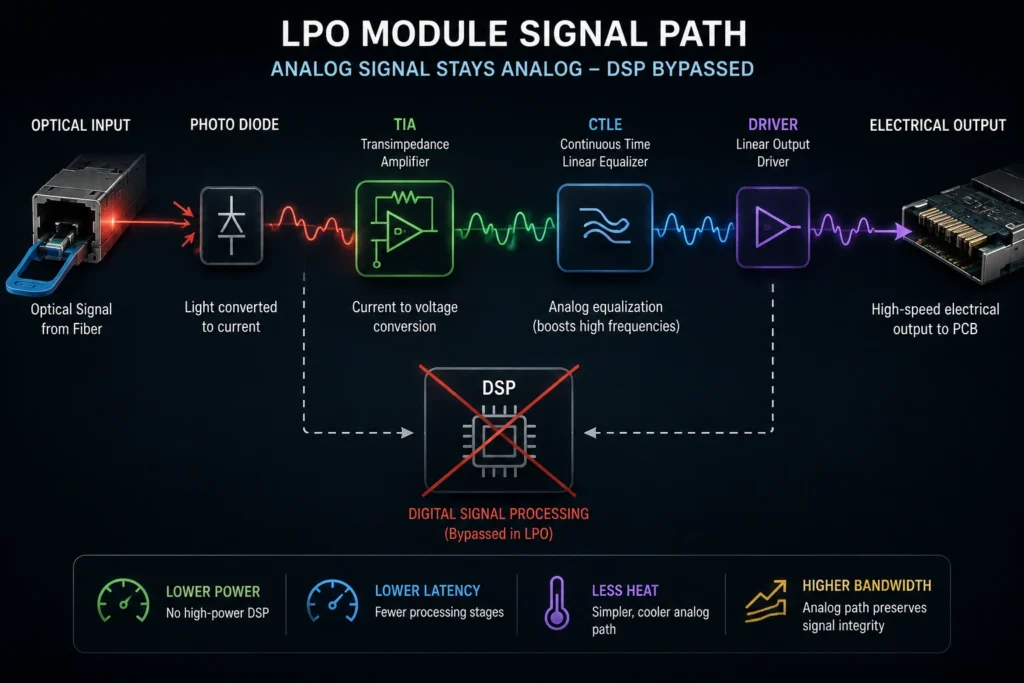
Extracting perfect 800G data streams without a digital brain requires mastering analog physics and exploiting the existing silicon on the host switch. Here is the first-principles breakdown of the LPO architecture.
1. The Fundamental Problem: Signal Integrity at 800G
When data is transmitted at 800 gigabits per second via Pulse Amplitude Modulation (PAM4), the signal degrades violently over distance due to chromatic dispersion and electrical noise. By the time the signal reaches the end of the wire, the clean, square digital waves look like a blurry, chaotic mess.
2. The Insufficiency of the DSP
In a traditional pluggable module, the DSP acts as a “retimer.” It takes the blurry analog signal, converts it to digital, runs heavy mathematical equalization algorithms to perfectly reconstruct the original square waves, and converts it back. At 800G, this process consumes roughly 7 to 9 watts per module and introduces hundreds of nanoseconds of latency.
3. The Core Mechanism: Unretimed Analog Conditioning
LPO removes the DSP. Instead, the module uses “unretimed” or “linear” analog components. It relies on a Continuous Time Linear Equalizer (CTLE) and a Transimpedance Amplifier (TIA) on the receiving end, and a linear laser driver on the transmitting end. These analog chips do not convert the signal to digital 1s and 0s. They simply amplify the continuous analog waveform and apply basic high-frequency boosting to counteract the signal droop.
4. Technical Depth: The CTLE Transfer Function
The analog equalization is achieved by manipulating the frequency response. The CTLE applies a specialized transfer function to boost high-frequency signal components that were degraded during transmission, typically represented mathematically as:
H(s) = [Av * (s + ωz)] / [(s + ωp1) * (s + ωp2)]
(Where Av is the DC gain, ωz is the zero frequency that boosts the signal, and ωp1, ωp2 are the poles determining the bandwidth limit). By carefully tuning these parameters, the analog chip pushes a “good enough” signal through the module.
5. Real-World Consequences: Shifting the Burden to the SerDes
Because the LPO module only provides a “good enough” analog signal, the heavy lifting must be done by the host switch. Modern network switch ASICs (like the Broadcom Tomahawk 5) already possess incredibly powerful Serializer/Deserializer (SerDes) components. In an LPO architecture, the host switch’s SerDes looks through the “dumb” optical plug, treats the entire fiber optic cable as if it were just a long piece of internal copper wire, and performs the final digital cleanup directly on the main switch chip.
Data Center Applications for LPO Modules
The deployment of LPO is highly targeted, solving bottlenecks in specific, high-density computing environments.
Hyperscale AI Training Clusters (GPU-to-GPU): When a model is being trained, thousands of GPUs must share parameters constantly. This creates an East-West “backend” network running on InfiniBand or specialized Ethernet. LPO is perfectly suited for this environment. The cables are relatively short (often within the same row of server racks, less than 50 meters), meaning the analog signal doesn’t degrade excessively, and the elimination of DSP latency drastically speeds up the synchronized machine learning calculations.
High-Frequency Algorithmic Trading: In the financial sector, trades are executed based on market data discrepancies that last microseconds. Eliminating the 100 to 200 nanoseconds of latency caused by a DSP provides a massive competitive advantage. Financial data centers deploy LPO modules to ensure their trading algorithms receive raw, unretimed optical data at the absolute physical speed of light.
Liquid-Cooled Supercomputers: As thermal limits force data centers to adopt direct-to-chip liquid cooling, dealing with the heat on the front panel (where the optical plugs sit) is notoriously difficult. By deploying LPO, the power dissipation of a 51.2T network switch drops by hundreds of watts, allowing air cooling to effectively manage the front panel while the liquid cooling focuses entirely on the main processing ASICs.
Economic & Strategic Impact
The transition to LPO creates a profound Interoperability and Ecosystem Risk.
In the traditional DSP era, you could buy a switch from Cisco, an optical plug from Finisar, and a server from Dell, and they would all work together seamlessly because the DSP inside the plug strictly standardized the signal. It was absolute plug-and-play.
With LPO, that standardization wall is gone. Because the analog plug relies on the host switch’s SerDes to clean the signal, the plug and the switch are part of a continuous, highly sensitive electrical circuit. An LPO plug tuned perfectly for an NVIDIA switch might throw massive error rates if plugged into an Arista switch.
For Enterprise CIOs, this threatens to reintroduce severe vendor lock-in. Hyperscalers are actively mitigating this through groups like the LPO Multi-Source Agreement (MSA), striving to create electrical specifications strict enough to guarantee interoperability, but the physics of 800G analog transmission make universal standardization excruciatingly difficult.
Advantages
- Massive Power Reduction: Slashes the power consumption of an 800G optical module from roughly 15-18W down to 8W, saving megawatts of power across a hyperscale AI cluster.
- Sub-Nanosecond Latency: Eliminates the digital conversion and processing delay, reducing optical transit latency from hundreds of nanoseconds to virtually zero, accelerating distributed AI training.
- Lower Bill of Materials (BOM) Cost: Removing the advanced 5nm or 3nm silicon DSP chip from the module drastically reduces manufacturing costs and supply chain complexity for optics vendors.
- Maintains Hot-Swappability: Unlike Co-Packaged Optics (CPO), LPO modules can still be physically unplugged and replaced by a technician if a laser dies, protecting data center uptime.
Limitations
- Restricted Reach: Because there is no digital cleanup inside the module, the analog signal degrades faster. LPO is typically restricted to short-reach, intra-data center connections (usually 50 meters or less over multi-mode fiber, or very short single-mode links).
- Interoperability Friction: Requires intense, bespoke electrical tuning (link training) between the optical transceiver and the specific host switch ASIC, making “mix-and-match” procurement highly risky.
- Degraded Signal Margins: The analog link operates closer to the “noise floor” than a retimed DSP link. A slightly dirty fiber optic connector or a minor temperature fluctuation can push the Bit Error Rate (BER) beyond what the host switch can correct, causing packet loss.
Common Misconceptions
Misconception: LPO means there are zero chips in the optical module.
Reality: LPO removes the digital chip (the DSP). The module is still packed with highly advanced analog chips, specifically Transimpedance Amplifiers (TIAs) and laser drivers.
Misconception: LPO is the exact same thing as Co-Packaged Optics (CPO).
Reality: They are competing architectures. CPO permanently solders the optical lasers directly onto the same silicon motherboard as the main switch chip to save power. LPO keeps the optics at the front of the server rack in a removable plug, saving power by removing the DSP while keeping the hardware easily serviceable.
Misconception: LPO will be used for long-haul internet cables under the ocean.
Reality: Absolutely not. Long-haul transmission requires incredibly powerful, specialized Coherent DSPs to correct massive signal distortion over thousands of miles. LPO is strictly an “inside the building” technology for distances measured in feet, not miles.
What Most People Miss
The strategic compromise of Linear Receive Optics (LRO) / Half-Retimed Linear Optics (HALO).
Hyperscalers loved the power savings of LPO, but they hated the interoperability nightmare of full analog transmission. What most analysts miss is that the industry quickly pivoted to a compromise.
Instead of removing the DSP completely, manufacturers created LRO (Linear Receive Optics). In this architecture, the transmit side of the module keeps a small, low-power DSP (to ensure the laser signal going out is perfectly clean and standardized), but the receive side of the module is purely analog (saving power and relying on the host switch to clean the incoming signal). LRO cuts power by roughly 30% instead of 50%, but it vastly improves plug-and-play interoperability, acting as the pragmatic middle ground for risk-averse data center operators.
Comparison Table
| Feature | Standard DSP Pluggable | Linear Pluggable Optics (LPO) | Co-Packaged Optics (CPO) |
| Power Consumption | High (15W – 18W at 800G) | Low (~8W) | Lowest (~5W) |
| Latency | High (>100ns) | Zero (Analog speed of light) | Minimal |
| Hot-Swappable? | Yes | Yes | No (Hard-soldered) |
| Interoperability | Universal (Plug-and-play) | Complex (Requires host tuning) | Vendor-locked |
| Maximum Distance | Long (Up to several kilometers) | Short (<50 meters typically) | Short (Intra-rack) |
Case Study
Situation: A Tier-1 hyperscale cloud provider was architecting a next-generation 100,000-GPU cluster to train a multi-trillion parameter foundation model. The cluster utilized a massive, non-blocking 800G Ethernet fabric. During thermal modeling, engineers realized the 51.2T network switches were hitting thermal limits; the heat generated by the 64 standard DSP-equipped optical transceivers on the front panel was overwhelming the air-cooling infrastructure.
Challenge: Upgrading the entire networking tier to direct-to-chip liquid cooling would cause massive facility delays and CapEx overruns. They needed to immediately drop the thermal load of the network switches by at least 400 watts per rack without sacrificing 800G bandwidth.
Solution (The LPO Pivot): The cloud provider rejected Co-Packaged Optics due to the inability to hot-swap failed lasers in the field. Instead, they mandated an LPO architecture. They partnered with a pure-play analog semiconductor firm to provide high-linearity TIAs and drivers, completely omitting the DSP. Because the entire network fabric used identical switches from a single vendor, the hyperscaler could strictly control the electrical link training, neutralizing LPO’s interoperability weakness.
Outcome: The deployment reduced transceiver power consumption by roughly 45%. The thermal footprint of the switch front-panels collapsed into manageable air-cooled thresholds. Furthermore, the elimination of DSP latency across three tiers of networking switches shaved critical microseconds off the GPU parameter-synchronization loop, materially accelerating the overall AI training time.
Lessons Learned: The implementation proved that LPO is uniquely suited for “walled garden” AI clusters. When a single company controls both the host switch and the optical procurement, the interoperability risk is negated, allowing the operator to harvest massive thermodynamic and latency dividends.
Future Outlook
Next 12–24 Months
The era of 800G LRO Standardization. Throughout 2026 and 2027, the market will overwhelmingly settle on Linear Receive Optics (LRO) as the dominant volume deployer over pure LPO. The LPO Multi-Source Agreement (MSA) will finalize strict electrical specifications, giving hyperscalers the confidence to deploy millions of 800G half-retimed modules without fearing vendor lock-in. Startups specializing in high-linearity analog equalizers will see aggressive acquisition attempts by legacy DSP monopolies seeking to protect their market share.
Next 3–5 Years
The 1.6T Physical Barrier. As networking doubles again to 1.6 Terabits per second (1.6T / 200G per lane), the physics of unretimed analog transmission become intensely hostile. Pushing a 200G analog signal over even a few inches of copper trace creates immense signal loss. In this window, pure LPO will struggle. The market will split: short-reach connections will adopt advanced analog materials (like Gallium Arsenide TIAs), while longer data center links will be forced to revert back to 3nm, ultra-low-power “Lite DSPs.”
Next 10 Years
The LPO vs. CPO Convergence. By the mid-2030s, the distinction between LPO and Co-Packaged Optics will blur. As silicon photonics reach maturity, we will see the rise of “Near-Packaged Optics” (NPO). Analog linear optical engines will be miniaturized and placed directly on the switch motherboard, mere millimeters from the SerDes, but maintaining a detachable fiber-optic jumper. This will deliver the power efficiency of CPO with the serviceability of LPO, completely rendering the traditional bulky, front-panel DSP pluggable module obsolete in high-performance computing.
Most Likely Scenario
Linear Pluggable Optics is not a complete replacement for the DSP; it is a highly specialized scalpel used to cut power and latency out of the most dense, critical AI networks on Earth. While DSPs will always rule long-distance and highly chaotic internet traffic, LPO and its variants will absolutely dominate the “short-haul” backend networks that form the nervous system of the global artificial intelligence infrastructure.
Key Takeaways
- Linear Pluggable Optics (LPO) removes the power-hungry Digital Signal Processor (DSP) from fiber optic networking plugs, relying entirely on analog components.
- By removing the DSP, LPO cuts power consumption by nearly 50% and drops processing latency to zero, solving the massive heat and power constraints of AI data centers.
- Instead of cleaning the signal inside the plug, LPO shifts the mathematical burden to the powerful Serializer/Deserializer (SerDes) located on the host network switch.
- The primary drawback is a lack of interoperability. Without a DSP to standardize the signal, LPO plugs must be meticulously tuned to the specific brand of switch they are plugged into.
- LPO is restricted to short distances (usually within the same row of servers) because an unretimed analog signal degrades too quickly over long fiber optic cables.
- To solve the interoperability problem, the industry is compromising with Linear Receive Optics (LRO / HALO), which keeps a small DSP for transmitting but uses pure analog for receiving.
Glossary
Continuous Time Linear Equalizer (CTLE): An analog electronic component that boosts high-frequency signals to counteract the blurring and degradation that occurs when data travels at extreme speeds.
Co-Packaged Optics (CPO): A competing technology that solders the optical lasers and components directly next to the main switch chip on the motherboard to save power, but sacrifices the ability to easily unplug and replace them.
Digital Signal Processor (DSP): A specialized microprocessor used in standard optical modules to clean, error-correct, and standardize high-speed data signals. It consumes massive power and adds latency.
Linear Receive Optics (LRO / HALO): A hybrid “Half-Retimed” compromise architecture. It uses a DSP to transmit a clean signal but uses pure analog LPO architecture to receive the signal, balancing power savings with interoperability.
Serializer/Deserializer (SerDes): The powerful input/output component located directly on a networking switch chip. In LPO, the SerDes is forced to do all the heavy signal-cleanup work that the DSP used to do.
Transimpedance Amplifier (TIA): A highly sensitive analog amplifier that converts the tiny electrical currents generated by light hitting a photodetector into a usable voltage signal.
Sources
[1] IEEE Communications Magazine: Linear-Drive Pluggable Optics for Next-Generation Data Centers (2025/2026 Updates)
[2] LPO Multi-Source Agreement (MSA): Linear Pluggable Optics Specifications and Interoperability Guidelines (April 2026)
[3] Arista Networks: The Future of 800G and 1.6T Networking: LPO, CPO, and DSP Evolution
[4] LightCounting: Optical Communications Market Forecast: The Rise of Linear and Half-Retimed Optics (2026 Analysis)
[5] Broadcom / Macom Technical Briefs: Analog Signal Integrity at 200G per Lane