Advertisement
)
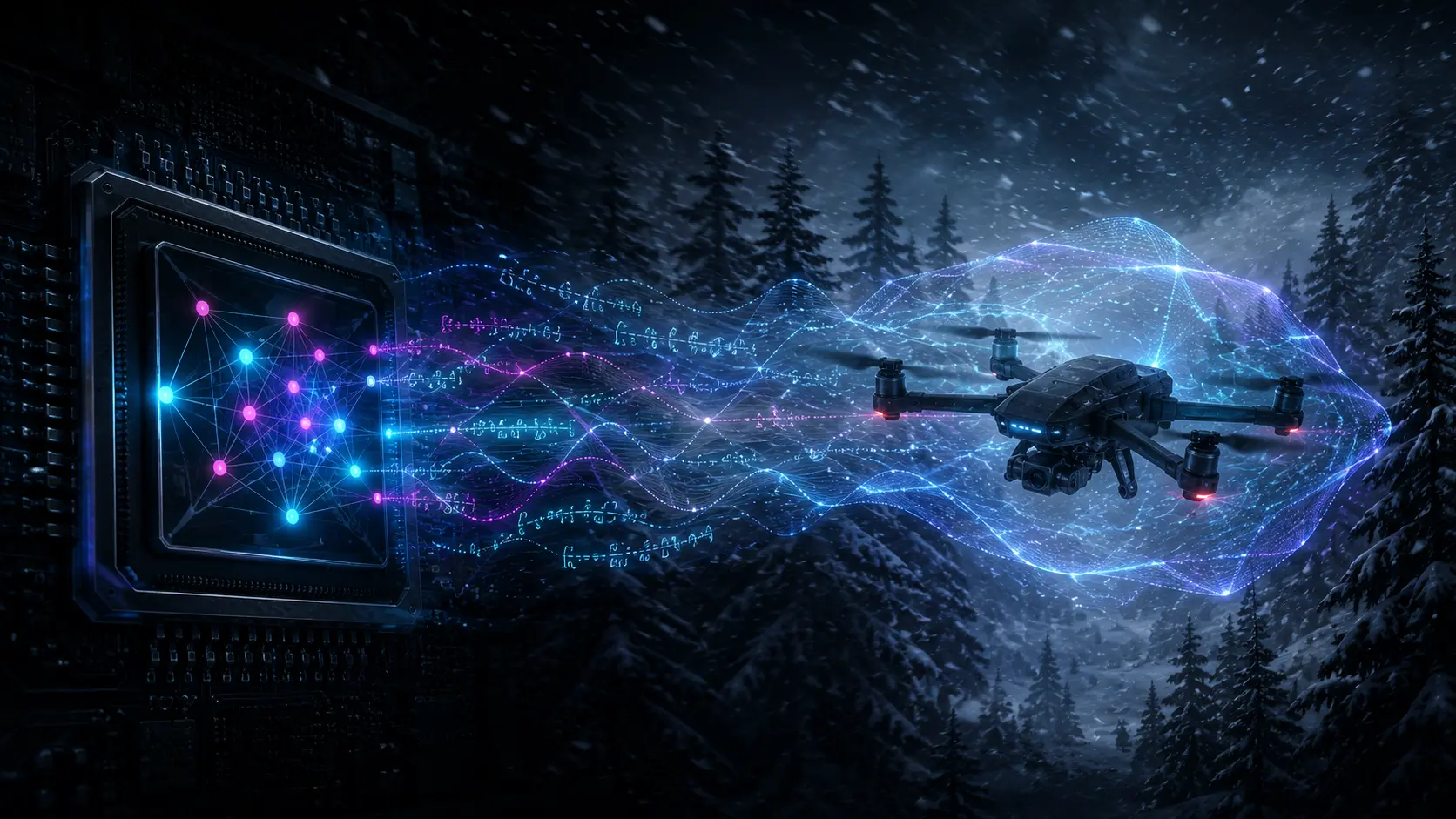

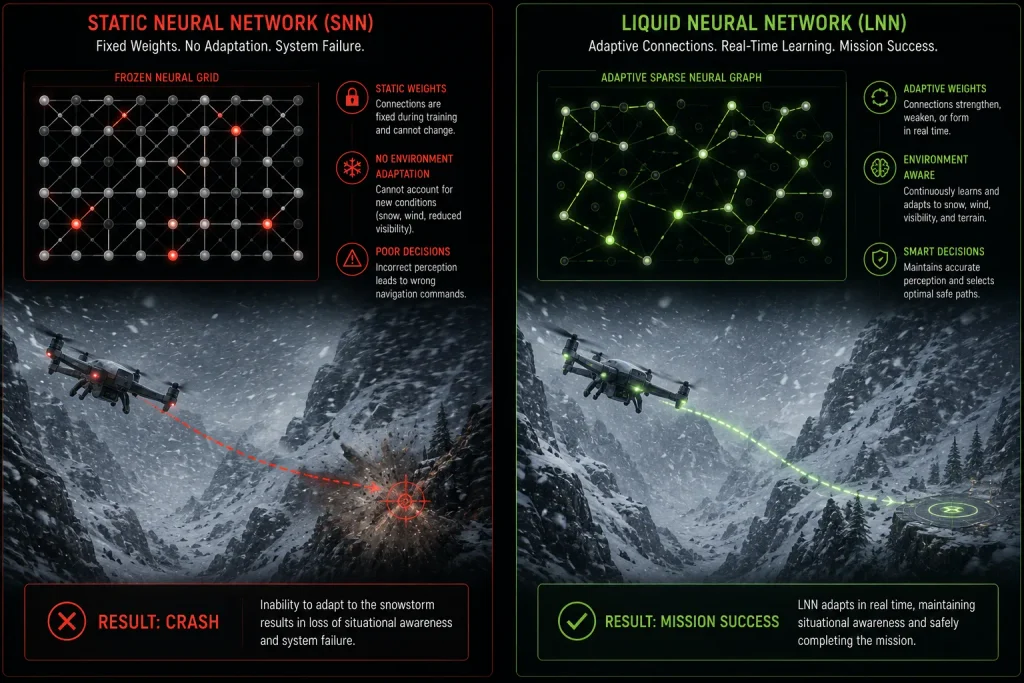
Imagine a multi-million-dollar autonomous drone navigating a dense forest. It was trained for millions of hours in perfect, sunny summer conditions. Suddenly, a violent winter blizzard rolls in. The ambient lighting drops, the wind violently alters the drone’s aerodynamics, and the camera sensors are hit with blinding snow. A traditional AI—the kind powering most modern autonomous vehicles—will instantly crash the drone. Why? Because traditional AI is “frozen.” Once an AI leaves the laboratory, its mathematical weights are locked; it cannot learn or adapt to physical environments it hasn’t seen before.
Why should you care right now? Because researchers have developed an artificial brain that stays “alive” outside the lab. By modeling the microscopic nervous system of a roundworm, scientists created Liquid Neural Networks (LNNs). Instead of relying on frozen numbers, LNNs continuously rewrite their own equations in real-time to survive chaotic, unpredictable physical conditions. This continuous-time adaptation doesn’t just stop the drone from crashing—it does so using 99% less computing power than standard AI models. For robotics engineers and automation investors, LNNs represent the holy grail of edge computing: an infinitely adaptable, ultra-lightweight intelligence designed specifically to conquer the unforgiving physics of the real world.
What are Liquid Neural Networks (LNNs)?
Liquid Neural Networks (LNNs) are a class of continuous-time recurrent neural networks that adapt their internal parameters in real-time. Inspired by biological nervous systems, LNNs use mathematical differential equations to continuously learn and adjust to new physical environments and time-series data long after their initial training phase has ended.
At a Glance
- Concept: An AI that doesn’t freeze its learning. It continuously adjusts its “brain” based on the environment it is currently experiencing.
- Why it matters: Standard AI requires massive server farms (GPUs) and fails when encountering unexpected situations (like snow or rain). LNNs adapt to the unexpected instantly and run on tiny computer chips mounted directly on a robot.
- Who uses it: Robotics startups, autonomous drone manufacturers, autonomous vehicle engineers, and aerospace contractors.
- Biggest takeaway: An LNN can steer a self-driving car using just 19 neurons, whereas a standard neural network requires millions. This extreme compression makes LNNs highly auditable, allowing engineers to mathematically prove exactly why a robot made a specific decision.
In Simple Words
Imagine you are trying to drive across a country using a navigation system.
A Standard Neural Network is like a printed paper map. It was created in a factory (the training phase) based on how the roads looked yesterday. If you encounter a brand-new detour, a flooded road, or a sudden traffic jam, the paper map is completely useless. It cannot update.
A Liquid Neural Network is like having an experienced local scout sitting in your passenger seat. The scout studied the same map, but as they look out the windshield and see the flooded road or the heavy rain, they instantly adapt their understanding of the environment. They change the route on the fly based on the specific, real-time context of the storm. The intelligence is “liquid”—it flows and shapes itself to match whatever container (environment) you pour it into.
Why This Matters
For Robotics Engineers, AI Researchers, and Automation Investors, LNNs solve the Edge Compute Bottleneck.
The AI revolution is entirely dependent on NVIDIA GPUs and massive cloud data centers. However, an autonomous drone flying a search-and-rescue mission in a remote canyon cannot rely on an internet connection to the cloud to process its camera feed; the latency would cause it to crash. The intelligence must live entirely on the drone (Edge Computing).
Standard AI models are too massive to fit on the tiny, low-power microchips a battery-powered drone can carry. Because LNNs are exponentially smaller (often reducing parameter counts by over 90%), they can run flawlessly on tiny, cheap edge processors (like a Raspberry Pi or an onboard mobile chip). LNNs completely decouple physical robotics from the multi-billion-dollar cloud computing monopoly.
The Evolution of Continuous-Time Neural Networks
The evolution of artificial intelligence is the pursuit of mastering Time.
Standard networks (Feedforward) analyze a single image frozen in time. Standard Recurrent Neural Networks (RNNs) and Transformers process time in discrete, blocky steps (like frames in a movie).
The physical world, however, does not happen in blocky frames; it is continuous. If a drone’s camera drops a frame, or the frame rate slows down due to a low battery, a discrete-time AI gets mathematically confused. Liquid Neural Networks process data in continuous time. By using differential equations, the AI understands the space between the frames, making it perfectly resilient to messy, real-world sensor streams.
How Liquid Neural Networks (LNNs) Adapt in Real-Time
Building an AI that adapts its weights without requiring an entirely new training run requires a fundamental shift from algebra to calculus. Here is the first-principles breakdown of the architecture.
1. The Fundamental Problem: Static Weights
In a standard AI, learning is the process of adjusting the “weights” (the connection strength between artificial neurons). Once the AI achieves high accuracy in the lab, the training stops. The weights are permanently locked. If the real world looks slightly different than the training data (a phenomenon called Domain Shift), the locked weights process the new data incorrectly, and the AI fails.
2. The Inspiration: The C. elegans Roundworm
MIT researchers looked away from massive supercomputers and toward the microscopic roundworm, Caenorhabditis elegans. This worm only has 302 neurons, yet it can navigate complex, changing environments flawlessly. Its biological neurons don’t just fire in a binary way; they release neurotransmitters that dynamically change the sensitivity of the entire nervous system based on the immediate context.
3. The Core Mechanism: Liquid Time-Constant (LTC) Networks
Researchers translated this biological concept into math by creating Liquid Time-Constant (LTC) networks. Instead of assigning a fixed number to an artificial neuron, the state of the neuron is governed by a continuous-time differential equation (specifically, a non-linear ordinary differential equation, or ODE).
The equation determines how fast or slow a neuron reacts to new information:
dx(t)/dt = -x(t)/τ + f(x(t), I(t), θ)
(Where τ represents the dynamically changing time-constant, allowing the system to speed up or slow down its reaction to the input I(t)).
4. Technical Depth: Continuous Adaptation
Because the neuron’s state is dictated by an equation that includes the current input, the parameters of the network literally compute themselves in real-time. If the drone flies into heavy rain, the optical input changes rapidly. The differential equations absorb this chaotic new input, and the “time-constant” of the network shifts dynamically. The network is “liquid”—it restructures its internal math to stabilize the drone despite the new physics.
5. Real-World Consequences: Extreme Sparsity
Because every single neuron in an LNN is so mathematically expressive (acting as a dynamic filter rather than a static switch), you do not need millions of them. The network can extract features using a shockingly small number of parameters. This extreme “sparsity” shrinks the physical size of the software, enabling deployment on microscopic hardware while maintaining elite autonomous performance.
LNN Applications: Autonomous Drones and Edge Computing
LNNs are rapidly transitioning from MIT research papers into the commercial control stacks of the aerospace and robotics sectors.
Autonomous Drone Swarms: Flying a single drone in a windstorm is hard; flying fifty drones in tight formation requires absolute precision. Because drones create aerodynamic wakes (wind turbulence) that disrupt the drones flying behind them, the physical environment is constantly shifting. Standard AI requires massive compute to constantly recalculate this turbulence. LNNs inherently absorb these aerodynamic shifts via continuous-time equations, allowing massive drone swarms to fly in tight formations using tiny onboard microprocessors.
Medical Wearables and Edge Diagnostics: A pacemaker or wearable ECG monitor tracks human heart rates over time. Heartbeats are continuous, but patients frequently move, sweat, or experience adrenaline spikes, changing the “shape” of the data. An LNN running on a low-power smartwatch chip can dynamically adjust its baseline understanding of the patient’s heart rhythm, ignoring the noise caused by a jog and accurately detecting a genuine cardiac anomaly without sending private medical data to the cloud.
Automotive Advanced Driver Assistance Systems (ADAS): Self-driving cars frequently suffer “phantom braking” when a static AI model misinterprets a strange shadow or a plastic bag blowing across the highway as a solid wall. Liquid Neural Networks excel at temporal awareness—understanding how objects move through time. An LNN can immediately interpret that a plastic bag lacks the physical mass and temporal continuity of a concrete barrier, suppressing the phantom braking error and providing a smoother, safer autonomous ride.
Economic & Strategic Impact
The core strategic disruption of LNNs is Mechanistic Interpretability for Regulated Industries.
When a self-driving car powered by a 100-million-parameter Black Box AI crashes, engineers cannot confidently explain exactly why it crashed. This lack of “Mechanistic Interpretability” makes it incredibly difficult for regulatory bodies (like the FAA or NHTSA) to legally certify autonomous vehicles for public deployment.
Because an LNN can perform the exact same driving task using only 19 to 50 neurons, human engineers can literally print out the entire network structure and point to the exact differential equation that caused the vehicle to turn left. This extreme transparency transforms AI from an unpredictable black box into a fully auditable software system, clearing the primary legal roadblock for the mass commercialization of autonomous robotics.
Advantages
- Out-of-Distribution (OOD) Resilience: Perfectly adapts to new, messy real-world environments (snow, fog, broken sensors) that were never included in the original training data.
- Microscopic Parameter Count: Reduces the size of the AI brain by up to 99%, entirely eliminating the need for heavy, power-hungry, and expensive GPU hardware on edge devices.
- Variable Framerate Independence: Because it calculates continuous time via calculus rather than discrete time steps, it won’t crash if a camera sensor lags or drops a frame.
- Auditable Transparency: The extreme sparsity allows human safety engineers to mathematically verify the logic of the network, satisfying stringent defense and aviation regulations.
Limitations
- Training Bottlenecks: While LNNs are incredibly fast and lightweight during deployment (inference), they are agonizingly slow to train. Solving thousands of non-linear ordinary differential equations (ODEs) during the training phase requires massive, specialized cloud compute and highly complex solver algorithms.
- Static Data Inferiority: LNNs are purpose-built for continuous time-series data (video feeds, sensor streams, audio). If you ask an LNN to perform a static task—like classifying a single, motionless JPEG image—it is vastly outperformed by a standard, traditional Convolutional Neural Network (CNN).
- Hardware Ecosystem Maturity: The global AI industry has spent a decade optimizing silicon chips (TPUs, NPUs) specifically to run the matrix multiplications required by Transformer networks. LNNs run on completely different mathematics, meaning they currently cannot leverage the full hyper-optimized efficiency of modern AI hardware accelerators.
Common Misconceptions
Misconception: LNNs use actual liquids or biological fluid.
Reality: They are 100% digital software code. The term “liquid” is purely a mathematical metaphor describing how the equations are fluid and adaptable, rather than rigid and frozen.
Misconception: LNNs will replace Large Language Models (like ChatGPT).
Reality: While new Liquid Foundation Models are entering the text space, LNNs shine brightest in physical, continuous-time environments (robotics, autonomous driving). Massive, parallelized Transformers are still the reigning champions for ingesting and regurgitating static, discrete human language.
Misconception: The network completely rewrites its own code and becomes uncontrollable.
Reality: The LNN does not rewrite its core architecture. It dynamically changes its internal state variables (the time-constants) within strict, pre-programmed mathematical bounds. It is highly adaptable, but it is mathematically constrained from going “rogue.”
What Most People Miss
The disruptive capability of Closed-Form Continuous-Time (CfC) Networks.
The primary complaint about early LNNs was that solving ordinary differential equations (ODEs) for every neuron at every millisecond was too slow.
What most observers miss is that MIT researchers recently solved this. They derived a “closed-form” mathematical solution for the equations. Instead of making the computer slowly simulate the equation step-by-step to find the answer, the CfC formulation allows the computer to instantly jump to the correct answer using a simplified algebraic formula. This breakthrough stripped away the heavy math overhead, allowing Liquid Neural Networks to scale to massive sizes while remaining exponentially faster than traditional AI architectures.
Comparison Table
| Feature | Standard CNN / RNN | Transformer (LLMs) | Liquid Neural Network (LNN) |
| Primary Domain | Static Images / Basic Time | Text / Massive Datasets | Robotics / Continuous Time |
| Parameter Weights | Frozen after training | Frozen after training | Dynamic / Adapts in real-time |
| Parameter Count | Millions | Billions | Tens to Hundreds (Sparse) |
| OOD Generalization | Very Poor (Crashes) | Moderate (Hallucinates) | Excellent (Adapts to physics) |
| Time Processing | Discrete (Blocky steps) | Discrete (Tokens) | Continuous (Calculus) |
| Interpretability | Black Box | Black Box | Highly Transparent & Auditable |
Case Study
Situation: The MIT Computer Science and Artificial Intelligence Laboratory (CSAIL) aimed to push autonomous drone navigation beyond the limits of standard Deep Learning. Standard neural networks deployed on drones performed beautifully in the environments they were trained in, but failed catastrophically when introduced to new visual “noise”—such as moving from a summer forest to a winter forest.
Challenge: Create an AI capable of steering a drone through a highly dense, unmapped forest environment subject to extreme out-of-distribution (OOD) visual and aerodynamic shifts, without increasing the onboard computing power limits of the drone.
Solution (The Liquid Drone Deployment): The researchers trained a Liquid Neural Network (specifically utilizing the CfC architecture) and a standard state-of-the-art neural network on the exact same dataset of a human flying a drone in a sunny, summer environment. Both networks were then deployed onto physical drones and instructed to fly through a completely unmapped forest during the winter, surrounded by dead trees and blinding snow.
Outcome: The standard neural network immediately crashed. The frozen weights could not interpret the white snow and bare branches, as it had only ever seen green leaves. The Liquid Neural Network, however, dynamically adjusted its internal parameters based on the continuous flow of the new data. It successfully ignored the visual noise of the snow, identified the spatial geometry of the obstacles, and flawlessly navigated the drone to the target destination.
Lessons Learned: The deployment definitively proved that generalized intelligence in robotics cannot rely on massive datasets to cover every possible scenario (which is impossible). True autonomy requires continuous-time adaptation. The LNN demonstrated that a network with a microscopic fraction of parameters could vastly outperform a massive network, provided those parameters are “liquid.”
Future Outlook
Next 12–24 Months
The era of Aerospace and Defense Integration. Due to their extreme auditability and low size, weight, and power (SWaP) requirements, LNNs will aggressively penetrate the defense sector. Contractors building loitering munitions, autonomous wingman drones, and hypersonic glide vehicles will replace fragile standard AI with Liquid architectures. The ability to mathematically prove to a military general exactly how an AI will behave, combined with its resistance to physical environmental changes, makes LNNs the undisputed architecture for lethal, edge-deployed autonomy.
Next 3–5 Years
The scaling of Liquid Foundation Models (LFMs). While Transformers (the architecture behind ChatGPT) currently dominate, they suffer from quadratic compute scaling (they get exponentially more expensive to run as the context window grows). Liquid AI and other frontier labs will aggressively commercialize LFMs. Because Liquid architectures have constant memory requirements, LFMs will be able to process infinite lengths of text, video, and audio (a context window of millions of words) using a fraction of the RAM required by a Transformer, severely threatening NVIDIA and OpenAI’s current brute-force monopoly.
Next 10 Years
The Ubiquitous Embodied Intelligence. By the mid-2030s, the distinction between a machine and an intelligent agent will blur. Every physical machine with a sensor—from industrial robotic arms sorting recycling, to household humanoid robots folding laundry, to agricultural combines harvesting wheat—will run on Liquid architectures. Because these robots will locally adapt to the unique physics of your specific living room or factory without requiring a Wi-Fi connection to a cloud supercomputer, Liquid Neural Networks will be recognized as the definitive spark that ignited the era of mass-market Embodied AI.
Most Likely Scenario
Liquid Neural Networks successfully solve the final bottleneck of robotics: the unpredictable chaos of the real world. By reverting to the elegance of biological nervous systems and continuous-time calculus, LNNs prove that AI does not need to be a massive, energy-devouring black box. They will establish a dual-paradigm in artificial intelligence: massive Transformers will remain in the cloud to think, write, and reason, while lightweight, dynamic Liquid networks will live on the edge, enabling metal bodies to safely walk, drive, and interact with the physical Earth.
Key Takeaways
- Standard artificial intelligence is “frozen.” Once an AI finishes its training in the lab, it cannot adapt its core mathematical weights to handle bizarre, unexpected situations in the real world.
- Liquid Neural Networks (LNNs) are built differently. They use continuous-time calculus to constantly rewrite their own internal equations, allowing them to adapt to rain, snow, or broken sensors in real-time.
- Because they are so adaptable, an LNN can safely steer a self-driving car using only 19 artificial neurons. A standard AI requires millions of neurons to do the exact same task.
- This extreme reduction in size (Sparsity) means LNNs do not need massive, expensive cloud supercomputers. They can run effortlessly on tiny, cheap computer chips mounted directly on a drone.
- Because there are only 19 neurons, human engineers can actually read the math and understand exactly why the robot made a decision, completely curing the “Black Box” problem of modern AI.
- LNNs are poised to dominate the robotics, automotive, and aerospace industries, providing safe, auditable, and unstoppable intelligence at the edge of the network.
Glossary
Continuous-Time Differential Equation: A branch of calculus used to describe how things change smoothly over time, rather than in blocky, discrete steps. The mathematical engine of an LNN.
Domain Shift / Out-of-Distribution (OOD): When an AI encounters a real-world situation that is radically different from the data it was trained on (e.g., training in summer, flying in winter).
Edge Computing: Running software or AI directly on the physical device (like the microchip inside a drone) rather than relying on an internet connection to send data to a cloud data center.
Embodied AI: Artificial intelligence that doesn’t just type text on a screen, but physically interacts with the world through a robotic body (cameras, arms, wheels).
Liquid Time-Constant (LTC): The specific architecture of an LNN where the “speed” at which an artificial neuron reacts to new information changes dynamically based on the current environment.
Sparsity: An engineering principle where an AI achieves its goal using the absolute lowest number of parameters or neurons possible, resulting in a tiny, highly efficient network.
Sources
MIT CSAIL: Liquid Neural Networks
Nature Machine Intelligence: Closed-form continuous-time neural networks
MIT News: “Liquid” machine-learning system adapts to changing conditions
Science Robotics: Robust flight navigation out of distribution with liquid neural networks
Liquid AI (Corporate Research): Introducing Liquid Foundation Models