Advertisement
)

AT A GLANCE
- Concept: Gravimetric Energy Density: The amount of energy a battery can hold relative to its total physical weight.
- Concept: Polysulfide Shuttle: A destructive chemical cycle where sulfur dissolves and leaks across the battery, ruining its capacity.
- Concept: Lithium Metal Anode: A negative electrode made of pure solid lithium, maximizing energy but risking dangerous short circuits.
- Concept: Solid-Electrolyte Interphase (SEI): A microscopic protective layer on the anode required to stabilize the intense internal chemistry.
IN SIMPLE WORDS
Imagine carrying a heavy backpack full of water bottles. If you want to hike further, you either need a bigger backpack or a magic powder that turns one bottle of water into three.
Traditional lithium-ion batteries are like the heavy backpack. They are too heavy for electric airplanes or massive cargo ships. If you add more batteries to fly further, the vehicle simply becomes too heavy to take off.
Lithium-sulfur batteries act like the magic powder. By replacing heavy metals like cobalt and nickel with sulfur—one of the lightest and cheapest elements on Earth—engineers can pack significantly more energy into a much lighter package. The primary problem is that sulfur tends to dissolve and leak inside the battery, ruining the cell after a few dozen charges. Solving this internal chemical leak is the final hurdle to building feather-light batteries that could make commercial electric flight a reality.
HOW LITHIUM-SULFUR BATTERIES WORK
To understand the lithium-sulfur (Li-S) architecture, you must examine the electrochemical mechanics at the sub-atomic level. A standard lithium-ion battery relies on intercalation. Lithium ions physically slide in and out of the rigid crystal structures of graphite and heavy metal oxides.
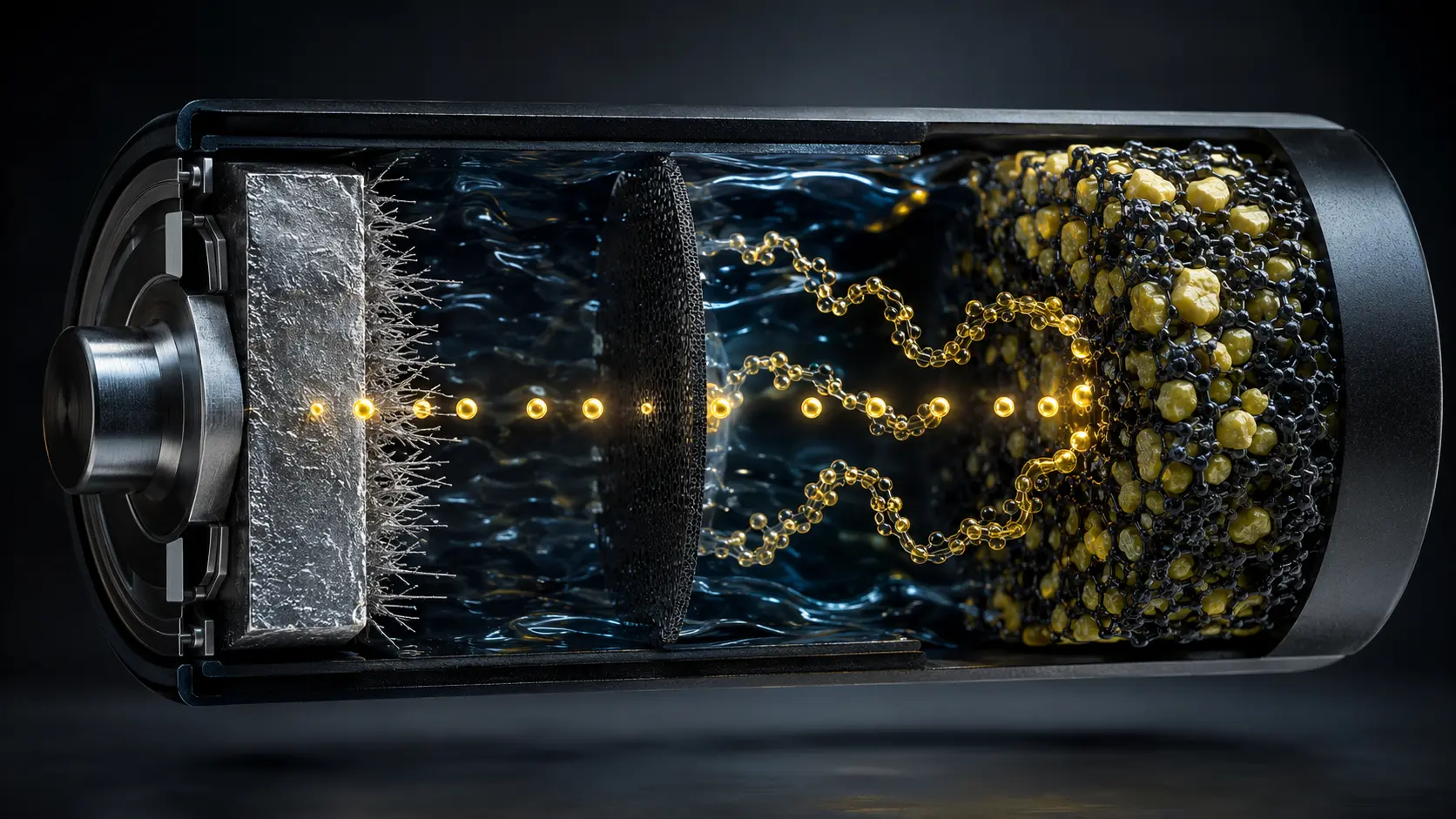
Lithium-sulfur operates on an entirely different conversion chemistry. The cell pairs a pure lithium metal anode with a sulfur-carbon composite cathode. During discharge, the lithium metal anode oxidizes, stripping electrons and sending lithium ions (Li+) across the liquid electrolyte separator.
At the cathode, the solid ring-shaped sulfur molecules (S8) accept these electrons and lithium ions. They break apart through a complex series of reduction reactions. This conversion creates a cascade of intermediate lithium polysulfide compounds.
This intermediate phase introduces the fatal flaw of the architecture: the polysulfide shuttle effect. These long-chain polysulfides are highly soluble in standard organic liquid electrolytes. Instead of remaining at the cathode, they dissolve and physically migrate—or “shuttle”—across the separator to the lithium metal anode.
Once they contact the highly reactive lithium metal, they undergo parasitic reduction. They form insoluble short-chain sulfides that permanently plate the anode. This consumes active sulfur and degrades the lithium metal, resulting in catastrophic capacity fade. The battery effectively eats itself from the inside out.
To bypass this degradation, modern materials scientists engineer highly specialized solvation arrays. They utilize highly concentrated “solvent-in-salt” electrolytes or solid-state polymers that physically lack the molecular space to dissolve the polysulfides. Simultaneously, they encapsulate the sulfur cathode inside microscopic carbon nanotubes or graphene matrices, acting as a physical cage that traps the sulfur while allowing the lithium ions to pass.
REAL WORLD EXAMPLE
In aerospace, the weight penalty of traditional batteries is absolute. Airbus partnered with advanced battery startups to test high-altitude pseudo-satellites (HAPS), like the Zephyr drone.
The Zephyr requires immense energy to maintain station-keeping in the stratosphere overnight when its solar panels cannot collect light. Using standard lithium-ion cells, the aircraft was too heavy to remain airborne indefinitely. By switching to early-generation lithium-sulfur cells, the engineers capitalized on an energy density exceeding 400 Wh/kg. This massive weight reduction allowed the Zephyr to stay aloft for a record-breaking 64 consecutive days, proving the aerospace viability of the chemistry.
WHY IT MATTERS NOW
The global clean energy transition faces a strict metallurgical bottleneck. Modern lithium-ion batteries rely heavily on nickel, manganese, and cobalt (NMC). Cobalt is extremely expensive, politically toxic due to horrific mining practices in the Democratic Republic of Congo, and highly concentrated in Chinese processing supply chains.
Sulfur, by contrast, is a globally abundant byproduct of the petroleum refining industry. It is practically free. A lithium-sulfur battery entirely eliminates the need for cobalt and nickel.
This fundamentally rewrites the geopolitical map of energy storage. It strips influence away from rare-earth mining monopolies and shifts it to nations with advanced chemical engineering capabilities.
Furthermore, commercial electrification is hitting a physical limit. Electric vehicles (EVs) have achieved parity with combustion cars for daily commuting, but heavy industries remain locked out. Long-haul trucking, oceanic shipping, and commercial aviation cannot use lithium-ion because the batteries subtract too much cargo weight.
Lithium-sulfur offers a theoretical maximum gravimetric energy density of 2,600 Wh/kg—over five times the theoretical limit of traditional lithium-ion. While commercial cells currently hover around 400-500 Wh/kg, this is still double the capacity of an EV battery. Reaching 500 Wh/kg is widely is widely considered the absolute threshold required to commercialize short-haul regional electric airplanes.
COMMON MISCONCEPTIONS
- “Lithium-sulfur batteries will replace all EV batteries.” They excel in light weight but struggle with volumetric density, meaning they require more physical space. They will likely dominate aerospace and heavy trucking, while cheaper lithium-iron-phosphate (LFP) cells dominate passenger cars.
- “They use the exact same lithium as current batteries.” Standard batteries use a graphite anode coated in lithium ions. Lithium-sulfur uses a pure, solid lithium metal anode, which presents entirely different safety and manufacturing challenges.
- “Sulfur is dangerous and highly toxic.” While hydrogen sulfide gas is toxic, the solid elemental sulfur used in battery cathodes is a stable, safe, and abundant yellow powder that poses minimal environmental risk compared to heavy metals like cobalt.
WHAT MOST PEOPLE MISS
Battery analysts obsess over the sulfur cathode, but they frequently ignore the extreme volatility of the lithium metal anode.
During charging, lithium ions plate back onto the pure metal surface. If the charging occurs too rapidly, the lithium does not deposit smoothly. It forms microscopic, needle-like structures called dendrites. These dendrites physically pierce the internal battery separator, creating a dead short-circuit that instantly triggers catastrophic thermal runaway and fire.
Protecting this anode requires the formation of a flawless Solid-Electrolyte Interphase (SEI). This microscopic passivation layer allows ions through but physically blocks dendrite growth, ensuring the battery does not destroy itself during rapid charging.
THE ECONOMIC AND STRATEGIC IMPACT
The primary financial beneficiaries are advanced materials startups. Because traditional mega-factories are heavily optimized for lithium-ion roll-to-roll manufacturing, startups that figure out how to directly integrate lithium-sulfur cathode production into existing gigafactory assembly lines will capture massive licensing revenue.
The aerospace industry, including defense contractors and eVTOL (electric vertical takeoff and landing) manufacturers, are the immediate strategic winners. A 50 percent reduction in battery weight directly translates to extended loiter time for military surveillance drones or double the passenger payload for urban air taxis.
Conversely, nickel and cobalt mining conglomerates face a looming demand shock. If high-capacity EV architectures transition toward lithium-sulfur to increase range and reduce weight, the massive capital currently deployed to secure African and Indonesian mining rights will result in stranded financial assets.
THE TRAJECTORY
Next 12–36 Months: Niche commercialization in aerospace. Military drones, high-altitude satellites, and specialized aerospace applications will deploy first-generation commercial lithium-sulfur cells. These applications tolerate the lower lifecycle (fewer total recharges) in exchange for the absolute premium placed on low weight.
Next Five Years: The integration of solid-state sulfur hybrids. Engineers will combine lithium-sulfur cathodes with solid-state ceramic electrolytes. This solid barrier physically stops the polysulfide shuttle effect entirely and suppresses lithium dendrites, pushing the battery lifecycle past the 1,000-charge threshold required for commercial vehicles.
Next Ten Years: The commercialization of regional electric aviation. As lithium-sulfur cells consistently surpass 500 Wh/kg with high safety ratings, major aerospace manufacturers will launch 50-passenger regional electric jets for short-haul routes, drastically reducing domestic aviation carbon emissions.
What Could Go Wrong: Severe volumetric expansion failure. As sulfur absorbs lithium ions during discharge, its physical volume expands by up to 80 percent. This massive mechanical swelling physically fractures the cathode structure over time. If nanomaterials cannot contain this swelling, the battery will crush itself to death from the inside out after a few hundred cycles.
Most Likely Outcome: Lithium-sulfur will not kill lithium-ion; it will fork the energy storage market. Lithium-ion will remain the baseline for stationary grid storage and passenger cars, while lithium-sulfur will become the undisputed, high-margin standard for anything that must fight gravity to move.
KEY TERMS
- Gravimetric Energy Density: A metric defining how much energy a battery can hold relative to its total physical weight, usually measured in Watt-hours per kilogram (Wh/kg).
- Polysulfide Shuttle: A destructive chemical cycle where sulfur dissolves into the electrolyte and migrates across the battery, causing rapid capacity loss.
- Lithium Metal Anode: A negative electrode made of pure, solid lithium metal, offering maximum energy storage but highly prone to dangerous dendrite growth.
- Intercalation: The standard process in lithium-ion batteries where lithium ions smoothly slide in and out of a host material’s crystal structure without breaking it.
- Conversion Chemistry: A battery mechanism where the electrode completely breaks apart and forms new chemical compounds to store energy.
- Solid-Electrolyte Interphase (SEI): A microscopic protective film that forms on the battery’s anode, critical for stabilizing the cell and preventing continuous chemical breakdown.
BEGINNER FAQ
What makes a lithium-sulfur battery different?
Instead of using heavy, expensive metals like cobalt or nickel, it uses sulfur. This makes the battery significantly lighter and cheaper to manufacture while holding vastly more energy.
Why is it important for the battery to be lighter?
Weight is the absolute enemy of transportation. A lighter battery means an electric car can drive much further on a single charge. More importantly, it provides the extreme weight reduction required to make electric airplanes physically possible.
What is the “shuttle effect”?
It is the primary technical flaw of lithium-sulfur. During operation, the sulfur dissolves into a liquid and floats over to the wrong side of the battery, getting stuck and ruining the battery’s ability to hold a charge.
Why aren’t they in electric cars yet?
Because of the shuttle effect, early lithium-sulfur batteries died after only a few dozen recharges. Engineers are currently designing advanced carbon cages and solid materials to trap the sulfur and extend the battery’s lifespan to last for years.
Does sulfur make the battery dangerous?
No. The sulfur itself is a safe, stable powder. The actual danger comes from the pure lithium metal used on the other side of the battery, which can grow microscopic metal spikes that cause short circuits if not carefully managed.
Will this make electric vehicles cheaper?
Yes. Sulfur is an extremely abundant and cheap byproduct of the oil and gas industry. Removing the need for expensive, hard-to-mine metals will drastically lower the cost of the raw materials inside the battery.
Can we manufacture them in current battery factories?
This is a massive engineering challenge. Startups are trying to design lithium-sulfur materials that can be processed using standard factory machinery so companies do not have to rebuild their billion-dollar gigafactories from scratch.
When will we see them in the real world?
They are already being tested in high-altitude drones and specialized military equipment. You will likely see them in premium aerospace applications within three years, and in commercial heavy transport later in the decade.
SOURCES
- Department of Energy (DOE) — Vehicle Technologies Office: Next-Generation Lithium-Sulfur Battery Materials
- The Faraday Institution — Degradation Mechanisms and Polysulfide Shuttle Mitigation in Li-S Cells
- Nature Energy — Solid-State Electrolytes for High-Energy Lithium Metal Batteries
- Argonne National Laboratory — Volumetric Expansion and Cathode Architecture in Conversion Chemistry Batteries