Advertisement
)
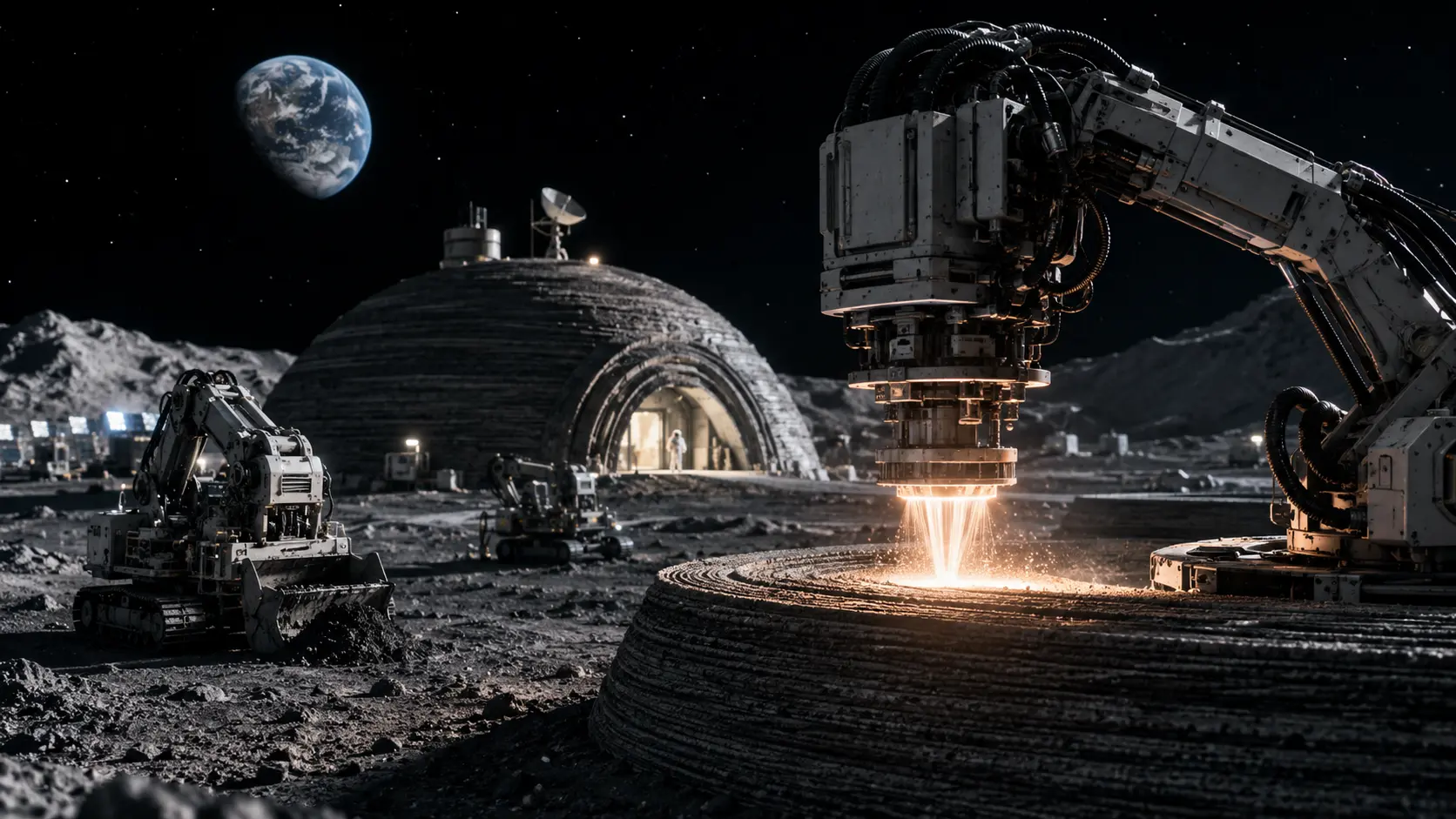

Launching a single brick to the surface of the moon costs approximately $1 million. If the United States intends to build a permanent, crewed Artemis Basecamp by the end of the decade, flying prefabricated steel and concrete modules out of Earth’s gravity well is mathematically and economically impossible. You cannot colonize a new world if you have to import the ground you walk on.
Why should you care right now? Because aerospace engineers have solved the mass penalty by abandoning Earth-based supply chains entirely. Using a process called In-Situ Resource Utilization (ISRU), NASA and commercial partners are deploying autonomous robotic swarms to literally 3D print the lunar basecamp using the moon’s native dirt. By focusing giant microwave arrays onto the radioactive lunar regolith, they can melt the dust into solid, radiation-proof landing pads, roads, and habitats. This marks the first time in human history that we are transitioning from exploring space as tourists to manufacturing infrastructure as permanent residents.
What is Lunar In-Situ Resource Utilization (ISRU)?
Lunar In-Situ Resource Utilization (ISRU) is the practice of harvesting and processing native materials on the moon—primarily lunar regolith and water ice—to manufacture structural infrastructure, breathable oxygen, and rocket propellant. This process drastically reduces mission launch mass, serving as the foundational economic enabler for permanent deep-space human habitation.
At a Glance
- Concept: Sending giant 3D printers to the moon to melt the local dirt into permanent buildings before astronauts arrive.
- Why it matters: It costs too much fuel to fly heavy building materials to the moon. Using local dirt is the only way a permanent basecamp is financially viable.
- Who uses it: NASA’s Artemis Program, commercial space contractors like ICON (Project Olympus), and the European Space Agency (ESA).
- Biggest takeaway: Melting lunar dirt doesn’t just create walls. The extreme heat releases trapped oxygen from the rocks, providing a dual-use byproduct that astronauts can actually breathe.
In Simple Words
Imagine you are hiking deep into a frozen wilderness to build a winter cabin.
If you use Earth-Based Supply Chains, you have to load 500 heavy wooden logs into your backpack and carry them for fifty miles. You will quickly collapse under the weight.
If you use In-Situ Resource Utilization (ISRU), you hike into the wilderness carrying nothing but an empty ice-mold and a small heater. Once you arrive, you shovel the local snow into the mold, heat it slightly, and freeze it into solid ice bricks to build your igloo.
By using the materials that are already there, you travel light, move fast, and can build a structure infinitely larger than what you could have carried on your back.
Why This Matters
For Aerospace Engineers, Space Tech Investors, and Mission Planners, lunar ISRU solves the Tyranny of the Rocket Equation.
To launch one kilogram of cargo to the moon, you need hundreds of kilograms of rocket fuel just to escape Earth’s gravity. To lift that extra fuel, you need even more fuel. This exponential math is the Rocket Equation, and it makes deep-space logistics brutally expensive.
To maintain a permanent presence at the lunar South Pole, the Artemis Basecamp requires blast shields. When a lunar lander fires its engines to land, it kicks up lunar dust at supersonic speeds, acting like a sandblaster that can destroy nearby habitats or solar arrays in seconds. Building landing pads and blast walls is mandatory. Since we cannot afford to launch thousands of tons of concrete, ISRU is not just an optimization—it is an absolute mission-critical prerequisite for human survival.
The Cislunar Supply Chain and Lunar ISRU
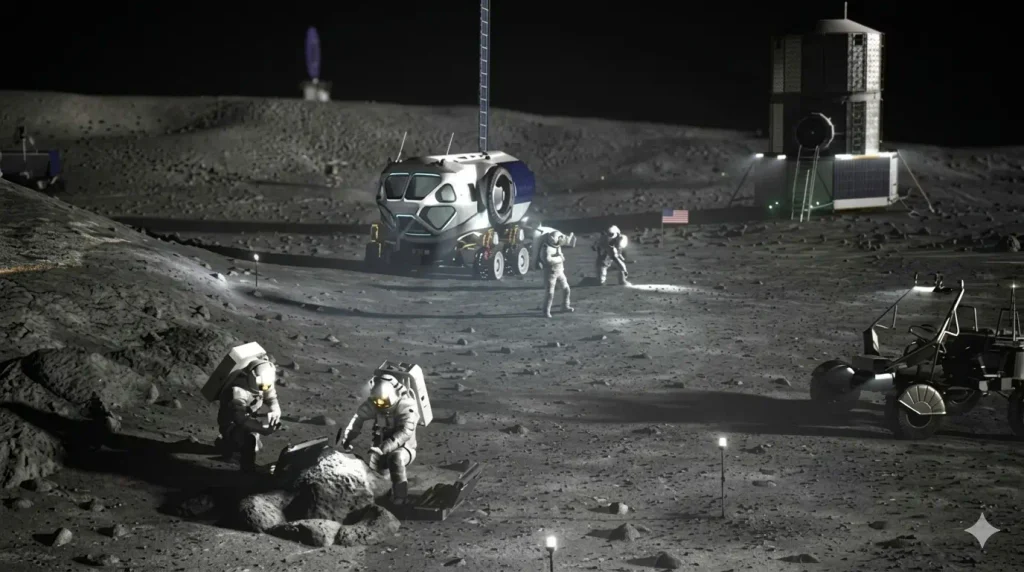
We are witnessing the birth of the Cislunar Supply Chain.
Through 2026 and 2027, the Artemis program’s Commercial Lunar Payload Services (CLPS) initiative will deliver the first generation of heavy ISRU demonstration hardware to the lunar surface. These are not science experiments; they are industrial manufacturing testbeds.
Companies like ICON are paving the way with their Vulcan 3D printer concept, a massive robotic system designed to rove across the lunar surface and extrude melted regolith layer by layer. The successful deployment of these systems transitions the aerospace sector from an exploration mindset to a heavy-industry paradigm, proving that the moon is not just a destination, but a quarry.
How Microwave Sintering Melts Lunar Regolith
Turning abrasive, glass-like space dust into structural architecture in a hard vacuum requires entirely new construction physics. Here is the first-principles breakdown of the architecture.
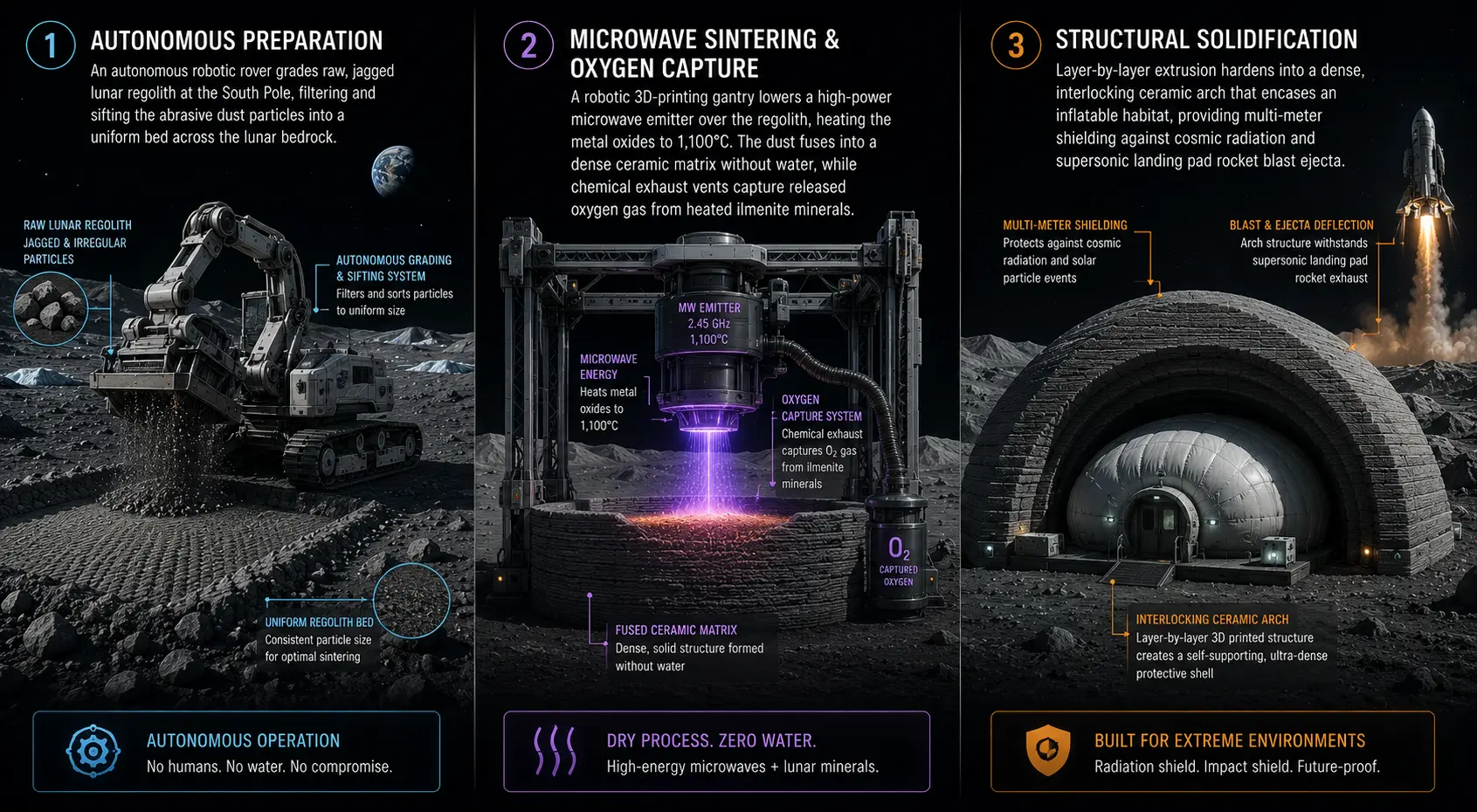
1. The Fundamental Problem: Lunar Concrete Doesn’t Work
Earth concrete requires water to cure. Water is the single most precious resource in space; wasting it to mix concrete is unacceptable. Furthermore, the moon has no atmosphere and experiences temperature swings from 120°C in the sun to -130°C in the shade. Standard liquid binders would instantly boil off or freeze solid.
2. The Core Mechanism: Microwave Sintering
Instead of a liquid binder, engineers use directed thermal energy. Lunar regolith is rich in iron, magnesium, and silica. A robotic 3D printer lowers a massive microwave emitter (or high-power laser) directly over the dirt. The microwaves excite the metal oxides in the dust, heating them to over 1,100°C.
3. Technical Depth: The Sintering State
The regolith is not heated until it becomes a runny liquid. Instead, it is “sintered.” The heat causes the jagged edges of the dust particles to melt slightly and fuse together at the molecular level, forming a dense, dark gray ceramic solid. The robot moves slowly across the surface, sintering the dirt layer by layer into landing pads or arched habitat shells.
Micro-Insight: Sintered regolith is incredibly brittle under tension, much like unreinforced concrete. Engineers design lunar habitats as rounded domes or arches, which rely entirely on compressive strength to support their own weight.
4. Technical Depth: Ilmenite Reduction for Oxygen
The moon’s dirt is roughly 40% to 45% oxygen by weight, trapped chemically in minerals like Ilmenite (FeTiO₃). When the 3D printers heat the regolith to extreme temperatures, they can pass hydrogen or methane gas over the molten dirt. This chemical reaction strips the oxygen out of the rock. The printer can literally capture this exhaust gas, providing breathable oxygen for astronauts while simultaneously building their house.
5. Real-World Consequences: Autonomous Swarm Assembly
Because there is a 2.5-second communication delay between Earth and the moon, a human operator cannot joy-stick a 3D printer in real-time. The construction rovers must be fully autonomous swarms. One robot bulldozes and grades the dirt; another scoops and sifts it to the right particle size; the third follows behind, actively sintering the graded path into a smooth, solid ceramic road.
Lunar Regolith Sintering Simulator
Lunar ISRU Microwave Sintering Simulator
Thermodynamic Optimization of 3D Printed Regolith
50 kW
10 kW
100 kW
5 Sec / Layer
1 Sec (Fast)
10 Sec (Slow)
Structural Density
0%
Energy Efficiency
0%
Output State
AWAITING DATA
Thermodynamic Rules: Microwaves selectively heat metals. Mare Basalt contains nanophase iron, which acts as a microwave “susceptor,” absorbing energy rapidly and sintering efficiently at lower power. Highland Anorthosite lacks iron, requiring drastically more Power and Time to reach melting temperatures. If total energy is too low, the structure remains brittle dust. If power is pushed too high, it melts into a useless, glass-like pool, devastating the rover’s Energy Efficiency. Finding the precise thermodynamic balance is the core engineering challenge of lunar 3D printing.
Artemis Basecamp Infrastructure Applications
The deployment of lunar ISRU directly enables the scale-up of the Artemis mission architecture.
Landing Pads and Blast Shields: The most urgent requirement for the Artemis program is a hardened landing pad. Unprotected lunar dust is highly abrasive. When a 50-ton lander touches down, the engine exhaust ejects microscopic glass shards at 3,000 meters per second into orbit, completely shredding any nearby solar panels or habitats. 3D printing a solid, 100-meter sintered landing pad is the mandatory first step before multiple spacecraft can safely operate in close proximity.
Cosmic Radiation Shielding: The moon lacks a magnetic field, exposing astronauts to lethal doses of solar radiation and galactic cosmic rays. The most effective shield against radiation is sheer mass. Autonomous rovers will 3D print thick, multi-meter shells of sintered regolith directly over the inflatable, pressurized crew habitats. The astronauts live safely inside a pressurized aluminum can, buried under a 3D-printed ceramic mountain.
Road Networks and Dust Mitigation: Lunar dust adheres to spacesuits and rapidly degrades mechanical seals and life support systems. Building sintered roads between the landing pad, the solar array fields, and the main habitat allows astronaut rovers to transit without kicking up suffocating clouds of electrostatic dust, drastically extending the operational lifespan of the multi-billion-dollar spacesuits.
Economic & Strategic Impact
The core strategic consequence of lunar ISRU is the Decoupling of Orbital Expansion from Earth’s Gravity Well.
Currently, every space program operates on a “carry-along” model. When you shift to a “live-off-the-land” model, the economics of deep space travel flip. If a spacecraft can launch from Earth empty, land on the moon, and refuel using ISRU-generated liquid oxygen (LOX), the size of the rocket required to go to Mars drops exponentially.
The nation or corporation that controls the lunar ISRU hardware effectively controls the gas stations and the construction firms of the inner solar system. For aerospace venture capital, investing in lunar 3D printing companies is a direct proxy bet on the monopolization of off-world real estate development.
Advantages
- Extreme Cost Reduction: Bypasses the staggering $1 million-per-kilogram launch mass penalty by utilizing infinite native materials.
- Inherent Radiation Protection: Thick layers of dense, 3D-printed lunar ceramic offer vastly superior protection against cosmic rays and micrometeorite impacts compared to thin aluminum hull plating.
- Dual-Use Byproducts: High-temperature processing of regolith chemically liberates trapped oxygen, providing critical life-support consumables as a free byproduct of the construction cycle.
Limitations
- Electrostatic Dust Degradation: Lunar regolith is razor-sharp and highly electrostatically charged. It penetrates the mechanical joints and optical sensors of the 3D printing robots, risking catastrophic hardware failure before the basecamp is finished.
- Extreme Power Requirements: Generating the microwaves or lasers required to melt rock at 1,100°C requires massive electrical grids. ISRU robots must be tethered to multi-kilowatt solar arrays or advanced fission surface power (FSP) nuclear reactors.
- Low Tensile Strength: Sintered regolith performs like unreinforced concrete; it is incredibly strong when compressed, but pulls apart easily under tension. Designing safe, pressurized habitats requires highly specific, vaulted architectural geometries.
Takeaway: You cannot build skyscrapers on the moon. Because lunar concrete has no steel rebar inside it to prevent stretching, lunar architecture is forced to mimic the rounded arches of ancient Roman aqueducts.
Common Misconceptions
Misconception: We are sending 3D printers that squeeze out liquid plastic.
Reality: Plastic degrades instantly under the high UV radiation and extreme thermal cycling of the lunar surface. The “printers” are actually directed-energy arrays (lasers or microwaves) that melt the existing ground into rock.
Misconception: Humans will drive the 3D printers.
Reality: The printers will arrive years before the astronauts. They will operate autonomously in swarms, slowly crawling across the surface for months, guided by AI to complete the landing pads and radiation shells before human crews land.
Misconception: Lunar dirt is just like Earth sand.
Reality: Earth sand has been weathered smooth by wind and water for billions of years. The moon has no weather. Lunar regolith is composed of microscopic, jagged shards of glass created by billions of years of meteorite impacts. It is highly abrasive and clings to everything like static cling.
What Most People Miss
The disruptive capability of Microwave Selective Heating.
When analysts look at melting regolith, they assume the robots use lasers to blast the dirt from above. What they miss is the distinct thermodynamic advantage of microwaves.
Lasers only heat the top surface of the dust; the heat then has to slowly conduct downward, which is highly inefficient in a vacuum. Microwaves penetrate deep into the regolith volume, heating the material from the inside out. Furthermore, certain minerals in the regolith (like nanophase iron) absorb microwaves significantly faster than others. By tuning the exact frequency of the microwave emitter, engineers can selectively melt the iron particles first, creating a web of liquid metal that glues the surrounding rock together using a fraction of the energy required by a surface laser.
Comparison Table
| Feature | Earth-Launched Prefabricated Modules | Lunar ISRU 3D-Printed Infrastructure |
| Launch Mass Cost | Astronomically High ($1M / kg) | Near-Zero (Uses native dirt) |
| Radiation Shielding | Poor (Thin aluminum walls) | Excellent (Thick ceramic shells) |
| Supply Chain | Vulnerable to Earth launch delays | Autonomous & Independent |
| Power Requirement | Low (Pre-assembled) | Extreme (Megawatts for sintering) |
| Architectural Limit | Restricted by rocket fairing size | Unlimited (Prints across surface) |
Case Study
Situation: In 2022, NASA awarded a $57.2 million contract to ICON, a Texas-based construction technologies firm, to develop the underlying architecture for Project Olympus—a space-based construction system designed to build the Artemis Basecamp using only local lunar regolith. NASA recognized that sending unprotected, soft-shell habitats to the lunar South Pole left crews vulnerable to lethal solar flare radiation events and catastrophic micrometeoroid impacts.
Challenge: Design an autonomous, multi-purpose robotic 3D-printing architecture capable of ingesting, grading, and solidifying raw lunar regolith into high-strength, radiation-proof structures without requiring liquid binders or human maintenance.
Solution (The Olympus System): ICON developed an integrated robotic hardware and software stack utilizing directed energy deposition. Instead of attempting to mix the regolith with imported polymers, the system employs high-powered lasers and microwaves to execute localized, layer-by-layer sintering. The team tested the system extensively on Earth using highly accurate lunar simulant (JSC-1A), validating the thermodynamic parameters required to melt the jagged shards into a continuous ceramic matrix.
Outcome: The testing proved that microwave-sintered regolith achieves compressive strengths exceeding standard terrestrial concrete. The architecture was finalized as a multi-robot swarm: one specialized for site grading, and another acting as the primary extrusion gantry. By decoupling the binding process from water, ICON provided NASA with the baseline technological framework required to begin scheduling heavy CLPS lander manifests aimed at preparing the South Pole for sustained human habitation.
Lessons Learned: The project validated that the hardest part of off-world construction is not the structural engineering; it is the raw material handling. Managing the flow of statically charged, abrasive dust through a robot’s internal hoppers without destroying the machine is the ultimate bottleneck to autonomous space manufacturing.
Future Outlook
Next 12–24 Months
The era of Lunar Surface Technology Demonstrations. Through 2026 and 2027, the Artemis program will aggressively deploy CLPS landers carrying scaled-down ISRU testbeds. We will see the first robotic rovers attempting to melt small, meter-wide patches of lunar regolith in the actual vacuum and thermal extremes of the lunar South Pole. These critical “first light” demonstrations will provide the exact thermodynamic telemetry required to calibrate the software for the massive, full-scale 3D printers being designed by commercial contractors.
Next 3–5 Years
The scaling of The Autonomous Construction Swarm. By the end of the decade, heavy-lift rockets like SpaceX’s Starship will land the full-scale construction gantries. Operating completely autonomously, these swarms will spend 18 to 24 months slowly driving across the Shackleton Crater rim. They will grade the crater floor, sinter the first 100-meter landing pads, and extrude the massive, vaulted ceramic shells that will eventually cover the inflatable crew habitats. The moon will host an active, uncrewed construction site.
Next 10 Years
The Cislunar Extractive Economy. By the mid-2030s, 3D printing will expand from basic habitats into complex industrial manufacturing. The sintering heat will be captured and routed into chemical reduction plants to harvest hundreds of tons of liquid oxygen from the dirt. The Artemis Basecamp will transition into a fully functional orbital gas station. Spacecraft bound for Mars will launch from Earth empty, dock at the lunar Gateway, and refuel using propellant entirely manufactured and stored within 3D-printed lunar silos, permanently unlocking the deeper solar system.
Most Likely Scenario
In-Situ Resource Utilization is not an optional upgrade; it is the absolute mathematical threshold for becoming a multi-planetary species. The commercial development of microwave sintering and autonomous robotic swarms has successfully solved the gravity well mass penalty. While the abrasive nature of lunar dust will undoubtedly cause early hardware failures and timeline delays, the core physics of melting regolith into architecture are sound. The 3D printing of the Artemis Basecamp represents the exact moment human civilization stops visiting space and begins occupying it.
Key Takeaways
- Launching building materials from Earth costs $1 million per kilogram, making it financially impossible to build a lunar base using Earth concrete or steel.
- In-Situ Resource Utilization (ISRU) solves this by sending 3D-printing robots to the moon to build landing pads and habitats using the moon’s native dirt (regolith).
- Because the moon has no water to mix concrete, the robots use high-powered lasers or microwaves to melt the dust at 1,100°C, fusing it into a solid, high-strength ceramic.
- These thick, 3D-printed ceramic shells are mandatory for human survival; they act as blast shields against rocket exhaust and protect astronauts from lethal cosmic radiation.
- Heating the moon dirt to extreme temperatures also releases trapped oxygen, providing a dual-use byproduct that astronauts can breathe and use as rocket fuel.
Glossary
Artemis Basecamp: NASA’s planned permanent human settlement located near the lunar South Pole, designed to enable sustained exploration and eventual missions to Mars.
Cislunar Space: The area of space between the Earth and the Moon, which will host the supply chains and orbital stations supporting the lunar economy.
In-Situ Resource Utilization (ISRU): The practice of collecting, processing, and utilizing native resources found on other planets or moons to replace materials that would otherwise need to be brought from Earth.
Lunar Regolith: The fine, abrasive, jagged, and electrostatically charged dust and rock fragments that completely cover the surface of the moon.
Microwave Sintering: A manufacturing process that uses microwave energy to heat a powdered material (like lunar dust) just below its melting point, causing the particles to fuse together into a solid mass.
Project Olympus: A massive NASA-funded initiative led by commercial firm ICON to develop a fully autonomous 3D-printing construction system for the lunar surface.
Rocket Equation: The mathematical formula that shows that to launch more weight into space, you need more fuel, which itself adds weight, making heavy deep-space transport exponentially expensive.
Sources
NASA: In-Situ Resource Utilization (ISRU) Technology Overview
ICON: Project Olympus: Off-World Construction
European Space Agency (ESA): 3D Printing a Lunar Base from Lunar Soil
Journal of Aerospace Engineering: Microwave Sintering of Lunar Regolith Simulant for Extraterrestrial Construction
MIT Technology Review: How to 3D print a habitat on the moon