Advertisement
)
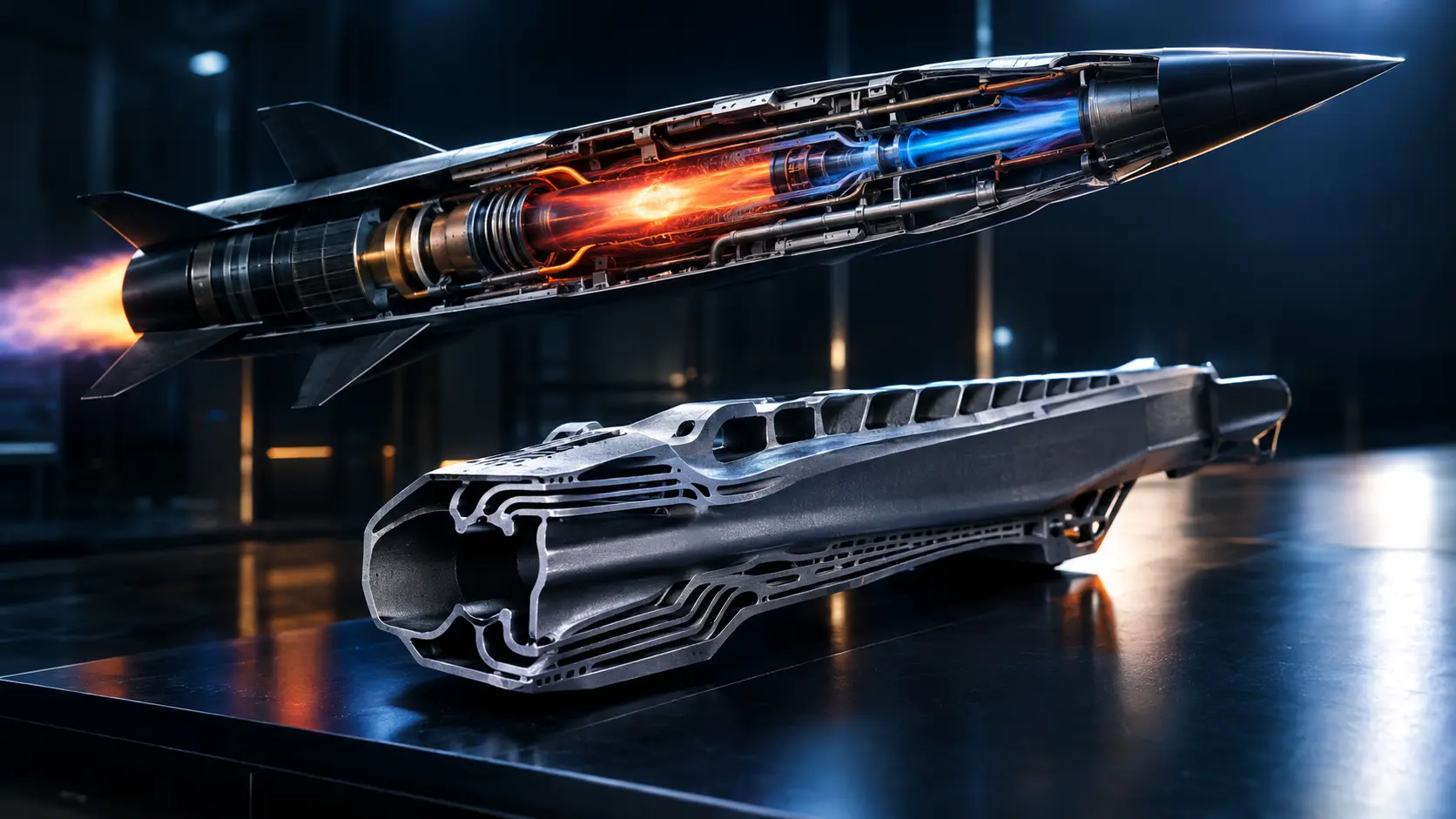

In the high-stakes arms race for hypersonic supremacy, the United States Department of Defense has successfully achieved sustained Mach 5 flight. But victory in a peer-to-peer conflict is not determined solely by who has the fastest missile; it is determined by who has the deepest magazine. Currently, advanced hypersonic cruise missiles are built like bespoke Swiss watches. Highly specialized technicians hand-weld exotic alloys and meticulously assemble hundreds of individual scramjet components, limiting production to a mere handful of units per year. If a major conflict erupts, this artisanal supply chain will be completely exhausted in the opening 48 hours.
Why should you care right now? Because the military is officially pausing the pursuit of purely experimental speeds to focus on brutal industrial reality. Through initiatives like DARPA’s late-2026 Next Generation Hypersonic Cruise Missile (NGHCM) program, the aerospace sector is forcefully implementing Design for Manufacturing and Assembly (DFMA). By consolidating complex scramjet engines into single, 3D-printed blocks of high-temperature superalloys, defense contractors are attempting to transform hypersonic weapons from multi-million-dollar laboratory prototypes into mass-produced munitions. This industrial pivot will dictate whether a military can sustain a prolonged hypersonic engagement or run out of ammunition on day two.
What is Scramjet DFMA?
Scramjet Design for Manufacturing and Assembly (DFMA) is an aerospace engineering methodology that redesigns hypersonic air-breathing engines for rapid, high-volume mass production. By replacing hundreds of hand-assembled components with single-piece, additively manufactured superalloys, DFMA drastically reduces unit costs, assembly times, and supply chain bottlenecks to enable wartime stockpiling.
At a Glance
- Concept: Stopping the practice of building missiles by hand and redesigning them so they can be 3D printed and assembled on an automated factory line.
- Why it matters: A hypersonic missile is useless as a deterrent if an adversary knows you only have twelve of them in your entire inventory. DFMA ensures we can build thousands.
- Who uses it: DARPA, the US Air Force, Raytheon (RTX), Northrop Grumman, and advanced additive manufacturing defense suppliers.
- Biggest takeaway: Going from Mach 5 to Mach 7 is a physics problem. Going from building 5 missiles a year to 500 missiles a year is an industrial engineering problem. DFMA solves the latter.
In Simple Words
Imagine trying to build a modern sports car by carving every individual engine piece out of solid metal and having a master mechanic glue them together by hand. The car would be incredibly fast, but it would cost $10 million and take a year to build one. You could never supply a whole city with cars this way.
This is how we currently build Scramjets (the engines that power hypersonic cruise missiles). Because they fly at 4,000 miles per hour, they get incredibly hot. To stop them from melting, engineers historically had to hand-weld hundreds of tiny metal cooling tubes together.
DFMA (Design for Manufacturing and Assembly) completely changes the blueprint. Instead of making 200 tiny tubes, engineers use advanced 3D metal printers to print the entire engine as one solid, continuous piece of metal, with the cooling tubes already perfectly hollowed out inside. The assembly time drops from months to days, the parts fit together perfectly every time, and the factory can finally start churning out missiles fast enough to actually stock a military arsenal.
Why This Matters
For Defense Contractors, Aerospace Engineers, and Military VCs, this shift addresses the Magazine Depth Crisis.
During recent global conflicts, military planners observed a terrifying reality: modern, high-intensity warfare consumes precision-guided munitions at an astronomical rate. Artillery shells and standard cruise missiles are being fired faster than the global industrial base can replace them.
Hypersonic weapons are orders of magnitude more complex than standard munitions. A scramjet engine must maintain stable combustion while air is forced through it at supersonic speeds—often compared to keeping a match lit in a hurricane. Because early prototypes like the Hypersonic Air-breathing Weapon Concept (HAWC) focused purely on proving that this “lit match” physics actually worked, engineers compromised on manufacturability. They used exotic, un-scalable fabrication techniques just to get the prototypes into the air.
As programs transition into the Hypersonic Attack Cruise Missile (HACM) and the 2026 DARPA NGHCM, the Pentagon is refusing to buy weapons that cannot be mass-produced. DFMA is now a mandatory prerequisite for defense contracts. If a prime contractor pitches a missile with superior speed but an artisanal supply chain, they will lose the multi-billion-dollar contract to a competitor pitching a slightly slower missile that can be printed by the thousands.
Micro-Insight: In defense procurement, a “good enough” missile you can build 1,000 of is strategically infinitely more valuable than a “perfect” missile you can only build 10 of.
Transitioning Hypersonics to a Munitions Commodity
We are witnessing the transition of hypersonics from Boutique R&D to Munitions Commodity.
For the past twenty years, hypersonics have been the domain of PhD physicists and experimental test pilots. The implementation of DFMA marks the moment hypersonics leaves the laboratory and enters the factory floor. By standardizing component geometries, reducing part counts, and automating the thermal management systems through additive manufacturing, the defense base is treating Mach 5 scramjets with the same industrial ruthlessness as the automotive industry treats internal combustion engines.
How Scramjet DFMA Uses Additive Manufacturing
Transforming a hypersonic scramjet from an artisanal prototype to a mass-produced weapon requires completely re-engineering thermal thermodynamics. Here is the first-principles breakdown of the architecture.
1. The Fundamental Problem: Aerodynamic Heating
When a missile flies at Mach 5 (roughly 3,800 mph) through the atmosphere, the friction of the air rubbing against the missile creates extreme aerodynamic heating. Temperatures inside the scramjet combustor can easily exceed 3,000°F (1,650°C), which will melt standard aerospace aluminum or titanium into slag in seconds.
2. The Core Mechanism: Regenerative Cooling
To prevent the engine from melting, engineers use the missile’s own jet fuel as a coolant. Before the fuel is injected into the engine to be burned, it is pumped through a labyrinth of microscopic channels wrapped tightly around the outside of the combustion chamber. The cold fuel absorbs the heat from the engine walls (cooling the engine) and becomes super-heated in the process (making it burn more efficiently). This is called regenerative cooling.
3. Technical Depth: The Assembly Bottleneck
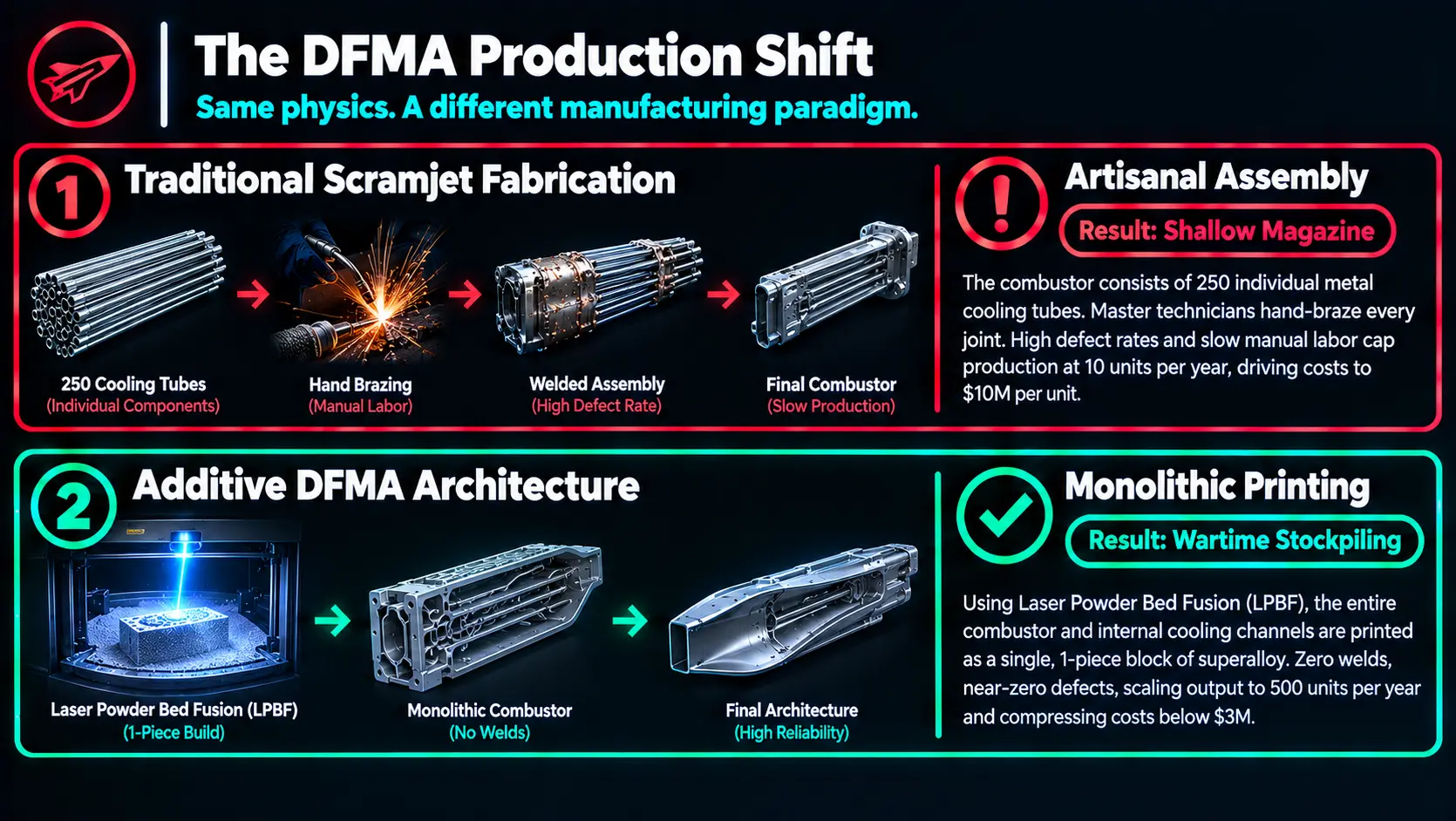
Historically, building a regeneratively cooled scramjet was a nightmare. Machinists had to physically manufacture hundreds of individual, microscopic metal cooling tubes, bend them to the exact shape of the engine, and hand-braze (weld) them together. If a single weld out of a thousand was flawed, the high-pressure fuel would leak, and the missile would explode in mid-air. This hand-brazing resulted in a massive “part rejection rate”, destroying production scalability.
4. Technical Depth: Additive Manufacturing (DFMA)
Design for Manufacturing and Assembly explicitly eliminates this hand-brazing. Instead of assembling tubes, contractors use Laser Powder Bed Fusion (LPBF)—a high-end 3D printing technique. A laser melts microscopic layers of exotic superalloy powder (like Inconel or specialized niobium alloys) layer-by-layer.
The entire scramjet combustor, complete with the microscopic internal cooling channels, is printed as one single, continuous, monolithic block of metal.
5. Real-World Consequences: Production Velocity
By applying DFMA, a scramjet that previously required 250 parts and 6 months of skilled manual labor is reduced to a 5-part assembly that can be printed in a matter of days. The monolithic design eliminates hundreds of potential points of failure (welds/seals), making the missile exponentially more reliable while allowing automated robotic factories to scale output to match wartime expenditure rates.
DFMA Hypersonics: Traditional vs. Additive
Simulating Scramjet Production Scalability and Unit Cost Compression
Factory Time Scale
Month 1
Manufacturing Methodology
Traditional Hand-Brazing
Additive DFMA (3D)
Total Missiles Produced
0 Units
Cost Per Unit
$8.00M
Assembly Defect Rate
28.0%
Assembly Line Visualization
ARTISANAL ASSEMBLY (SLOW)
Production Volume & Unit Cost vs. Time
DARPA NGHCM and HACM Contract Deployments
The pivot to manufacturability is currently dictating the flow of billions of dollars in Pentagon contracts.
DARPA Next Generation Hypersonic Cruise Missile (NGHCM): In late 2026, DARPA launched the NGHCM program to move beyond the limitations of early prototypes.While the program seeks advanced speed and range, the core distinguishing feature of the Request for Information (RFI) was an aggressive mandate for affordability and large-scale production.DARPA explicitly stated that previous demonstrators established technical feasibility but failed to establish wartime affordability. DFMA is being hard-coded into the NGHCM requirement trades from day one.
Raytheon and Northrop Grumman (HACM): The Hypersonic Attack Cruise Missile (HACM) is the premier air-breathing hypersonic program for the US Air Force, with Northrop Grumman supplying the scramjet engine to Raytheon. To transition from testing to operational fielding, Northrop Grumman has heavily invested in digital engineering and additive manufacturing to reduce the part count of the scramjet combustor. By optimizing the engine for 3D printing, they are establishing the blueprint for the first true high-rate hypersonic assembly line in US history.
Solid Rocket Motor (SRM) DFMA: While the scramjet sustains Mach 5 flight, every cruise missile needs a traditional Solid Rocket Motor (SRM) booster to accelerate it to Mach 5 before the scramjet can turn on. The DFMA philosophy is simultaneously being applied to these boosters. Companies are using robotic continuous-mixing of solid propellants and 3D-printed composite casings to eliminate the intense manual labor traditionally required to cast and cure rocket motors.
The Strategic Impact on Hypersonic Unit Costs
The core strategic consequence of Scramjet DFMA is the Compression of the Unit Cost.
In the current paradigm, hypersonic boost-glide vehicles (like the Army’s Dark Eagle) can cost upwards of $40 million per shot. This restricts their use to only the highest-value strategic targets (e.g., an enemy aircraft carrier or central command node).
Air-breathing scramjet cruise missiles are inherently smaller and cheaper than boost-glide vehicles because they pull oxygen from the air instead of carrying massive, heavy tanks of liquid oxidizer. By coupling this inherent architectural advantage with DFMA additive manufacturing, the DoD aims to compress the unit cost of a hypersonic cruise missile down to the $2 million to $4 million range. At this price point, commanders can expend hypersonics tactically against distributed air defense nodes and mobile missile launchers, completely overwhelming adversary anti-access/area denial (A2/AD) networks through sheer volume of fire.
Advantages
- Massive Throughput: Reduces fabrication and assembly times from months to weeks, enabling defense contractors to build hundreds of missiles per year.
- Enhanced Reliability: Consolidating 250 brazed parts into a single monolithic printed component eliminates hundreds of potential points of failure (leaks, cracked welds) under extreme Mach 5 vibration.
- Rapid Iteration: If a design flaw is found during a flight test, engineers simply update the CAD file and 3D print a new engine the next day, bypassing the need to re-tool expensive physical factory molds.
- Geometric Freedom: Additive manufacturing allows engineers to create internal cooling channels with complex, organic geometries that are physically impossible to create using traditional drills and lathes.
Limitations
- Powder Supply Chain: 3D printing scramjets requires thousands of pounds of exotic, aerospace-grade superalloy powder (e.g., specialized niobium or high-entropy alloys). The global supply chain for these raw powders is tight and vulnerable to geopolitical shocks.
- Printer Throughput: A high-end Laser Powder Bed Fusion (LPBF) machine can take several days to print a single large scramjet combustor. To achieve a rate of 500 missiles a year, a contractor must buy, house, and power a massive “printer farm” of multi-million-dollar machines.
- Surface Finish Friction: 3D printed parts have a microscopic roughness to their surface. Inside a scramjet, supersonic airflow demands perfectly smooth walls to prevent drag and premature combustion. Printed engines still require time-consuming post-processing (polishing or chemical etching) to achieve flight-ready smoothness.
Takeaway: DFMA solves the assembly bottleneck, but it creates a new capital equipment bottleneck. The limit on hypersonic production is no longer how many master welders you can hire; it is how many industrial 3D printers you can afford to plug into the wall.
Common Misconceptions
Misconception: We already have plenty of hypersonic missiles.
Reality: The United States has successfully tested prototypes, but the actual operational inventory (magazine depth) is incredibly shallow. Without DFMA, we have a bespoke capability, not a warfighting arsenal.
Misconception: Scramjets and Boost-Glide vehicles are the same thing.
Reality: A boost-glide vehicle (like the Navy’s CPS) is launched into space on a massive rocket and glides down.A scramjet cruise missile (like NGHCM or HACM) flies like a normal airplane within the atmosphere, breathing oxygen. Scramjets are smaller, fit on fighter jets, and are much easier to mass-produce via DFMA.
Misconception: 3D printing is only used for prototyping.
Reality: While true a decade ago, modern LPBF additive manufacturing produces superalloys that are structurally stronger and more heat-resistant than traditionally forged metals. They are used for the final, end-use flight hardware.
What Most People Miss
The disruptive capability of Platform Flexibility and Payload Agnosticism.
When analysts look at the NGHCM and HACM programs, they focus heavily on the engine. What they miss is the modularity enabled by DFMA.
Because the propulsion system is consolidated into a single, standardized, reliable block, defense engineers can easily iterate the front half of the missile. A single mass-produced scramjet backend can be mated to an electronic warfare (EW) payload, a kinetic penetrator, or an intelligence, surveillance, and reconnaissance (ISR) sensor package. This allows the Air Force to use the exact same manufacturing assembly line to produce a diverse family of tactical weapons, drastically lowering the integration costs for new capabilities.
Comparison Table
| Metric | Traditional Manufacturing | Additive Manufacturing (DFMA) |
| Part Count (Combustor) | 150 – 300 individual parts | 1 to 5 Monolithic Parts |
| Assembly Method | Hand-brazing, manual welding | Laser Powder Bed Fusion (LPBF) |
| Defect Rate | High (Welding leaks) | Low (Continuous material) |
| Design Flexibility | Constrained by machining tools | Unconstrained (Internal channels) |
| Production Scaling | Linear (Requires more skilled labor) | Exponential (Requires more printers) |
Future Outlook
Next 12–24 Months
The era of Digital Twin Validation. Through 2027, the aerospace primes responding to the DARPA NGHCM request for information will rely heavily on digital engineering. Before a single printer is turned on, the entire DFMA assembly line will be simulated in a digital twin environment. The primary focus will be proving to the DoD that their proposed manufacturing process can yield 50 to 100 defect-free scramjet cores per month without breaking the supply chain for raw materials.
Next 3–5 Years
The scaling of The Hypersonic Foundry. By 2030, we will see the completion of dedicated hypersonic manufacturing facilities. Unlike traditional sprawling aerospace hangars filled with riveting stations, these facilities will resemble semiconductor cleanrooms. Rows of automated 3D metal printers will run 24/7 in “lights-out” manufacturing environments, feeding monolithic scramjet components into robotic inspection bays to achieve unprecedented aerospace production rates.
Next 10 Years
The Tactical Hypersonic Saturation Era. By the mid-2030s, the unit cost compression enabled by DFMA will completely alter military doctrine. Hypersonic cruise missiles will no longer be hoarded for strategic “silver bullet” strikes against high-value targets. They will be mass-deployed on tactical fighter aircraft like the F-15EX and F-35, allowing battlefield commanders to saturation-bomb adversary air defense networks with un-interceptable munitions, rendering current anti-access/area denial (A2/AD) strategies obsolete.
Most Likely Scenario
Design for Manufacturing and Assembly is the ultimate hurdle in the hypersonic arms race. While early programs proved that scramjet physics work, the DARPA NGHCM program officially acknowledges that a weapon is only strategically viable if it is affordable and scalable. By aggressively leveraging additive manufacturing to consolidate part counts and eliminate artisanal hand-assembly, the US defense industrial base will successfully transition hypersonic cruise missiles into high-rate production by the end of the decade.
Key Takeaways
- While hypersonic missiles have been successfully tested, they are currently built by hand, limiting production to a few units per year and driving unit costs to unsustainable levels.
- To solve this, DARPA and aerospace contractors are aggressively pushing Design for Manufacturing and Assembly (DFMA) to prepare for high-rate, wartime mass production.
- Scramjets experience extreme heat and must be cooled by pumping fuel through microscopic channels. Hand-welding these channels results in massive defect rates.
- DFMA utilizes 3D printing (additive manufacturing) to print the entire scramjet engine and its internal cooling channels as a single, solid piece of metal, eliminating hundreds of parts.
- By printing monolithic engines, defense contractors can compress the unit cost, automate the assembly line, and build the deep magazines required to deter peer-to-peer conflict.
Glossary
Additive Manufacturing: The industrial term for 3D printing. In hypersonics, it usually refers to melting metal powders with lasers to build complex components layer by layer.
A2/AD (Anti-Access/Area Denial): An adversary’s strategy of using long-range missiles and advanced radar to prevent US forces from entering a specific geographic theater.
DFMA (Design for Manufacturing and Assembly): An engineering philosophy that designs a product specifically so it can be manufactured easily, cheaply, and quickly on an automated assembly line.
HACM (Hypersonic Attack Cruise Missile): A flagship US Air Force program developing a scramjet-powered hypersonic missile that can be launched from tactical fighter jets.
Magazine Depth: A military term referring to the total inventory of available munitions. A “shallow” magazine means you will run out of missiles quickly in a war.
Regenerative Cooling: A thermal management technique where a vehicle’s cold jet fuel is routed through the hot engine walls to cool the engine before the fuel is injected and burned.
Scramjet (Supersonic Combustion Ramjet): An air-breathing engine designed to operate at hypersonic speeds (Mach 5+), relying on the forward speed of the vehicle to compress incoming air without using moving turbine blades.
Sources
DARPA: Next Generation Hypersonic Cruise Missile (NGHCM) Request for Information
Air Force Life Cycle Management Center: HACM Transition to High-Rate Production
Physical Sciences Inc.: Additively Manufactured Scramjets and DFMA Integration
National Defense Industrial Association (NDIA): The Hypersonic Supply Chain and Magazine Depth Crisis
Raytheon (RTX) / Northrop Grumman: Hypersonic Air-Breathing Propulsion Architectures