Advertisement
)

At a Glance
Concept: Using magnetic fields to hold plasma at temperatures hotter than the sun’s core without touching physical walls.
Why it matters: Successfully mastering this technology promises nearly infinite, clean, baseload electricity for human civilization.
Who uses it: International research coalitions, national laboratories, and private climate-tech startups.
Biggest takeaway: The fundamental science of fusion is proven; the remaining barrier is entirely a problem of extreme materials engineering and plasma stability.
In Simple Words
Nuclear fusion is the process that powers the stars. Inside the sun, immense gravity crushes hydrogen atoms together until they merge, releasing massive amounts of light and heat.
On Earth, we do not have the sun’s gravity. To force atoms to fuse, we have to heat them to over 100 million degrees Celsius—nearly ten times hotter than the center of the sun. At this temperature, matter turns into a volatile, electrically charged soup called plasma.
The problem is containment. No physical material in the universe can hold something that hot; any metal or ceramic would vaporize instantly.
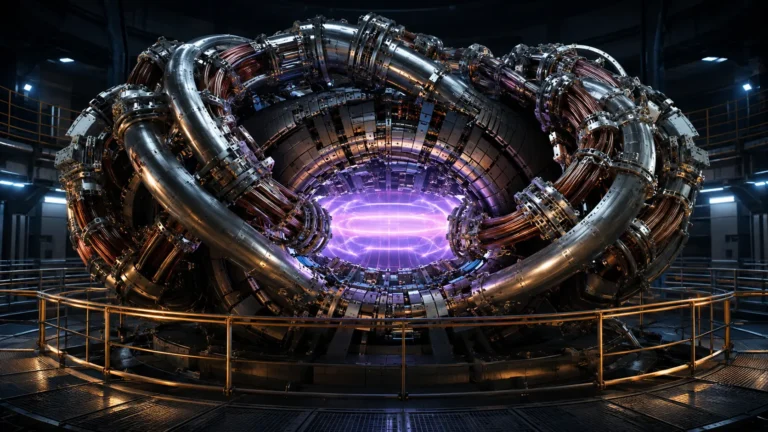
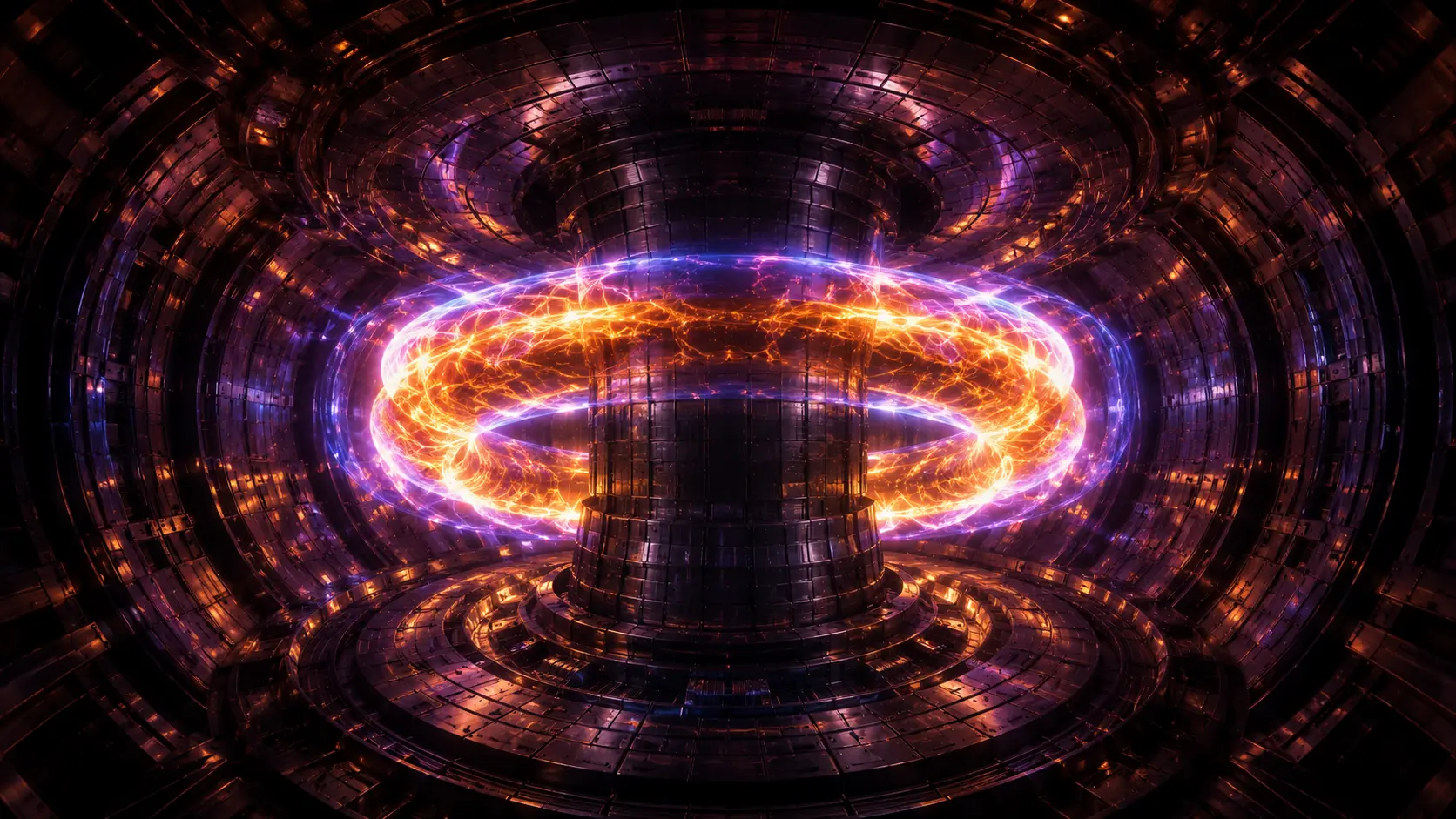
Magnetic confinement solves this by using invisible force fields. Engineers build a giant, donut-shaped machine surrounded by powerful electromagnets. These magnets create a cage of magnetic force that suspends the superheated plasma in mid-air inside a vacuum chamber. The plasma circles endlessly, fusing atoms and releasing energy, without ever touching the walls of the machine.
Why This Matters
Humanity is currently racing against a global energy crisis. The modern economy requires massive amounts of “baseload” power—electricity that is generated continuously, regardless of weather conditions.
Fossil fuels provide baseload power but release catastrophic amounts of greenhouse gases. Renewable sources like wind and solar are clean but intermittent, requiring massive and expensive grid-scale battery storage. Traditional nuclear fission provides clean baseload power but carries the burden of long-lived radioactive waste and public fear of meltdowns.
Nuclear fusion represents the ultimate solution to the energy trilemma. It produces zero greenhouse gases. Its primary fuels can be extracted from seawater. A fusion reactor cannot physically melt down; if anything goes wrong, the plasma instantly cools and the reaction stops. It produces no high-level, long-lived radioactive waste.
If magnetic confinement fusion achieves commercial viability, it fundamentally alters the trajectory of human civilization. It decouples economic growth from carbon emissions and ends geopolitical conflicts over scarce energy resources. The nation or company that builds the first commercially viable artificial sun will control the energy foundation of the 21st century.
HOW MAGNETIC CONFINEMENT FUSION WORKS
Confining a miniature star requires a staggering symphony of physics, cryogenic engineering, and material science.
Here is exactly how a magnetic confinement reactor operates.
1. The Fuel and Plasma State: The process begins with two heavy isotopes of hydrogen: deuterium (found in seawater) and tritium (derived from lithium). When these gases are injected into the reactor’s vacuum chamber and subjected to intense heat and electrical currents, their electrons are stripped away. The gas transitions into the fourth state of matter: plasma. Because plasma is composed of charged particles (ions and electrons), it can be manipulated by magnetic fields.
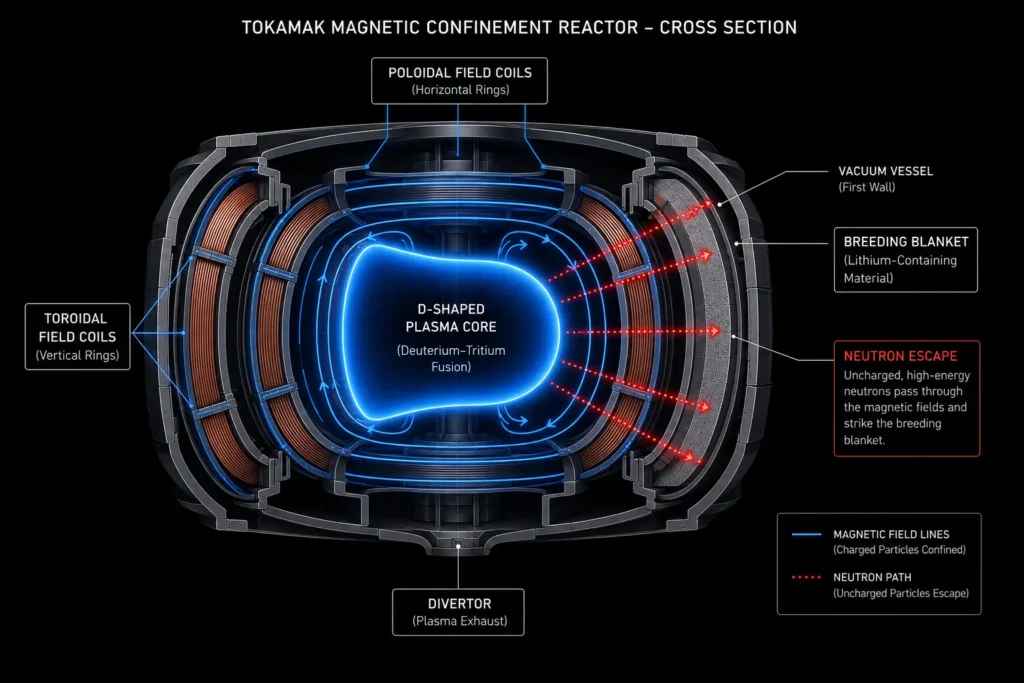
2. The Magnetic Cage: The vacuum chamber is surrounded by massive superconducting electromagnets. These magnets generate a complex, twisting magnetic field. The field lines act as invisible tracks. Because the plasma particles are electrically charged, they are forced to spiral tightly along these magnetic tracks, trapped in a continuous loop and prevented from touching the physical walls of the chamber.
3. Heating the Plasma: To achieve fusion, the plasma must reach roughly 150 million degrees Celsius. This is achieved through three primary methods. First, pushing an electrical current directly through the plasma creates resistance, generating heat (Ohmic heating). Second, neutral beam injection fires high-energy, uncharged atoms into the plasma, transferring their kinetic energy. Third, high-frequency radio waves (microwave heating) are beamed into the chamber, causing the plasma particles to vibrate violently and heat up.
4. The Fusion Reaction and Energy Extraction: When the plasma is hot enough and dense enough for a sufficient amount of time, the deuterium and tritium ions collide with enough force to overcome their natural electrical repulsion. They fuse to form a helium nucleus and a highly energetic neutron.
Because neutrons carry no electrical charge, they are not trapped by the magnetic field. They fly out of the plasma and crash into the walls of the reactor, specifically into a component called the “blanket.” The kinetic energy of these crashing neutrons generates intense heat in the blanket, which is used to boil water, create steam, and spin a traditional electrical turbine.
5. System Limitations: Instability and Quench: Plasma is extraordinarily chaotic, governed by the complex mathematics of magnetohydrodynamics (MHD). It constantly tries to bulge, twist, and break out of its magnetic cage. If the plasma touches the wall, it cools instantly, halting the reaction and potentially damaging the machine.
Furthermore, the superconducting magnets must be kept near absolute zero (-269°C) using liquid helium. If a magnet slightly warms up, it loses its superconductivity and experiences a “quench.” The massive electrical current suddenly meets resistance, violently boiling off the liquid helium and requiring the entire system to be shut down safely to prevent catastrophic physical damage.
Real-World Applications
Magnetic confinement is pursued through two primary architectural designs, actively built across the globe today.
The Tokamak (ITER): The Tokamak is a donut-shaped (toroidal) machine originally designed by Soviet physicists in the 1950s. It drives an electrical current directly through the plasma to help create the magnetic cage. The largest scientific experiment on Earth, ITER, is currently under construction in France. It is a massive Tokamak designed to prove that a magnetic confinement system can produce more thermal energy than it consumes.
The Stellarator (Wendelstein 7-X): The Stellarator, pioneered in the United States, takes a different approach. Instead of relying on a current inside the plasma, a Stellarator uses incredibly complex, twisted external magnets to create a perfectly stable magnetic cage. The Wendelstein 7-X in Germany is the world’s most advanced Stellarator. It resembles a mobius strip built by a computer algorithm.
Compact Private Fusion (SPARC): Private startups like Commonwealth Fusion Systems (CFS) are building compact Tokamaks. By utilizing newly developed High-Temperature Superconducting (HTS) tape, they can generate magnetic fields significantly stronger than ITER’s, allowing them to build a machine that is much smaller, cheaper, and faster to construct while aiming for the same power output.
Economic & Strategic Impact
The realization of commercial fusion will trigger a systemic restructuring of the global economy.
For the energy sector, fusion changes the fundamental math of capital expenditure. Currently, energy economics are driven by the cost of fuel extraction (mining coal, drilling for gas). A fusion power plant requires almost zero fuel cost—a few grams of deuterium and tritium can power a city for days. However, the initial capital cost to build the incredibly complex reactor will be massive. Fusion will transform energy into a purely infrastructure-based industry, similar to software, where upfront costs are high but the marginal cost of producing the next watt of electricity approaches zero.
Geopolitically, magnetic confinement fusion erases the concept of resource scarcity. Nations will no longer need to secure oil shipping lanes or negotiate natural gas pipelines. The primary fuel, deuterium, can be extracted cheaply from ordinary water available to any nation with a coastline.
Strategically, the nations leading fusion development (the US, China, the EU, and the UK) view the technology as the ultimate anchor for long-term economic dominance. Controlling the intellectual property and manufacturing supply chains for superconducting magnets and specialized fusion materials will be as critical in the late 21st century as controlling oil refineries was in the 20th century.
Advantages
- Near-Infinite Fuel Supply: Deuterium is easily extracted from seawater, and lithium (for tritium) is abundant in the Earth’s crust.
- Zero Greenhouse Emissions: The only byproduct of the reaction is harmless, non-radioactive helium gas.
- Inherent Safety: A fusion reactor cannot melt down; any disruption to the delicate magnetic balance immediately extinguishes the plasma.
- High Energy Density: A pineapple-sized amount of fusion fuel contains the energy equivalent of 10,000 tons of coal.
Limitations
- Extreme Complexity: Controlling turbulent plasma requires supercomputing speed, and building the necessary magnets pushes the limits of human manufacturing.
- Tritium Scarcity: Tritium is a rare, radioactive isotope of hydrogen. Current global supplies are incredibly low and expensive to procure.
- Material Degradation: The high-energy neutrons bombarding the reactor walls degrade and weaken the metal over time, requiring components to be frequently replaced.
- Economic Viability: A machine that costs billions to build must operate reliably for decades to offer electricity at a price competitive with natural gas or solar power.
Common Misconceptions
Misconception: Nuclear fusion is the same thing as traditional nuclear power and creates dangerous waste.
Reality: Traditional power is nuclear fission (splitting heavy atoms like uranium). Fusion (combining light atoms) creates no long-lived, high-level radioactive waste. The reactor walls become mildly radioactive over time, but they are safe to handle within a few decades, unlike fission waste which lasts millennia.
Misconception: A fusion reactor could explode like a hydrogen bomb.
Reality: A fusion bomb relies on a fission bomb trigger to create uncontrollable runaway compression. A magnetic confinement reactor uses a sparse, thin gas in a vacuum. There is not enough fuel present at any one time to cause an explosion.
Misconception: Fusion is always “30 years away.”
Reality: This historical joke resulted from severe, chronic underfunding of fusion research in the late 20th century. Today, breakthroughs in superconducting materials and artificial intelligence have vastly accelerated the development timeline.
What Most People Miss
The most difficult engineering challenge in a fusion plant is not the plasma—it is the fact that the machine must manufacture its own fuel to survive.
Because tritium does not exist naturally in large quantities on Earth, a commercial fusion reactor must create its own. To do this, engineers design a “breeding blanket” made of lithium that lines the inside of the vacuum chamber.
When a high-energy neutron escapes the plasma and hits this lithium blanket, a nuclear reaction occurs that splits the lithium into helium and a new atom of tritium. The reactor must actively harvest this newly created tritium gas, filter it, and immediately pump it back into the plasma core to keep the reaction going. A fusion power plant is simultaneously an energy generator and a highly complex, closed-loop chemical refinery.
Comparison Table
| Feature | Tokamak Architecture | Stellarator Architecture |
| Purpose | Symmetrical magnetic plasma confinement. | Asymmetrical magnetic plasma confinement. |
| Magnetic Design | Uses simple, circular magnets and an internal plasma current. | Uses highly complex, twisted external magnets. |
| Plasma Stability | Prone to sudden disruptions if the internal current fails. | Inherently stable; no internal current required. |
| Engineering Complexity | Easier to physically construct and design. | Extremely difficult to manufacture the twisted coils. |
| Operational Mode | Traditionally operates in short pulses. | Designed for continuous, steady-state operation. |
| Leading Example | ITER (France), SPARC (USA). | Wendelstein 7-X (Germany). |
| Best Fit | Near-term energy production scaling. | Long-term, highly stable commercial baseload plants. |
Case Study
Situation: For decades, the path to commercial fusion required building increasingly massive reactors to achieve a net-positive energy yield (Q > 1), culminating in the $20+ billion ITER project in France.
Challenge: The enormous size of ITER makes construction slow, expensive, and difficult to iterate upon. If fusion is going to impact the immediate climate crisis, the physical size and cost of the reactors must be drastically reduced.
Solution: Researchers at MIT and the startup Commonwealth Fusion Systems (CFS) utilized a recently commercialized material called REBCO (Rare-Earth Barium Copper Oxide). REBCO can be manufactured as a thin tape and operates as a High-Temperature Superconductor (HTS).
Outcome: In 2021, CFS successfully demonstrated an HTS magnet capable of generating a 20-tesla magnetic field—the strongest fusion magnet ever built. Because magnetic confinement efficiency scales with the fourth power of the magnetic field strength, doubling the magnet strength allows the reactor volume to be reduced by a factor of 16.
Lessons Learned: Breakthroughs in adjacent material sciences often unlock stagnant engineering problems. HTS tape fundamentally altered the economics of fusion, allowing private capital to fund compact reactors (like the SPARC project) rather than relying solely on massive multinational government consortiums.
Future Outlook
Next 12–24 Months: Private fusion startups will continue to close massive venture capital rounds. The focus will shift from theoretical physics to supply chain development, specifically securing the global manufacturing capacity for High-Temperature Superconducting (HTS) tape and specialized first-wall materials like tungsten.
Next 3–5 Years: Key demonstrator machines, including SPARC in the United States and the activation of initial plasma operations at ITER in France, will attempt to definitively prove “breakeven” (Q > 1)—where the plasma generates more thermal energy than the energy injected to heat it.
Next 10 Years: Following successful breakeven demonstrations, national governments will begin funding the construction of DEMO (Demonstration Power Plant) facilities. These will be the first magnetic confinement machines integrated directly into a national power grid, proving that a fusion reaction can continuously spin a commercial steam turbine.
Most Likely Scenario: Magnetic confinement fusion will not solve the climate emissions goals set for 2030 or 2040; renewable energy and traditional nuclear fission must carry that burden. However, fusion will achieve commercial grid integration in the 2050s. By the late 21st century, fusion reactors will replace legacy nuclear and fossil fuel plants, providing the ultimate clean baseload foundation for a highly electrified global economy.
Key Takeaways
- Magnetic confinement uses powerful electromagnets to suspend superheated plasma in a vacuum, forcing atoms to fuse.
- The primary fuels, deuterium and tritium, promise a virtually inexhaustible and geoconsistent energy source.
- Fusion produces zero greenhouse gases and carries zero risk of a catastrophic nuclear meltdown.
- The Tokamak uses symmetrical magnets and plasma current, while the Stellarator uses complex, twisted external magnets for greater stability.
- High-energy neutrons carry the energy out of the magnetic cage to heat water and drive electrical turbines.
- Commercial reactors must manufacture their own scarce tritium fuel using complex lithium breeding blankets.
- High-Temperature Superconductors (HTS) have allowed private startups to build smaller, cheaper, and faster reactors.
Glossary
Breakeven (Q > 1): The crucial milestone where a fusion reaction produces more thermal energy than the energy required to heat the plasma.
Breeding Blanket: A layer of lithium inside the reactor walls designed to absorb escaping neutrons and chemically create new tritium fuel.
Deuterium: A stable isotope of hydrogen containing one proton and one neutron, easily extracted from standard seawater.
High-Temperature Superconductor (HTS): Advanced materials that can conduct electricity with zero resistance at temperatures higher than traditional superconductors, allowing for vastly stronger magnetic fields.
Magnetohydrodynamics (MHD): The study of the magnetic properties and behavior of electrically conducting fluids, like plasmas.
Plasma: The fourth state of matter; a superheated, electrically charged gas where electrons have been stripped from atomic nuclei.
Quench: A dangerous event where a superconducting magnet slightly warms, suddenly regains electrical resistance, and rapidly boils off its cryogenic cooling fluids.
Tritium: A rare, radioactive isotope of hydrogen containing one proton and two neutrons, required as a primary fuel for early commercial fusion reactors.
Frequently Asked Questions
Why is it so hard to build a fusion reactor? You are trying to hold a gas that is 150 million degrees Celsius in a confined space. The plasma acts like a compressed spring, constantly fighting the magnetic fields and trying to escape. Controlling this turbulence requires extreme precision.
Is the radiation from a fusion plant dangerous? It is highly manageable. Fusion does not use uranium or plutonium. The only radioactive fuel is tritium, a weak beta emitter with a short half-life. The reactor walls become mildly radioactive over time, but the waste requires cooling for decades, not thousands of years.
What happens if the power goes out at a fusion plant? The reaction stops immediately. Magnetic confinement relies on an active, immense input of power to maintain the magnetic fields and heat the plasma. If a blackout occurs, the plasma touches the walls, cools instantly, and the fusion process ceases.
How does a fusion reactor actually make electricity? The exact same way a coal plant does. The fusion reaction creates high-energy neutrons that smash into the reactor walls, creating intense heat. This heat boils water to make steam, which turns a traditional electrical turbine.
Why do they use magnets instead of a physical container? No physical material in the universe can withstand temperatures of 150 million degrees. Any metal or ceramic container would instantly vaporize if it touched the plasma.
Are private companies really building fusion reactors? Yes. Historically, fusion was entirely funded by massive government projects like ITER. Today, over 40 private startups, backed by billions in venture capital, are aggressively pursuing commercial fusion timelines.
What is the difference between a Tokamak and a Stellarator? A Tokamak is shaped like a donut and uses an electrical current running through the plasma itself to help maintain the magnetic cage. A Stellarator uses incredibly complex, twisted magnets to hold the plasma without needing an internal current, making it harder to build but easier to run continuously.
If fusion fuel comes from seawater, will we run out of water? No. A single gallon of seawater contains enough deuterium to produce the energy equivalent of 300 gallons of gasoline. The amount of water required to power the entire globe is statistically insignificant compared to the volume of the oceans.
Sources
- ITER Organization: The Science and Engineering of the Tokamak
- International Atomic Energy Agency (IAEA): Advances in Magnetic Confinement Fusion
- Massachusetts Institute of Technology (MIT) Plasma Science and Fusion Center
- Max Planck Institute for Plasma Physics: Wendelstein 7-X Stellarator Research