Advertisement
)

The greatest bottleneck in the artificial intelligence revolution is not math; it is traffic. When you ask ChatGPT a question, the processors inside the data center must physically move billions of parameters (the AI’s “brain”) out of memory storage and into the calculating cores to predict the next word. Because AI models are so massive, the physical wires connecting the memory to the processor get jammed. This “Memory Wall” dictates that AI inference is painfully slow and astronomically expensive. If you want the AI to talk faster, you must make the data smaller.
Why should you care right now? Because the world’s most bitter tech rivals—NVIDIA, AMD, Intel, and Arm—just called a truce to solve this exact problem. Together through the Open Compute Project (OCP), they have standardized a radical new data format called Microscaling Formats (MXFP4). By restructuring how computers store decimals, MXFP4 shrinks the digital footprint of a neural network by 75%, fundamentally bypassing the memory wall. It allows cloud providers to pack four times as much AI onto the exact same server hardware, doubling inference speeds overnight and permanently altering the unit economics of global cloud computing.
What are Microscaling Formats (MXFP4)?
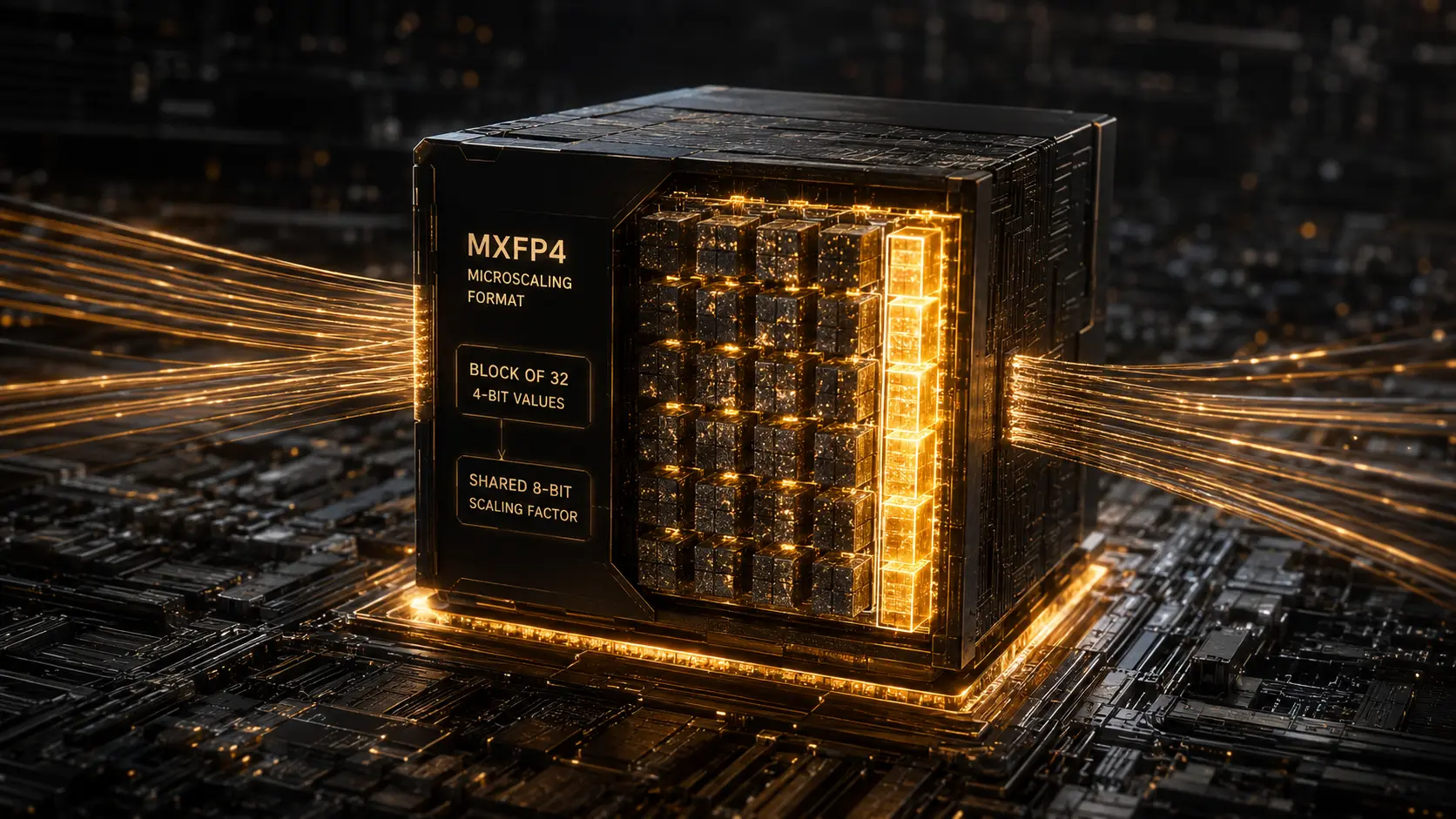
Microscaling Formats (MXFP4) are a standardized data compression architecture for artificial intelligence. By grouping 32 individual 4-bit numbers into a block that shares a single 8-bit scaling factor, MXFP4 drastically reduces a neural network’s memory footprint while maintaining the dynamic mathematical range required to prevent AI accuracy loss.
At a Glance
- Concept: Shrinking the size of the numbers an AI uses to “think” from heavy 16-bit files down to tiny 4-bit files, drastically accelerating how fast they move through a microchip.
- Why it matters: Older 4-bit compression techniques (INT4) ruined AI logic, causing chatbots to hallucinate and fail at math. MXFP4 preserves the AI’s intelligence while keeping the 4-bit speed.
- Who uses it: Cloud architects, MLOps engineers, and hardware manufacturers. NVIDIA’s latest Blackwell chips are explicitly wired to execute MXFP4 math natively.
- Biggest takeaway: It works by “block scaling.” Instead of attaching a heavy mathematical exponent to every single number, 32 numbers share a single exponent, saving massive amounts of memory storage.
In Simple Words
Imagine you have to mail 32 packages to the exact same apartment building in New York.
The Standard Way (FP16) is to write the full address—Country, State, City, Zip Code, Street, and Apartment Number—on every single box. Writing this takes a lot of ink, and the boxes must be large enough to fit all that text.
The Standard 4-Bit Way (INT4) is to try to shrink the boxes by just writing the Apartment Number and leaving off the City and State entirely. The boxes are tiny and cheap to ship, but the post office gets confused, and the packages are delivered to the wrong states (the AI hallucinates).
The Microscaling Way (MXFP4) is to put all 32 tiny boxes into one medium-sized shipping crate. You write the Country, State, City, and Zip Code once on the outside of the crate (the Shared Scaling Factor). Inside, each tiny box only has a 1-digit Apartment Number on it. You save massive amounts of ink and shipping space, but the post office still delivers every package with absolute, perfect accuracy.
Why This Matters
For Cloud Architects, MLOps Engineers, and Hardware VCs, MXFP4 is the ultimate capital expenditure (CapEx) hack.
Currently, running a massive model like Meta’s Llama 3 (70 Billion parameters) requires multiple $30,000 GPUs linked together purely because the model is too “fat” to fit into the High Bandwidth Memory (HBM) of a single chip. By transitioning a model to MXFP4, the total memory requirement drops by up to 75%. Suddenly, that massive open-source model fits entirely onto a single GPU. For a cloud provider operating 100,000 servers, adopting this standard effectively quadruples their total AI hosting capacity without buying a single new piece of silicon, radically crushing the cost of token generation.
The Evolution of AI Quantization: FP16 to 4-Bit
The evolution of AI data types is a continuous battle between precision and speed.
Historically, AI was trained using 32-bit floating-point (FP32). As models grew, the industry realized FP32 was overkill and transitioned to 16-bit (FP16 and BF16), sacrificing microscopic decimals for massive speed gains.
When the industry attempted to drop down to 4-bit, they hit a mathematical wall. A standard 4-bit integer can only represent 16 distinct values. Neural networks contain “outliers”—rare, massive numbers that are critical to the AI’s reasoning. If a 4-bit format tries to round a massive outlier down to fit into one of its 16 slots, the AI’s logic shatters. MXFP4 was invented specifically to preserve these outliers in a 4-bit container, permanently unlocking the next era of hyper-compressed computing.
How MXFP4 Block Scaling Works
Preserving a massive dynamic range inside a 4-bit limit requires decoupling the exponent from the mantissa. Here is the first-principles breakdown of the architecture.
1. The Fundamental Problem: The Memory Wall
An AI processor (like a Tensor Core) can multiply numbers much faster than the memory bus can retrieve them. If the data highway is clogged, the processor sits idle, burning electricity while waiting for data. This is why LLM inference is “memory-bound.”
2. The Core Mechanism: Block Scaling
MXFP4 utilizes “block scaling” (microscaling). It groups data into blocks, usually containing 32 elements.
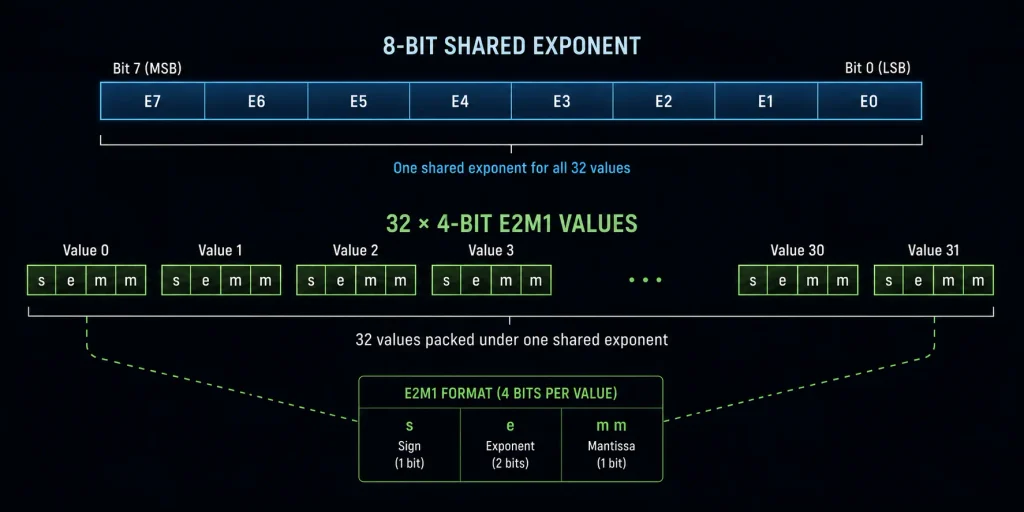
Instead of each element carrying its own massive mathematical exponent, the block computes the largest absolute value among the 32 elements. It generates a single 8-bit scaling factor (the shared exponent) that applies to the entire block.
3. Technical Depth: The E2M1 Format
Inside the block, each of the 32 individual elements is stripped down to just 4 bits. Under the OCP standard, the preferred format for inference is E2M1:
- 1 Sign Bit: (Positive or Negative)
- 2 Exponent Bits: (Allows for dynamic shifting)
- 1 Mantissa Bit: (The precision fraction)
Because the overall block has a shared 8-bit exponent, the tiny 2-bit exponent inside the element only acts as an offset from the shared block exponent.
4. Bypassing Outlier Destruction
If one of the 32 numbers is a massive outlier, the shared 8-bit block exponent simply scales up to cover it. The other 31 numbers use their internal 2-bit exponents to scale down relative to the block. This ensures the massive outlier is preserved mathematically, avoiding the catastrophic clipping that plagues standard INT4 quantization.
5. Real-World Consequences: Hardware Acceleration
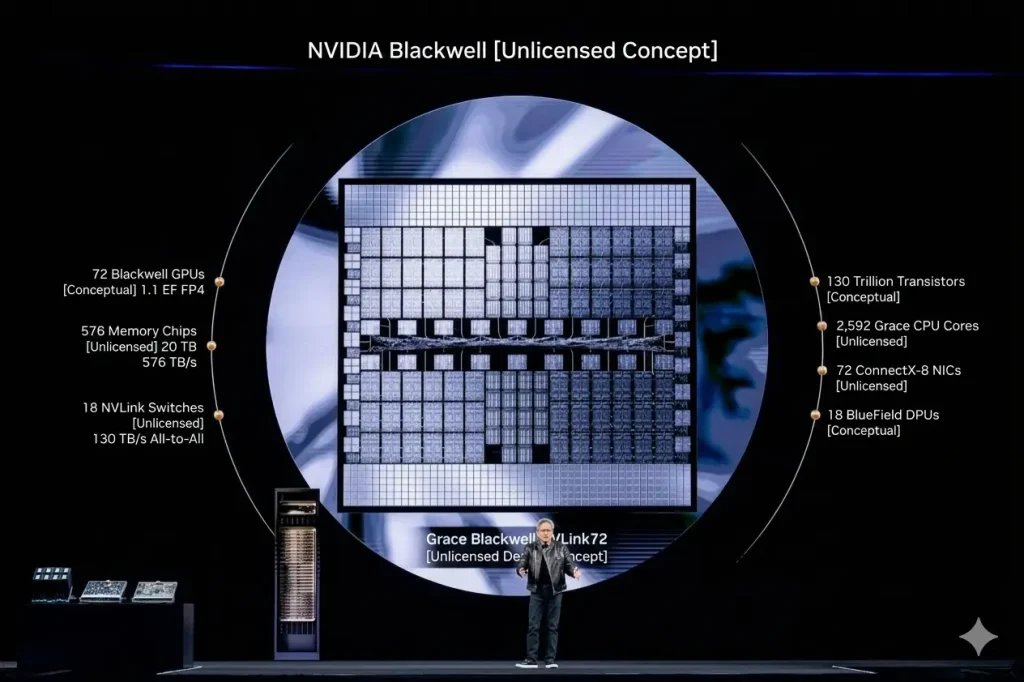
Standard CPUs cannot do math with shared exponents efficiently. The MX format requires dedicated silicon. NVIDIA’s Blackwell architecture integrates 2nd-Generation Transformer Engines specifically hardwired to ingest these shared-exponent blocks. The hardware automatically unpacks the shared scaling factor, multiplies the 4-bit mantissas natively, and accumulates the results in high-precision (FP32), ensuring zero latency penalties during decoding.
Real-World MXFP4 Hardware Acceleration
The OCP standard is moving rapidly from an engineering specification into the global deployment of frontier models.
High-Throughput LLM Cloud Endpoints: Cloud providers hosting APIs for Llama 3 or Mixtral are aggressively utilizing MXFP4. By quantizing a 70B parameter model down to 4-bits, the model easily fits into the 80GB of VRAM on a single H100 or B200 GPU. This eliminates the need for “Tensor Parallelism” (splitting the model across multiple chips), slashing the network latency caused by chips talking to each other and radically improving the Tokens-per-Second generation rate for end users.
Edge AI and Local Inference: Running powerful AI on smartphones or autonomous vehicles is strictly limited by the device’s battery and RAM. A standard AI model drains a phone battery in minutes due to constant RAM access. MXFP4 compresses massive language and vision models so densely that they can be loaded directly into the onboard cache of an Apple or Snapdragon neural processing unit (NPU), enabling instant, offline, Siri-level intelligence without ever polling the cloud.
KV Cache Compression in Long-Context Windows: When a user uploads a 500-page PDF to ChatGPT, the AI must store the context of that entire book in its “KV Cache” (Key-Value Cache) to remember it while chatting. Long contexts rapidly consume hundreds of gigabytes of memory. MLOps engineers are applying MX formats specifically to the KV Cache, shrinking the memory requirement of long-document retrieval and allowing millions of tokens to be processed simultaneously.
Economic & Strategic Impact
The core strategic value of MXFP4 is the Bypass of the HBM Supply Chain Bottleneck.
High Bandwidth Memory (HBM)—manufactured primarily by SK Hynix, Samsung, and Micron—is the most constrained, expensive component in AI hardware. The global supply of HBM cannot keep up with the demand for larger neural networks.
MXFP4 acts as a synthetic expansion of global HBM capacity. By proving that 4-bit representation is mathematically viable for complex reasoning, the industry requires half as much HBM to achieve the same result. This alleviates the extreme pricing power held by memory manufacturers and allows hyperscalers to deploy trillion-parameter models without waiting for the physical construction of next-generation, high-density memory fabs.
Advantages
- Quadrupled Throughput: Shrinking data from 16-bit to 4-bit allows four times as many model weights to be transferred from memory to the processing cores in the same clock cycle, destroying the memory wall.
- Outlier Preservation: The block-shared 8-bit exponent effectively protects the high-magnitude, critical weights that are routinely destroyed by standard integer (INT4) rounding.
- Cross-Vendor Standardization: Because MXFP4 is an Open Compute Project (OCP) standard agreed upon by NVIDIA, AMD, and Intel, developers can write an MXFP4 quantization script once and trust it will run natively on any competing hardware platform.
Limitations
- Silicon Dependency: Legacy GPUs (like the NVIDIA A100 or older) do not have the specific hardware routing to unpack shared block exponents natively. Running MXFP4 on older chips requires software emulation, which is often slower than just running standard FP16.
- The Calibration Tax: You cannot simply “chop off” bits from an existing model. Converting a model to MXFP4 requires “Post-Training Quantization” (PTQ) or “Quantization-Aware Training” (QAT). This calibration process takes immense engineering skill to ensure the scaling blocks align perfectly with the model’s activation patterns.
- Scientific Compute Degradation: While language models are highly robust to precision loss, models used for ultra-precise scientific simulations (like computational fluid dynamics or quantum chemistry) often suffer unacceptable accuracy degradation when forced into 4-bit formats.
Common Misconceptions
Misconception: MXFP4 makes the AI less intelligent.
Reality: While there is a microscopic loss in pure mathematical precision, language models are incredibly resilient. The block-scaling technique preserves the “shape” of the data so perfectly that human evaluators cannot distinguish between text generated by an FP16 model and an MXFP4 model.
Misconception: The entire model is 4-bits.
Reality: Only the heavy, static weights and activations are compressed to 4-bits. The actual math (the dot-product multiplication and accumulation inside the Tensor Core) is still done in high precision (FP32) to prevent mathematical rounding errors from compounding.
Misconception: OCP MX is an NVIDIA proprietary format.
Reality: The Open Compute Project format was designed collaboratively. While NVIDIA’s Blackwell is heavily marketed around it, AMD’s Instinct accelerators and Intel’s Gaudi chips also natively support the exact same specification, breaking vendor lock-in for quantized models.
What Most People Miss
The disruptive capability of MXFP6 and MXFP8 for Training.
Most analysts view microscaling entirely as an “inference” (running the model) trick. What they miss is that the OCP standard includes higher-bit variants (MXFP6 and MXFP8) explicitly designed for training the model.
Training an AI is infinitely more sensitive to precision loss than inference because the model is constantly updating its own gradients. However, by using block-scaled MXFP6, AI labs can fit massive, un-trained models into smaller GPU clusters. This effectively halves the total CapEx required to build a supercomputer cluster capable of training the next GPT-5 or Llama 4, fundamentally lowering the barrier to entry for training frontier foundation models.
Comparison Table
| Feature | 16-Bit Float (FP16 / BF16) | 4-Bit Integer (INT4) | Microscaling 4-Bit (MXFP4) |
| Memory Footprint | Massive (Baseline) | Tiny (25% of baseline) | Tiny (25% of baseline) |
| Dynamic Range | Extremely High | Very Low | High (Via shared exponent) |
| Outlier Preservation | Perfect | Terrible (Causes Hallucinations) | Excellent |
| Hardware Required | Standard GPUs | Standard GPUs | Next-Gen Tensor Cores (Blackwell) |
| Standardization | Universal | Highly fragmented | OCP Alliance Standard |
Case Study
Situation: As the parameter counts of leading Open-Weight models (like Llama 3) exceeded 70 billion, independent developers and mid-sized enterprises found themselves physically unable to run the models. A 70B FP16 model requires roughly 140GB of VRAM just to load the weights, forcing companies to rent multiple, highly expensive GPUs simply to run a basic inference API.
Challenge: Compress the model down to 4-bits to fit it onto a single GPU (which requires only ~35GB of VRAM) without destroying the nuanced reasoning and coding capabilities that made the 70B model valuable in the first place.
Solution (The OCP MX Specification): A consortium of hardware rivals published the OCP Microscaling Formats specification. Instead of blunt-force integer quantization, developers utilized frameworks that applied MXFP4 block scaling. The weights were clustered into groups of 32, assigning an 8-bit exponent to preserve the vital outlier values, while dropping the individual parameters down to E2M1 formats.
Outcome: The compressed MXFP4 model successfully loaded into the VRAM of a single, modern GPU. Because the memory bus was no longer choked by transferring 16-bit weights, the Tensor Cores operated at maximum efficiency, generating tokens four times faster than the FP16 baseline. Crucially, on standard benchmarks (like MMLU and HumanEval), the MXFP4 model maintained over 99% of the accuracy of the original, uncompressed model.
Lessons Learned: The deployment validated that the AI memory wall is a data-formatting problem, not just a hardware problem. By standardizing the math at the hardware level across the entire silicon industry, the OCP alliance proved that intelligent data compression is the most financially efficient method of scaling the artificial intelligence economy.
Future Outlook
Next 12–24 Months
The era of Blackwell Adoption and Emulation Frameworks. Through 2026, the primary narrative will be the physical deployment of NVIDIA Blackwell and AMD MI300/400 clusters. As these chips come online, the major machine learning frameworks (PyTorch, vLLM) will release deep, native integrations for OCP MX types. For users still on legacy A100 or H100 clusters, software engineers will heavily optimize PTX (Parallel Thread Execution) kernels to emulate MXFP4 math, attempting to claw back memory bandwidth even without the dedicated hardware routing.
Next 3–5 Years
The scaling of Sub-4-Bit and Mixed-Precision Routing. The industry will not stop at 4 bits. By the late 2020s, developers will deploy advanced “Mixed-Precision” algorithms. The AI will analyze its own layers dynamically: standard attention layers might run in MXFP4, while highly resilient feed-forward layers are brutally compressed down to MXFP2 (2-bit). This selective compression will squeeze 100-billion-parameter models onto consumer laptops and high-end smartphones, completely decentralizing the power of frontier AI away from massive cloud data centers.
Next 10 Years
The Analog and Photonic Precision Convergence. By the mid-2030s, the limits of digital block-scaling will be fully exhausted. To shrink models further without destroying logic, the industry will pivot to Photonic Neural Networks and Analog Compute-in-Memory (CiM). These chips do not use digital 1s and 0s or floating-point formats at all; they use the continuous physical properties of light or electrical resistance to perform math natively inside the memory cell itself. MXFP4 will be viewed as the final, masterful optimization of the digital era before the transition to analog AI physics.
Most Likely Scenario
Microscaling Formats are the definitive operational standard for the late 2020s. By forging a rare alliance between NVIDIA, AMD, and Intel, the OCP specification ensures that the entire global supply chain will align behind block-scaled floating-point math. This format single-handedly extends the commercial viability of current memory architectures, buying the industry the vital years needed to solve the long-term physics of AI hardware scaling.
Key Takeaways
- Microscaling Formats (MXFP4) compress AI models down to 4-bits, reducing their memory footprint by 75% so they can run four times faster on cloud servers and edge devices.
- AI speed is limited by the “Memory Wall”—the time it takes to move data from RAM to the processor. Shrinking the data is the fastest way to speed up the AI.
- Standard 4-bit compression (INT4) breaks AI logic because it crushes “outliers” (massive, rare numbers). MXFP4 fixes this using “block scaling.”
- In block scaling, 32 tiny numbers share a single, larger exponent. If an outlier appears, the shared exponent scales up to protect it, preventing the AI from hallucinating.
- The format was created by the Open Compute Project (OCP), a rare alliance of NVIDIA, AMD, Intel, and Arm, ensuring it works seamlessly across competing hardware.
- NVIDIA’s latest Blackwell chips have specialized Tensor Cores physically hardwired to process MXFP4 math natively, achieving unprecedented generation speeds.
Glossary
Block Scaling: Grouping a set of numbers (usually 32) together to share a single scaling factor (exponent), drastically saving memory space while preserving dynamic range.
E2M1: A specific 4-bit floating-point format under the MX standard. It uses 1 Sign bit, 2 Exponent bits, and 1 Mantissa bit.
High Bandwidth Memory (HBM): The incredibly fast, expensive memory chips stacked directly next to an AI processor. A shortage of HBM is the primary bottleneck in AI scaling.
Memory Wall: The architectural limitation where a computer’s processor can do math much faster than the memory can feed it data, leaving the processor idle.
Open Compute Project (OCP): An organization that shares designs of data center products. Their MX specification standardized AI microscaling across all major chip manufacturers.
Quantization: The process of converting a neural network from a high-precision format (like 16-bit) to a lower-precision format (like 4-bit) to make it smaller and faster.
Sources
Open Compute Project (OCP): OCP Microscaling Formats (MX) Specification
NVIDIA Technical Blog: NVIDIA Blackwell Architecture and 2nd Generation Transformer Engine
AMD Developer Central: Accelerating AI Inference with OCP MX Data Types
arXiv (Cornell University): Microscaling Data Formats for Deep Learning
Hugging Face: Understanding Post-Training Quantization and MXFP4 Integration