Advertisement
)

AT A GLANCE
- Concept: Sparse Activation: Activating only a tiny, selective fraction of a massive neural network for each word.
- Concept: The Gating Network: The algorithmic router deciding exactly which expert processes which specific token.
- Concept: Top-K Routing: A mathematical function that forces the router to pick only the top few experts.
- Concept: Token Dropping: The catastrophic data loss when too many tokens overwhelm a single hardware expert.
HOW MIXTURE-OF-EXPERTS WORKS
Traditional large language models operate as dense networks. When a user inputs a single word, the software forces that data through every single mathematical parameter in the entire model. Scaling a dense network to trillions of parameters physically breaks data center economics, as the energy required to activate every neuron for every syllable becomes financially catastrophic.
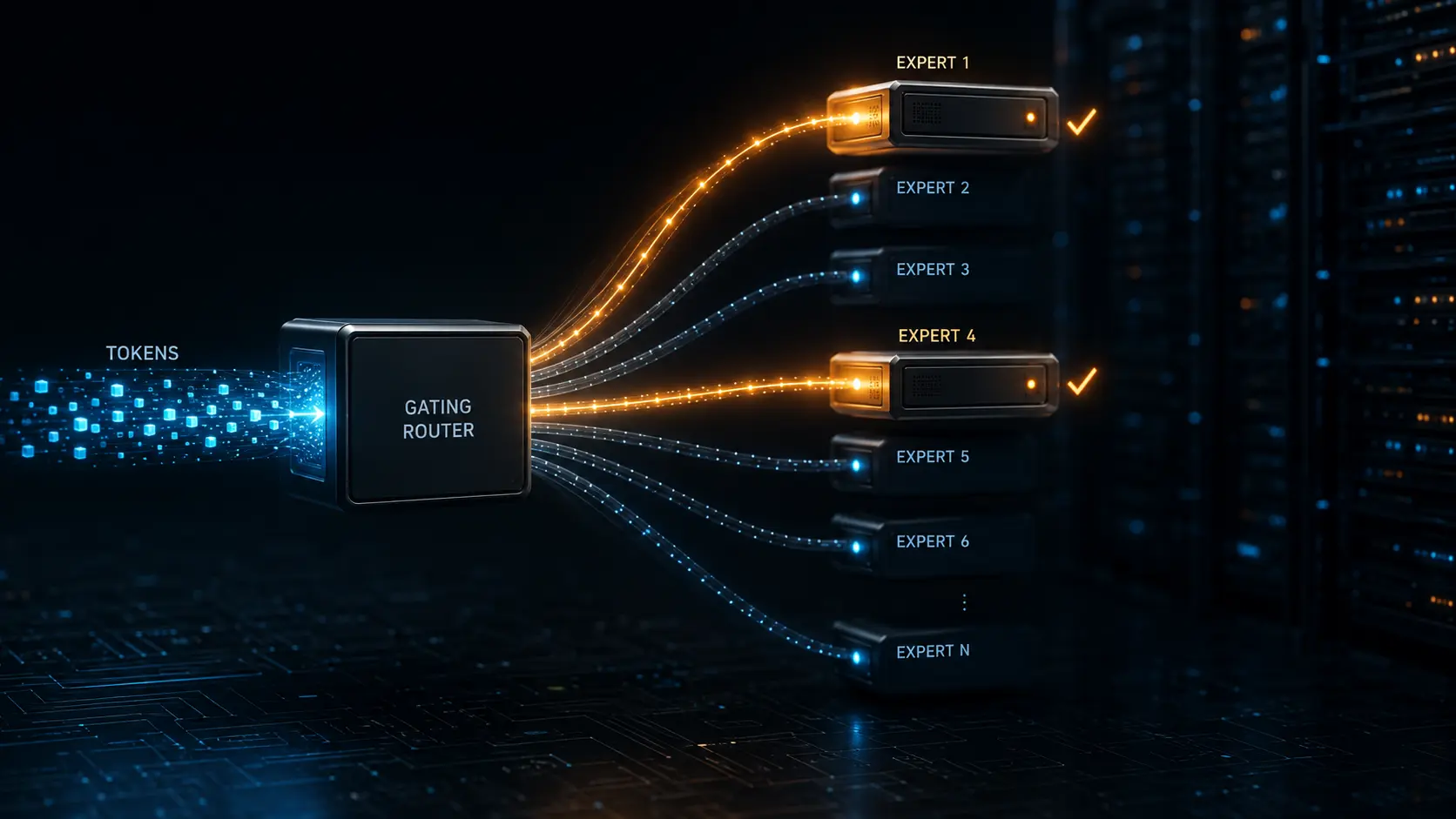
Mixture-of-Experts (MoE) fundamentally abandons this dense architecture by substituting it with sparse activation. Engineers take the massive feed-forward layers of the neural network and fracture them into dozens of smaller, isolated neural networks called experts. When a token enters the model, it does not wake up the entire system. Instead, it hits the gating router.
The gating router is a lightweight neural circuit that acts as an ultra-fast traffic director. It calculates a probability distribution across all available experts, determining which sub-network is most qualified to process the specific token. Using a mathematical Top-K gating function, the router selects only the highest-scoring experts—typically just two out of eight or sixteen available paths.
The software then physically routes the token exclusively to the graphics processing units (GPUs) hosting those active experts. The remaining experts sit completely idle, drawing minimal power and saving massive amounts of memory bandwidth. By utilizing this sparse matrix architecture, an AI laboratory can build a one-trillion-parameter model that only consumes the electrical compute equivalent of a hundred-billion-parameter model during live inference.
WHY IT MATTERS NOW
The entire generative artificial intelligence industry hit a hard hardware ceiling dictated by memory bandwidth and GPU availability. Training massive monolithic models requires hundreds of thousands of highly specialized chips operating in perfect unison for months. If companies continued scaling dense architectures linearly, the resulting models would simply not fit inside commercial server racks.
MoE routing bypasses this physical compute wall. Models like Mixtral 8x7B or the frontier models developed by hyperscalers explicitly rely on this sparse routing to achieve massive intelligence without bankrupting their host infrastructure. By physically distributing different experts across different GPU clusters, hyperscalers heavily optimize their existing hardware investments.
This architecture forces a severe shift in data center networking requirements. Because tokens must travel rapidly between the gating router and the physical server holding the assigned expert, the system demands extreme intra-cluster networking speeds. Technologies like Nvidia’s NVLink and InfiniBand become the primary bottlenecks; if the network switch drops a token while moving it between server blades, the model hallucinates or crashes entirely.
Consequently, the MoE framework dictates modern enterprise deployment. Open-source developers can run massive, highly capable MoE models on consumer-grade hardware by only loading the active experts into the GPU memory while keeping the dormant experts parked on a slower solid-state drive. This fundamentally decentralizes access to trillion-parameter intelligence across the civilian tech sector.
WHAT MOST PEOPLE MISS
Tech commentators frequently assume that the MoE router perfectly understands context, neatly assigning grammar questions to a “language expert” and numbers to a “math expert.” They entirely miss the brutal load-balancing mathematics required to prevent hardware-level expert strangulation. In reality, the router learns its own alien internal logic, which frequently results in the router overwhelmingly favoring one single expert for almost all tokens.
If the router sends ninety percent of the tokens to Expert A, the GPU hosting Expert A instantly maxes out its computational capacity. Because neural networks process data in rigid, fixed-size batches, the overwhelmed expert physically cannot accept the excess data, resulting in catastrophic token dropping. To prevent this hardware gridlock, engineers inject an artificial “load-balancing loss” directly into the training algorithm, financially punishing the router if it plays favorites and forcing it to distribute tokens evenly across all hardware nodes.
THE TRAJECTORY
Next 12–36 Months: The standardization of fine-grained routing. Developers will abandon massive, monolithic experts and transition to architectures featuring thousands of microscopic experts, dynamically routing individual token fragments to maximize hardware utilization and entirely eliminate token dropping.
Next Five Years: The rise of heterogeneous expert hardware. Data centers will stop running all experts on identical GPUs and instead deploy specialized silicon accelerators tailored perfectly to specific mathematical functions, allowing the MoE router to physically direct coding tokens to a logic processor and creative text to a standard tensor core.
Next Ten Years: Recursive dynamic sparsity. Models will embed secondary gating networks inside the primary experts themselves, creating a fractal routing architecture that activates only hundreds of parameters per token out of a multi-trillion-parameter base.
What Could Go Wrong: Severe communication overhead collapse. As the number of experts scales into the thousands, the time required to physically transmit tokens across the data center network will mathematically exceed the time required to actually calculate the answer, creating an “all-to-all” communication bottleneck that permanently caps model sizing.
Most Likely Outcome: MoE gating will become the absolute, mandatory foundation for all future hyperscale artificial intelligence. Dense neural networks will be relegated entirely to edge devices and smartphones, while server-side intelligence relies exclusively on conditional, sparsely activated routing matrices.
KEY TERMS
- Sparse Activation: A computational architecture where only a tiny, selective fraction of a neural network processes a specific piece of data.
- Gating Router: A secondary mathematical function within a neural network that evaluates incoming data and decides which expert path it should take.
- Top-K Routing: A mathematical selection algorithm that forces the router to activate only the highest-scoring number of experts while actively ignoring all others.
- Token Dropping: The unrecoverable loss of data that occurs when a gating router sends too many tokens to a single hardware node operating at maximum batch capacity.
- Load-Balancing Loss: A specific mathematical penalty applied during training to force the gating router to distribute data evenly across all available hardware.
SOURCES
- Google Brain — Outrageously Large Neural Networks: The Sparsely-Gated Mixture-of-Experts Layer
- Stanford University Artificial Intelligence Laboratory — Load Balancing and Token Routing Kinetics in Distributed MoE Training
- Meta AI Research — MegaBlocks: Efficient Sparse Training with Mixture-of-Experts
- Institute of Electrical and Electronics Engineers (IEEE) — Network Bottlenecks and All-to-All Communication in Sparse Transformer Architectures