Advertisement
)

AT A GLANCE
- Concept: Spiking Neural Networks: Algorithms that communicate in bursts of energy only when necessary, mimicking biological brain synapses.
- Concept: Von Neumann Bottleneck: The massive delay and energy waste caused by constantly moving data between a computer’s processor and its memory.
- Concept: Crossbar Arrays: A physical grid of microscopic wires that computes and stores data in the exact same location.
- Concept: Event-Driven Processing: A system that remains completely dormant until a specific sensor input forces it to react.
IN SIMPLE WORDS
Your brain runs on about 20 watts of power—roughly the same as a dim lightbulb. Yet, it can recognize faces, understand speech, and drive a car perfectly. To make a modern AI do those same tasks, technology companies must build massive data centers that consume as much electricity as entire cities.
This massive inefficiency exists because traditional computers separate their memory from their processing. The computer spends 90 percent of its time and energy just moving data back and forth between the two.
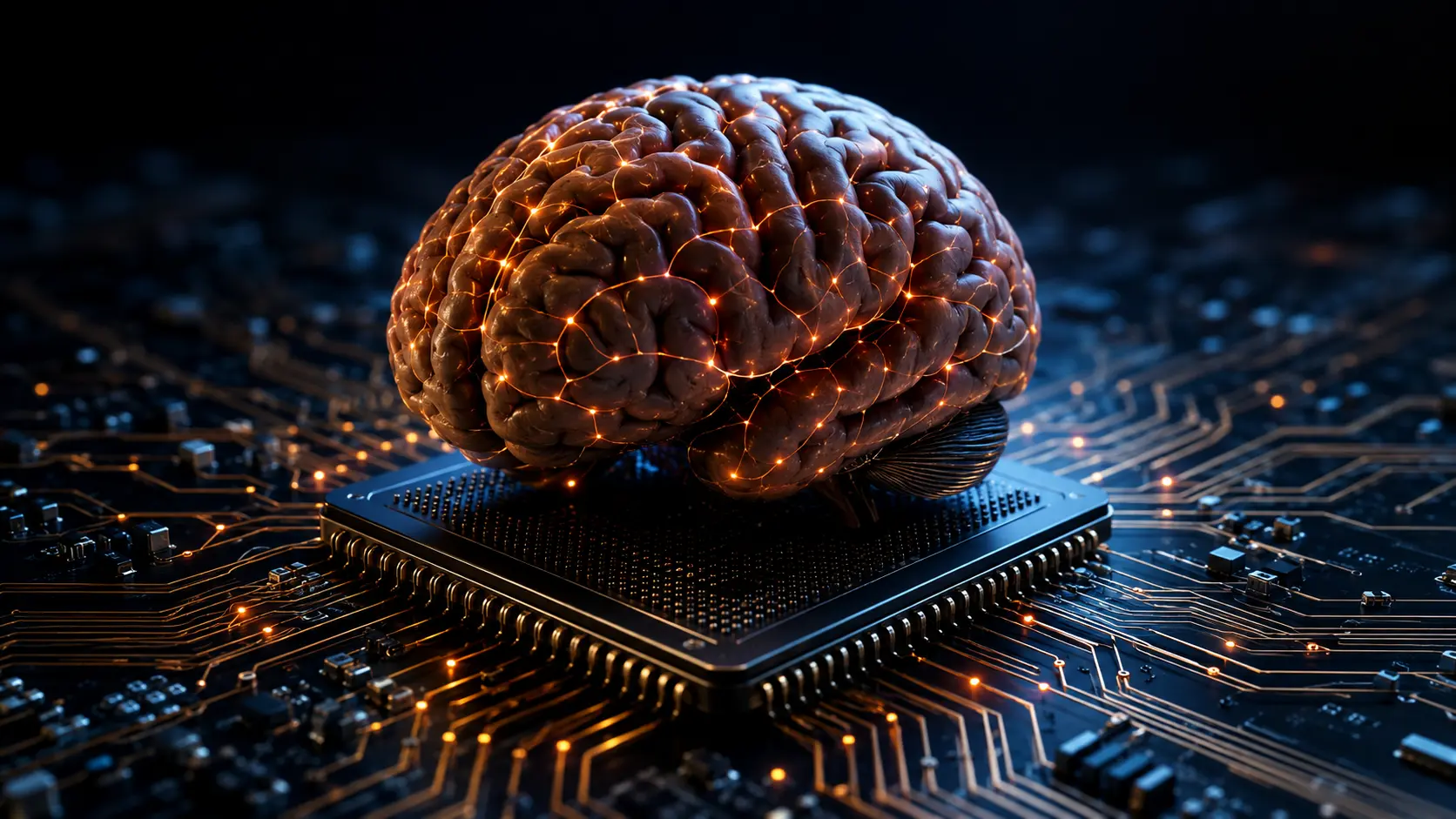
Neuromorphic computing fixes this by copying biology. Engineers are designing microchips that fuse memory and processing together into artificial “neurons.” Instead of running continuously like a car engine left idling, these chips remain asleep until something happens, communicating in tiny electrical spikes. This drastically cuts power consumption, allowing massive AI models to run directly on smartphones and small robots without needing the cloud.
HOW IT WORKS
For the past 70 years, all computers have relied on the Von Neumann architecture. This design physically separates the Central Processing Unit (CPU) from the memory (RAM). To calculate anything, the CPU must fetch data from the memory, process it, and send the result back.
As artificial intelligence models grow, this constant shuttling of data creates a physical traffic jam known as the Von Neumann bottleneck. The chip burns massive amounts of electricity just moving the data, generating extreme heat and limiting processing speed.
Neuromorphic chips eliminate this separation entirely. They utilize analog crossbar arrays to perform In-Memory Computing. In a crossbar array, a grid of horizontal and vertical wires intersects. At each microscopic intersection sits a memristor—a resistor with memory.
These intersections act as artificial synapses. They store the data and perform the mathematical calculation simultaneously in the exact same physical location. There is no data movement, virtually eliminating the energy waste of the data bus.
Furthermore, these chips run Spiking Neural Networks (SNNs). Traditional AI neural networks process every single piece of data simultaneously, continuously multiplying massive matrices of numbers. SNNs are event-driven. They use an “integrate-and-fire” model. An artificial neuron gathers electrical signals silently until it reaches a specific threshold. Only then does it “spike,” sending a burst of data to the next neuron.
If there is no new information, the chip does nothing. It draws almost zero power. This asynchronous, event-based processing mirrors exactly how the human optic nerve communicates with the biological brain, ignoring static background noise and reacting only to movement and change.
REAL WORLD EXAMPLE
Intel’s Loihi 2 is a highly advanced neuromorphic research chip. Traditional robotic arms require a continuous feed from standard cameras, processing 60 frames per second to catch a moving object. This requires a heavy, power-hungry desktop computer tethered to the robot.
Researchers paired the Loihi 2 chip with an event-based “neuromorphic camera.” The camera only records pixels when the lighting changes (motion occurs). The Loihi 2 chip sits directly on the robot arm, receiving these irregular spikes of data. Because the chip is event-driven, it processes the movement in microseconds using mere milliwatts of power. The robot can catch a thrown ball in mid-air using a chip the size of a postage stamp, running purely on a small battery.
WHY IT MATTERS NOW
The artificial intelligence industry is currently facing a catastrophic energy crisis. Training large language models like ChatGPT and running their daily queries consumes hundreds of terawatt-hours of electricity. Data centers are exhausting the local power grids of major cities.
If AI is going to scale from text chatbots to physical, autonomous robots operating in the real world, the hardware paradigm must break. A self-driving car or a humanoid robot cannot be tethered to a nuclear power plant. They require extreme intelligence processing directly on the device—known as Edge AI—with a strict thermal and battery budget.
Neuromorphic computing provides the only known physical pathway to achieve this. By cutting the energy consumption of AI inference by up to 1,000 times, these chips will untether artificial intelligence from the massive cloud data centers.
This fundamentally shifts the technological economy. Devices that were previously too small or battery-constrained to run complex AI—such as smart contact lenses, ingestible medical sensors, and micro-drones—will suddenly possess the ability to run advanced neural networks locally, in real-time.
COMMON MISCONCEPTIONS
- “Neuromorphic chips are just faster CPUs.” They are actually much slower in raw clock speed. A traditional CPU might run at 4 gigahertz, while a neuromorphic chip runs at a few megahertz. They achieve speed through massive parallelism, computing millions of small things simultaneously rather than one thing blazingly fast.
- “They will replace normal computers.” Neuromorphic chips are terrible at running standard software like Microsoft Excel or rendering a 3D video game. They are highly specialized co-processors built exclusively for pattern recognition and sensory processing.
- “They literally use biological brain cells.” While some experimental fields (wetware) do try to use biological cells, commercial neuromorphic computing is entirely silicon and metal. It merely copies the mathematical and structural design of the brain, not the biological tissue.
WHAT MOST PEOPLE MISS
Tech analysts focus on the hardware design, but they drastically underestimate the software bottleneck holding the industry back.
We have spent fifty years writing code designed specifically for the Von Neumann architecture. Modern programming languages (like Python or C++) execute commands sequentially. Spiking neural networks do not operate sequentially; they operate in chaotic, asynchronous bursts. To fully utilize a neuromorphic chip, the entire software industry must invent entirely new programming languages and compilers that can write logic based on “time and spikes” rather than “ones and zeros.”
THE ECONOMIC AND STRATEGIC IMPACT
The primary financial beneficiaries are early-stage hardware startups like BrainChip, SynSense, and major semiconductor research divisions at Intel and IBM. If a company successfully commercializes a universal neuromorphic compiler, they will instantly capture the multi-billion-dollar Edge AI market, dictating the standard for all mobile robotics.
Strategically, neuromorphic computing is a massive national security asset. Modern military drones rely on connecting back to the cloud via satellite to process AI targeting data. If an adversary jams the satellite signal, the drone goes blind.
A drone equipped with a neuromorphic chip processes all radar, optical, and targeting data directly on the aircraft using very little power. It requires no connection to the outside world, making it completely immune to electronic warfare jamming and allowing autonomous swarms to operate indefinitely behind enemy lines.
THE TRAJECTORY
Next 12–36 Months: The deployment of neuromorphic chips in ultra-low-power consumer electronics. We will see them embedded in smartwatches for continuous, real-time heart monitoring and in security cameras that can run facial recognition for years on a single AA battery.
Next Five Years: The integration into advanced automotive safety. Autonomous vehicles will pair event-based LIDAR and neuromorphic co-processors to drastically reduce the reaction time of emergency braking systems, bypassing the central computer entirely.
Next Ten Years: The rise of continuous on-chip learning. Current AI models are static; they learn in a data center, are frozen, and deployed. Future neuromorphic chips will use synaptic plasticity to physically rewire their own crossbar arrays on the fly. The AI will learn and adapt to new environments in real-time without ever needing to connect to the cloud.
What Could Go Wrong: The optimization of traditional hardware outpaces neuromorphic adoption. If companies like Nvidia successfully develop ultra-efficient, low-power versions of their standard GPUs, developers may simply stick with the traditional coding languages they already know, leaving neuromorphic chips as an expensive, niche academic experiment.
Most Likely Outcome: Neuromorphic architecture will not replace traditional chips; it will permanently sit beside them. Every advanced device will feature a hybrid System-on-Chip (SoC) where a standard CPU handles operating systems, and a neuromorphic block acts as the “brain stem,” continuously monitoring sensory inputs with near-zero energy consumption.
KEY TERMS
- Neuromorphic Computing: The design of computer chips that physically mimic the neural structure and operating methods of the biological brain.
- Von Neumann Bottleneck: The severe delay and energy loss caused by a computer constantly moving data back and forth between the processor and the memory.
- Spiking Neural Network (SNN): An artificial intelligence model where neurons only communicate via short bursts of energy when a specific threshold is reached.
- In-Memory Computing: A hardware architecture that performs calculations directly inside the memory cells, eliminating the need to move data.
- Memristor: A microscopic electrical component that remembers the last electrical state it held even when the power is turned off, acting like an artificial synapse.
- Edge AI: Running artificial intelligence algorithms directly on a local device (like a phone or robot) rather than relying on a distant cloud server.
BEGINNER FAQ
What is neuromorphic computing? It is a new way of building computer microchips. Instead of designing them like a standard calculator, engineers design them to physically copy the layout of the human brain.
Why do we need brain-like chips? Because normal computer chips waste massive amounts of electricity just moving data around. Brain-like chips process data where it sits, allowing them to run AI using almost no battery power.
Will my laptop have one? Eventually, yes. But it won’t run your web browser. It will likely sit in the background, listening for your voice commands or monitoring your webcam without draining your laptop’s battery.
How is a spiking neural network different from normal AI? Normal AI is always “on,” constantly crunching math even if nothing is happening. A spiking neural network stays completely asleep until a sensor triggers it, sending a quick “spike” of data to react.
Are these chips actually alive? No. They are made of standard silicon, copper, and glass, just like normal microchips. They only copy the math and the wiring of a biological brain.
Can they learn on their own? The most advanced versions are being designed to do exactly that. They will be able to adapt and learn new things locally, without needing an internet connection to download an update.
Who is building these chips? Major companies like Intel (with their Loihi chip) and IBM (with TrueNorth) have built advanced prototypes, alongside dozens of highly specialized hardware startups.
Why aren’t they everywhere yet? Because they are incredibly hard to program. The entire software world was built for traditional chips. Programmers have to invent entirely new coding languages to make these new brain chips work.
SOURCES
- Institute of Electrical and Electronics Engineers (IEEE) — Neuromorphic Computing and Engineering: Architectures and Algorithms
- Intel Labs — Neuromorphic Computing Research and the Loihi 2 Architecture
- Nature Electronics — In-Memory Computing and the Physics of Memristive Crossbar Arrays
- Defense Advanced Research Projects Agency (DARPA) — Synapse Project and Brain-Inspired Processing