Advertisement
)
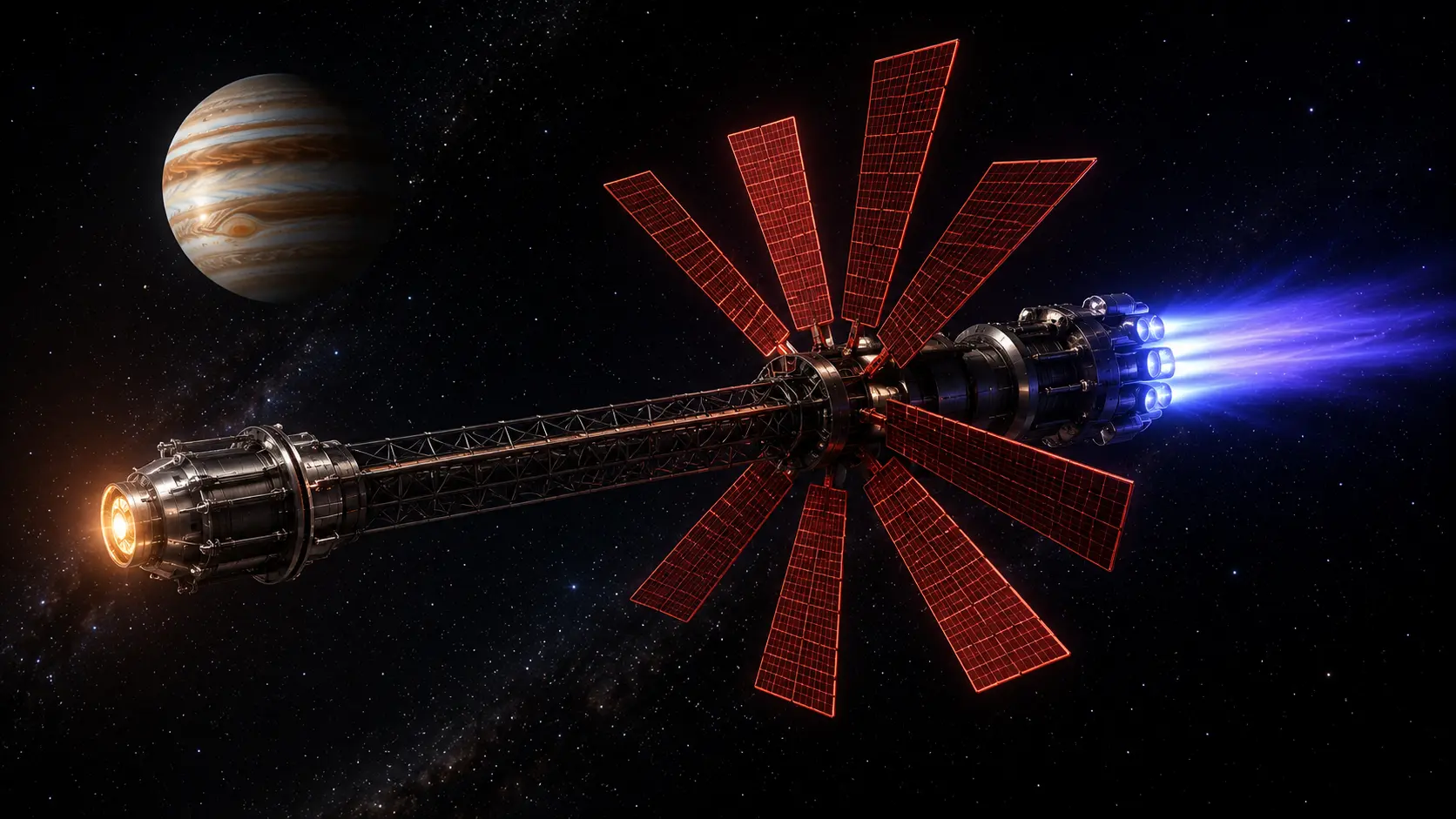

Space exploration is currently constrained by the tyranny of the rocket equation. If you want to send a heavy scientific payload to Jupiter or establish a permanent cargo route to Mars, traditional chemical rockets are useless. A chemical rocket burns through all of its fuel in the first ten minutes of flight, generating a massive explosion of speed, but forcing the spacecraft to simply coast through the dark void for the next five years. To go faster, you need a rocket engine that never turns off. We possess these engines—they are called ion thrusters—but they require massive amounts of continuous electricity. Out past the orbit of Mars, the sun is too dim for solar panels to work.
Why should you care right now? Because aerospace engineers are solving this power deficit by putting actual nuclear power plants into orbit. This architecture, known as Nuclear Electric Propulsion (NEP), connects a miniaturized atomic reactor to a massive electric engine, allowing a spacecraft to accelerate continuously for years. It is the definitive technology required to shift humanity from merely visiting the inner solar system to establishing a heavy, industrialized logistics network across the outer planets.
What is Nuclear Electric Propulsion (NEP)?
Nuclear Electric Propulsion (NEP) is an advanced spacecraft architecture where a nuclear fission reactor generates thermal energy, which is converted into electricity (often via a Brayton or Stirling cycle turbine). This multi-megawatt electrical power is then used to drive highly efficient electromagnetic ion thrusters for deep space navigation.
At a Glance
- Concept: Putting a small nuclear power plant on a spaceship. Instead of burning fuel with fire, the nuclear plant generates electricity to shoot electrified gas (ions) out the back of the ship at extreme speeds.
- Why it matters: Chemical rockets are like drag racers—fast but out of gas instantly. NEP is like a freight train—it accelerates slowly but never stops pushing, eventually reaching top speeds that chemical rockets cannot mathematically match.
- Who uses it: NASA, the European Space Agency (ESA), and defense contractors planning deep-space cargo logistics and outer-planet orbiters (like the historical JIMO concept).
- Biggest takeaway: NEP relies on two entirely separate systems: a nuclear reactor to make electricity, and an ion engine to make thrust. It is fundamentally different from Nuclear Thermal Propulsion, which just uses the reactor as a giant, hot exhaust pipe.
In Simple Words
Imagine you want to cross a massive, calm lake.
A Chemical Rocket is like strapping a cannon to the back of a rowboat. You light the fuse, there is a massive explosion, and the boat shoots forward violently. But the cannon runs out of powder in 10 seconds. For the next three weeks, you just drift across the lake, slowly losing speed.
Nuclear Electric Propulsion (NEP) is like putting a nuclear-powered battery into an electric trolling motor. The trolling motor doesn’t have a lot of kick—it pushes the boat very gently. However, because it has nuclear power, the motor never dies. It pushes the boat gently on Day 1, Day 2, and Day 100. Because there is no friction in space to slow you down, that continuous, gentle push builds up over months until the boat is traveling at unimaginable speeds, ultimately arriving at the other side of the lake much faster, and carrying much more cargo, than the cannon boat.
Why This Matters
For Aerospace Engineers, Mission Planners, and Space Tech Investors, NEP breaks the primary bottleneck of outer solar system exploration: Mass Fraction.
When using chemical rockets, up to 90% of a spacecraft’s weight must be fuel just to break Earth’s orbit and achieve a transfer trajectory. This leaves only a tiny fraction of the weight for the actual payload (scientific instruments, habitats, or asteroid-mining equipment). NEP is extraordinarily fuel-efficient. Because it uses electricity to accelerate gas to extreme velocities, it requires only a fraction of the propellant mass. This drastically increases the payload mass fraction, allowing space agencies to send massive, multi-ton, power-hungry radar and communication suites to orbit moons like Europa or Titan—missions that are physically impossible with chemical propulsion.
Nuclear Thermal Propulsion (NTP) vs. Nuclear Electric Propulsion (NEP)
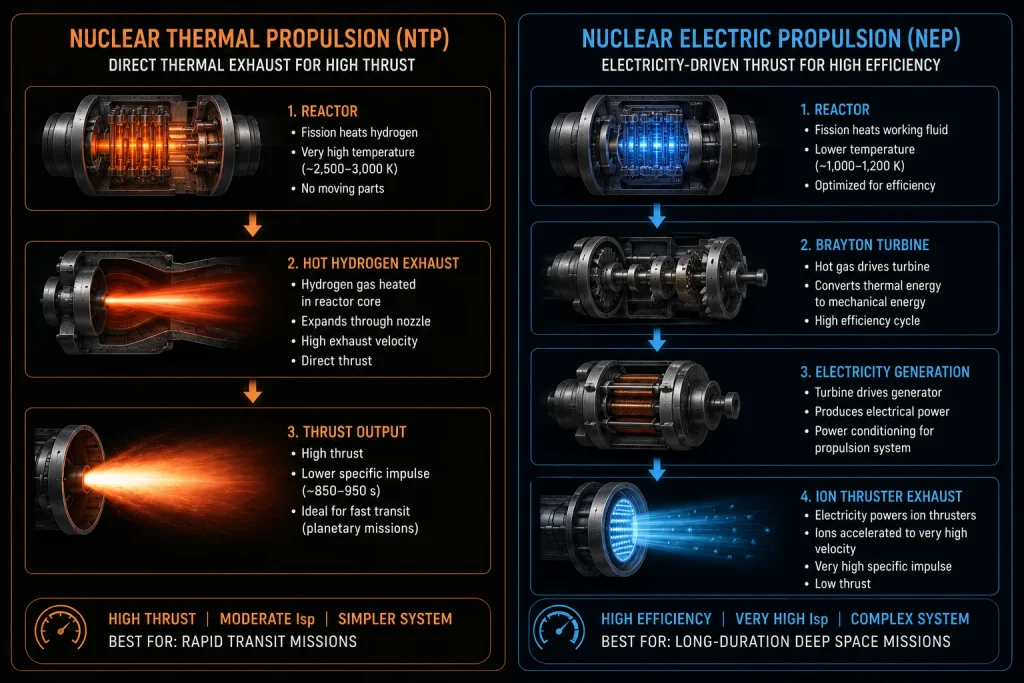
There are two primary ways to use nuclear energy in space: Nuclear Thermal Propulsion (NTP) and Nuclear Electric Propulsion (NEP).
NTP is currently the focus of NASA’s DRACO program. It is a brute-force method: you pump freezing liquid hydrogen directly through a hot nuclear core and blast the expanding gas out of a nozzle. It provides high thrust and gets humans to Mars quickly, minimizing radiation exposure.
NEP is a more elegant, complex, and long-term solution. The reactor doesn’t shoot gas; it turns a turbine to make electricity. This electricity powers an entirely separate electric engine. While NTP is for fast human transport, NEP is the undisputed king of heavy, unmanned cargo logistics. It will be the “container ship” architecture of the future space economy, slowly moving thousands of tons of mining equipment or habitat shielding across the solar system.
How Nuclear Electric Propulsion and MPD Thrusters Work
Extracting nuclear energy and converting it into thrust in a vacuum requires navigating complex thermodynamics. Here is the first-principles breakdown of the NEP architecture.
1. The Power Source: The Fission Reactor
The heart of an NEP vehicle is a compact, high-temperature nuclear fission reactor, typically fueled by High-Assay Low-Enriched Uranium (HALEU). The reactor sustains a controlled chain reaction, generating immense thermal energy (heat).
2. Energy Conversion: The Closed-Loop Brayton Cycle
Because there is no air in space to burn, the heat must be converted to electricity using a closed-loop thermodynamic cycle. The reactor heats an inert noble gas mixture (like Helium-Xenon). This superheated gas expands violently, spinning a mechanical turbine. The turbine spins a massive alternator to generate raw, multi-megawatt electricity. The gas is then cooled and pumped back into the reactor in a continuous loop.
3. The Thrust Mechanism: Magnetoplasmadynamic (MPD) Thrusters
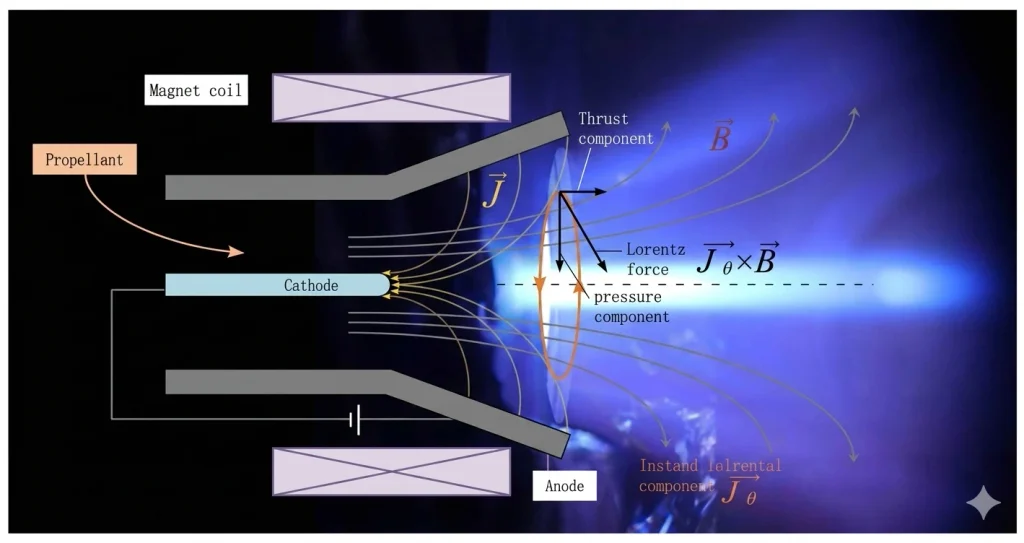
The generated electricity is routed to the propulsion system. For multi-megawatt architectures, standard ion thrusters are insufficient. Engineers utilize Magnetoplasmadynamic (MPD) thrusters.
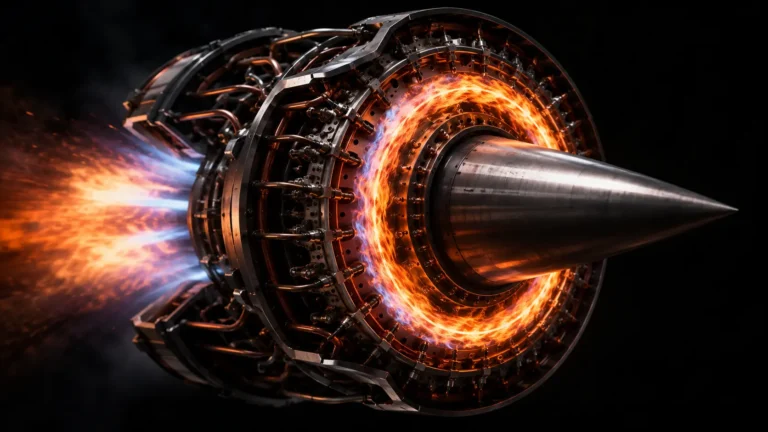
An inert propellant (like Argon or Xenon) is injected into a chamber. The massive electrical current strips electrons from the gas, turning it into a plasma. An intense magnetic field then interacts with the electrical current (via the Lorentz force), violently accelerating the plasma out the back of the engine at speeds exceeding 50,000 meters per second.
4. The Physics of Specific Impulse (I_sp)
The efficiency of a rocket is measured in Specific Impulse (I_sp), representing how much thrust is gained per unit of propellant.
- Chemical Rocket: I_sp ≈ 450 s
- Nuclear Thermal (NTP): I_sp ≈ 900 s
- Nuclear Electric (NEP): I_sp > 5,000 s Governed by the Tsiolkovsky rocket equation (Δv = I_sp × g₀ × ln(m₀/m_f), the exceptionally high I_sp of an MPD thruster means it can achieve massive changes in velocity (Δv) while consuming very little propellant mass.
5. Real-World Consequences: The Radiator Bottleneck
The fundamental flaw of NEP is thermodynamics. If the reactor generates 10 Megawatts of thermal heat, the Brayton turbine might only convert 20% of that into electricity (2 MWe). The remaining 8 Megawatts is pure waste heat.
In a vacuum, you cannot use air or water to cool the ship; heat can only be removed via infrared thermal radiation (governed by the Stefan-Boltzmann law). Removing 8 MW of heat requires deploying massive, football-field-sized radiator panels.
Commercial Applications in Deep Space and Mars Logistics
While NEP is still heavily in the design and prototyping phase, its architecture dictates the future roadmaps of deep space exploration.
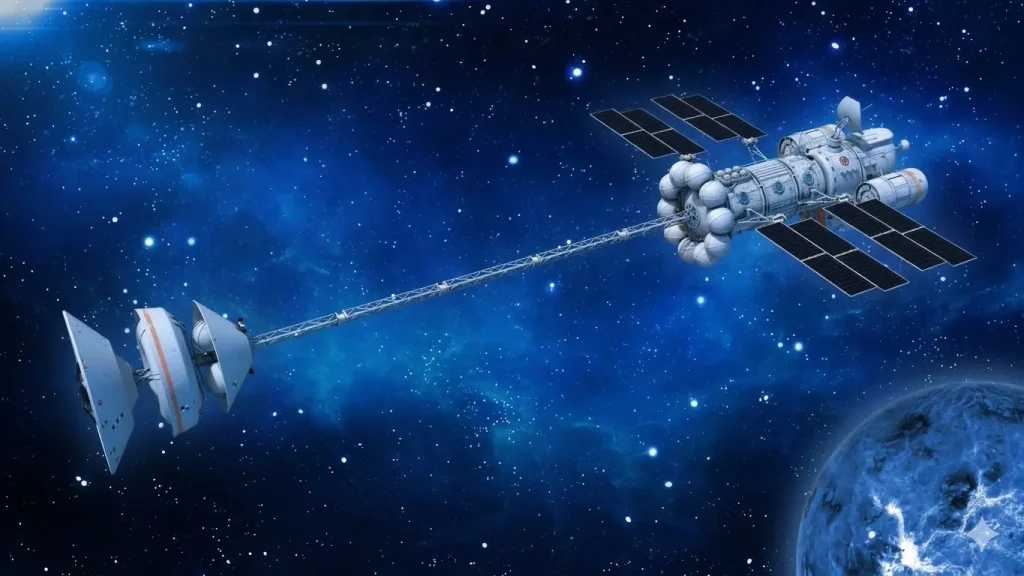
The Jupiter Icy Moons Orbiter (JIMO): The most famous historical attempt at NEP was NASA’s JIMO project in the early 2000s (under Project Prometheus). The goal was to send a massive spacecraft to orbit Jupiter’s moons (Callisto, Ganymede, and Europa). Solar panels are useless at Jupiter’s distance. JIMO was designed around a 200-kWe nuclear reactor powering ion thrusters. Though cancelled due to budget constraints, JIMO established the baseline engineering required to mount a heavy reactor on a long boom to shield the scientific payload from radiation.
Asteroid Deflection and Planetary Defense: If Earth detects a massive, civilization-ending asteroid on a collision course, chemical rockets lack the sustained thrust required to push heavy deflection equipment into deep space quickly. An NEP “gravity tractor” could rendezvous with an asteroid years in advance. Because NEP provides continuous thrust, the spacecraft could hover next to the asteroid, using its own gravitational mass to slowly, continuously tug the asteroid off its collision course over several years.
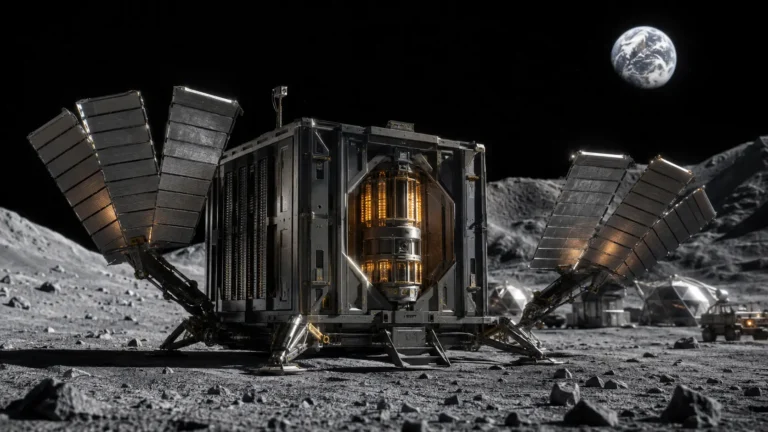
Deep Space Cargo Logistics (Mars & Lunar Base): Sustaining a human colony on Mars requires shipping thousands of tons of habitats, rovers, and life-support equipment. Launching this massive weight on chemical rockets is financially impossible. Space agencies plan to use “split missions.” The cargo is loaded onto slow, ultra-efficient NEP freighter ships that take 2-3 years to reach Mars. Once the cargo arrives safely, the human astronauts are launched on fast, high-thrust NTP or chemical rockets, arriving months later to a fully stocked, pre-built Martian base.
Economic & Strategic Impact
The core strategic friction surrounding NEP is the Weaponization and Orbital Debris Risk.
Putting highly enriched uranium reactors into space triggers intense geopolitical anxiety. A mega-watt class NEP reactor requires significant amounts of fissile material. If a launch vehicle carrying the reactor explodes in the atmosphere, it risks scattering radioactive material across the globe (though modern reactor designs remain mathematically sub-critical and inactive until safely parked in a high orbit).
Furthermore, any spacecraft possessing a multi-megawatt power source and an engine capable of continuous Δv is inherently a strategic weapon. A military could theoretically use an NEP vehicle to relentlessly alter its orbit, chasing down and neutralizing adversarial satellites across multiple orbital planes—a maneuver standard satellites cannot perform because they lack the fuel. The deployment of NEP systems will inevitably force a rewrite of international space treaties to govern high-power orbital assets.
Advantages
- Extreme Fuel Efficiency: Achieves an I_sp of 5,000 to 10,000 seconds, meaning it can move massive amounts of weight utilizing a fraction of the propellant required by chemical rockets.
- Abundant Payload Power: The nuclear reactor doesn’t just power the engines. Once the ship reaches its destination (e.g., orbiting Saturn), the multi-megawatt reactor can be redirected to power massive, city-scale ice-penetrating radar arrays or deep-space communication lasers.
- Solar Independence: Totally immune to the inverse-square law of solar radiation. It provides robust, reliable power whether the ship is orbiting Earth or plumbing the dark, freezing depths of the Oort Cloud.
Limitations
- Ultra-Low Thrust: NEP engines generate a force equivalent to the weight of a piece of paper resting on your hand. It takes months of continuous firing just to break out of Earth’s orbit, making it completely useless for launching from the ground or conducting rapid emergency maneuvers.
- The Radiator Vulnerability: The mandatory, sprawling heat radiators are fragile. A single micro-meteoroid traveling at 15 km/s could puncture the coolant loops, destroying the ship’s ability to shed heat and causing the reactor to melt down.
- Heavy Shadow Shields: To protect the computer banks and cargo from the intense gamma and neutron radiation emitted by the reactor, a massive, dense shield (often made of tungsten and lithium hydride) must be placed between the reactor and the rest of the ship, adding significant “dead weight” to the mission.
Common Misconceptions
Misconception: NEP means shooting nuclear explosions out the back of the ship.
Reality: That is Nuclear Pulse Propulsion (Project Orion from the 1960s). NEP is entirely clean at the exhaust nozzle. The nuclear reactor simply makes electricity; the engine shoots harmless, glowing inert gas (like Xenon) out the back.
Misconception: NEP will get humans to Mars in 30 days.
Reality: NEP is incredibly slow to build up speed. While its top speed is massive, the slow acceleration means a trip to Mars would likely take longer than a chemical rocket. For fast human transport, Nuclear Thermal Propulsion (NTP) is the preferred architecture.
Misconception: The reactor is dangerous if the rocket explodes on the launchpad.
Reality: The uranium fuel is completely cold and only slightly radioactive before it is turned on. The reactor is mechanically locked and programmed not to begin the fission chain reaction until it is hundreds of miles safely out in space.
What Most People Miss
The disruptive capability of Bimodal Nuclear Propulsion.
Most aerospace analysis assumes a rigid binary choice: you must choose either NTP (for high thrust) or NEP (for high efficiency). What most analysts miss is the aggressive engineering pursuit of Bimodal systems.
A Bimodal reactor attempts to do both. During the initial push out of Earth’s gravity well, the system pumps liquid hydrogen directly through the core (acting as an NTP rocket for high thrust). Once the ship is safely coasting in deep space, the reactor valves shut, and it switches to a closed-loop Brayton cycle, generating electricity to power ion thrusters for the long, multi-year cruise (acting as an NEP rocket). Engineering a reactor core that can survive both the violent thermal shock of freezing hydrogen and the steady-state multi-year burn of a closed-loop gas cycle is the holy grail of 21st-century astronautics.
Comparison Table
| Feature | Chemical (Liquid H2/O2) | Nuclear Thermal (NTP) | Nuclear Electric (NEP) |
| Power Source | Chemical Combustion | Nuclear Fission (Direct Heat) | Nuclear Fission (Electricity) |
| Specific Impulse (I_sp) | ~450 s | ~900 s | > 5,000 s |
| Thrust Level | Massive (Millions of Newtons) | High (Tens of thousands of N) | Microscopic (Fractions of a Newton) |
| Primary Limitation | Heavy fuel mass (Tyranny of Rocket Eq) | Radioactive exhaust testing limits | Massive waste heat radiators required |
| Optimal Mission | Launching from Earth surface | Fast human transport to Mars | Heavy cargo logistics to deep space |
Case Study
Situation: To fully map the subsurface oceans of Jupiter’s icy moons (Europa, Ganymede, Callisto), NASA needed an orbiter capable of performing complex orbital insertions around multiple different moons. A standard chemical rocket would not have enough fuel to hop between these moons, and solar panels would not provide enough electricity at Jupiter’s distance to power the heavy ice-penetrating radar.
Challenge: Design an architecture capable of providing massive continuous Δv for complex orbital maneuvering, while simultaneously supplying hundreds of kilowatts of electricity to heavy scientific payloads in the dark outer solar system.
Solution (Project Prometheus / JIMO): In 2003, NASA launched Project Prometheus, aiming to develop the Jupiter Icy Moons Orbiter (JIMO). The design utilized a 200 kWe nuclear fission reactor positioned at the very front of the spacecraft, separated from the payload by a massive boom and radiation shield. The reactor powered a closed-loop Brayton cycle, which supplied electricity to advanced High Power Electric Propulsion (HiPEP) ion thrusters.
Outcome: Although JIMO was ultimately cancelled in 2005 due to shifting agency priorities and budget overruns, the engineering analysis yielded foundational data. It proved that managing the waste heat via massive deployable radiator panels was the primary engineering bottleneck.
Lessons Learned: JIMO validated that NEP is the mandatory baseline architecture for deep space science. It confirmed that while chemical rockets can get a probe to simply fly past Jupiter, only a multi-kilowatt or multi-megawatt NEP vehicle possesses the fuel efficiency and electrical budget to stop, orbit, and thoroughly analyze the outer planets for years at a time.
Future Outlook
Next 12–24 Months
The era of Megawatt Brayton Cycle Ground Testing. Before flying a reactor in space, engineers must prove that the energy conversion systems can survive for years without maintenance. Through 2026 and 2027, aerospace contractors and the Department of Energy (DOE) will focus heavily on non-nuclear ground testing of closed-loop supercritical CO_2 and Helium-Xenon Brayton turbines. Proving that these turbines can spin flawlessly at extreme temperatures using simulated electric heat sources is the absolute prerequisite for advancing NEP from a theoretical design to a flight-ready program.
Next 3–5 Years
The scaling of MPD Thruster Vacuum Chamber Validation. Currently, standard Hall-effect thrusters max out at around 100 kilowatts of power. To utilize a megawatt-class nuclear reactor, the thrusters must be vastly more powerful. In the late 2020s, NASA and private space contractors will test massive Magnetoplasmadynamic (MPD) thrusters in giant vacuum chambers on Earth. The primary goal will be preventing the extreme plasma from eroding the thruster’s internal cathode, aiming to achieve 10,000+ hours of continuous firing without the engine destroying itself.
Next 10 Years
The Cislunar Cargo Tug Fleet. By the mid-2030s, the first commercial integration of NEP will likely not be to Jupiter, but in “cislunar space” (the space between the Earth and the Moon). NEP vehicles will operate as permanent “space tugs.” Because they never need to land, these tugs will remain in orbit, ferrying heavy cargo containers from Low Earth Orbit (LEO) to the Lunar Gateway. They will act as the slow, highly efficient freight trains of the orbital economy, dramatically lowering the cost of supplying a permanent human base on the Moon.
Most Likely Scenario
Nuclear Electric Propulsion will inevitably define the logistics of the inner and outer solar system. While chemical rockets will always be required to overcome gravity and launch from planetary surfaces, the vacuum of space belongs to ions and atoms. The nations or private corporations that master the thermodynamic management of space-based fission reactors will secure a permanent, unassailable monopoly over asteroid mining and deep space infrastructure.
Key Takeaways
- Nuclear Electric Propulsion (NEP) places a nuclear fission reactor on a spacecraft to generate electricity, which powers ultra-efficient ion thrusters for deep space travel.
- Unlike chemical rockets that burn all their fuel in minutes and coast, NEP thrusters fire continuously for months or years, slowly building up massive terminal velocities.
- Because it uses electricity to accelerate gas (plasma) to extreme speeds, NEP is incredibly fuel-efficient (Specific Impulse > 5,000s), saving massive weight for scientific cargo.
- NEP is distinct from Nuclear Thermal Propulsion (NTP). NTP uses the reactor to heat and shoot gas directly out the back for high thrust. NEP uses the reactor strictly to make electricity.
- The fatal bottleneck of NEP is waste heat. Because there is no air in space, cooling a megawatt-class reactor requires deploying gigantic, fragile radiator panels to bleed heat into the void.
- NEP is too weak to lift a rocket off the Earth, but once safely in orbit, it is the only viable engine for moving thousands of tons of cargo to Mars or powering heavy radar suites around Jupiter.
Glossary
Brayton Cycle: A thermodynamic cycle used to generate electricity. In NEP, a hot gas is expanded through a turbine to spin a generator, then cooled and pumped back through the reactor in a closed loop.
High-Assay Low-Enriched Uranium (HALEU): The specific type of nuclear fuel often proposed for space reactors, offering a dense power output without crossing the enrichment thresholds of weapons-grade material.
Ion Thruster / MPD Thruster: An electric propulsion engine that uses electrical and magnetic fields to strip electrons from a gas (like Argon or Xenon) and shoot the resulting plasma out the back at extreme speeds.
Nuclear Thermal Propulsion (NTP): An alternative nuclear rocket that pumps freezing liquid hydrogen directly through the hot reactor core, shooting the expanding gas out for high thrust but lower efficiency than NEP.
Specific Impulse (I_sp): The measure of a rocket engine’s fuel efficiency, calculated by how much thrust is gained from a specific amount of propellant. Higher is better.
Tyranny of the Rocket Equation: The mathematical reality that to move heavier cargo, you need more fuel, but adding more fuel makes the rocket heavier, which requires even more fuel to lift. NEP breaks this by needing vastly less fuel.
Sources
NASA Technical Reports Server (NTRS): Nuclear Electric Propulsion: A Summary of Concepts and Technologies
American Institute of Aeronautics and Astronautics (AIAA): Magnetoplasmadynamic (MPD) Thruster Performance and Scaling
U.S. Department of Energy (DOE): Space Nuclear Power and Propulsion Systems
European Space Agency (ESA): Advanced Concepts for Nuclear Electric Propulsion in Deep Space
Project Prometheus (NASA Archive): Jupiter Icy Moons Orbiter (JIMO) Design Parameters