Advertisement
)
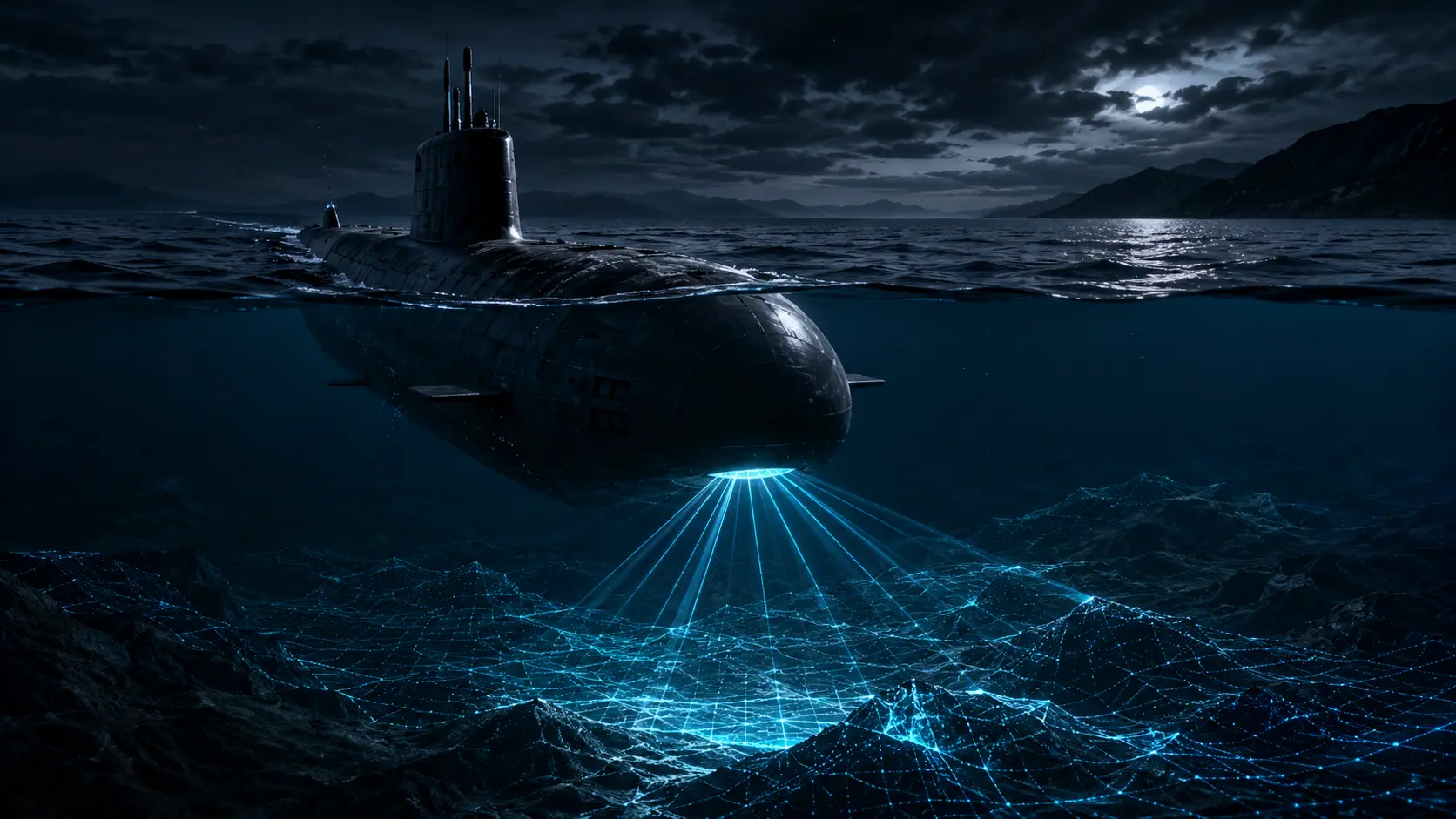

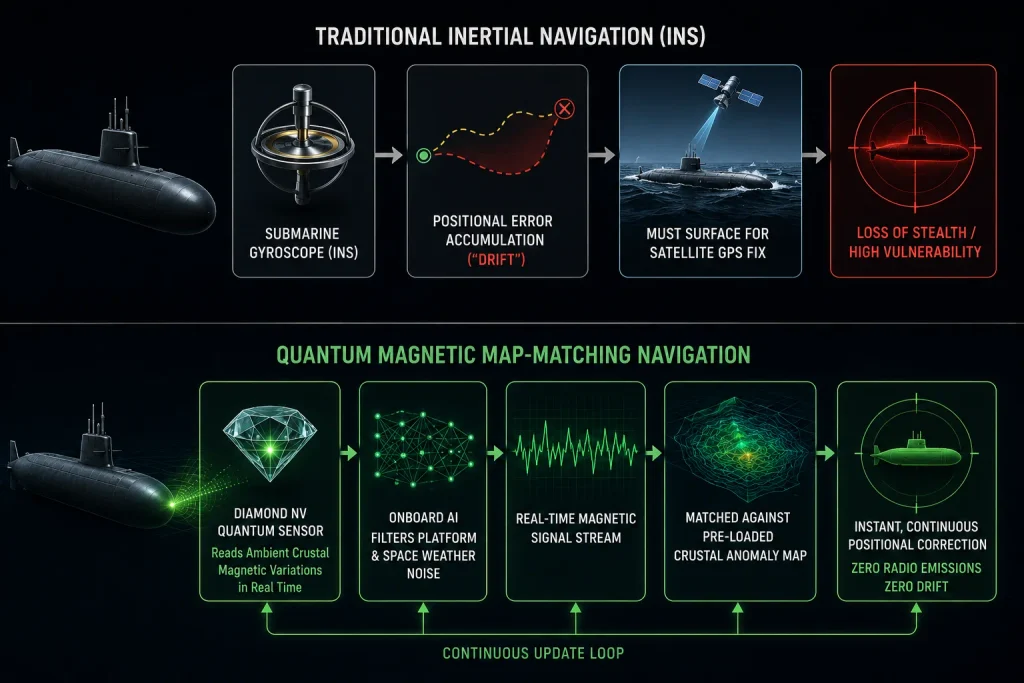
Imagine commanding a $3 billion nuclear submarine deep beneath the Pacific Ocean. Your most critical vulnerability isn’t enemy torpedoes—it is simply getting lost. Because radio waves cannot penetrate deep seawater, submarines are completely cut off from GPS. For decades, crews have relied on internal gyroscopes that slowly “drift” off course, forcing the submarine to eventually approach the surface and expose an antenna to enemy satellites just to re-calibrate its location. In modern naval warfare, surfacing means detection, and detection means death.
Why should you care right now? Because the era of the blind submarine is ending. Defense contractors and physicists are weaponizing the bizarre rules of quantum mechanics to solve the military’s greatest navigational flaw. By harnessing microscopic atomic flaws trapped inside synthetic diamonds, modern quantum sensors can read the incredibly faint, permanent magnetic fingerprints of the Earth’s crust. This allows a submarine to navigate seamlessly across the globe by reading the ocean floor like a magnetic braille map. This technology, known as Quantum Magnetometry, permanently severs the military’s reliance on fragile GPS satellites and fundamentally alters the geometry of underwater stealth and anti-submarine warfare.
What is Quantum Magnetometry?
Quantum Magnetometry is an advanced sensing technology that exploits the quantum states of atomic systems, such as Nitrogen-Vacancy (NV) centers in diamonds or alkali vapor cells, to measure extremely faint magnetic fields. It enables precise, GPS-free navigation by correlating microscopic local magnetic readings with established maps of the Earth’s crustal anomalies.
At a Glance
- Concept: Using synthetic diamonds that glow under green lasers to detect incredibly tiny shifts in the Earth’s magnetic field, allowing vehicles to map their exact location.
- Why it matters: GPS is easily jammed or spoofed by adversaries and does not work underwater. Quantum magnetic navigation provides a completely passive, unjammable positioning system.
- Who uses it: Naval warfare architects (hunting enemy submarines), defense contractors (Lockheed Martin, BAE Systems), and advanced autonomous underwater vehicle (AUV) developers.
- Biggest takeaway: The technology is entirely passive. Unlike radar or active sonar which emit loud pulses that reveal your location, a quantum magnetometer only “listens,” allowing a submarine to hunt and navigate in total, undetectable silence.
In Simple Words
Imagine trying to walk through your house in pitch darkness.
If you use a flashlight (like Radar or Active Sonar), you can see where you are going, but everyone else in the house can instantly see you, too.
If you try to count your footsteps from the bedroom to the kitchen (Inertial Navigation), you might do well for the first twenty steps, but eventually, you miscount or take a slightly larger step, and you drift off course, stubbing your toe.
Quantum Magnetometry is like knowing that the floorboards in your hallway have a very specific, permanent pattern of tiny squeaks. As you walk in total darkness, a highly sensitive microphone glued to your shoe listens to the squeaks. By comparing the exact squeak you just heard to a map of the floorboards in your head, you instantly know your exact position in the hallway. You navigate perfectly without ever turning on a flashlight or opening your eyes.
Why This Matters
For Defense Contractors, Quantum Physicists, and Naval Warfare Analysts, the transition away from the Global Positioning System (GPS) is the defining strategic imperative of the decade.
The U.S. military assumes that in a peer-to-peer conflict (e.g., in the South China Sea), the GPS satellite constellation will be systematically jammed, spoofed, or kinetically destroyed by anti-satellite (ASAT) weapons in the opening hours of the war. A military that cannot navigate without GPS cannot coordinate strikes, launch precision missiles, or safely route its submarines. Quantum magnetometry provides a secure, physical “ground truth” that cannot be hacked or jammed from space. The country that masters quantum sensing first secures an unshakeable operational advantage in a digitally degraded battlespace.
Navigating via Earth’s Crustal Magnetic Anomalies
Navigating by the Earth’s magnetic field isn’t new—compasses have existed for centuries. However, a traditional compass only points to Magnetic North, which is a broad, imprecise vector.
Quantum magnetometry operates on an entirely different scale. The Earth’s crust is littered with iron-rich rocks, tectonic scars, and sunken metallic wrecks. These localized structures create tiny ripples, or “anomalies,” in the background magnetic field. These anomalies are permanent and mathematically unique. By turning these microscopic magnetic ripples into a highly detailed topographical map, defense agencies are effectively drawing a permanent, invisible GPS grid across the ocean floor.
How Quantum Magnetometers and NV Centers Work
Measuring a magnetic field down to a fraction of a nanotesla requires isolating individual electrons and observing their quantum states. Here is the first-principles breakdown of the Nitrogen-Vacancy (NV) center architecture.
1. The Fundamental Problem: INS Drift
Submarines use Ring Laser Gyroscopes to track their movement. If a sub turns 10 degrees, the gyro records it. But minor frictional and mathematical errors compound. Over weeks of submerged travel, this “drift” means the submarine’s computer might think it is a mile away from its actual physical location, making it impossible to safely navigate through narrow undersea canyons or fire a ballistic missile accurately.
2. The Core Mechanism: Nitrogen-Vacancy (NV) Centers
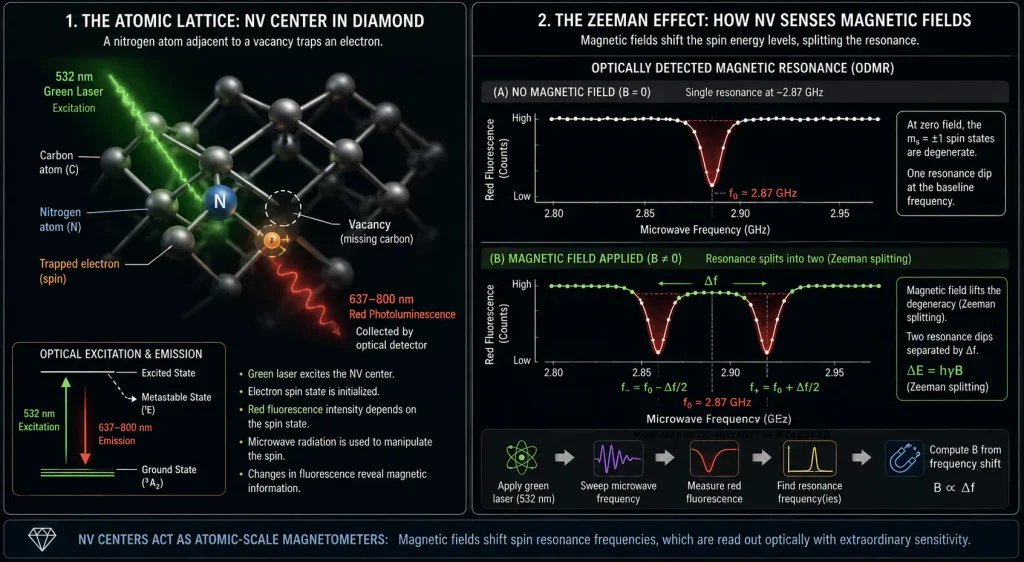
To fix this, physicists engineered the ultimate sensor using synthetic diamonds. In a perfect diamond lattice, every carbon atom binds to four others. Engineers intentionally break this structure by removing one carbon atom (creating a “Vacancy”) and replacing an adjacent carbon atom with a Nitrogen atom. This is an NV center.
3. Technical Depth: Optically Detected Magnetic Resonance (ODMR)
The NV center traps extra electrons. When physicists shine a green laser into the diamond, these electrons get “excited” and jump to a higher energy state. When they fall back down, they release red light (fluorescence).
Crucially, the electrons have a property called quantum spin (m_s = 0 or m_s = ±1). The m_s = 0 state glows significantly brighter.
Physicists bombard the diamond with a sweeping microwave frequency. When the microwave hits the exact resonant frequency of the electrons, they flip from the bright m_s = 0 state to the dimmer m_s = ±1 state, creating a sharp dip in the red light.
4. The Zeeman Effect
Here is where the magic happens: ambient magnetic fields interact with the electrons’ spin, causing the energy levels of the m_s = ±1 states to split apart. This splitting is governed by the Zeeman effect:
ΔE = hγB
(where h is Planck’s constant, γ is the gyromagnetic ratio, and B is the magnetic field strength).
As the submarine glides over a magnetic rock, the ambient magnetic field (B) changes. This alters the energy gap (ΔE), which shifts the exact microwave frequency required to dim the red light. By simply measuring the shifting microwave frequencies, the computer calculates the exact intensity of the magnetic field outside the hull.
5. Real-World Consequences: Map-Matching Algorithms
The diamond sensor outputs a continuous stream of magnetic intensity data. An onboard AI algorithm cross-references this specific stream against a massive, pre-loaded digital map of the ocean floor’s magnetic anomalies. The algorithm acts like a barcode scanner: once the stream matches a known magnetic “fingerprint” on the map, the computer instantly corrects the submarine’s INS drift, confirming its absolute position without ever looking at the sky.
Applications in Stealth ASW and Autonomous Drones
Beyond pure navigation, the hyper-sensitivity of quantum magnetometry is revolutionizing how navies hunt each other.
Passive Anti-Submarine Warfare (ASW): Traditionally, hunting an enemy submarine requires dropping sonar buoys that emit loud acoustic “pings” to bounce sound waves off the enemy hull. This alerts the enemy that they are being hunted. However, a 10,000-ton steel submarine moving through saltwater creates an unavoidable, localized distortion in the Earth’s magnetic field. By mounting quantum magnetometers on low-flying P-8 Poseidon maritime patrol aircraft or autonomous drones, the military performs Magnetic Anomaly Detection (MAD). The drone silently detects the tiny magnetic warp caused by the enemy submarine deep underwater, tracking it entirely passively.
Autonomous Underwater Vehicles (AUVs): Unmanned drone submarines (like the U.S. Navy’s Orca Extra Large UUV) face a unique challenge: they must patrol hostile waters for months without human intervention. Surfacing to get a GPS signal invites interception. By embedding compact diamond quantum sensors directly into the drone’s hull, the AUV can loiter near the ocean floor indefinitely, conducting intelligence gathering and mine-laying missions with absolute navigational autonomy.
Unexploded Ordnance (UXO) and Mine Detection: The ocean floor is littered with unexploded naval mines from previous conflicts. These objects are heavily encrusted in coral and invisible to standard optical cameras, and often designed to evade standard acoustic sonar. A quantum magnetometer, towed by a small drone, can easily detect the distinct magnetic signature of the explosive’s steel casing buried under the sand, allowing for safe, rapid mine-clearing operations ahead of amphibious landings.
Economic & Strategic Impact
The core strategic value of quantum sensors is their Immunity to Electronic Warfare (EW).
In modern combat, the electromagnetic spectrum is a chaotic warzone. Adversaries use massive transmitters to drown out GPS signals, spoof communications, and blind radar.
Quantum magnetometers cannot be jammed by radio waves. They do not rely on external signals being transmitted to them; they measure a physical property of the Earth itself. To “jam” a magnetic map-matching system, an adversary would literally have to rebuild the iron deposits in the Earth’s crust or deploy massive, localized electromagnetic generators across thousands of square miles of open ocean—a logistical impossibility. This makes quantum navigation the ultimate fallback capability, ensuring that a nation’s nuclear deterrent remains functional even if its space infrastructure is completely annihilated.
Advantages
- Absolute Stealth: The sensors emit no radiation, light, or sound. They are purely passive receivers, guaranteeing the host vehicle’s location remains undetected.
- GPS Independence: Secures vital navigation and targeting data without relying on external satellites, insulating the military from space-based ASAT attacks or localized RF jamming.
- Solid-State Durability: NV center diamond sensors operate flawlessly at room temperature, unlike SQUID (Superconducting Quantum Interference Device) magnetometers, which require heavy, expensive, cryogenic liquid helium cooling.
- Miniaturization: Because the sensing element is a microscopic diamond lattice, the technology can be condensed onto a microchip, allowing deployment on tiny drones, wearable soldier tech, and smart munitions.
Limitations
- The Data Mapping Bottleneck: A magnetic sensor is useless without a map to check its readings against. Surveying the entire global ocean floor to create a high-resolution, centimeter-accurate magnetic map is an astoundingly expensive, decades-long endeavor that is still largely incomplete.
- Dynamic Magnetic Interference: The Earth’s magnetic field is not perfectly static. Solar storms (coronal mass ejections) hitting the ionosphere, and dynamic shifts in the Earth’s molten core, cause continuous, subtle changes in the background magnetic field. The onboard AI must constantly filter out this “space weather” noise to avoid misreading the map.
- Platform Self-Interference: Mounting a highly sensitive magnetic sensor inside a submarine made of thousands of tons of moving, magnetic steel is a paradox. Engineers must employ complex active cancellation algorithms to subtract the submarine’s own massive magnetic signature from the sensor data before it can read the faint signals of the ocean floor.
Common Misconceptions
Misconception: Quantum sensors rely on quantum entanglement (“spooky action at a distance”).
Reality: While they use quantum mechanics (specifically electron spin states and energy levels), NV center magnetometers do not typically rely on entanglement. They simply measure how external physical forces alter the behavior of a single, isolated quantum system inside a crystal.
Misconception: They will completely replace standard INS systems.
Reality: They are complementary. An INS is brilliant at measuring fast, second-by-second changes in direction, but it drifts over time. The quantum magnetometer is brilliant at verifying absolute location, but it updates slower. Future submarines will fuse the two systems together via Kalman filters.
Misconception: We can track any submarine anywhere in the ocean from space.
Reality: Magnetic fields decay exponentially over distance (following the inverse-cube law). Even the most advanced quantum sensor on an aircraft or satellite must be relatively close (a few hundred meters) to the target to detect the magnetic distortion of a submarine hull deep underwater.
What Most People Miss
The disruptive application of Optically Pumped Atomic Magnetometers (OPAM) in Vapor Cells.
While diamond NV centers get the most media attention due to their solid-state toughness, they are not the only quantum sensors changing naval warfare.
Most analysts overlook Optically Pumped Atomic Magnetometers (OPAMs). Instead of a diamond, OPAMs use a small glass cell filled with a vapor of alkali metals, like Rubidium or Cesium. A polarized laser aligns the “spin” of the atoms in the gas. When an external magnetic field interacts with the gas, the atoms begin to precess (wobble) like a spinning top, which changes how much laser light passes through the cell.
OPAMs are currently the undisputed kings of absolute sensitivity for Anti-Submarine Warfare (ASW). While they are slightly more fragile than diamonds and require strict magnetic shielding, airborne MAD drones specifically prefer OPAM arrays to detect the faintest possible metallic disruptions deep in the water column.
Comparison Table
| Feature | Inertial Navigation System (INS) | Global Positioning System (GPS) | Quantum Magnetometry (NV Centers) |
| Primary Dependency | Internal Gyroscopes/Accelerometers | External Satellite Constellations | Earth’s Local Crustal Anomalies |
| Signal Attenuation | N/A (Internal) | Fails entirely underwater | Unaffected by water/depth |
| Vulnerability to Jamming | Zero | Extremely High (RF Spoofing) | Zero (Cannot jam Earth’s field) |
| Positional Accuracy | Drifts significantly over time | Extremely High (~1 meter) | High (Bounded by map resolution) |
| Emission Signature | Purely Passive | Passive (Receiver only) | Purely Passive |
Case Study
Situation: The proliferation of advanced electronic warfare (EW) capabilities by near-peer adversaries created massive “Anti-Access/Area Denial” (A2/AD) zones. U.S. and allied naval planners recognized that in a high-intensity conflict, GPS access would be denied immediately. Submarines, the ultimate strategic deterrent, risked losing their navigational certainty, which could lead to critical errors in ballistic missile targeting or disastrous collisions in contested littorals.
Challenge: Develop a highly miniaturized, room-temperature sensor capable of confirming absolute geographic location without emitting a single radio wave or relying on external celestial or satellite references.
Solution (The Quantum Magnetic Navigation Initiative): Defense research agencies (like DARPA and the UK’s Quantum Technology Hub) accelerated funding into solid-state quantum sensing. Researchers integrated Nitrogen-Vacancy (NV) center diamond lattices onto semiconductor chips. By illuminating the diamond with a green laser diode and applying a microwave frequency, the sensor tracked the Zeeman splitting of the electron spin states to derive ultra-precise magnetic readings.
Outcome: When integrated with deep-learning map-matching algorithms, the system successfully allowed test vehicles to correlate their localized magnetic readings against pre-mapped crustal anomalies. The vehicles maintained strict, bounded navigational accuracy indefinitely, completely nullifying the standard mathematical drift of the onboard Inertial Navigation Systems (INS).
Lessons Learned: The initiative proved that quantum mechanics is no longer restricted to cryogenic laboratories. By demonstrating that ruggedized, solid-state diamond sensors could operate in harsh field conditions at room temperature, the defense industry verified that magnetic anomaly navigation is the definitive, un-jammable solution for achieving operational supremacy in GPS-denied environments.
Future Outlook
Next 12–24 Months
The era of Drone-Mounted MAD Arrays. In the immediate term, the heavy deployment of quantum magnetometry will focus on airborne Anti-Submarine Warfare (ASW). We will see the rapid retrofitting of standard maritime patrol aircraft (like the P-8) and autonomous drones (like the MQ-9B SeaGuardian) with highly sensitive OPAM and NV center arrays. These drones will fly low-altitude grids over critical naval chokepoints (like the GIUK gap or the Taiwan Strait), passively mapping the magnetic deformations caused by deeply submerged adversary submarines.
Next 3–5 Years
The scaling of Crowdsourced Magnetic Bathymetry. The primary bottleneck—the lack of high-resolution magnetic maps of the ocean floor—will be solved through aggressive data harvesting. Navies will outfit their entire fleets of surface ships, submarines, and commercial shipping partners with passive magnetic sensors. As these ships traverse the globe on standard routes, they will continuously record magnetic data, feeding it back into a massive, AI-stitched global database, creating an ever-updating, dynamic map of the Earth’s magnetic crust.
Next 10 Years
The Quantum Inertial Sensor Integration. By the mid-2030s, the reliance on classical mechanical gyroscopes will end. The NV center magnetometers will be combined directly with Quantum Accelerometers (which use cold-atom interferometry to measure acceleration with absolute perfection). This combined “Quantum Compass” will be entirely solid-state, free of moving parts, and immune to friction or drift. A submarine equipped with this fused system could dive on day one of a conflict and patrol the oceans for a year, knowing its position down to the centimeter, fundamentally neutralizing the strategic threat of anti-satellite warfare.
Most Likely Scenario
Quantum magnetometry ensures that the disruption of the GPS constellation will no longer paralyze naval operations. As the technology miniaturizes from bulky laboratory equipment into standard silicon-compatible microchips, magnetic map-matching will become the mandatory fallback architecture not just for submarines, but for autonomous vehicles, ballistic missiles, and commercial shipping, cementing the Earth’s magnetic field as the ultimate, unhackable navigational grid.
Key Takeaways
- Quantum magnetometry uses microscopic flaws in synthetic diamonds (NV centers) or atomic vapor cells to read the Earth’s magnetic field with astonishing precision.
- Because GPS radio waves cannot travel underwater, submarines traditionally rely on gyroscopes that slowly lose accuracy over time, forcing them to surface and risk detection.
- By comparing highly precise local magnetic readings to a digital map of the ocean floor, a submarine can pinpoint its exact location without ever turning on a radio or surfacing.
- The system is entirely passive. It emits no sound or radiation, allowing the submarine to navigate in complete stealth.
- The technology is also weaponized for Anti-Submarine Warfare (ASW). Low-flying drones use these sensors to detect the tiny magnetic distortion caused by a steel enemy submarine deep underwater.
- Unlike GPS, which can be jammed or spoofed by enemy electronic warfare, the Earth’s magnetic field cannot be hacked, making this the ultimate secure navigation system.
Glossary
Inertial Navigation System (INS): The traditional method of navigating without GPS, using complex gyroscopes and accelerometers to track movement from a known starting point. It suffers from mathematical “drift” over time.
Magnetic Anomaly Detection (MAD): The military tactic of using sensitive magnetometers to detect the magnetic disruption caused by the massive steel hull of a submerged submarine.
Nitrogen-Vacancy (NV) Center: A specific, engineered flaw in a diamond crystal lattice where a carbon atom is replaced by a nitrogen atom next to an empty space. It traps electrons whose spin states are highly sensitive to magnetic fields.
Optically Detected Magnetic Resonance (ODMR): The technique of reading the quantum spin state of the electrons inside an NV center by shining a green laser on it and measuring the brightness of the red light it emits.
Optically Pumped Atomic Magnetometer (OPAM): A highly sensitive quantum sensor that uses a glass cell filled with a vapor of alkali metals (like Rubidium) to measure magnetic fields by observing how the atoms wobble (precess) when hit by a laser.
Zeeman Effect: The physics principle describing how external magnetic fields cause the energy levels of an atom or electron to split apart. This splitting is the exact mathematical measurement used by quantum magnetometers.
Sources
MIT Technology Review: Diamond Sensors for GPS-Free Navigation
DARPA: Quantum-Assisted Sensing and Readout (QuASAR) Program Overview
Nature Communications: Magnetic navigation with nitrogen-vacancy centers in diamond
Journal of Applied Physics: Optically pumped atomic magnetometers for defense applications
U.S. Naval Institute (USNI): The Future of Anti-Submarine Warfare and Magnetic Anomaly Detection