Advertisement
)

AT A GLANCE
- Concept: Magnetic Confinement: No physical material on Earth can hold a miniature star; the plasma must be suspended entirely in a magnetic cage.
- Concept: High-Temperature Superconductors (HTS): REBCO materials conduct infinite electricity with zero resistance at temperatures accessible by cheap liquid nitrogen, rather than expensive liquid helium.
- Concept: The 20-Tesla Threshold: These new magnets generate fields double the strength of legacy superconductors, exponentially increasing plasma density.
- Concept: The Shrinking Tokamak: Because magnetic power scales to the fourth power, doubling the field strength allows engineers to shrink the physical reactor by a factor of forty.
HOW REBCO MAGNETS WORK
To achieve nuclear fusion, hydrogen isotopes must be heated to temperatures exceeding 100 million degrees Celsius—roughly ten times the heat of the sun’s core. At this extreme temperature, the gas transitions into a charged plasma. If this plasma touches the steel walls of the reactor, the walls will instantly melt, and the plasma will violently cool, killing the fusion reaction.
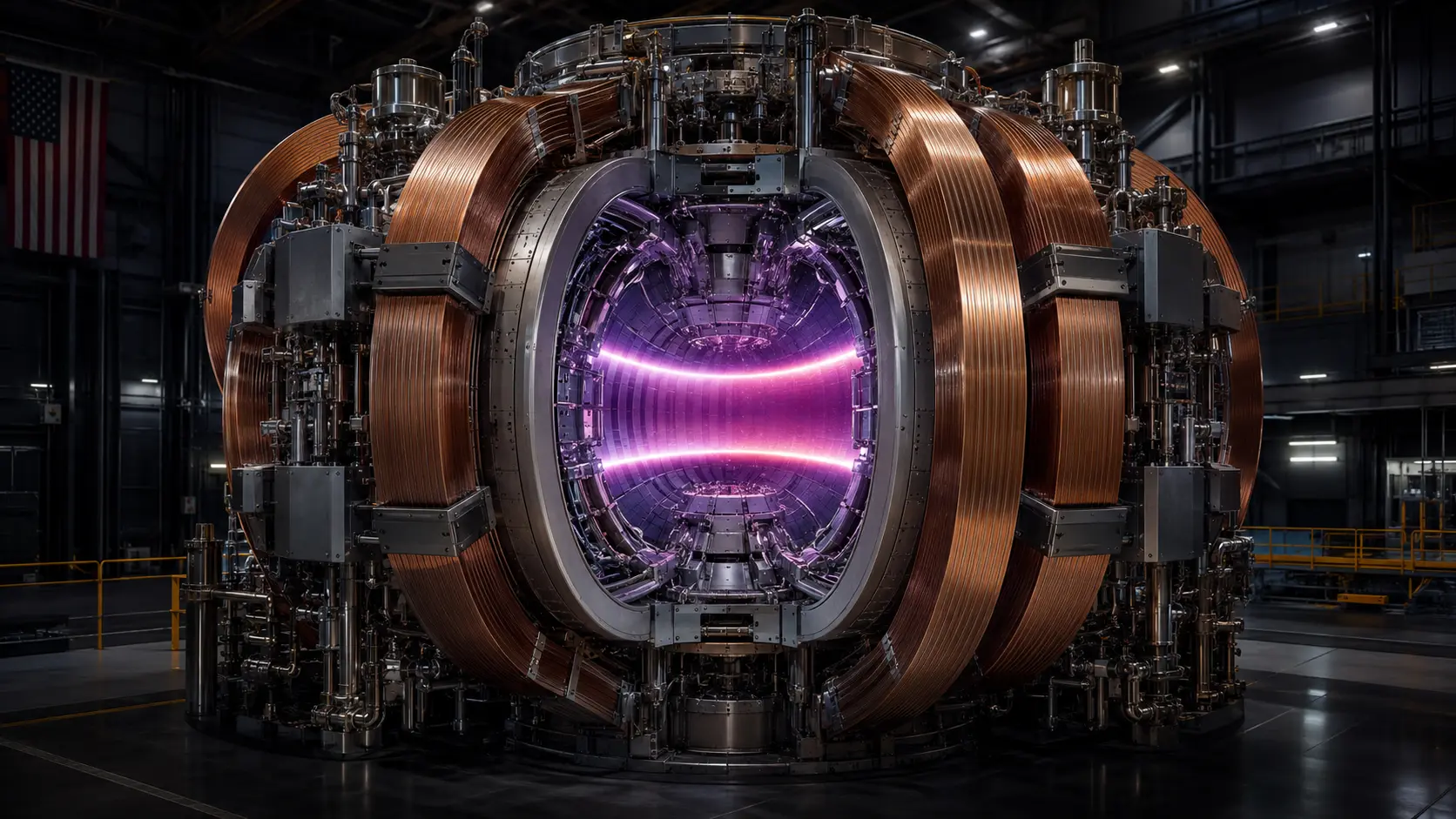
Engineers trap this plasma using a device called a tokamak, a donut-shaped vacuum chamber surrounded by massive electromagnets. These magnets generate an invisible, toroid-shaped magnetic cage that physically crushes the plasma and suspends it in the center of the vacuum chamber. The strength of this magnetic cage dictates the absolute viability of the reactor.
For decades, tokamaks relied on Low-Temperature Superconductors (LTS), typically niobium-tin. These metals require extreme cooling down to near absolute zero (4 Kelvin) using highly expensive liquid helium. More critically, niobium-tin possesses a strict physical limit; if the magnetic field exceeds roughly 12 Tesla, the material abruptly loses its superconductivity and violently regains its electrical resistance, a catastrophic event known as a “quench.”
Rare-Earth Barium Copper Oxide (REBCO) shatters this physical ceiling. REBCO is a High-Temperature Superconductor (HTS). It achieves zero electrical resistance at much warmer temperatures (77 Kelvin) and, crucially, can sustain immense electrical currents while generating magnetic fields exceeding 20 Tesla without quenching.
Because REBCO is a brittle ceramic, it cannot be drawn into a traditional wire. Manufacturers use vapor deposition to “print” a microscopic layer of the REBCO crystal—thinner than a human hair—onto a flexible steel ribbon. Engineers then tightly wind hundreds of miles of this REBCO tape into massive D-shaped coils, creating the most powerful, continuous magnetic fields ever engineered on Earth.
WHY IT MATTERS NOW
The physics of fusion dictates that the fusion power output of a tokamak scales to the fourth power of its magnetic field strength (P ∝ B⁴).
If you double the strength of the magnetic cage, the reactor generates sixteen times more energy. Historically, because legacy niobium-tin magnets were capped at 12 Tesla, the only way physicists could increase the total power output was to physically build the reactor larger.
This physical constraint birthed the ITER project in France—a monolithic, 23,000-ton experimental tokamak that has consumed decades of time and tens of billions of dollars of sovereign capital to construct. ITER is mathematically forced to be the size of an arena simply because its legacy magnets are too weak.
REBCO tape completely disrupts this civilizational scaling law. By utilizing 20-Tesla REBCO magnets, companies like Commonwealth Fusion Systems (CFS), born out of MIT, can achieve the exact same plasma performance as ITER in a physical reactor roughly one-fortieth the volume (the SPARC tokamak).
This single material shift moves nuclear fusion out of the realm of multi-decade, government-funded mega-projects and into the domain of venture-backed, iterative commercial manufacturing. The ability to build a fusion plant small enough to fit inside a standard industrial warehouse radically alters the unit economics of deployment, establishing a credible physical path to supplying limitless, zero-carbon baseload power directly to major urban centers.
WHAT MOST PEOPLE MISS
Tech media heavily fixates on “net energy gain”—the moment a fusion reaction produces more power than it consumes. They entirely miss that achieving ignition is primarily an exercise in manufacturing supply chains, not just plasma physics.
A commercial tokamak requires up to 10,000 kilometers of REBCO tape to build a single set of magnetic coils. Five years ago, the entire global manufacturing base produced less than 100 kilometers of REBCO tape annually. The true moat for fusion startups is not their plasma control algorithms; it is their ability to aggressively finance and monopolize the global production of this specific, hyper-niche superconducting ribbon.
THE TRAJECTORY
Next 12–36 Months: The activation of the first fully integrated, REBCO-powered net-energy demonstration tokamaks (like SPARC). These facilities will scientifically prove that compact, high-field magnetic confinement can successfully sustain a burning plasma, instantly validating billions of dollars of private fusion capital.
Next Five Years: The transition to non-insulated (NI) coil architectures. Current REBCO magnets use layers of copper and epoxy to protect the tape during a quench. Engineers will perfect “no-insulation” winding techniques, allowing the electrical current to automatically reroute itself across bare REBCO layers during a fault, drastically increasing the physical durability and magnetic density of the coils.
Next Ten Years: The commoditization of REBCO manufacturing via continuous reel-to-reel deposition. Chemical companies will perfect the roll-to-roll printing of the crystalline ceramic, crashing the cost of the tape from hundreds of dollars per meter down to industrial commodity pricing, mathematically unlocking the mass production of commercial fusion power plants.
What Could Go Wrong: Neutron degradation of the superconducting crystal. When a deuterium-tritium fusion reaction occurs, it releases a massive barrage of high-energy neutrons. If the reactor’s shielding is insufficient, these neutrons will physically bombard the REBCO coils, shattering the delicate atomic lattice of the ceramic and permanently destroying its ability to carry a superconducting current.
Most Likely Outcome: REBCO tape will become the defining raw material of the fusion age, mirroring the role of metallurgical silicon in the computing age. The mastery of high-temperature superconducting magnetics will permanently separate the theoretical physics of the 20th century from the commercial grid reality of the 21st.
KEY TERMS
- Tokamak: A toroidal (donut-shaped) device that uses powerful magnetic fields to confine and control high-temperature plasma to achieve nuclear fusion.
- REBCO (Rare-Earth Barium Copper Oxide): A specific class of high-temperature superconducting ceramics capable of carrying massive electrical currents without resistance.
- Magnetic Confinement: The use of customized magnetic fields to suspend plasma in a vacuum, preventing it from touching and melting the physical walls of the reactor.
- Quench: A dangerous event where a superconducting magnet suddenly loses its zero-resistance state, rapidly converting its stored electrical energy into violent thermodynamic heat.
- Plasma: The fourth state of matter, created by superheating a gas until the electrons are stripped from their atomic nuclei, forming a highly conductive, magnetically sensitive cloud.
SOURCES
- Massachusetts Institute of Technology (MIT) Plasma Science and Fusion Center — High-Field Superconducting Magnets and the SPARC Tokamak
- Department of Energy (DOE) — High-Temperature Superconductor Tape Manufacturing for Fusion Applications
- IEEE Transactions on Applied Superconductivity — Mechanical and Electrical Limits of REBCO Coils
- Commonwealth Fusion Systems — Magnet Technology and the Scaling Laws of Tokamak Architecture