Advertisement
)

AT A GLANCE
- Concept: Reversible Oxidation: The battery physically breathes in atmospheric oxygen to discharge power and exhales oxygen to charge.
- Concept: Long-Duration Energy Storage (LDES): Designed specifically to provide continuous multi-day power, crossing the critical 100-hour discharge threshold.
- Concept: Elemental Abundance: Iron is the most mined metal on Earth, eliminating the geopolitical bottlenecks of lithium and cobalt extraction.
- Concept: The Weight Trade-off: The system is structurally far too heavy for electric vehicles, optimizing strictly for stationary grid utility.
HOW IT WORKS
Lithium-ion batteries store energy by moving lithium ions between a graphite anode and a metal oxide cathode. While highly efficient for short bursts, this solid-state chemistry mathematically hits an economic wall at four hours of storage. To achieve multi-day storage, engineers must abandon expensive, lightweight metals and embrace the cheapest, heaviest transition metal available: iron.
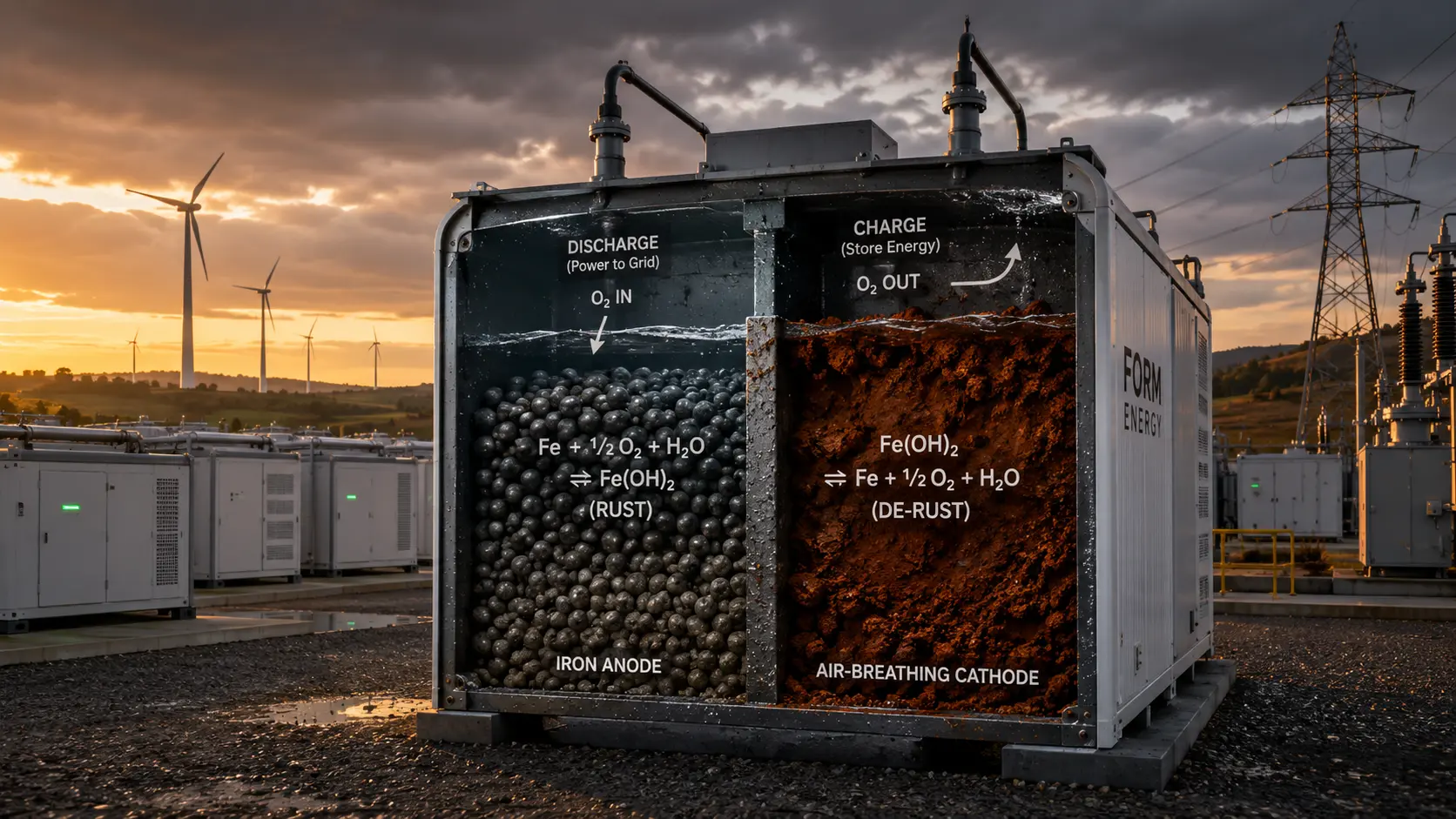
An iron-air battery operates on the principle of reversible oxidation. The fundamental components are an iron anode, composed of thousands of tiny iron pellets, and an air-breathing cathode. Both components sit submerged in a non-flammable, water-based alkaline liquid electrolyte.
To discharge energy to the grid, the battery literally inhales. The cathode pulls ambient atmospheric oxygen into the electrolyte. The oxygen reacts with the iron pellets, executing a strict electrochemical oxidation reaction Fe + ½ O₂ + H₂O ⇌ Fe(OH)₂.
The iron physically rusts, converting into iron hydroxide and releasing a continuous stream of electrons that flow out to the public power grid. Because iron is incredibly dense, this rusting process can sustain a continuous electrical output for over 100 hours.
To recharge the system, grid operators push excess renewable electricity back into the battery. This electrical current forces the chemical reaction backward. The current strips the oxygen atoms away from the rust, converting the iron oxide back into pure metallic iron. The battery physically exhales the separated oxygen gas back into the atmosphere, restoring its fully charged, un-rusted state.
WHY IT MATTERS NOW
Global power grids are currently attempting a mathematically complex transition. They are replacing continuous, always-on coal and natural gas baseload generation with highly intermittent wind and solar power. Grid operators can manage brief daily drops in solar production seamlessly using standard four-hour lithium-ion batteries.
However, power grids face severe seasonal weather anomalies known as “dunkelflaute”—multi-day periods of low wind and heavy cloud cover. During these extreme weather events, a grid relying solely on four-hour storage will experience catastrophic, systemic blackouts. True decarbonization physically requires 100-hour Long-Duration Energy Storage (LDES) to backstop these massive, multi-day generational deficits.
The iron-air battery, commercialized aggressively by companies like Form Energy, solves this exact geographic and economic constraint. Because the active materials are just rust, water, and air, the capital cost of the battery scales down to roughly $20 per kilowatt-hour. This is an order of magnitude cheaper than lithium-ion, making 100-hour storage financially viable for independent power producers.
By deploying massive, 50-acre fields of iron-air batteries directly adjacent to retiring coal plants, utilities can reuse the existing high-voltage transmission lines. This electrochemical rust cycle completely displaces the need for natural gas peaker plants, permanently altering the baseline economics of planetary electricity generation.
WHAT MOST PEOPLE MISS
Clean tech commentary frequently judges all batteries by round-trip efficiency. They point out that an iron-air battery loses roughly 50 percent of its energy during the rusting and un-rusting cycle, compared to lithium-ion which loses less than 10 percent. They entirely miss that round-trip efficiency is economically irrelevant for seasonal grid storage.
The input energy for an iron-air battery comes from curtailed renewable power. This is solar and wind energy generated during periods of extreme oversupply when wholesale electricity prices physically drop to zero or become negative. Losing half of an energy source that is mathematically free does not alter the financial model.
The economic value is generated purely by the battery’s ability to discharge that trapped energy days later during a severe localized price spike. This executes a massive temporal arbitrage that lithium-ion cannot physically sustain without bankrupting the grid operator.
THE TRAJECTORY
Next 12–36 Months: Major US utilities will activate the first commercial multi-megawatt iron-air pilot facilities. These initial deployments will validate the physical durability of the air-breathing cathodes against airborne contaminants, establishing the baseline maintenance curves required for institutional project finance.
Next Five Years: Iron-air systems will become the default replacement infrastructure for decommissioned thermal power plants. Financial markets will structure specific LDES capacity contracts, paying battery operators a fixed premium simply to hold 100 hours of reserve power to mathematically guarantee grid stability during winter storms.
Next Ten Years: The complete bifurcation of the global battery supply chain. Lithium, cobalt, and nickel will be exclusively reserved for the high-margin electric vehicle and aerospace sectors. Stationary grid storage will run almost entirely on cheap, hyper-abundant transition metals like iron and sodium.
What Could Go Wrong: The air-breathing cathode requires highly engineered, proprietary catalysts to facilitate the oxygen exchange without degrading in the alkaline electrolyte. If these catalysts suffer accelerated microscopic fouling from industrial air pollution (like sulfur dioxide), the battery will lose its ability to “breathe,” mechanically choking the system and destroying its 20-year financial lifespan.
Most Likely Outcome: Iron-air batteries will establish a permanent, invisible safety net across the global electrical grid. The reversible rust cycle will physically decouple power consumption from volatile weather patterns, acting as the ultimate economic backstop for total renewable energy penetration.
KEY TERMS
- Reversible Oxidation: An electrochemical process where a metal is intentionally rusted to release electrons and then un-rusted by applying an electrical current.
- Long-Duration Energy Storage (LDES): A classification of grid-scale batteries designed to discharge continuous, baseload-equivalent power for a minimum of 10 to 100 hours.
- Dunkelflaute: A meteorological term used in the energy sector to describe periods of low wind and low solar radiation that threaten renewable grid stability.
- Air-Breathing Cathode: A specialized battery component that draws in ambient atmospheric oxygen to trigger the internal chemical reaction without requiring stored oxygen tanks.
- Temporal Arbitrage: The financial strategy of buying electricity when it is oversupplied and cheap, storing it, and selling it hours or days later when demand peaks.
SOURCES
- Department of Energy (DOE) — Long-Duration Energy Storage Earthshot and Transition Metal Chemistries
- National Renewable Energy Laboratory (NREL) — The Economics of 100-Hour Battery Storage for Grid Decarbonization
- Form Energy — Technical Specifications of Reversible Iron-Air Electrochemical Systems
- Journal of Power Sources — Catalyst Degradation Mechanisms in Alkaline Iron-Air Battery Cathodes