Advertisement
)

AT A GLANCE
- Concept: Volume Reduction: Natural gas must be chilled to -162°C to shrink enough for transoceanic shipping.
- Concept: The C3MR Process: A dual-stage cooling cycle using pure propane followed by a customized mixed hydrocarbon cocktail.
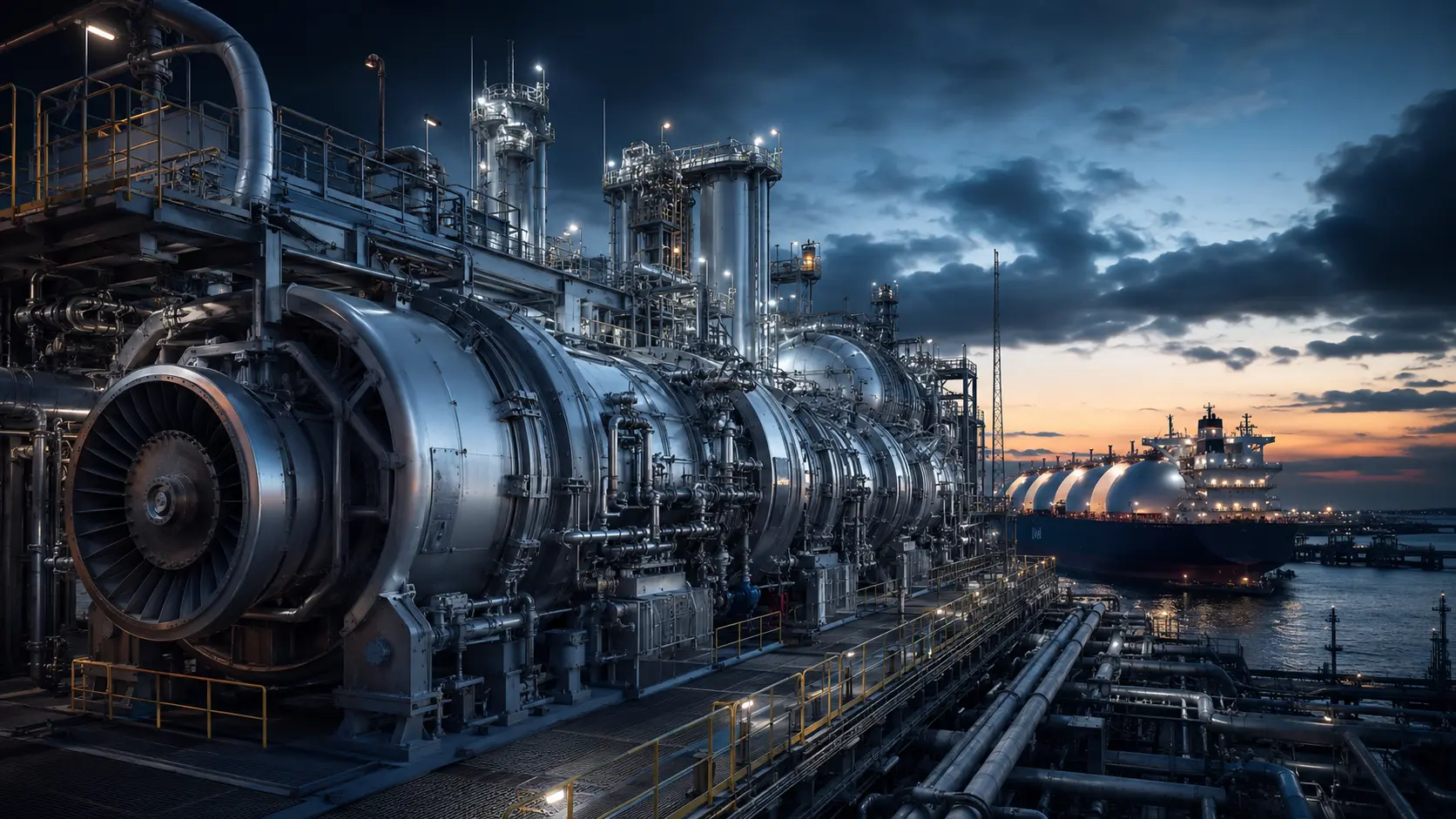
- Concept: Turbomachinery: Massive industrial gas turbines drive the centrifugal compressors that force refrigerants through the system.
- Concept: Geopolitical Bottleneck: The limited manufacturing capacity for these cryogenic components strictly caps global energy trade volumes.
HOW IT WORKS
Moving methane across an ocean presents a severe physical problem. A pipeline moves gas efficiently over land, but transoceanic shipping requires liquid density. By dropping the temperature to -162°C, methane condenses into Liquefied Natural Gas (LNG), shrinking to a fraction of its original volume.
You cannot achieve this extreme thermal drop with a single standard refrigeration cycle. The heavy industrial standard relies on the Propane Pre-cooled Mixed Refrigerant (C3MR) process. This system pushes raw natural gas through a massive, multi-stage thermodynamic cascade to systematically strip away its heat.
In the first physical stage, pure liquid propane loops through a closed refrigeration cycle. This pre-cooling step absorbs the bulk of the initial ambient heat, chilling the incoming natural gas down to roughly -35°C.
The partially chilled gas then enters the Main Cryogenic Heat Exchanger (MCHE). This component is a towering aluminum structure packed with thousands of miles of tightly wound, microscopic tubing.
Inside the MCHE, the gas meets the “mixed refrigerant”—a highly calibrated cocktail of nitrogen, methane, ethane, and propane. Massive centrifugal compressors squeeze this blend to extreme pressures before it rapidly expands, absorbing the final thermal energy and liquefying the gas for transport.
WHY LIQUEFIED NATURAL GAS MATTERS NOW
Global energy security is no longer determined by who possesses gas reserves in the ground. It is dictated entirely by who owns the turbomachinery required to physically liquefy it.
When the European Union abruptly severed its reliance on Russian pipeline gas, it shifted its entire survival strategy to seaborn LNG. This sudden pivot exposed a severe structural hardware bottleneck.
Building a new LNG export facility (a “train”) requires billions of dollars of capital expenditure and up to five years of intense metallurgical engineering. The cryogenic compressors and massive heat exchangers are custom-machined behemoths with multi-year manufacturing waitlists.
Because liquefaction capacity is physically capped by this slow manufacturing cycle, the spot price of global LNG is hyper-sensitive to any operational disruption. If a single compressor turbine trips offline at a major export terminal in Texas or Qatar, global supply drops instantly.
This hardware scarcity creates massive geopolitical control. The nations that successfully secure these highly specialized compressor trains capture the ability to price arbitrage natural gas across continents, extracting massive premiums from energy-starved markets.
WHAT MOST PEOPLE MISS
Mainstream reporting assumes LNG is a frictionless alternative to domestic pipeline networks. They entirely miss the staggering parasitic energy loss required just to operate the liquefaction plant.
A standard LNG export terminal consumes roughly ten percent of all the natural gas it processes strictly to fuel its own massive compressor turbines. Operating this extreme thermodynamic cycle physically destroys a tenth of the total energy supply before it ever enters a shipping vessel.
THE TRAJECTORY
Next 12–36 Months: Expected wave of Final Investment Decisions (FIDs) for modular mid-scale LNG trains. Instead of building custom mega-trains, developers will purchase standardized, pre-fabricated compressor modules to slash construction timelines and bypass the heavy-engineering backlog.
Next Five Years: The aggressive integration of algorithmic process control. Machine learning models will continuously adjust the exact chemical ratio of the mixed refrigerant cocktail in real-time, matching microsecond shifts in ambient air temperature to maximize thermodynamic compressor efficiency.
Next Ten Years: The complete electrification of new liquefaction terminals. Export facilities will entirely abandon gas-fired turbines, drawing massive loads directly from dedicated nuclear small modular reactors (SMRs) or gigawatt-scale wind farms to mathematically zero out the carbon intensity of the liquefaction process itself.
What Could Go Wrong: Severe supply chain constraints for specialized cryogenic metallurgy. The MCHE requires thousands of tons of high-grade aluminum and exotic steel alloys capable of surviving thermal shock at -162°C. A global shortage of these specific raw materials would immediately paralyze the expansion of the entire global LNG export architecture.
Most Likely Outcome: The mixed refrigerant compressor will remain the absolute physical arbiter of global natural gas trade. Mastery of this extreme thermodynamic cycle will permanently separate the nations that control global energy pricing from those held hostage by it.
KEY TERMS
- C3MR (Propane Pre-cooled Mixed Refrigerant): The dominant industrial liquefaction process utilizing a pure propane cycle followed by a mixed hydrocarbon cycle.
- Main Cryogenic Heat Exchanger (MCHE): A massive aluminum tower packed with microscopic tubing where the final deep-freezing of natural gas occurs.
- Turbomachinery: Heavy-duty rotating equipment, specifically the gas turbines and centrifugal compressors, used to drive the refrigeration cycles.
- Liquefaction Train: A single, independent mechanical unit within an LNG facility containing all the equipment required to liquefy gas.
- Parasitic Load: The massive percentage of electrical or thermal energy consumed by the facility itself to maintain operations.
SOURCES
- Department of Energy (DOE) — LNG Export Terminal Operational Efficiencies and E-Drive Transitions
- Air Products and Chemicals, Inc. (APCI) — C3MR Process Architecture and Cryogenic Heat Exchanger Thermodynamics
- Journal of Natural Gas Science and Engineering — Optimization of Mixed Refrigerant Cycles in Baseload LNG Plants
- Oxford Institute for Energy Studies — The Geopolitics of Global LNG Supply Chains and Infrastructure Bottlenecks