Advertisement
)

AT A GLANCE
- Concept: The Context Window: The amount of text an AI model can hold in its short-term memory before it begins forgetting earlier information.
- Concept: Quadratic Scaling: As text length doubles, the mathematical memory required to process it quadruples, rapidly crashing standard hardware.
- Concept: Sequence Parallelism: The system chops a massive book into equal blocks and assigns one specific block to each GPU in a server rack.
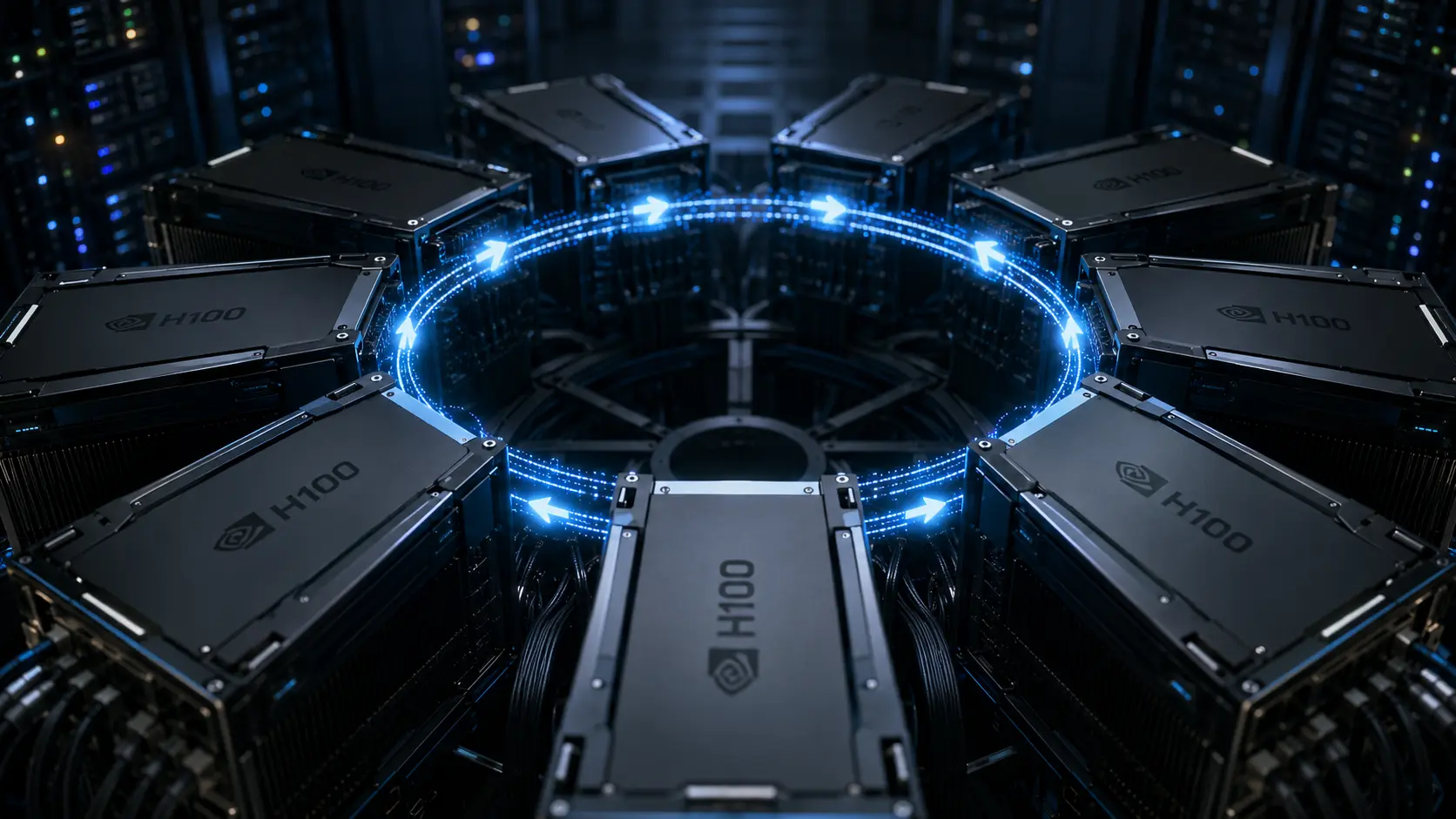
- Concept: The Communication Ring: GPUs pass their mathematical calculations in a continuous, overlapping circle, preventing data bottlenecks on the main network switch.
HOW RING-ATTENTION WORKS
The foundational mathematics of modern artificial intelligence rely on the Transformer architecture, specifically the attention mechanism. When an AI model reads a document, it must calculate the grammatical relationship between every single word and every other word in that document.
This calculation scales quadratically O(N²). If you feed a model a short paragraph, the math fits comfortably inside the High-Bandwidth Memory (HBM) of a standard Nvidia H100 GPU. However, if you attempt to feed the model a 1,000-page legal contract (a massive context window), the memory required to store those relationship calculations instantly balloons to terabytes, physically crashing the GPU with an “Out of Memory” error.
To solve this physics problem without inventing entirely new hardware, engineers developed sequence parallelism. Instead of forcing one GPU to read the entire legal contract, the Ring-Attention protocol divides the contract into discrete blocks. Block 1 goes to GPU A, Block 2 goes to GPU B, and Block 3 goes to GPU C.
However, GPU A still needs to know the grammatical context of the words sitting on GPU B and GPU C. Ring-Attention establishes a logical circular communication topology across the physical NVLink interconnects connecting the GPUs.
The protocol utilizes block-wise computation. GPU A calculates the internal relationships of its own text block. Simultaneously, it copies its core mathematical data (the key-value tensors) and passes them to the right, to GPU B. GPU A then receives the key-value tensors from the left, from GPU C. Because the math and the data transmission occur simultaneously in a continuous, overlapping circle, the GPUs never sit idle, and no single chip is forced to store the entire document at once.
WHY IT MATTERS NOW
The artificial intelligence arms race has shifted away from simply increasing the total number of parameters in a model. The new competitive frontier is context length. Enterprise clients do not want chatbots; they want sovereign intelligence agents capable of reading an entire corporate database, synthesizing millions of lines of proprietary source code, and identifying hidden structural patterns in seconds.
Achieving a million-token context window dictates the commercial viability of these enterprise agents. Before the deployment of Ring-Attention, AI companies were forced to use algorithmic shortcuts (like sparse attention or windowed retrieval) to simulate long memory. These shortcuts degraded the mathematical accuracy of the model, causing it to randomly forget critical facts buried in the middle of long documents.
Ring-Attention restores perfect mathematical fidelity. It allows a distributed cluster of GPUs to calculate the exact, uncompressed attention matrix for a functionally infinite sequence of text, bounded only by the total number of physical GPUs connected to the network ring.
This protocol completely redefines the economic value of hyperscale data centers. A cluster of 1,000 GPUs running standard data parallelism can only process 1,000 short documents simultaneously. A cluster of 1,000 GPUs running Ring-Attention sequence parallelism can function as a single, unified brain capable of ingesting and analyzing an entire genomic sequence or a decade of high-frequency trading data in a single, unbroken prompt.
WHAT MOST PEOPLE MISS
Tech analysts frequently attribute long-context capabilities entirely to the massive memory capacities of next-generation chips like the Nvidia B200 or AMD MI300X. They entirely miss the reality that silicon memory bandwidth will always mathematically lag behind the quadratic growth of the attention matrix.
You cannot simply buy enough raw VRAM to solve a squared mathematical function. The true competitive moat belongs to the software engineers who write the low-level CUDA and PyTorch kernels that perfectly synchronize the overlapping computation and communication cycles across the ring topology, squeezing infinite sequence length out of finite silicon.
THE TRAJECTORY
Next 12–36 Months: The open-source community will standardize Ring-Attention protocols into default training libraries like DeepSpeed and Megatron-LM. This will allow mid-sized tech companies to deploy their own localized, million-token models on relatively small, private GPU clusters, breaking the monopoly of hyperscale cloud providers.
Next Five Years: Multi-dimensional ring topologies. As cluster sizes scale to 100,000 GPUs, a single communication ring becomes too slow due to network latency. Engineers will deploy 2D and 3D torus topologies, where data blocks traverse multiple intersecting rings simultaneously, drastically shrinking the time required to pass tensors across massive data center floors.
Next Ten Years: The integration of optical switching directly into the ring protocol. The electronic constraints of passing heavy tensor blocks between physical servers will force the industry to adopt co-packaged silicon photonics. The Ring-Attention algorithm will mathematically dictate the physical routing of microscopic lasers firing across the data center, physically marrying software logic to optical physics.
What Could Go Wrong: Straggler node cascading failure. Ring-Attention requires perfect, synchronized clock speeds across all participating processors. If a single GPU in a 512-GPU ring experiences a microscopic thermal throttle and slows down by a few milliseconds, the entire circular chain instantly stalls waiting for that specific data block, crippling the computational throughput of the entire multi-million dollar server rack.
Most Likely Outcome: Sequence parallelism will become the absolute standard for enterprise AI deployment. The ability to seamlessly ingest infinite data structures without degrading mathematical recall will permanently shift AI from a conversational interface to a civilization-scale analytical engine.
KEY TERMS
- Context Window: The strict maximum limit on the amount of text, code, or data an AI model can hold in its active memory during a single interaction.
- Quadratic Scaling: A mathematical relationship where doubling the input size results in a fourfold increase in the computational resources required.
- Sequence Parallelism: A distributed computing technique where a single, massive input sequence is chopped into blocks and processed simultaneously across multiple independent processors.
- Key-Value Tensors: The compressed mathematical representations of words and their contextual relationships that are physically passed between GPUs during the attention calculation.
- NVLink: A proprietary, ultra-high-speed data center network connection developed by Nvidia specifically designed to pass massive tensors directly between GPU memory banks.
SOURCES
- University of California, Berkeley (BAIR) — Ring Attention with Blockwise Computation for Near-Infinite Context
- Meta AI Research — Sequence Parallelism: Long Sequence Training from System Perspective
- Institute of Electrical and Electronics Engineers (IEEE) — Optimizing Communication Topologies for Distributed Deep Learning
- OpenAI — Scaling Laws for Neural Language Models and Context Window Mathematics