Advertisement
)

AT A GLANCE
- Concept: Embodied AI: Artificial intelligence that interacts physically with the real world through a robotic chassis.
- Concept: VLA Architecture: A neural network that simultaneously processes Vision, Language, and physical Action data.
- Concept: Spatial Tokenization: Converting continuous physical movements into discrete mathematical variables the AI understands.
- Concept: Sim-to-Real Transfer: Training a robot inside a physics simulator before deploying it into physical reality.
IN SIMPLE WORDS
For decades, robots were essentially blind and deaf. If you wanted a factory arm to pick up a box, a human engineer had to write hundreds of lines of code detailing the exact millimeter coordinates of that movement. If the box moved slightly, the robot crashed.
Recent advancements in artificial intelligence change this entirely. Instead of writing hardcoded coordinates, engineers are giving robots the same underlying brain structure that powers modern text chatbots.
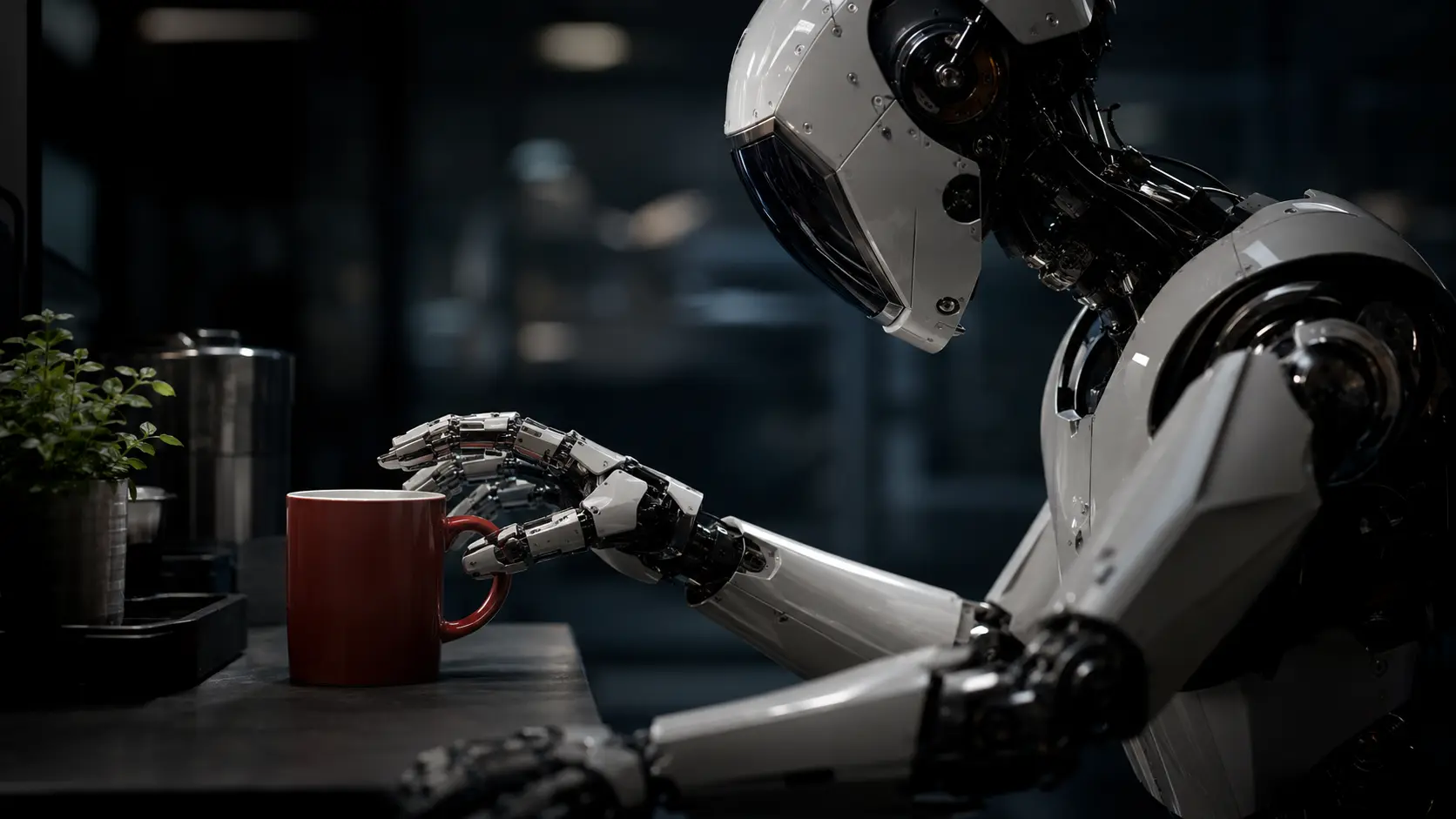
By combining cameras and language processors, the robot can now look at a messy table, hear the command “pick up the red cup,” and figure out how to move its arm on its own. The AI predicts the correct sequence of physical movements just like a chatbot predicts the next word in a sentence. This shift turns stiff, easily confused machines into adaptable assistants capable of handling unpredictable human environments.
HOW IT WORKS
Traditional robotics relied on rigid control theory. Engineers mapped exact joint angles, velocity profiles, and spatial coordinates into a closed loop. The system operated strictly within a highly controlled, static environment.
Modern robotics abandons this rigidity in favor of Vision-Language-Action (VLA) architectures. A VLA model operates as a multimodal neural network. It ingests three distinct streams of data simultaneously: live video feeds from its cameras (Vision), text or voice commands from a user (Language), and telemetry data from its own motors and joints (Action).
To make sense of the physical world, the model relies on spatial tokenization. A standard language model breaks English sentences into mathematical tokens. A VLA model executes this exact process on physical space. It breaks 3D volume, joint rotation, and gripper pressure into discrete, bite-sized mathematical vectors.
When a human issues a command, the VLA model processes the image and the text through a massive cross-attention mechanism. It calculates the statistical relationship between the pixels representing an object and the words in the command. Instead of predicting the next word of text, the model predicts the next action token.
This output token translates directly into motor torque. The model generates a continuous stream of these action tokens, updating its predictions fractions of a second at a time as the camera feed changes. If an object slips, the model instantly recalculates the spatial tokens, adjusting the physical grip in real time without requiring explicit human reprogramming.
REAL WORLD EXAMPLE
Google DeepMind’s RT-X (Robotics Transformer) project acts as a primary manifestation of this shift. Previously, if Google wanted a robot to fold laundry and another to assemble gears, they built two separate AI systems.
With the RT-X framework, they trained a single, massive foundation model on data collected from dozens of different robot types across multiple university labs. Now, a single generalized “brain” can operate a four-axis industrial arm in a German car factory and a bipedal humanoid walking through a California office. The same neural network simply adjusts its output tokens depending on which mechanical body it is currently driving.
WHY ROBOTICS FOUNDATION MODELS MATTER NOW
The global labor market is facing a severe demographic collapse. Advanced economies across Europe, East Asia, and North America simply do not have enough young workers to staff logistics warehouses, manufacturing lines, and eldercare facilities.
Solving this physical labor shortage mathematically requires general-purpose robotics. Historically, industrial robots were economically viable only for high-volume, perfectly repetitive tasks like welding car frames. Deploying them in messy, chaotic environments was computationally impossible.
VLA foundation models fundamentally alter the unit economics of automation. By giving machines a generalized physical understanding, companies can deploy humanoid and mobile robots into completely unstructured environments. A warehouse owner no longer needs to rebuild their facility to accommodate the robot; the robot can now adapt to the existing warehouse layout.
This initiates a massive hardware investment cycle. Trillions of dollars of capital are migrating from digital software into physical edge computing. Semiconductor manufacturers are aggressively designing highly specialized, low-power inference chips specifically built to run these massive VLA models inside the battery-constrained chassis of a walking robot.
COMMON MISCONCEPTIONS
- “Robots will learn exactly like humans.” Observers assume robots learn physical tasks through trial and error in the real world. In reality, physical hardware breaks too easily. Almost all training occurs inside hyper-realistic, physics-based digital simulators, with only the final polished model transferred to reality.
- “Chatbots and robot brains are identically deployed.” While they share the Transformer architecture, robotic models face severe latency constraints. A chatbot can take three seconds to generate a sentence. If a robot takes three seconds to calculate its next movement, it drops the object or falls over.
- “Humanoid shapes are strictly necessary.” People assume robots must look like humans to be useful. In industrial settings, foundation models frequently operate non-humanoid, highly optimized mobile manipulators that resemble boxes on wheels with multiple specialized arms.
WHAT MOST PEOPLE MISS
Technology analysts focus heavily on the mechanical hardware—the motors, actuators, and battery life of humanoid robots. They completely miss the extreme data starvation bottleneck throttling the entire industry.
Large language models became intelligent because they ingested the entire written internet. There is no equivalent “internet of physical movement” to scrape.
To train a VLA model, engineers must physically teleoperate robots to collect vast amounts of high-quality, human-demonstrated spatial data. The organizations that successfully scale and monopolize this proprietary physical training data—not the companies building the shiniest metal joints—will permanently dominate the robotics sector.
THE ECONOMIC AND STRATEGIC IMPACT
The primary financial winners are edge-compute semiconductor designers and specialized data collection firms. As intelligence moves from centralized cloud servers into localized robotic hardware, silicon manufacturers that master high-bandwidth, low-power inference will capture massive hardware margins.
Logistics, agriculture, and manufacturing face total structural disruption. Companies that integrate VLA-powered automation will instantly decouple their operational scale from local labor market constraints. This creates an unbridgeable efficiency gap, bankrupting legacy competitors who rely on manual human labor for unpredictable tasks.
Strategically, sovereign nations recognize embodied AI as a critical defense and industrial asset. The ability to mass-produce autonomous logistics machines ensures supply chain resilience during geopolitical conflicts. The United States and China are currently locked in a fierce, heavily subsidized race to establish domestic supply chains for the actuators and specialized compute necessary to field millions of generalized units.
THE TRAJECTORY
Next 12–36 Months: Logistics and automotive giants will deploy the first commercial fleets of VLA-powered humanoid robots into highly constrained, single-task warehouse environments for beta testing.
Next Five Years: The standardization of cross-embodiment training. Open-source foundations will release massive, shared datasets. This will allow researchers to train models that seamlessly transfer learned skills between entirely different robotic brands and body shapes.
Next Ten Years: The commercialization of consumer embodied AI. Foundation models will become efficient enough to run locally on cheap hardware. This introduces general-purpose, physically capable robotic assistants into domestic household environments.
What Could Go Wrong: Severe sim-to-real degradation. Physics simulators often fail to perfectly replicate real-world friction, lighting, and sensor noise. If models overfit to the simulation, their performance will collapse unpredictably when exposed to the chaotic variables of the physical world.
Most Likely Outcome: Foundation models will successfully solve the robotic software bottleneck. The abstraction of physical movement into predictive tokenization ensures that robots will scale in capability at the exact same exponential rate currently seen in text-based language models.
KEY TERMS
- Vision-Language-Action (VLA) Model: A neural network that simultaneously processes visual inputs, text commands, and physical movement data to operate a robot.
- Embodied AI: Artificial intelligence that possesses a physical body, allowing it to interact directly with the real world rather than just a digital screen.
- Spatial Tokenization: The mathematical process of converting continuous physical space and movement into discrete numbers that a neural network can process.
- Sim-to-Real Transfer: Training a robot inside a highly accurate digital physics simulation before downloading that brain into a physical machine.
- Edge Compute: Processing data locally directly on the robot’s internal computer chips rather than sending it to a distant cloud server.
- Teleoperation: A training method where a human physically steers a robot through a task, recording the sensor data to teach the AI how to move.
BEGINNER FAQ
What is a foundation model in robotics? It is a massive, general-purpose AI brain trained on huge amounts of data. Instead of being programmed for one specific task, it can adapt to many different physical jobs.
How is this different from traditional robots? Traditional robots follow a strict, unchangeable script. If something is out of place, they crash. VLA-powered robots can see their environment and adapt their movements in real time.
What does VLA stand for? It stands for Vision-Language-Action. This means the AI looks at camera feeds (Vision), understands human commands (Language), and outputs physical movement (Action).
How do robots understand language? They use the same underlying technology as modern chatbots. The robot translates your English command into mathematical data and matches it with what its cameras are currently seeing.
Do these robots think like humans? No. They are highly advanced predictive engines. They use statistics to calculate the most likely physical movement required to achieve the goal you typed or spoke to them.
Why do we need humanoid robots? The entire human world—stairs, doors, tools, and hallways—is designed for the human body shape. Building a robot shaped like a human allows it to navigate our existing environments without us having to redesign our buildings.
Is the processing done in the cloud? Some heavy thinking can be done in the cloud, but the actual movement controls must happen locally on the robot. If a cloud connection drops, a robot cannot safely freeze in the middle of a physical task.
Will these robots take manufacturing jobs? Yes, they will inevitably automate highly repetitive or dangerous physical labor. However, they will also solve severe labor shortages in countries with aging and shrinking working populations.
How are these models trained without breaking the robots? Engineers train them inside hyper-realistic video game-like simulations. The AI can crash a million times in the digital world to learn physics before it ever touches a real, expensive metal chassis.
What is the biggest barrier to this technology? High-quality physical data. Unlike text, you cannot just scrape the internet for physical movement data. Engineers must painstakingly record humans performing tasks to teach the robots how to move properly.
SOURCES
- Google DeepMind — Open X-Embodiment: Robotic Learning Datasets and RT-X Models
- Massachusetts Institute of Technology (MIT) — Sim-to-Real Transfer and Reinforcement Learning in Agile Robotics
- Institute of Electrical and Electronics Engineers (IEEE) — Vision-Language-Action Architectures for Generalist Robots
- Stanford University — Scaling Laws for Embodied Intelligence and Spatial Tokenization