Advertisement
)


When a major hedge fund launches a multi-billion-dollar attack against a struggling public corporation, they are aggressively selling shares they do not actually own. But where do those physical shares come from? They come from you. Hidden deep beneath the public stock exchanges is a highly lucrative, invisible plumbing system where massive asset managers quietly rent out the stocks sitting in everyday retirement accounts.
Because financial regulations strictly forbid “naked” short selling, a hedge fund cannot simply hit a sell button out of thin air; they must physically locate and borrow a share from someone who already owns it. This massive logistical hurdle birthed the Prime Brokerage industry—the Wall Street titans who act as the ultimate middlemen, shuffling trillions of dollars in stocks and cash collateral across the globe every day. Why should you care right now? Because this notoriously opaque market is currently undergoing a violent regulatory crackdown. Armed with new SEC mandates requiring 15-minute reporting intervals, regulators are finally pulling back the curtain on how billionaires borrow assets to bet against the market. Understanding this plumbing is the only way to comprehend how institutional leverage truly operates, and how a failure in this shadow market can instantly freeze the global financial system.
What is Securities Lending and Prime Brokerage?
Securities lending is the process where institutional investors temporarily transfer stocks or bonds to a borrower in exchange for collateral and a fee. Prime brokerages act as the central intermediaries in this market, sourcing these securities to provide hedge funds with the leverage and physical shares required to execute short selling strategies.
At a Glance
- Concept: A massive rental market for financial assets. Long-term investors lend their stocks to short-term speculators, collecting a rental fee while holding cash as a security deposit.
- Why it matters: It is the absolute prerequisite for short selling. Without securities lending, hedge funds cannot bet against overvalued companies, stripping the market of its primary price-discovery and fraud-detection mechanism.
- Who uses it: Pension funds and ETF providers (Lenders), Prime Brokers (Middlemen), and Quantitative/Macro Hedge Funds (Borrowers).
- Biggest takeaway: The lender doesn’t just make money on the “borrow fee.” Because the hedge fund must hand over massive amounts of cash as collateral to borrow the stock, the lender takes that cash and reinvests it, creating a powerful secondary engine of yield generation.
In Simple Words
Imagine you own a rare, expensive car that you only drive on weekends. During the week, it just sits in your garage doing nothing.
A stunt driver wants to use that exact car for a movie stunt on Tuesday, but they don’t want to buy it. So, they go to a high-end rental agency (the Prime Broker). The rental agency calls you and says, “Can we borrow your car for the stunt driver? They will give us $100,000 in cash to hold as a security deposit, and they will pay you a daily rental fee.”
You agree. The stunt driver gets the car, does their trick, and returns the car on Wednesday. They get their $100,000 deposit back, minus the rental fee. You get your car back in perfect condition, plus the extra cash you made from the fee.
In the financial world, your rare car is a stock. The stunt driver is a Hedge Fund trying to short the stock. You are an Asset Manager (like Vanguard or BlackRock) looking to make a little extra money on the side. The entire transaction is brokered and guaranteed by the Prime Broker.
Why This Matters
For Institutional Investors and Macro Economists, the securities lending market is the defining indicator of market sentiment. It is the raw data that reveals exactly what the “smart money” is doing.
If you want to know if Wall Street thinks a specific electric vehicle startup is a fraud, you do not read analyst reports. You look at the “Stock Borrow Rate” in the securities lending market. If a stock is heavily shorted, the supply of available shares to borrow dries up, and the rental fee skyrockets from a standard 0.3% per year to 50%, 100%, or even 300% per year. These exorbitant “Hard-to-Borrow” fees dictate whether a hedge fund can mathematically afford to maintain its short position, serving as the definitive catalyst for violent market events like short squeezes.
The Role of Securities Lending in Passive Investing
Securities lending is not a niche activity; it is a structural pillar of passive investing.
When you buy a standard S&P 500 Index ETF, the management fee might be near 0.03%. However, the massive asset manager running that ETF actively lends out the underlying Apple, Microsoft, and Tesla shares to prime brokers. The revenue generated from this lending program is often so massive that it entirely offsets the cost of running the ETF. In highly efficient funds, securities lending revenue can actually exceed the management expenses, resulting in the fund tracking slightly above its benchmark index. It is the invisible engine subsidizing the modern retail investing boom.
How Prime Brokerage and Securities Lending Work
Moving billions of dollars of equities between hostile market participants requires ironclad contractual frameworks and absolute mathematical collateralization. Here is the first-principles breakdown of the architecture.
1. The Fundamental Problem: Regulation SHO
Before 2005, traders could execute a “naked short”—selling a stock without actually ensuring it existed, causing massive settlement failures. Today, the SEC’s Regulation SHO legally mandates that a broker-dealer must have “reasonable grounds” to believe the security can be located and delivered before allowing a client to short it. The broker must physically “locate” the share.
2. The Core Mechanism: The Prime Brokerage Desk
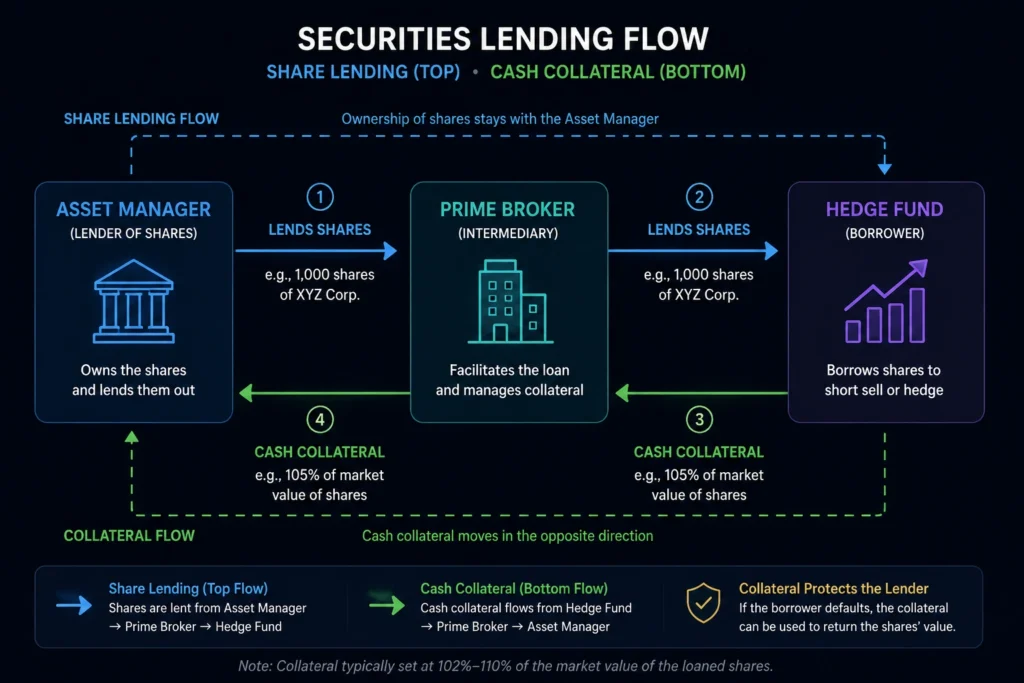
Hedge funds do not have the network to call pension funds directly. They rely on their Prime Broker (e.g., Goldman Sachs). The prime broker maintains an automated global inventory system. When a hedge fund hits “Sell Short” on 10,000 shares of IBM, the prime broker instantly checks its internal inventory, borrows the shares from an external institutional lender, and delivers them to the buyer.
3. Technical Depth: Collateral and Margin
To protect the lender from default, the transaction is wildly over-collateralized. The hedge fund must post collateral (cash or highly rated sovereign bonds). In U.S. equities, the standard is 102% of the market value of the borrowed shares.
Because the stock price changes every minute, the loan is marked-to-market daily. If the stock price goes up, the prime broker issues a margin call, forcing the hedge fund to deposit more cash to maintain the 102% ratio.
4. Real-World Consequences: Substitute Dividend Payments
When an asset manager lends out a stock, they technically transfer the legal title of that stock to the borrower. This means the borrower (or whoever the borrower sells it to) receives the corporate dividend. Because the original lender expects that dividend, the borrower is legally required to pay the lender a “Substitute Dividend Payment” out of their own pocket exactly equal to the corporate dividend. (Crucially, the original lender also loses their corporate voting rights while the stock is on loan).
5. The Yield Engine: Cash Collateral Reinvestment
The true profit center of securities lending is not the borrow fee; it is the collateral. When the lender receives the 102% cash collateral from the hedge fund, they do not just put it in a vault. They invest that cash into safe, short-term money market funds to earn yield.
The net yield generated by the lender is mathematically defined as the return on the reinvested cash minus the “rebate rate” (the interest rate the lender agrees to pay the borrower for the privilege of holding their cash collateral).
Net Yield = (R_reinvest - R_rebate) * V_collateral
Institutional Applications for Securities Lending
The architecture of prime brokerage scales far beyond simple stock speculation.
Quantitative Arbitrage: Statistical arbitrage funds execute millions of algorithmic trades daily, simultaneously buying one stock and shorting another to capture micro-pennies of price difference (Statistical Pairs Trading). This requires a prime broker with a massive, instantaneous “locate” API. The prime broker automatically confirms the availability of millions of shares in milliseconds, allowing the quant fund’s algorithms to fire without human intervention.
Merger Arbitrage: When Company A announces it will acquire Company B for stock, the price of Company B goes up, and Company A usually goes down. Hedge funds execute a strategy where they buy Company B and heavily short Company A to lock in the spread. This creates a massive, localized surge in demand to borrow Company A’s stock, making the prime brokerage desks the ultimate gatekeepers of M&A liquidity.
Corporate Governance Hacking (Empty Voting): Because the legal voting rights of a stock transfer to the borrower, activist investors have historically utilized securities lending to quietly borrow massive amounts of a company’s stock right before an annual shareholder meeting. This allows them to cast millions of votes to fire a CEO or force a board seat without actually possessing any long-term economic exposure to the company.
Economic & Strategic Impact
The greatest vulnerability in the prime brokerage ecosystem is the systemic threat of Collateral Rehypothecation.
When a prime broker holds a hedge fund’s assets as collateral, the broker is legally allowed to “rehypothecate” (reuse) those assets. The prime broker can pledge that same collateral to a massive clearing bank to secure their own corporate loans.
This creates a highly fragile chain of leverage. The exact same $100 million pool of assets is simultaneously serving as the safety net for three different financial institutions. If the original hedge fund suddenly defaults, the prime broker must liquidate the collateral. But if the prime broker has rehypothecated that collateral into a different illiquid trade, they cannot access it. This exact mechanism of collateral contagion is what triggered the catastrophic implosion of Lehman Brothers in 2008 and the multi-billion-dollar destruction of Archegos Capital Management in 2021.
Advantages
- Market Liquidity and Price Discovery: Short selling, enabled entirely by securities lending, allows skeptical investors to bring negative information to the market, actively punishing corporate fraud and preventing massive asset bubbles from forming.
- Yield Generation for Passive Investors: Transforms idle, static stock portfolios into active, yield-generating assets, subsidizing the operational costs of the massive ETFs that secure global retirement accounts.
- Settlement Failure Prevention: If a standard broker accidentally sells a share they don’t have, they can quickly tap the securities lending market to borrow a share and deliver it by the T+1 settlement deadline, preventing the stock market infrastructure from gridlocking.
Limitations
- Counterparty Credit Risk: The lender is entirely reliant on the prime broker to return the shares. If the prime broker and the short-selling hedge fund both go bankrupt in a systemic market crash, the lender’s original shares may be permanently lost or tied up in bankruptcy court for a decade.
- Recall Risk (The Short Squeeze): A loan is open-ended. The original asset manager can demand their stock back at any time. If the prime broker cannot find replacement shares to borrow elsewhere, they issue a “buy-in,” forcefully liquidating the hedge fund’s short position at the current market price, sparking violent, uncontrollable short squeezes.
- Dividend Tax Complexity: Substitute dividend payments are often taxed differently than qualified corporate dividends. This introduces a massive accounting and tax-optimization headache for institutional lenders operating across different sovereign tax jurisdictions.
Common Misconceptions
Misconception: Short selling creates “fake” or “phantom” shares.
Reality: Legal short selling does not create new shares. It temporarily moves an existing share from an investor who isn’t trading it to a new buyer. The total number of shares issued by the corporation never changes; the accounting system simply records a negative balance (a liability) on the short seller’s ledger.
Misconception: Asset managers are risking your retirement money by lending it out.
Reality: The transaction is heavily over-collateralized (102% to 105%). If the borrower steals the stock and vanishes, the asset manager holds more than enough cash to immediately go into the open market and buy a replacement share, making the operation mathematically secure under normal market conditions.
Misconception: You can short any stock you want.
Reality: You can only short what your prime broker can physically locate. For highly illiquid, micro-cap stocks, or companies facing imminent bankruptcy, the prime broker simply will not have any inventory to lend, rendering the stock mathematically “un-shortable.”
What Most People Miss
The massive migration toward Total Return Swaps (TRS) and Synthetic Prime Brokerage.
As regulatory scrutiny over physical stock borrowing intensifies, the most sophisticated hedge funds are abandoning physical securities lending entirely.
What most analysts miss is the rise of the “Synthetic Short.” Instead of borrowing a physical share of Apple to sell, a hedge fund signs a Total Return Swap derivative contract with an investment bank. The contract simply states: If Apple stock goes down, the bank pays the hedge fund. If Apple stock goes up, the hedge fund pays the bank.
This achieves the exact same economic result as short selling, but no physical shares ever change hands, no locates are required, and the trade remains entirely off the public order books. This synthetic architecture allows prime brokers to extend massive, hidden leverage to clients without triggering the strict reporting thresholds mandated for physical equities.
Comparison Table
| Feature | Standard “Long” Stock Trading | Physical Short Selling (Securities Lending) | Synthetic Short (Total Return Swap) |
| Market Action | Buy low, sell high | Borrow, sell high, buy low, return | Pure derivative contract on price |
| Asset Ownership | Investor holds legal title | Title transfers to the new buyer | Neither party owns the physical stock |
| Locate Required? | No | Yes (Strict SEC Reg SHO compliance) | No |
| Dividend Handling | Investor receives dividend | Borrower pays substitute dividend | Factored into the swap cash flow |
| Primary Cost | Transaction commission | Daily Borrow Fee (0.3% to 300%+) | Swap financing rate (SOFR + Spread) |
Case Study
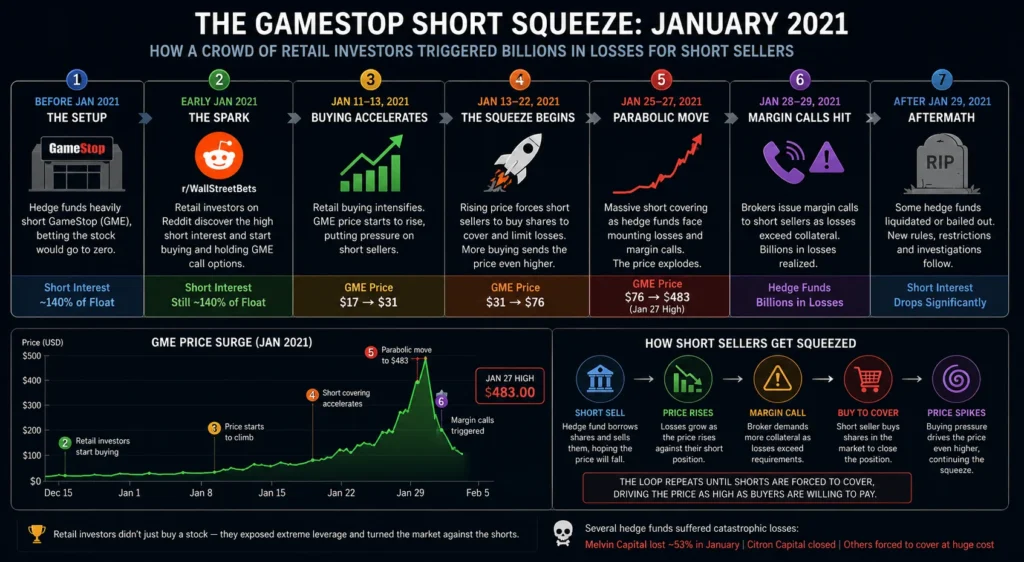
Situation: In early 2021, hedge funds noticed that the video game retailer GameStop was failing and initiated massive short positions, eventually shorting more than 100% of the publicly available “float” (a phenomenon possible because a single share can be borrowed, sold, and then borrowed again by a second party).
Challenge: A retail trading coalition coordinated on social media to aggressively buy the stock, driving the price up exponentially. The massive price spike triggered the brutal mathematical realities of the prime brokerage collateral system.
Solution / The Crisis: As GameStop’s stock price surged from $20 to over $300, the prime brokers issued catastrophic margin calls. Hedge funds that had borrowed the stock at $20 were now required to post 102% of $300 as cash collateral to maintain their loans.
Outcome: The hedge funds physically ran out of cash. To survive, they had to exit their positions by executing a “short cover”—buying back GameStop stock at market price to return it to the lenders. This forced buying artificially drove the stock price even higher, initiating a historic “Short Squeeze.” Several major hedge funds suffered multi-billion-dollar losses and required external bailouts to avoid bankruptcy, while prime brokers scrambled to manage the unprecedented systemic volatility.
Lessons Learned: The GameStop event exposed the fragility of the “locate” system. It proved that securities lending is not a passive, background operation; when borrow fees spike and collateral demands trigger cascading liquidations, the plumbing of the short market dictates the directional price of the global stock exchanges.
Future Outlook
Next 12–24 Months
The era of SEC Rule 10c-1a Compliance. The historical opacity of the securities lending market is ending. Throughout 2025 and 2026, the implementation of SEC Rule 10c-1a forces lenders to report the exact details of their securities loans—including the names of the securities, the volume, and the precise borrow fees—to FINRA within 15 minutes of the trade. This unprecedented data dump will destroy the informational edge that prime brokers have held for decades, compressing their profit margins and allowing quantitative hedge funds to trade directly on the newly visible borrow-rate volatility.
Next 3–5 Years
The scaling of Smart Contracts and DLT. Reconciling millions of borrowed shares, dividend payments, and margin calls across entirely different corporate ledgers currently requires massive back-office accounting armies. By the late 2020s, the prime brokerage industry will transition to Distributed Ledger Technology (DLT). Securities loans will be executed as smart contracts on permissioned enterprise blockchains. When a stock pays a dividend, the smart contract will automatically extract the substitute payment from the borrower’s digital wallet and route it to the lender in nanoseconds, eliminating the billion-dollar drag of settlement failures and manual reconciliation.
Next 10 Years
The T+0 Settlement Shock. As global markets transition from T+1 (one day to settle a trade) to T+0 (instantaneous, same-day settlement) by the mid-2030s, the mechanics of short selling will face an existential crisis. A prime broker will no longer have 24 hours to “locate” a share to cover a client’s short sale. The locate, the borrow, and the collateral transfer will have to occur simultaneously with the trade execution. This absolute compression of time will force the consolidation of the prime brokerage market, leaving only a few hyper-scaled megabanks with the computing power and balance sheet depth required to facilitate instantaneous global shorting.
Most Likely Scenario
Securities lending will remain the indispensable circulatory system of global capital. As regulatory reporting mandates strip away its shadow-market status, it will transition into a highly formalized, algorithmic utility. The prime brokers who survive will be the ones who successfully transition their clients away from the messy reality of physical stock borrowing and into the mathematically clean, highly lucrative realm of synthetic total return swaps.
Key Takeaways
- Securities lending is the financial plumbing that allows short selling to exist; an investor cannot legally sell a stock short without a Prime Broker first locating and borrowing the physical share.
- Asset managers (like pension funds and ETFs) lend their idle stocks to generate massive amounts of extra yield, which subsidizes the low fees enjoyed by retail investors.
- The transaction is heavily secured. The short-selling hedge fund must provide 102% to 105% of the stock’s value in cash collateral to protect the lender if the borrower defaults.
- The true profit engine of this market is “Cash Collateral Reinvestment”—the lender takes the borrower’s massive cash security deposit and invests it in short-term bonds to generate additional interest.
- Prime brokers (e.g., Goldman Sachs) face severe systemic risk due to “Rehypothecation,” where the same pool of collateral is aggressively reused to back multiple different loans across the financial system.
- The market is currently undergoing a massive transparency overhaul due to SEC Rule 10c-1a, which forces lenders to publicly report the volume and fees of their stock loans every 15 minutes.
Glossary
Beneficial Owner: The actual owner of the asset (like a pension fund or a retail ETF investor) who lends out their shares to generate extra income.
Collateral Rehypothecation: The highly risky financial practice where a prime broker takes the collateral given to them by a client and re-uses it to back their own separate borrowing from a larger bank.
Margin Call: A demand by a prime broker for an investor to deposit additional money or securities into their account when the value of the borrowed stock rises, ensuring the 102% safety buffer is maintained.
Prime Brokerage: A specialized division within a massive investment bank that provides hedge funds with complex services, including clearing trades, extending leverage, and sourcing hard-to-borrow stocks for short selling.
Regulation SHO: A strict SEC rule established in 2005 that attempts to prevent “naked short selling” by legally requiring brokers to “locate” a valid share to borrow before executing a short sale.
Total Return Swap (TRS): A synthetic derivative contract where two parties exchange the financial performance of an asset. It allows hedge funds to bet against a stock without ever physically borrowing or shorting it.
Frequently Asked Questions
Do I lose my stock when my ETF manager lends it out?
No. You still own the economic value of the stock. If you decide to sell your ETF, the manager simply recalls the loaned share from the prime broker and sells it. You never notice the transaction occurring in the background.
Who gets the dividend if my stock is lent out?
The person who physically bought the shorted share gets the official corporate dividend. However, the hedge fund that borrowed the share is legally forced to pay you a “substitute dividend payment” out of their own pocket, ensuring you do not lose any money.
If the hedge fund goes bankrupt, do I lose my stock?
Highly unlikely. Because the prime broker required the hedge fund to deposit 102% of the stock’s value in cash before they borrowed it, the prime broker simply takes that cash, buys a new share on the open market, and gives it back to you.
Can a stock be shorted more than 100%?
Yes. If Investor A lends a share to a hedge fund, the hedge fund sells it to Investor B. Investor B’s broker can then turn around and lend that exact same share to a second hedge fund. This chain of re-lending creates a situation where the “short interest” mathematically exceeds the total number of physical shares in existence.
Why is it called a “Hard-to-Borrow” stock?
If a stock is highly controversial or widely believed to be a fraud, every hedge fund in the world wants to short it. The supply of available shares sitting in pension funds runs out. Prime brokers then jack up the “borrow fee” based on supply and demand, sometimes charging over 100% annual interest just to rent the share.
Sources
[1] U.S. Securities and Exchange Commission (SEC): Final Rule: Reporting of Securities Loans (Rule 10c-1a)
[2] Financial Industry Regulatory Authority (FINRA): Securities Lending and Margin Requirements under Regulation T
[3] Bank for International Settlements (BIS): The Mechanics and Systemic Risks of Prime Brokerage and Collateral Rehypothecation (2025/2026 Analysis)
[4] Risk Management Association (RMA): Securities Lending Industry Trends and Yield Generation Metrics
[5] Federal Reserve Bank of New York: Shadow Banking, Total Return Swaps, and Non-Bank Financial Intermediation (NBFI) Vulnerabilities