Advertisement
)

At a Glance
- Concept: Spying on a computer’s physical behavior rather than attacking its software code.
- Why it matters: It renders mathematically perfect encryption (like AES-256) useless if the physical hardware leaks the key into the environment.
- Who uses it: State-sponsored intelligence agencies, hardware security researchers, and cyber syndicates attacking IoT devices and smart cards.
- Biggest takeaway: A computer requires electricity to move data; by carefully measuring the microscopic changes in that electrical draw, an attacker can literally “see” a password being processed.
In Simple Words
Imagine a massive steel safe with an unbreakable combination lock. A thief knows that guessing the combination by force would take a million years.
Instead of guessing the numbers, the thief presses a medical stethoscope against the metal door. They slowly turn the dial and listen closely. When the right number slides into place, the internal gears make a slightly louder “click.” By analyzing the sounds, the thief figures out the combination in five minutes.
This is exactly how a side-channel attack works on a computer chip.
We protect our data using incredibly complex mathematical algorithms. But software does not exist in a vacuum; it runs on physical hardware. Every time a microchip processes a “1” or a “0,” it consumes a tiny pulse of electricity, emits a faint radio wave, and takes a fraction of a second to complete the task. Hackers use oscilloscopes and antennas to measure this physical “exhaust.” By listening to the hum and heat of the chip, they deduce the secret keys hidden inside.
Why This Matters
The cybersecurity industry spends billions of dollars designing unbreakable mathematical algorithms. Side-channel attacks prove that perfectly secure math is irrelevant if it is placed inside leaky hardware.
This vulnerability affects the foundation of physical security. Credit cards with EMV chips, biometric passports, cryptocurrency hardware wallets, and the secure enclaves inside modern smartphones all rely on localized cryptographic chips. If these chips are not physically hardened against side-channel analysis, an attacker with brief physical access to the device can extract the master keys.
Furthermore, this threat scales to the military and industrial level. Military radios rely on secure chips to encrypt battlefield communications. SCADA systems use them to authenticate commands in power plants. A hardware leak in these environments compromises national security. As a result, mitigating side-channel leaks has become a mandatory hardware engineering standard, regulated heavily under government frameworks like FIPS 140-3.
The Big Picture
Before discussing the attacks, it is essential to understand the gap between theoretical computer science and applied physics.
In computer science, algorithms are treated as abstract logic. Variables change instantly, and memory requires no physical space. In the real world, computing is a kinetic event. Moving digital data requires moving physical electrons through silicon transistors.
When millions of transistors switch on and off, they interact with the physical world. They pull current from the power supply, generating localized heat and electromagnetic fields. A side-channel attack bridges the gap between these two worlds. It uses the laws of physics to reverse-engineer the logic of the software. It is not an attack on the math; it is an attack on the implementation.
HOW SIDE-CHANNEL ATTACKS WORK
Extracting a 256-bit secret key from the chaotic electrical noise of a running microchip requires a blend of electrical engineering and advanced statistics.
Here is the step-by-step mechanism of how hackers execute these attacks.
1. The Fundamental Problem
To encrypt a message, a microchip must combine the message with a secret key. To do this, the processor’s transistors flip open and closed. A transistor flipping from a “0” to a “1” requires more electrical current than a transistor simply staying at “0”. Therefore, the power consumption of the chip fluctuates continuously based on the exact data it is processing.
2. Timing Attacks (The Simplest Side-Channel)
The easiest way to exploit a system is through time. If a system checks a password character by character and stops the moment it hits an incorrect letter, it will take slightly longer to reject a password where the first three letters are correct versus a password where the first letter is wrong. An attacker feeds thousands of variations into the chip, measures the exact microseconds it takes to respond, and slowly guesses the key based on how long the chip “thinks.”
3. Simple Power Analysis (SPA)
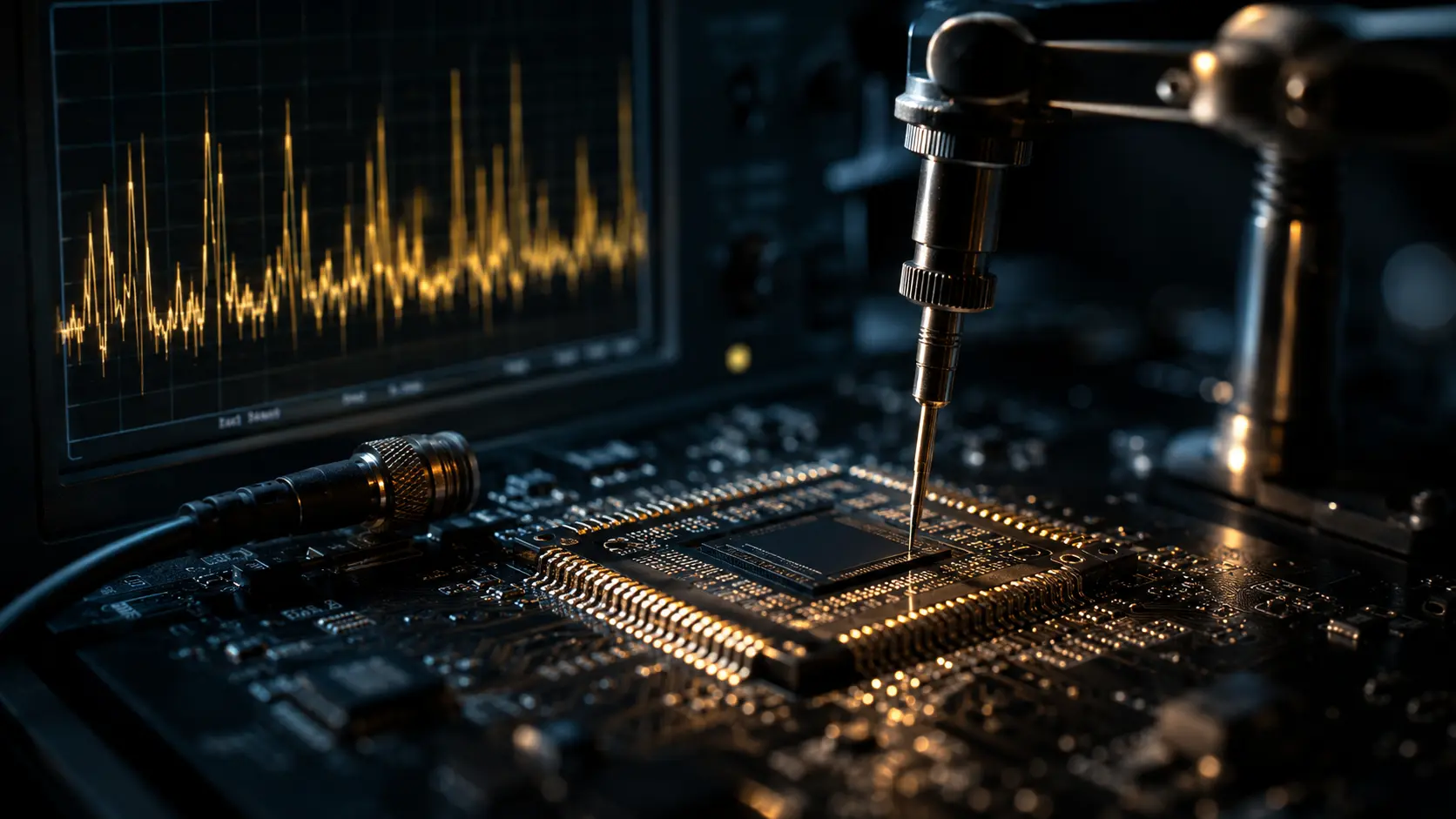
An attacker connects an oscilloscope to the power supply of the microchip. As the chip performs a cryptographic operation, the oscilloscope plots the power consumption on a graph. In poorly designed hardware, the difference between the processor handling a “1” and a “0” is visually obvious. The attacker simply looks at the screen and reads the high and low spikes to extract the key.
4. Differential Power Analysis (DPA)
Modern chips are noisy, and a single encryption operation hides the power spikes beneath layers of electrical static. Differential Power Analysis solves this using statistics. The attacker commands the chip to encrypt 10,000 different messages and records the power trace for each one. They then use statistical correlation algorithms to filter out the static. Because the secret key remains exactly the same across all 10,000 operations, the tiny, recurring power spikes associated with that specific key amplify mathematically, revealing the secret clearly.
5. Electromagnetic (EM) Emanation
Instead of measuring the power cord, attackers can measure the air. Transistors emit faint electromagnetic radiation when they switch. By hovering a highly sensitive micro-antenna a few millimeters above the surface of the silicon chip, an attacker can capture the EM waves and perform the exact same statistical DPA analysis without ever physically cutting a wire.
6. Hardware Mitigation
To stop these attacks, engineers must sever the relationship between the data and the physical exhaust. They use “Constant-Time Algorithms” so that every operation takes the exact same number of milliseconds, regardless of the password. They also use “Masking,” which involves feeding a stream of random electrical noise into the chip alongside the real data, drowning out the actual power spikes so the attacker’s statistical models fail.
Real-World Applications
Side-channel vulnerabilities dictate the design of almost all secure physical hardware today.
Smart Cards and Credit Cards: The microchips embedded in modern credit cards process transactions using private cryptographic keys. In the late 1990s, researchers proved these chips were highly susceptible to Differential Power Analysis. Today, financial institutions mandate that all smart card chips contain hardware-level power masking to ensure a thief cannot extract the card’s master cloning key using a modified point-of-sale terminal.
Cryptocurrency Hardware Wallets: Devices like Ledger and Trezor store the cryptographic seed phrases that control billions of dollars in digital assets. Because these devices physically change hands, they are prime targets for EM emanation attacks. Manufacturers utilize highly specialized “Secure Enclave” chips designed specifically to randomize their power consumption to frustrate side-channel analysis.
Cloud Computing (Microarchitectural Attacks): While physical power analysis requires proximity, side channels also exist in software. In shared cloud servers (like AWS or Azure), an attacker’s virtual machine can monitor how the physical CPU’s shared memory cache behaves. Attacks like Spectre and Meltdown use these timing side-channels to read passwords belonging to entirely different companies hosted on the same physical processor.
Economic & Strategic Impact
The threat of side-channel attacks forces massive capital expenditure in the semiconductor industry.
For hardware manufacturers, building a secure chip is vastly more expensive than building a fast chip. Adding physical noise generators, dedicated cryptographic co-processors, and tamper-resistant silicon shielding increases the manufacturing cost and physical footprint of the microchip. It also severely reduces processing speed.
Strategically, side-channel attacks are a preferred weapon for state-sponsored intelligence agencies. When a nation captures an adversary’s encrypted communications drone or military radio, they do not waste supercomputing resources trying to crack the AES algorithm. They take the physical circuit board to a laboratory, decap the silicon chip with acid, and use high-resolution EM probes to silently extract the decryption keys directly from the hardware.
For regulatory bodies, mitigating these physical leaks is critical. The U.S. National Institute of Standards and Technology (NIST) strictly enforces the FIPS 140-3 standard, which requires vendors selling hardware to the government to prove their devices can mathematically resist Differential Power Analysis.
Advantages
Total Cryptographic Bypass
For the attacker, side-channel analysis is incredibly efficient. It completely ignores the mathematical complexity of the encryption algorithm, allowing them to crack otherwise impenetrable military-grade systems.
Passive Intelligence Gathering
Most side-channel attacks are entirely passive. The attacker simply listens to the electromagnetic waves or power draw. Because they do not inject malicious code or alter the chip’s memory, the target system never triggers a security alarm.
Rapid Execution
While brute-forcing a 256-bit key could take billions of years, a well-executed Differential Power Analysis attack can extract a master key from an unprotected smart card in less than a few minutes using standard laboratory equipment.
Limitations
Extreme Proximity Requirements
Traditional power and EM side-channel attacks require the attacker to have direct physical access to the device or be within a few millimeters of the silicon surface, limiting the threat against distant, physical data centers.
Signal-to-Noise Complexity
Modern chips generate immense amounts of background electrical noise. Isolating the microscopic power spike of a single cryptographic operation from the roar of a multi-core processor running an operating system requires highly advanced statistical modeling.
Immediate Mitigation Vulnerability
If an engineer successfully implements constant-time software and adds physical power masking to the silicon design, the attack vector is almost completely neutralized, rendering the attacker’s expensive laboratory equipment useless.
Common Misconceptions
Misconception: Side-channel attacks are software bugs or viruses.
Reality: They are not software bugs. The software is executing exactly as intended. The vulnerability is a physical physics leak caused by the fundamental nature of electricity and silicon transistors.
Misconception: Making a password longer stops the attack.
Reality: A longer password makes traditional brute-force guessing impossible, but it does very little against Differential Power Analysis. The attacker simply measures the power consumption for a slightly longer duration to extract the extra characters.
Misconception: You need massive supercomputers to perform these attacks.
Reality: The math involved is relatively lightweight. Once the power traces are captured, the statistical correlation required to reveal the key can easily be processed on a standard consumer laptop within minutes.
What Most People Miss
Attackers do not need to steal the entire 256-bit key all at once.
The brilliance of Differential Power Analysis is that it employs a “divide and conquer” strategy. Because encryption algorithms process data in small chunks (usually 8 bits, or a single byte, at a time), the attacker only focuses their statistical model on finding the first byte of the key.
There are only 256 possible combinations for a single byte. The attacker correlates the power trace against those 256 possibilities, instantly finds the correct match for the first byte, and then simply moves on to the next one. They break the impossible math puzzle down into a sequence of incredibly easy, localized physics puzzles.
Comparison Table
| Feature | Brute Force Attack | Phishing / Social Engineering | Side-Channel Attack (DPA) |
| Attack Vector | Mathematical guessing. | Human manipulation. | Physical hardware exhaust (Power/Time/EM). |
| Target Element | The algorithm’s key space. | The user’s psychology. | The physical implementation of the chip. |
| Bypasses Encryption? | No (attacks it head-on). | Yes (steals it directly). | Yes (extracts it from physical leakage). |
| Proximity Required | Remote (Anywhere). | Remote (Anywhere). | Usually Physical / Extreme Proximity. |
| Traceability | Highly visible to network logs. | Often visible to security teams. | Completely passive; leaves zero trace. |
| Best Defense | Longer, more complex keys. | Employee training and MFA. | Constant-time algorithms and power masking. |
Case Study
Situation: In the late 1990s, the financial industry was rapidly deploying early smart cards (chips embedded in plastic cards) to replace easily forged magnetic stripes. The industry believed the encrypted chips were impenetrable.
Challenge: Cryptographer Paul Kocher theorized that because the smart cards lacked their own internal battery, they had to draw power directly from the point-of-sale terminal. He suspected this power draw was directly linked to the math being calculated inside the chip.
Solution (The Attack): Kocher and his team developed Differential Power Analysis (DPA). By attaching an oscilloscope to the power pin of the smart card reader, they recorded the electrical current as the card encrypted data. Using statistical analysis on the resulting power traces, they successfully extracted the card’s master cryptographic key in minutes.
Outcome: The discovery sent shockwaves through the global financial and intelligence communities. It proved that mathematically perfect encryption was completely broken by physical implementation flaws.
Lessons Learned: The smart card industry was forced to redesign the global hardware standard overnight. They implemented randomized clock speeds, power masking, and dummy instructions to ensure that the electricity consumed by a chip could no longer be mathematically correlated to the data it was processing.
Future Outlook
Next 12–24 Months
The integration of Post-Quantum Cryptography (PQC) algorithms will temporarily increase side-channel vulnerabilities. As engineers rush to implement new, complex mathematical standards (like ML-KEM) onto older microcontrollers, poor initial software implementations will likely leak timing data. Hardware security researchers will heavily target these new PQC implementations to find physical bypasses.
Next 3–5 Years
Artificial intelligence and deep learning will fully automate side-channel analysis. Instead of humans manually aligning power traces and writing complex statistical models, neural networks will be trained to look at the raw electrical noise of a chip and instantly filter out the hidden cryptographic keys, drastically lowering the skill barrier required to execute these attacks.
Next 10 Years
Semiconductor foundries will move toward “Hardware-Intrinsic Security.” Instead of trying to mask power consumption, new chip architectures will compute directly on encrypted data using Fully Homomorphic Encryption (FHE) at the hardware level, or utilize asynchronous logic circuits that do not use a centralized clock, completely shattering the timing mechanisms that DPA relies upon.
Most Likely Scenario
Side-channel attacks will remain a persistent, high-tier threat for any device that can fall into an adversary’s physical possession. As IoT devices proliferate in critical infrastructure, the manufacturing cost of implementing advanced side-channel shielding will create a bifurcated market: cheap, leaky consumer devices, and highly expensive, physically impenetrable industrial hardware.
Key Takeaways
- A side-channel attack extracts secret cryptographic keys by analyzing the physical behavior of a microchip, such as its power consumption or processing time.
- It completely bypasses the mathematical strength of encryption algorithms like AES or RSA.
- Timing attacks measure exactly how many microseconds a processor takes to complete an operation, revealing the logic of the code.
- Differential Power Analysis (DPA) uses statistical correlation across thousands of operations to amplify the microscopic electrical spikes of a secret key.
- Attackers can use micro-antennas to capture Electromagnetic (EM) emanations, performing power analysis without physically touching the target circuit board.
- To defend against these attacks, engineers must write “constant-time” software and design silicon chips that generate randomized background electrical noise (masking).
- These physical vulnerabilities dictate the strict hardware security requirements for military radios, credit cards, and cryptocurrency hardware wallets.
Glossary
Constant-Time Algorithm: Software written so that every possible execution path takes the exact same amount of time, preventing an attacker from deducing information based on processing speed.
Differential Power Analysis (DPA): A highly advanced side-channel attack that uses statistical error correction across thousands of power traces to extract hidden cryptographic keys from electrical noise.
Electromagnetic (EM) Emanation: The faint, invisible radio waves naturally emitted by silicon transistors as they switch on and off.
FIPS 140-3: A mandatory U.S. government computer security standard used to approve cryptographic modules, specifically requiring mitigation against physical side-channel leaks.
Masking: A hardware defense technique where random electrical noise is deliberately generated alongside the real cryptographic operation to confuse statistical analysis.
Oscilloscope: A laboratory instrument used to graphically display and measure the exact timing and voltage of electrical signals.
Side-Channel Attack: Any cyberattack based on information gained from the physical implementation of a computer system, rather than weaknesses in the implemented mathematical algorithm itself.
Simple Power Analysis (SPA): A basic side-channel attack that involves directly observing a single power trace on a graph to visually identify major cryptographic operations.
Frequently Asked Questions
Are side-channel attacks common on the internet?
No. Traditional power and EM side-channel attacks require the hacker to be physically near the target device. They are highly common in attacks against stolen hardware, smart cards, and IoT sensors, but cannot easily be executed over a standard internet connection.
How does a timing attack work over a network?
If a web server rejects a wrong password in 2 milliseconds, but takes 5 milliseconds to reject a password with a correct first letter, a hacker can measure that network delay to guess the password. Modern web servers mitigate this by forcing all password checks to take a constant amount of time.
Can an attacker steal my phone’s password this way?
Theoretically, yes, if they steal your physical phone and take it to a lab. However, companies like Apple and Google design the “Secure Enclave” chips inside modern phones specifically to resist power and EM analysis.
Why doesn’t encryption hide the power consumption?
Encryption scrambles the data, but it does not change the physical laws of electricity. The transistors executing the encryption math still require physical current to move the 1s and 0s.
What is the difference between SPA and DPA?
SPA (Simple Power Analysis) requires looking at a single power graph visually. It only works on very poorly designed chips. DPA (Differential Power Analysis) uses algorithms to analyze thousands of graphs simultaneously, pulling a tiny signal out of massive background noise.
Are quantum computers related to side-channel attacks?
No. Quantum computers attack the mathematical algorithm itself (like breaking RSA using Shor’s algorithm). Side-channel attacks use classical physics to attack the physical hardware.
How do engineers test if a chip is leaking?
Hardware security engineers operate specialized test benches (often using equipment from companies like Riscure). They intentionally attack their own prototype chips using DPA and EM probes to certify that the power leakage is mathematically uncorrelated to the secret keys before mass production.
Sources
- Cryptography Research (Rambus): Introduction to Differential Power Analysis
- National Institute of Standards and Technology (NIST): FIPS 140-3 Security Requirements for Cryptographic Modules
- IEEE Xplore: A Survey on Side-Channel Attacks and Mitigation Techniques
- Riscure: Electromagnetic Fault Injection and EM Emanation Testing