Advertisement
)

At a Glance
- Concept: The commercialization of open-source processor architecture. SiFive sells the ready-to-manufacture intellectual property (IP) blocks built on the RISC-V standard.
- Why it matters: As artificial intelligence workloads demand extreme power efficiency and highly specific hardware accelerators, legacy architectures (x86 and ARM) are proving too rigid, too power-hungry, and too expensive.
- Who uses it: Hyperscale cloud providers (Google, Meta), AI hardware giants (NVIDIA), aerospace contractors, and global automotive manufacturers.
- Biggest takeaway: RISC-V is a free blueprint, but building a multi-billion transistor chip from a blueprint is incredibly difficult. SiFive monetizes the gap between the free standard and the physical foundry, acting as the primary weapon for companies seeking absolute architectural independence.
In Simple Words
Imagine you want to build a house.
Historically, if you wanted to build a smartphone or data center processor, you had two choices. You could buy a pre-built house from Intel (x86)—you could not change the floor plan, and you had to pay their premium price. Alternatively, you could rent a highly restrictive blueprint from ARM. ARM let you pick the paint colors, but if you wanted to move a load-bearing wall to make room for a new AI accelerator, ARM’s strict licensing agreement forbade it.
Then came RISC-V (pronounced “risk-five”). RISC-V is a master blueprint for a house that is completely free and open-source. Anyone can download it and modify it however they want.
However, downloading a free blueprint does not give you a physical house. You still need structural engineers, electricians, and plumbers to ensure the house won’t collapse when you build it. This is exactly what SiFive does. Founded by the original inventors of RISC-V at UC Berkeley, SiFive does the heavy engineering. They take the free RISC-V blueprint, optimize it for extreme performance, add custom AI extensions, verify that the physics of the silicon work perfectly, and license that finalized, ready-to-print design to tech giants.
Why This Matters
The semiconductor industry is currently undergoing a violent shift away from general-purpose computing toward “Domain-Specific Architectures” (DSA).
Generative AI and agentic AI models consume staggering amounts of electricity. Data centers are hitting hard physical power limits. To extract more performance per watt, hyperscalers like Google, Meta, and Microsoft are designing their own custom silicon rather than buying off-the-shelf chips.
SiFive provides the foundation for this custom silicon revolution. In April 2026, SiFive closed a massive USD 400 million Series G funding round, valuing the company at USD 3.65 billion. This round was heavily backed by NVIDIA, Apollo, and elite venture capital, signaling a definitive market consensus: the data center of the late 2020s will not be dominated exclusively by x86 or ARM. It will be powered by flexible, lower-power RISC-V host processors tightly integrated with massive AI accelerators.
For hardware investors and supply chain strategists, SiFive represents the most credible existential threat to the legacy semiconductor duopoly, offering a hardware-as-a-service (HaaS) and IP licensing model that guarantees architectural freedom.
The Big Picture
At the core of this disruption is the Instruction Set Architecture (ISA). The ISA is the fundamental vocabulary a software program uses to talk to a hardware chip.
For forty years, ISAs were proprietary walled gardens. Intel controls x86, which dominates PCs and legacy servers. ARM Holdings controls the ARM ISA, which dominates mobile phones and edge devices. Because software is compiled for a specific ISA, switching to a new architecture was historically considered corporate suicide.
The rise of high-level programming languages, cloud abstraction, and Linux has eroded this barrier. Software today is highly portable. This paradigm shift allowed RISC-V to gain traction, transforming the ISA from a proprietary corporate product into a global, open standard—much like USB or Wi-Fi. SiFive is the tip of the spear commercializing this standard, proving that the value in semiconductors is no longer owning the vocabulary, but in how efficiently you execute the instructions.
HOW SIFIVE RISC-V ARCHITECTURE WORKS
Replacing deeply entrenched legacy processors in an enterprise data center or autonomous vehicle requires a flawless pipeline of hardware validation and modular design. Here is the first-principles breakdown of SiFive’s operational model.
1. The Fundamental Problem
Modern AI workloads require massively parallel data movement (matrix multiplication). Traditional CPUs (like x86) are bogged down by decades of legacy “CISC” (Complex Instruction Set Computer) bloat, wasting precious silicon area and electricity on instructions that AI algorithms never use. Meanwhile, ARM’s licensing model heavily restricts customers from deeply integrating their own custom math accelerators directly into the CPU’s core pipeline.
2. The Insufficiency of Open-Source
While the open-source RISC-V ISA solves the legal and bloat issues, a tech company cannot simply download a PDF of the RISC-V standard and send it to TSMC to be manufactured. Designing, verifying, and testing a high-performance, out-of-order, superscalar microarchitecture takes hundreds of elite engineers and years of trial and error. Most hyperscalers want custom chips, but they do not want to spend a billion dollars reinventing the basic CPU wheel.
3. The Core Mechanism: SiFive’s Processor IP
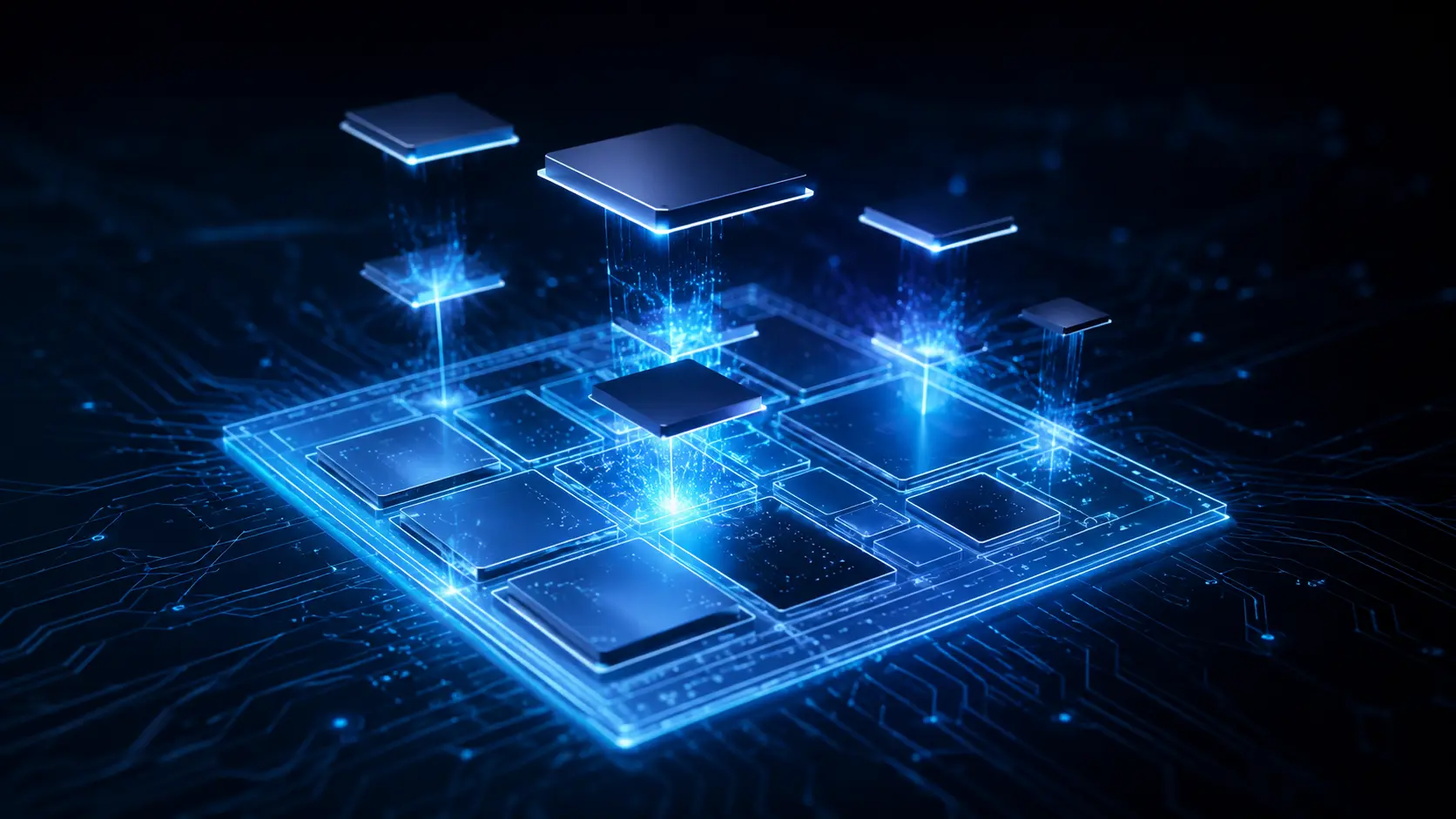
SiFive bridges this gap by acting as a premium IP vendor. They engineer the highly complex CPU cores—such as the Performance P870 (a 6-wide, out-of-order data center core) and the Intelligence X390 (an AI-optimized vector processor). SiFive packages these designs into highly modular blocks. A customer licenses these blocks, drops them into their own System-on-Chip (SoC) design, adds their proprietary AI accelerators around them, and sends the finalized file to a foundry.
4. Technical Depth: Vector Extensions and VCIX
The true power of SiFive’s architecture lies in its handling of AI math. Instead of rigid instruction formats, SiFive heavily utilizes the RISC-V Vector Extension (RVV). The Intelligence X390 core supports massive 1024-bit Vector Length (VLEN) registers. Furthermore, SiFive provides the Vector Coprocessor Interface Extension (VCIX). This interface allows a customer to plug their own proprietary AI hardware engines directly into the SiFive CPU’s internal pipeline. The CPU and the custom AI accelerator seamlessly share the same memory and instructions, eliminating the massive latency bottlenecks found in traditional PCIe-connected architectures.
5. Real-World Consequences: Agentic Data Centers
By leveraging SiFive’s IP, hyperscalers can strip away the legacy fat of x86 and the licensing barriers of ARM. They deploy custom RISC-V host processors that use a fraction of the power, dedicating the reclaimed electricity directly to their massive AI compute clusters. This fundamentally alters data center thermodynamics, enabling denser, highly specialized infrastructure capable of running autonomous “Agentic AI” workloads at scale.
Real-World Applications
SiFive’s core IP is rapidly proliferating across three primary verticals.
AI Data Center Host Processors: In hyperscale environments, GPUs do the heavy AI lifting, but they require a host CPU to feed them data and manage the operating system. NVIDIA has deeply partnered with SiFive, integrating SiFive’s RISC-V cores with NVIDIA NVLink Fusion. This allows high-bandwidth, cache-coherent connectivity between SiFive CPUs and NVIDIA GPUs, offering a scalable, energy-efficient alternative to pairing GPUs with power-hungry x86 processors.
Automotive and Autonomous Driving: The transition to “Software-Defined Vehicles” requires massive onboard compute. Automotive tier-one suppliers are licensing SiFive’s automotive-grade cores to handle real-time sensor fusion and infotainment. Through strategic partnerships (like their 2026 collaboration with HighTec EDV-Systeme), SiFive provides ISO-certified, ASIL-compliant safety-ready architectures that carmakers can fully customize without vendor lock-in.
Edge AI and Consumer IoT: In May 2026, SiFive launched the Performance P570 Gen 3. Purpose-built for power-constrained consumer devices, it introduced a 13-stage, fully out-of-order pipeline with dot-product extensions specifically designed to accelerate AI on the edge. This core directly targets the lucrative midrange smartphone and smart-home market historically dominated by ARM’s Cortex-A series.
Economic & Strategic Impact
The economics of the semiconductor IP market are undergoing a massive realignment.
ARM Holdings generates billions by charging licensing fees and per-chip royalties. For a company shipping 100 million smart devices, those royalties are a massive margin drain. SiFive offers a highly disruptive pricing structure. By leveraging an open standard, they drastically lower the barrier to entry for custom silicon design.
Geopolitically, RISC-V is viewed as a strategic imperative. The ISA is maintained by RISC-V International, a non-profit organization headquartered in Switzerland. Because the standard is open and globally governed, it is immune to the export controls and trade sanctions that govern proprietary US or UK-based architectures (like x86 and ARM). China, the European Union, and the United States are heavily funding domestic RISC-V startups to ensure “silicon sovereignty,” relying on vendors like SiFive to provide the foundational IP.
Advantages
- Architectural Freedom: Customers can deeply modify the silicon, adding custom instructions and tightly integrating proprietary hardware accelerators via the VCIX interface without violating licensing agreements.
- Power and Area Efficiency: By stripping out decades of legacy instruction bloat (CISC), SiFive’s RISC-V cores require significantly less silicon real estate and consume less power than equivalent x86 counterparts.
- Ecosystem Momentum: The architecture is backed by nearly every major tech giant (Google, Qualcomm, Samsung, NVIDIA), ensuring rapid development of open-source compilers, Linux distributions, and security protocols (like the RVA23 profile).
Limitations
- Legacy Software Compatibility: You cannot run legacy Windows applications natively on a RISC-V processor without using emulation, which degrades performance. RISC-V is currently best suited for Linux-based, cloud-native, or embedded environments.
- Verification Burden: When a company heavily modifies an open-source architecture, they take on the massive financial and technical burden of verifying that their modifications will actually work when printed on physical silicon.
- Fragmented Toolchains: While improving rapidly through initiatives like RISE (RISC-V Software Ecosystem), the availability of highly optimized, enterprise-grade debuggers and proprietary software compilers still lags behind the decades of polish found in the ARM and x86 ecosystems.
Common Misconceptions
Misconception: Because RISC-V is open-source, SiFive gives away its chips for free.
Reality: The RISC-V dictionary (the ISA) is free. SiFive’s novel (the physical, highly engineered microarchitecture) is a premium, paid commercial product.
Misconception: SiFive manufactures physical silicon microchips.
Reality: SiFive is fundamentally an Intellectual Property (IP) company. Like ARM, they generally do not manufacture or sell physical chips. They sell the digital design files (RTL) to companies, who then hire foundries (like TSMC or Samsung) to physically manufacture the chips.
Misconception: RISC-V is only for tiny, low-power microcontrollers in IoT devices.
Reality: While RISC-V started in the embedded space, modern cores like SiFive’s P870 are 64-bit, multi-issue, out-of-order, high-performance data center processors designed to compete directly with AMD EPYC and ARM Neoverse architectures.
What Most People Miss
The quietest but most devastating blow to legacy architectures is the standardization of RVA23.
Historically, critics argued that RISC-V would fail because it was too fragmented; if every company customized their chips differently, standard software (like a Red Hat Linux operating system) wouldn’t know how to run on them.
The ratification of the RVA23 profile solved this. RVA23 is a strict baseline set of mandatory instructions (including Hypervisor and Vector extensions). By guaranteeing that cores like SiFive’s P570 and P870 are fully RVA23 compliant, major software vendors (like Ubuntu, Google, and Red Hat) can now release a single, unified operating system that works perfectly out-of-the-box on any RVA23 RISC-V chip, instantly erasing the fragmentation argument that previously protected ARM’s monopoly.
Comparison Table
| Feature | x86 (Intel / AMD) | ARM (ARM Holdings) | RISC-V (SiFive IP) |
| Instruction Set Type | Proprietary (CISC). | Proprietary (RISC). | Open Standard (RISC). |
| Primary Business Model | Sells physical chips. | Licenses IP and charges royalties. | Licenses highly customizable IP. |
| Customization Freedom | Zero. | Highly Restricted (Architectural licenses are rare). | Absolute. Customers can add custom instructions freely. |
| Primary Domain | Desktop, Legacy Data Center. | Mobile, Edge, Cloud (AWS Graviton). | Custom Silicon, AI Data Center, Automotive, IoT. |
| Legacy Software Support | Flawless (Windows, legacy enterprise). | Excellent (macOS, iOS, Android). | Growing (Linux-native, Android evolving). |
Case Study
Situation: The rapid scaling of AI data centers exposed the severe power limitations of legacy host CPUs. Hyperscalers realized that standard, off-the-shelf x86 processors were drawing too much power and lacking the specific memory bandwidth needed to feed massive GPU clusters.
Challenge: Designing a custom data center CPU from scratch takes 5 years and billions of dollars. Licensing an ARM core provided faster time-to-market but restricted the hyperscalers from tightly integrating their own proprietary, high-speed networking and AI vector math units directly into the core pipeline.
Solution: In early 2026, the market shifted heavily toward SiFive. Driven by hyperscaler demand for “architectural freedom,” SiFive successfully closed a USD 400 million Series G funding round. The funding was leveraged to accelerate the integration of SiFive’s high-performance P870 and X390 cores directly into the AI supply chain.
Outcome: SiFive publicly announced a deep integration with NVIDIA’s NVLink Fusion. This breakthrough allowed hyperscalers to license SiFive’s RISC-V cores, customize them with proprietary extensions, and connect them coherently to NVIDIA GPUs using ultra-high-bandwidth interconnects.
Lessons Learned: The era of the general-purpose data center processor is ending. At hyperscale, power efficiency and custom integration dictate profitability. SiFive’s commercialization model proved that open-source standards, when backed by elite, silicon-ready engineering, can successfully dismantle legacy proprietary monopolies at the highest levels of high-performance computing.
Future Outlook
Next 12–24 Months
The AI Edge market will experience a rapid RISC-V takeover. With the launch of the SiFive Performance P570 Gen 3 in mid-2026, consumer device manufacturers will begin silently replacing mid-tier ARM Cortex cores in smart home hubs, industrial robots, and entry-level Android devices. The seamless compatibility with RVA23 ensures that consumers will not notice the architectural shift, but OEMs will capture massive licensing savings.
Next 3–5 Years
We will witness the tape-out and mass deployment of the first true “Agentic AI” hyperscale data centers powered primarily by RISC-V host processors. As AI models shift from simple prompt-response generation to autonomous, continuous multi-agent reasoning, the power envelopes of data centers will strictly enforce the adoption of stripped-down, highly efficient RISC-V architectures tightly bound to custom ASICs (Application-Specific Integrated Circuits).
Next 10 Years
The concept of a proprietary Instruction Set Architecture will be viewed historically in the same way we view proprietary networking protocols today (obsolete). RISC-V will become the undisputed, invisible foundation of global compute. SiFive, assuming it maintains its engineering lead, will transition from a disruptor into a foundational pillar of the global digital economy, effectively replacing ARM as the default IP library for the next generation of semiconductor designers.
Most Likely Scenario
SiFive will not kill Intel or AMD directly in the desktop or legacy enterprise server markets; the moat of legacy x86 software is too deep. However, SiFive will absolutely dominate the greenfield expansion of AI infrastructure and custom automotive silicon. The USD 400 million capital injection in 2026 guarantees that SiFive has the war chest required to scale its high-performance roadmap and cement RISC-V as the primary architecture of the AI era.
Key Takeaways
- SiFive is a fabless semiconductor company that monetizes the free RISC-V standard by selling highly optimized, ready-to-manufacture chip designs (IP).
- The transition to AI demands extreme power efficiency and highly custom hardware accelerators, exposing the rigid licensing constraints of legacy ARM and x86 architectures.
- SiFive’s Vector Coprocessor Interface Extension (VCIX) allows tech giants to plug their own proprietary AI math engines directly into the CPU pipeline without licensing friction.
- A recent USD 400 million Series G funding round (valuing the company at USD 3.65 billion) and strategic partnerships with NVIDIA (NVLink Fusion) validate SiFive’s penetration into the elite data center market.
- The ratification of the RVA23 software profile ensures that standard operating systems (like Red Hat Linux) run seamlessly on new SiFive chips, eliminating the risk of ecosystem fragmentation.
- SiFive provides the foundational IP required for nations and mega-corporations to achieve “silicon sovereignty,” freeing them from vendor lock-in and geopolitical export controls associated with proprietary ISAs.
Glossary
Agentic AI: Advanced artificial intelligence systems capable of autonomous reasoning, multi-step planning, and continuous execution, requiring highly specialized, power-efficient data center architectures.
CISC (Complex Instruction Set Computer): A legacy processor architecture (like x86) that utilizes highly complex, multi-step instructions, often resulting in larger, more power-hungry silicon footprints.
Domain-Specific Architecture (DSA): Hardware designed specifically to accelerate a narrow set of tasks (like machine learning matrix math) vastly more efficiently than a general-purpose CPU.
Instruction Set Architecture (ISA): The fundamental vocabulary and rulebook that allows software to communicate with the physical hardware of a processor.
RISC-V (Reduced Instruction Set Computer – Five): A free, open-source ISA that allows anyone to design, manufacture, and sell custom microchips without paying licensing fees for the fundamental architecture.
RVA23: A standardized profile of mandatory RISC-V extensions (including vector and hypervisor support) designed to ensure that operating systems and software run consistently across different manufacturers’ chips.
System-on-Chip (SoC): An integrated circuit that combines a CPU, memory interfaces, and custom accelerators onto a single piece of silicon.
Frequently Asked Questions
Is SiFive owned by the government or a non-profit?
No. SiFive is a private, for-profit commercial corporation backed by elite venture capital. The underlying instruction set they use (RISC-V) is governed by a non-profit foundation, but SiFive’s specific chip designs are proprietary, paid products.
Why would a massive company like Google buy from SiFive instead of building it themselves?
Time to market and engineering overhead. While Google could legally build a RISC-V core from scratch for free, engineering a flawless, out-of-order, multi-issue superscalar CPU takes years and costs hundreds of millions of dollars. Licensing SiFive’s proven core allows Google to focus their engineers strictly on their proprietary AI accelerators.
Can I buy a laptop with a SiFive processor in it?
Not typically at your local electronics store today. While there are RISC-V developer boards available, the current market for RISC-V is heavily focused on data centers, automotive, and embedded devices inside other products (like smartwatches or hard drives), rather than mainstream consumer laptops which are reliant on Windows/macOS.
How does SiFive make money if RISC-V is free?
RISC-V is like the English language (it is free to use). SiFive writes a highly complex, best-selling technical textbook using the English language, and they charge companies millions of dollars to buy and use that specific textbook (the silicon design files).
Does the US government restrict RISC-V?
This is a highly debated topic. Because RISC-V is an open global standard governed in Switzerland, it cannot easily be subjected to traditional US export controls, allowing Chinese technology companies to adopt it rapidly. However, specific, highly advanced physical chip designs created by US-based companies like SiFive may still be subject to regional export regulations depending on their capabilities.
Sources
- SiFive Corporate Press: SiFive Raises USD 400 Million to Accelerate High-Performance RISC-V Data Center Solutions (April 2026)
- TechPowerUp / SiFive: SiFive Launches RISC-V Performance P550 and P570 Gen 3 IP (May 2026)
- Futurum Group: SiFive’s P570 Gen 3 Tests Whether RISC-V Can Challenge Arm in Consumer Silicon (May 2026)
- Jon Peddie Research: SiFive Performance P870 and the SiFive Intelligence X390 AI Innovations