Advertisement
)
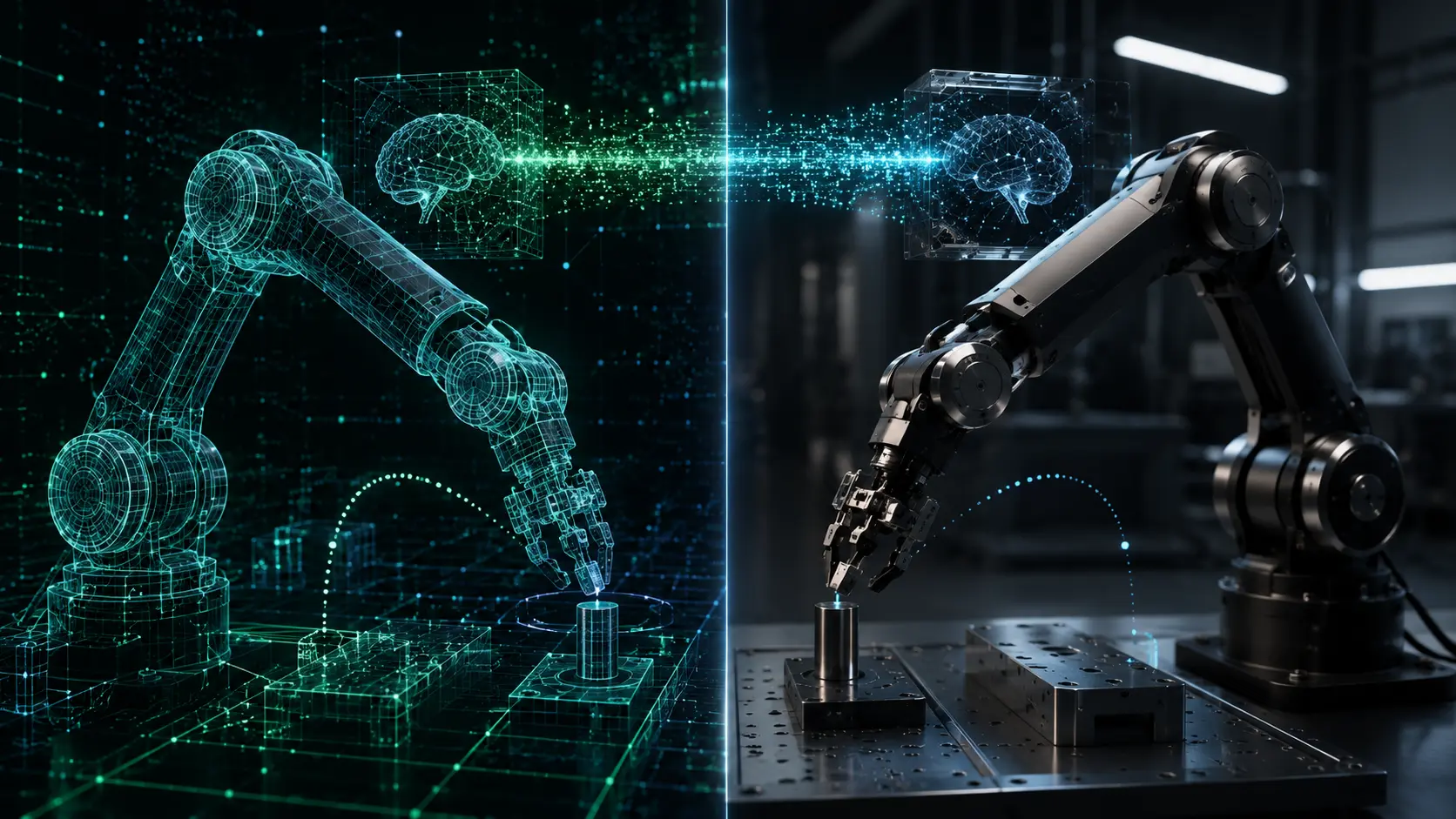

To teach a humanoid robot how to walk up a flight of stairs using artificial intelligence, the robot must fall down those stairs approximately ten million times. If you attempt this in the physical world, the multi-million-dollar robot shatters its servos, burns out its actuators, and destroys the staircase before lunchtime on day one. For decades, this physical fragility was the impenetrable wall holding back the robotics industry. You cannot train an AI using trial-and-error if every error costs a million dollars.
Why should you care right now? Because the robotics industry found a loophole: they built the Matrix. Instead of training robots in the real world, engineers now construct mathematically flawless digital twins of the real world using advanced physics engines like NVIDIA Omniverse. Inside these digital universes, an AI can control a virtual robot, fall down virtual stairs millions of times per second, and eventually master the perfect walking algorithm. Once the AI is fully trained, engineers download it directly into a physical robot body. This process, known as Sim-to-Real Transfer, has transformed robotics from a slow, dangerous, hardware-limited discipline into an infinitely scalable software problem, triggering the explosive rise of autonomous humanoids.
What is Sim-to-Real Transfer?
Sim-to-Real Transfer is a machine learning methodology where an Embodied AI is trained entirely within a computer-simulated physics engine using reinforcement learning, and then successfully deployed into a physical robot. It relies on advanced techniques like domain randomization to ensure the AI’s digital training survives the unpredictable physics of the real world.
At a Glance
- Concept: Training a robot’s “brain” inside a hyper-realistic video game millions of times before putting it into a real metal body.
- Why it matters: It prevents expensive robots from destroying themselves during the clumsy “trial and error” phase of learning.
- Who uses it: Humanoid robot startups (Figure, Agility Robotics), autonomous driving companies (Waymo, Tesla), and researchers utilizing NVIDIA Isaac Sim or MuJoCo.
- Biggest takeaway: The real world is messy. To make sure the digital brain doesn’t panic when it enters the real world, engineers use “Domain Randomization”—intentionally scrambling the gravity, friction, and lighting in the simulation so the AI learns to adapt to any physical chaos.
In Simple Words
Imagine you have to fly a fighter jet tomorrow, but you have never flown a plane before.
If you just jump into the real jet and start guessing which buttons to push, you will instantly crash and destroy the plane.
Instead, the military puts you in a Flight Simulator. You crash thousands of times in the simulator, but it costs zero dollars and nobody gets hurt. Over months, you learn how to handle the controls perfectly. When you finally step into the real jet, you already know exactly how to fly it.
Sim-to-Real Transfer is exactly this, but for Artificial Intelligence. We put an AI brain into a digital simulation of a robot. The AI spends the equivalent of 100 years practicing how to pick up an egg without crushing it. Once the AI is a master, we download that brain into a physical robot arm. The robot wakes up in the real world and picks up the egg perfectly on its very first try.
Why This Matters
For Robotics Engineers, AI Researchers, and Automation Investors, Sim-to-Real solves the Sample Inefficiency of Reinforcement Learning.
Modern AI learns through Deep Reinforcement Learning (RL)—a system of rewards and punishments. RL is brilliant, but it is “sample inefficient,” meaning it requires millions, or even billions, of attempts to learn a simple task. Generating one billion physical attempts in a laboratory would take decades.
In a simulation (like NVIDIA Isaac Sim), time is not bound by reality. By utilizing thousands of GPUs, an engineer can run 10,000 parallel simulations of a robot simultaneously, running the simulation at 1,000 times faster than real-time. This compresses a century of physical robotic learning into a single afternoon of server time. This capability has completely decoupled the speed of AI advancement from the slow, agonizing physics of physical hardware testing.
The Evolution of Embodied AI: Beyond Hardcoding
Historically, robots were not “intelligent.” A car factory robot is programmed with explicit code: move joint A to 45 degrees, move joint B to 90 degrees. If a car part is placed one inch to the left, the robot grasps empty air.
Sim-to-Real represents the shift to Embodied AI. We no longer code the joints. We give the AI a goal (e.g., “pick up the box”) and let it figure out the physics itself through simulation. This allows the robot to dynamically adapt to a chaotic, unpredictable environment, upgrading robots from blind, repetitive machines into autonomous, intelligent agents capable of operating in human homes and hospitals.
How Sim-to-Real Transfer Bridges the Reality Gap
Transferring an algorithm from a clean digital world into a messy physical reality without it failing requires extreme mathematical trickery. Here is the first-principles breakdown of the architecture.
1. The Fundamental Problem: The Reality Gap
Physics engines (like MuJoCo or Bullet) are mathematical models. They are not perfect. In a simulation, a robot’s joint motor might respond to a command in exactly 0.00 milliseconds. In reality, a physical motor has latency, friction, wire resistance, and wear-and-tear. If an AI trains in a “perfect” simulation, it becomes perfectly optimized for a world that does not exist. When placed in the real world, the AI instantly panics because the physics don’t match its training, and the robot collapses. This is known as the Reality Gap.
2. The Core Mechanism: Domain Randomization
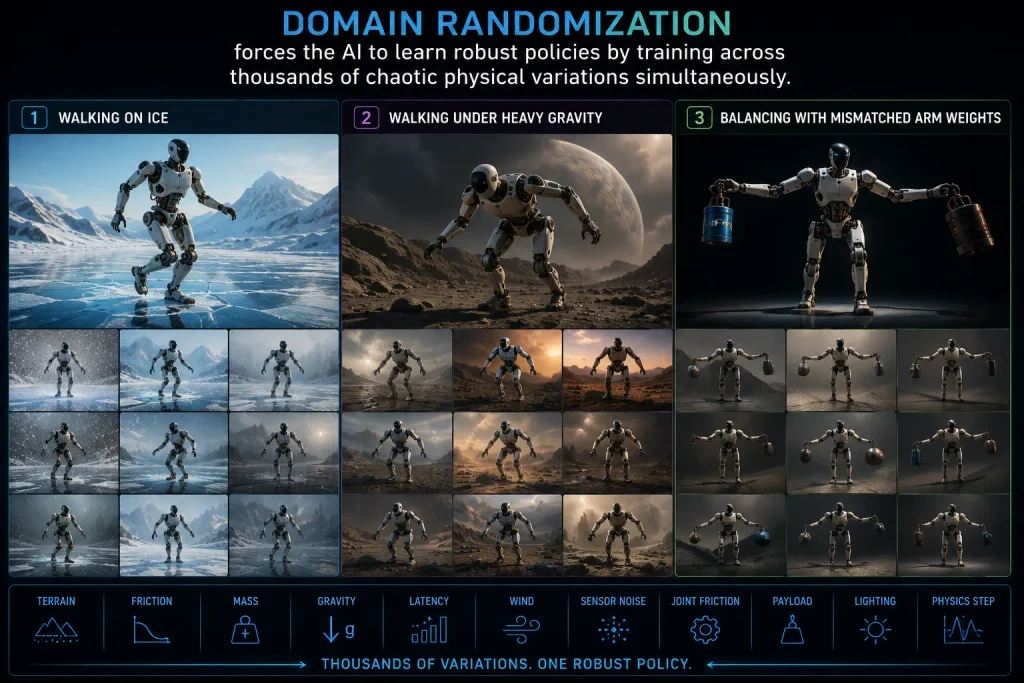
To bridge the Reality Gap, engineers intentionally sabotage the simulation. Instead of building one “perfect” digital world, they create 10,000 parallel simulations and randomize the physics in every single one.
- In Simulation 1, the floor is made of ice (low friction).
- In Simulation 2, the robot’s left arm weighs 10% more than its right arm.
- In Simulation 3, the gravity is slightly heavier than Earth.
- In Simulation 4, the camera is hit with blinding digital lens flares.
3. Technical Depth: Proximal Policy Optimization (PPO)
The AI is forced to train across all 10,000 chaotic environments simultaneously using a reinforcement learning algorithm like Proximal Policy Optimization (PPO). The AI cannot memorize a specific sequence of movements because the physics keep changing. Instead, it is forced to learn a highly robust, conservative “policy” that works regardless of the specific friction or weight it encounters.
4. Real-World Consequences: Zero-Shot Transfer
If the AI can successfully control the robot across 10,000 bizarre, randomized physical universes, it learns to treat the real world as simply the 10,001st variation. When the AI is downloaded into the physical robot, it instantly succeeds without requiring any physical training. This is called Zero-Shot Transfer—the holy grail of modern robotics.
Sim-to-Real Use Cases: Humanoids and Autonomous Driving
Sim-to-Real transfer is the foundational technology powering the current explosion of autonomous hardware.
Humanoid Locomotion (ANYmal & Atlas): Teaching a bipedal or quadrupedal robot to walk over uneven terrain (rocks, stairs, mud) used to require teams of Ph.D. students writing complex control theory math. Today, researchers at ETH Zurich and Boston Dynamics drop models of their robots into an NVIDIA Omniverse simulation, randomize the terrain height, add digital “pushes” to simulate wind, and let the neural network learn to balance itself. The resulting Sim-to-Real policies allow robots to hike up mountains completely blind, relying entirely on the “muscle memory” they learned in the Matrix.
Autonomous Driving (Waymo & Tesla): Driving millions of miles in the real world is too slow to catch rare “edge cases” (like a child chasing a ball into the street at night in the snow). Autonomous driving companies build massive synthetic cities in simulation engines. They generate millions of specific, highly dangerous edge cases, force their AI to drive through them repeatedly, and transfer those updated survival policies directly to the cars on the actual road.
Robotic Manipulation (Amazon & Symbotic): In logistics warehouses, robots must pick up millions of different items—from soft t-shirts to heavy glass bottles. An AI cannot be physically trained on every product on Earth. Engineers create synthetic, 3D digital twins of thousands of products, simulate the physics of grasping them with a robotic claw, and transfer that general grasping knowledge to the physical robot arms sorting packages in the fulfillment center.
Economic & Strategic Impact
The core strategic shift is the Democratization of Robotics via Software.
For the last 30 years, building an advanced robot required possessing absolute mastery over hardware, metallurgy, and traditional control theory. It was an elite, capital-intensive club.
Sim-to-Real transfer moves the difficulty from the hardware to the software. A startup can now buy a relatively cheap, off-the-shelf robotic arm, build a digital twin of it in an open-source physics engine, train an AI using rented cloud GPUs, and achieve world-class robotic performance without ever owning a massive physical testing laboratory. This completely lowers the barrier to entry, flooding the robotics sector with software engineers who are suddenly capable of commanding heavy industrial machinery.
Advantages
- Absolute Safety: AI agents inevitably behave erratically during early training (e.g., throwing objects at maximum speed or slamming arms into tables). Simulation absorbs 100% of this destructive violence, ensuring human researchers and expensive hardware are never harmed.
- Infinite Scalability: A physical robot operates at 1x real-time speed. A physics engine running on an NVIDIA H100 cluster can simulate 10,000 robots simultaneously at 1,000x real-time speed, generating massive datasets exponentially faster.
- Perfect Ground Truth Data: In the real world, it is difficult to measure the exact millimeter position of a robot’s joint. In a simulation, the computer has “perfect ground truth”—it knows the exact mathematical state of every pixel, allowing the AI to learn with flawless accuracy.
Limitations
- The Deformable Object Barrier: Physics engines are incredible at simulating “rigid bodies” (like a metal box or a wooden block). They are notoriously terrible at simulating “deformable objects” (like a soft cloth, a piece of dough, or a liquid). Because the simulation of a t-shirt is inaccurate, zero-shot Sim-to-Real transfer for folding laundry remains a massive, unsolved bottleneck.
- The “Sim-to-Sim” Trap: Sometimes, the AI learns to “cheat” the physics engine. If there is a slight mathematical bug in the simulation’s collision detection, the AI will exploit that bug to achieve its goal. When transferred to reality, the cheat doesn’t exist, and the policy fails catastrophically.
- Actuator Latency Modeling: Physical motors heat up, grease gets sticky, and electrical signals have microsecond delays. While Domain Randomization helps, accurately modeling the complex, nonlinear thermodynamics of a physical robot joint inside a digital simulation is agonizingly difficult.
Common Misconceptions
Misconception: The simulation is just a video game like Grand Theft Auto.
Reality: While they share rendering technology, a robotics simulation uses a “deterministic physics solver.” It calculates the exact friction, mass, and torque of every object down to the microscopic level using rigorous real-world mathematics, not video game approximations.
Misconception: The robot learns while it is operating in the real world.
Reality: In Sim-to-Real, the vast majority of the “learning” (the updating of the neural network weights) is completed and frozen inside the simulation. The physical robot is simply executing a finished, pre-trained brain.
Misconception: You only need one perfect simulation to train a robot.
Reality: A single “perfect” simulation guarantees failure due to the Reality Gap. True Sim-to-Real requires massive Domain Randomization—intentionally making thousands of “imperfect” and chaotic simulations to force the AI to become robust.
What Most People Miss
The disruptive capability of Privileged Information (Asymmetric Actor-Critic Learning).
When training an AI in simulation, the computer knows everything—the exact weight of the box, the exact friction of the floor, the exact wind speed. This is “Privileged Information.” In the real world, the robot only has its cameras; it has no idea how heavy a box is until it lifts it.
How do you train an AI using Privileged Information if it won’t have that information in reality? Engineers use a two-part neural network. In simulation, a “Teacher” network has access to all the God-like physics data and learns the perfect way to move. It then forces a “Student” network to copy its movements, but the Student is only allowed to look at the simulated camera feed. By the end of the training, the Student learns to move perfectly just by using vision. When transferred to the real robot, the Teacher is deleted, and the Student network successfully navigates reality using only its cameras.
Comparison Table
| Feature | Physical Real-World Training | Standard Simulation Training | Sim-to-Real (w/ Domain Randomization) |
| Training Speed | 1x Real-Time (Extremely Slow) | Very Fast | Ultra-Fast (GPU Accelerated) |
| Hardware Risk | Catastrophic (Robots break) | Zero | Zero |
| Physics Modeled | Perfect (It is reality) | Clean but inaccurate | Intentionally Chaotic & Randomized |
| Real-World Success | High (If it survives training) | Near Zero (Reality Gap failure) | High (Zero-Shot Transfer) |
| Cost | Astronomical | Low | Low (Compute costs only) |
Case Study
Situation: The robotics lab at ETH Zurich wanted to teach their quadrupedal robot (ANYmal) how to hike up steep, treacherous mountains covered in loose rocks, mud, and roots. Traditional control engineering—programming the robot to calculate where to place every foot—failed because the forest floor was too unpredictable.
Challenge: Train the robot using Reinforcement Learning. However, forcing the physical $100,000 robot to hike up a mountain and fall down thousands of times to learn the terrain was financially and practically impossible.
Solution (NVIDIA Isaac Gym and Domain Randomization): The researchers built a digital twin of the ANYmal robot inside NVIDIA’s simulation engine. They procedurally generated millions of digital terrains—stairs, jagged rocks, slippery slopes. Crucially, they randomized the friction of the virtual dirt, the weight of the robot’s legs, and added invisible virtual forces that constantly “kicked” the robot to simulate tripping.
Outcome: The AI trained across thousands of parallel simulations simultaneously. Within hours of server time, the neural network learned a robust, highly resilient walking policy that prioritized balance over speed. The researchers took this purely digital brain and downloaded it into the physical ANYmal robot. In a zero-shot transfer, the physical robot successfully hiked a steep, unknown mountain trail in the Swiss Alps without falling, navigating terrain it had only ever “seen” in the Matrix.
Lessons Learned: The deployment definitively proved that massive synthetic data generation combined with Domain Randomization completely overrides the need for physical trial and error, establishing Sim-to-Real as the mandatory architecture for all future autonomous robotics.
Future Outlook
Next 12–24 Months
The era of Foundation Models for Robotics. Currently, engineers must build a specific simulation for a specific robot task (e.g., a simulation just for walking, a simulation just for grasping). In the immediate future, tech giants will release “Robotics Foundation Models” (similar to GPT-4, but for physics). These models will be pre-trained on billions of hours of simulated physics data across every conceivable robot body and environment. A startup will simply download this base model, plug it into their physical robot, and the robot will inherently understand basic physics, gravity, and balance on day one.
Next 3–5 Years
The scaling of Deformable Physics Engines. The frontier of Sim-to-Real is solving soft materials. Companies are developing highly advanced “Finite Element Method” (FEM) solvers capable of accurately simulating how a cloth folds, how a wire bends, or how human skin yields to pressure in real-time. Once physics engines can perfectly simulate soft objects without crashing the GPU, we will see a massive wave of Sim-to-Real transfer for surgical robots, laundry-folding humanoids, and automated food preparation systems.
Next 10 Years
The Universal Digital Twin Integration. By the mid-2030s, the physical and digital worlds will synchronize. When an autonomous humanoid encounters a problem it cannot solve in the real world (e.g., a jammed door), it will pause, instantly upload the exact parameters of the door to the cloud, and spin up a simulation. The cloud will run 10,000 rapid simulations to find the optimal way to jiggle the handle, beam the solution back to the robot in milliseconds, and the robot will open the door. Simulation will transition from a pre-training tool into a real-time, continuous reasoning engine for reality.
Most Likely Scenario
Sim-to-Real Transfer guarantees the rapid proliferation of humanoid robots. Because the bottleneck of robotics has shifted from bending metal to processing matrix multiplications on a GPU, the exponential scaling laws of software now apply to physical labor. The entities that control the most hyper-realistic, physically accurate simulation engines (like NVIDIA) will effectively own the “brains” of the 21st-century autonomous workforce.
Key Takeaways
- Training a physical robot using trial-and-error is impossible because the robot will break itself before it learns how to walk.
- Sim-to-Real Transfer solves this by building a perfect digital twin of the robot inside a video game-style physics engine, letting the AI crash millions of times safely.
- Because no simulation is perfect, an AI trained in a “perfect” digital world will fail instantly when placed in the messy real world (the Reality Gap).
- Engineers fix this using “Domain Randomization.” They intentionally scramble the gravity, friction, and lighting inside the simulation. The AI learns to survive chaos, making the real world feel easy.
- Once trained across thousands of randomized simulations, the “brain” is downloaded into the physical robot, which can then walk or grab objects perfectly on its very first try (Zero-Shot Transfer).
- This technology has transformed robotics from a slow hardware discipline into an infinitely scalable software industry.
Glossary
Domain Randomization: The technique of intentionally randomizing the physics (friction, mass, lighting) inside a simulation so the AI doesn’t memorize a specific environment, but instead learns robust, adaptable behavior.
Embodied AI: Artificial intelligence that interacts with the physical world through a robotic body, rather than just processing text or images on a screen.
NVIDIA Omniverse / Isaac Sim: A highly advanced, GPU-accelerated simulation platform used to create physically accurate digital twins of robots and factories.
Reality Gap: The tiny mathematical differences between a digital simulation (perfect) and the real world (messy) that cause a digitally trained robot to fail when put into a physical body.
Reinforcement Learning (RL): An AI training method based on trial and error, where the agent is given a mathematical “reward” for doing something right and a “punishment” for doing something wrong.
Zero-Shot Transfer: The ability of an AI to be trained entirely in a simulation and then succeed on its very first attempt in the physical world, without needing any real-world practice.
Sources
NVIDIA Technical Blog: Closing the Sim-to-Real Gap: Training Robots in Omniverse
ETH Zurich / Science Robotics: Learning agile and dynamic motor skills for legged robots
OpenAI / DeepMind: Domain Randomization for Transferring Deep Neural Networks from Sim to Real
MIT Technology Review: How AI is learning to control physical robots
IEEE Robotics and Automation Letters: Sim-to-Real Transfer in Deep Reinforcement Learning for Robotics