Advertisement
)

AT A GLANCE
- Concept: Modularity: Building reactor components on a factory assembly line instead of pouring concrete onsite.
- Concept: HALEU Fuel: Uranium enriched near 20 percent to maximize energy density in smaller reactor cores.
- Concept: Passive Safety: Using fundamental physics like gravity and natural convection to cool reactors during emergencies.
- Concept: Molten Salt: Liquid chemical coolants that absorb extreme heat without requiring dangerously high internal pressure.
IN SIMPLE WORDS
Traditional nuclear power plants are like custom-built mansions. They take a decade to construct, cost billions, and require massive amounts of land. Because every plant is a unique engineering project, construction frequently faces massive delays.
Small Modular Reactors (SMRs) operate like manufactured homes. Instead of building the plant on-site, companies manufacture identical reactor modules in a central factory. They ship these finished units on standard trucks or trains and plug them in wherever power is needed.
By shrinking the physical size, these new reactors safely power individual data centers, military bases, or manufacturing hubs. To achieve this smaller size, they replace standard fuel and water cooling with highly concentrated uranium and advanced chemical coolants. This allows them to run safely for years without refueling, creating a reliable, zero-emission battery for the electrical grid.
HOW IT WORKS
Nuclear fission generates electricity by splitting uranium atoms, which releases immense heat. In a legacy nuclear plant, this heat boils water into steam, spinning a massive turbine. The physical size of the reactor is dictated by the need to hold millions of gallons of highly pressurized water to prevent a meltdown.
Small Modular Reactors fundamentally alter this physical constraint by changing the fuel and the coolant. Instead of using standard Low-Enriched Uranium (LEU) hovering around 4% concentration, many SMRs utilize High-Assay Low-Enriched Uranium (HALEU).
HALEU is enriched up to 19.75%, sitting just below the legal threshold for weapons-grade material. This extreme energy density allows engineers to drastically shrink the size of the reactor core while maintaining a multi-decade operational lifespan. To manufacture this fuel, operators push uranium hexafluoride gas through specialized centrifuge cascades, optimizing Separative Work Units (SWU) to isolate the lighter, reactive isotopes.
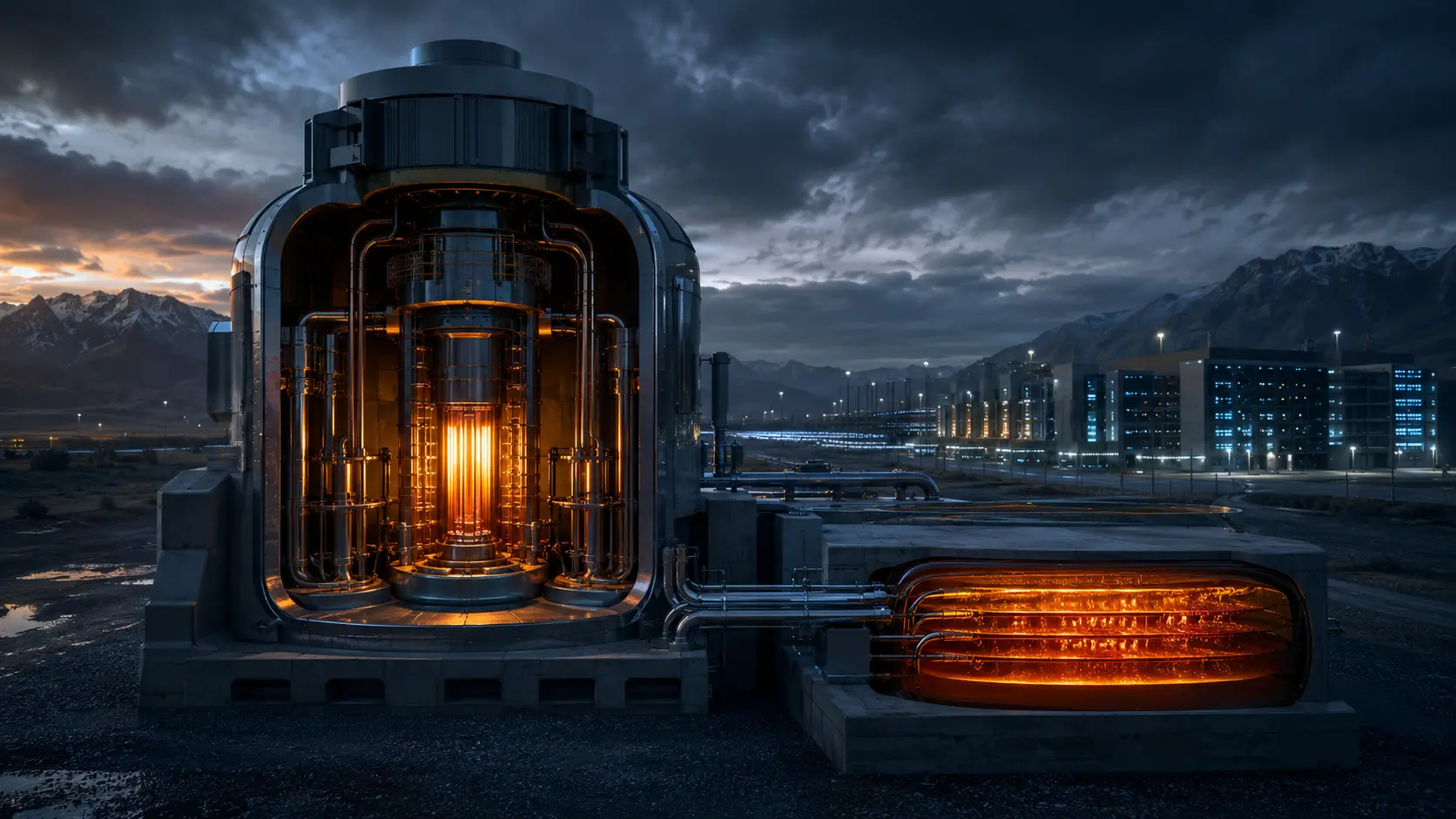
With a smaller core, SMR designers can eliminate the massive, pressurized water systems. Advanced designs utilize liquid metal or molten fluoride salts as the primary coolant. Because molten salt boils at temperatures well over 1,000°C, the reactor operates at normal atmospheric pressure. If a pipe breaks, the coolant simply pools on the floor instead of violently flashing into radioactive steam.
This lack of pressure enables absolute passive safety architectures. If the power grid collapses and the control room goes dark, SMRs do not require backup diesel generators to pump cooling water. They rely entirely on fundamental physics—gravity, natural convection, and freeze-plug valves. The liquid coolant circulates naturally, dissipating the residual heat directly into the surrounding earth or atmosphere indefinitely.
REAL WORLD EXAMPLE
Amazon and Microsoft are actively acquiring massive tracts of land next to existing nuclear facilities to power their artificial intelligence data centers. However, legacy power plants cannot scale fast enough to meet hyperscale computing demands.
To solve this, technology companies are directly financing SMR developers like TerraPower and NuScale. TerraPower is currently constructing a sodium-cooled fast reactor near a retiring coal plant in Wyoming.
Instead of requiring a massive reservoir for water cooling, the Natrium reactor uses liquid sodium to absorb the nuclear heat. It transfers this heat into a massive tank of molten salt, which acts as a thermal battery. This allows the plant to store heat during the day and generate peak electricity exactly when the local grid demands it, bridging the gap between steady nuclear fission and variable data center workloads.
WHY SMALL MODULAR REACTORS MATTER NOW
Global data center energy consumption is breaking the modern electrical grid. Artificial intelligence processors consume exponentially more power than traditional cloud servers. Wind and solar installations cannot provide the 24/7, uninterrupted baseload power these hyperscale facilities require without impossible amounts of battery storage.
This physical grid constraint forces a geopolitical pivot toward nuclear energy. However, building gigawatt-scale legacy nuclear plants takes fifteen years and requires massive sovereign financing. Tech conglomerates and industrial operators cannot wait a decade for power. They require off-the-shelf, predictable energy modules.
SMRs transition nuclear power from a bespoke construction project into a mass-produced manufacturing pipeline. By utilizing factory assembly lines, developers aim to drive down the Levelized Cost of Energy (LCOE). Once the initial regulatory approvals are secured, factories can stamp out identical reactor cores, deploying them across the globe in a fraction of the time.
Furthermore, this technology dictates the future of global energy diplomacy. The nation that dominates the SMR export market will essentially control the energy infrastructure of developing nations for the next century. Supplying an SMR creates a hundred-year bilateral relationship centered on fuel supply, maintenance, and security protocols.
COMMON MISCONCEPTIONS
- “SMRs are just smaller versions of old nuclear plants.” In reality, most advanced SMRs use entirely different physics, relying on molten salts, liquid metals, or helium gas instead of pressurized water.
- “SMRs will replace large nuclear reactors.” Large, gigawatt-scale reactors remain mathematically superior for powering dense megacities. SMRs are designed to power decentralized nodes, heavy industrial sites, and isolated regions.
- “Small reactors produce more nuclear waste.” Advanced SMRs actually operate at much higher fuel burnup rates. Many fast-reactor designs can even consume the spent nuclear fuel discarded by older legacy plants, reducing total long-term waste.
- “SMRs are easy to steal for weapons.” SMR cores are sealed, massive steel cylinders weighing hundreds of tons. HALEU fuel sits below the 20% enrichment threshold, making it physically unusable for weapons without a massive, highly visible centrifuge facility.
WHAT MOST PEOPLE MISS
Energy commentators often focus entirely on the reactor hardware, missing the brutal supply chain reality of the fuel cycle. The vast majority of next-generation SMRs are completely dependent on HALEU fuel.
Until very recently, the only commercial supplier of HALEU in the world was the Russian state-owned nuclear corporation, Rosatom. Western SMR companies designed brilliant, safe reactors but lacked the domestic fuel infrastructure to actually turn them on.
The true race in the SMR industry is not just reactor design; it is the frantic construction of domestic uranium enrichment cascades in the United States and Europe. A localized SMR is effectively a multi-million-dollar paperweight if the host nation cannot independently enrich and fabricate the high-assay fuel required to sustain the reaction.
THE ECONOMIC AND STRATEGIC IMPACT
The winners in the SMR economy are the heavy forging companies and specialized metallurgists. Manufacturing the high-pressure reactor vessels and chemically resistant piping requires elite industrial capability.
Hyperscale cloud providers stand to benefit massively. By deploying SMRs directly next to their data centers, companies like Google, Microsoft, and Amazon can completely bypass the heavily congested, heavily regulated municipal transmission grids. They secure absolute energy independence at a fixed, predictable cost.
Sovereign nations risk losing massive geopolitical leverage if they fail to commercialize SMRs. Russia and China are currently operating advanced fast reactors and aggressively marketing them to emerging economies in Africa and South America. Western governments must subsidize their domestic SMR startups to maintain nuclear non-proliferation standards and prevent adversarial control of global baseload power.
THE TRAJECTORY
Next 12–36 Months: Initial prototype deployments and regulatory milestones. Western startups will finalize non-nuclear physical testing and secure site permits, while uranium enrichment consortiums begin low-volume production of HALEU fuel under government defense contracts.
Next Five Years: The first commercial micro-reactors and SMRs will connect to local industrial grids. These early units will be highly expensive, heavily subsidized proof-of-concept plants designed to validate passive safety models and thermal battery integration.
Next Ten Years: The realization of factory-line economies of scale. Modular reactors will roll off assembly lines identically. Tech companies will integrate SMRs into the standard blueprint of all new artificial intelligence training clusters, permanently decoupling hyperscale compute from municipal power grids.
What Could Go Wrong: Regulatory paralysis. Nuclear regulatory bodies are historically optimized to evaluate legacy pressurized water reactors. If regulators refuse to adapt their frameworks to evaluate liquid metal or molten salt chemistry efficiently, the compliance costs will mathematically bankrupt SMR startups before they ever break ground.
Most Likely Outcome: Small Modular Reactors will become the mandatory energy infrastructure for heavy industry and artificial intelligence. The physical impossibility of sustaining baseload power with intermittent renewables ensures that factory-built fission will attract unlimited institutional capital.
KEY TERMS
- Small Modular Reactor (SMR): A nuclear power plant generating up to 300 megawatts of electricity, designed to be mass-produced in a factory and shipped to an operational site.
- High-Assay Low-Enriched Uranium (HALEU): Nuclear fuel enriched between 5 and 19.75 percent, allowing reactors to be physically smaller while running for longer cycles.
- Passive Safety System: An engineering design that relies on natural physics like gravity and thermal convection to cool a reactor without requiring external electricity or human intervention.
- Molten Salt Reactor (MSR): An advanced nuclear design where the primary coolant—and sometimes the fuel itself—is a liquid chemical salt operating at extremely high temperatures but low pressures.
- Levelized Cost of Energy (LCOE): A financial metric measuring the total lifetime cost of building and operating a power plant divided by the total energy it produces.
- Baseload Power: The minimum amount of electrical power that must be continuously generated to satisfy the steady, underlying demand of the power grid.
BEGINNER FAQ
What exactly makes an SMR different from a regular nuclear plant? Size and construction. Regular plants are massive, custom-built infrastructure projects that generate over a gigawatt of power. SMRs are much smaller, generate a fraction of the power, and are built identically on factory assembly lines to lower costs.
Are Small Modular Reactors safe? Yes. Advanced SMRs use passive safety systems. If the power fails, they do not need electronic pumps or backup generators. They use gravity and natural heat circulation to safely cool themselves down without human intervention.
What happens to the nuclear waste? SMRs still produce nuclear waste, but advanced designs are much more efficient. They burn a higher percentage of their fuel, meaning they create less physical volume of waste compared to older reactors. The waste is sealed in massive concrete and steel dry casks.
Why do tech companies want SMRs? Artificial intelligence requires massive data centers that consume as much electricity as small cities. Tech companies need zero-carbon, 24/7 power to run these computers, and wind or solar cannot provide continuous baseload power without massive batteries.
What is HALEU fuel? HALEU stands for High-Assay Low-Enriched Uranium. It is a highly concentrated form of nuclear fuel that packs vastly more energy into a smaller space, allowing SMRs to remain small and run for years without needing a refill.
Can a Small Modular Reactor melt down? Many new designs make traditional meltdowns physically impossible. By using molten salt or liquid metal instead of pressurized water, the reactors operate at normal atmospheric pressure. The coolant cannot boil away, ensuring the core always remains submerged and safe.
How much power does one SMR produce? SMRs typically produce between 50 and 300 megawatts of electrical power. A 300-megawatt reactor produces enough continuous electricity to power roughly 300,000 standard American homes.
How are these reactors transported? Because they are modular, the individual components are designed to fit within standard shipping constraints. They are loaded onto heavy-duty flatbed trucks, railcars, or barges and assembled on-site like interlocking building blocks.
Will SMRs be built in residential neighborhoods? No. While they are safe enough to be located near populations, their initial deployment will focus on heavy industrial zones, retired coal plant sites, military bases, and isolated data center campuses.
Who is currently leading the SMR industry? While dozens of Western startups like TerraPower and NuScale are developing designs, Russia and China are currently operating the world’s first active commercial SMRs, leading the race in actual physical deployment.
SOURCES
- Department of Energy (DOE) — Advanced Small Modular Reactors (SMRs) and High-Assay Low-Enriched Uranium (HALEU)
- International Atomic Energy Agency (IAEA) — Advances in Small Modular Reactor Technology Developments
- Massachusetts Institute of Technology (MIT) — The Future of Nuclear Energy in a Carbon-Constrained World
- Nuclear Regulatory Commission (NRC) — Passive Safety Systems and Licensing Frameworks for Advanced Reactors