Advertisement
)

What is a Sodium-Cooled Fast Reactor (SFR)?
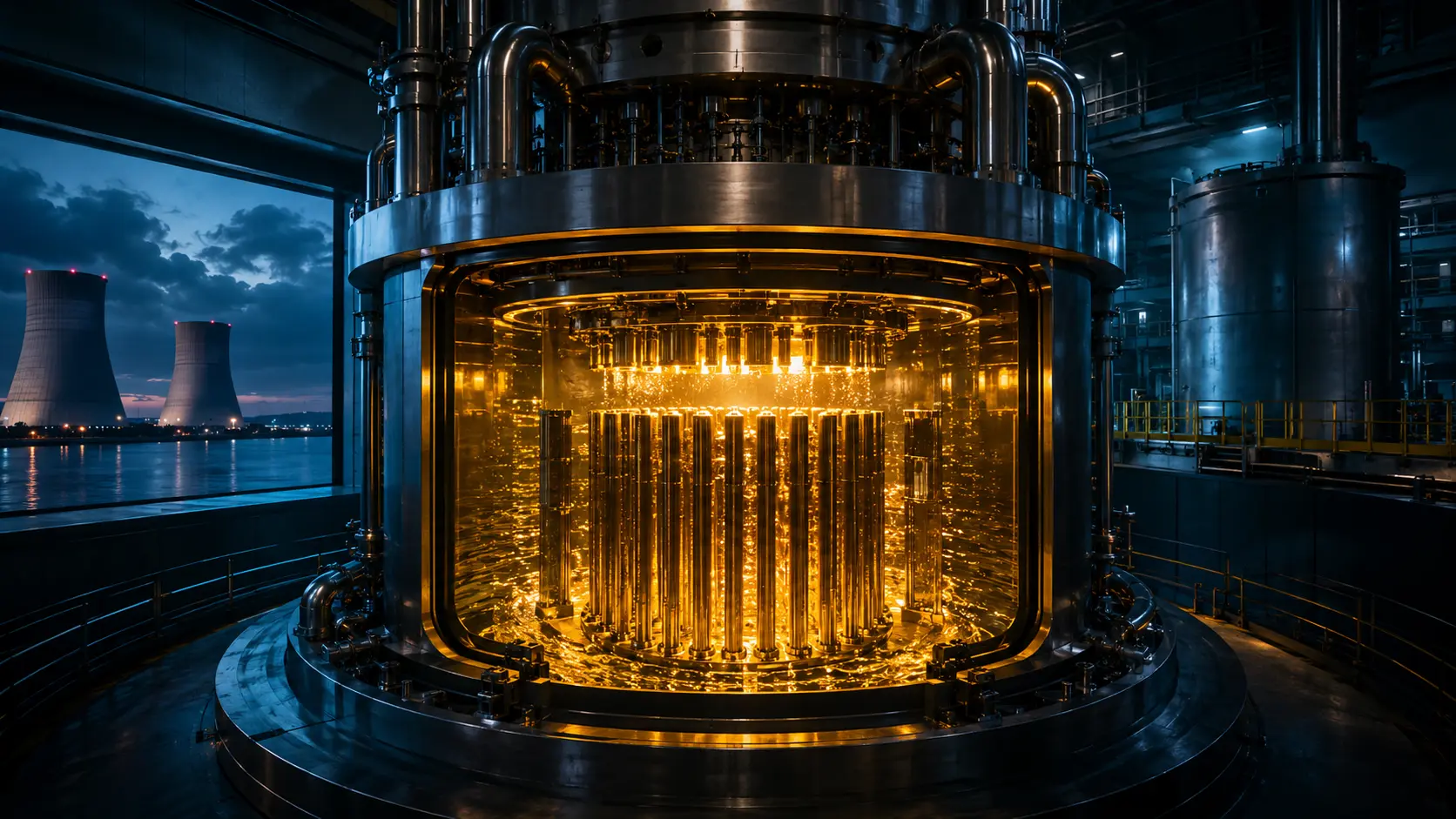
A Sodium-Cooled Fast Reactor (SFR) is an advanced Generation IV nuclear power plant that uses liquid sodium metal as a coolant instead of water. Because sodium does not slow down neutrons, the reactor operates on a fast neutron spectrum, allowing it to generate electricity while simultaneously burning long-lived radioactive nuclear waste as fuel.
At a Glance
- Concept: Swapping water for liquid sodium inside a nuclear core to sustain a high-energy chain reaction capable of splitting heavy, unburnable radioactive isotopes.
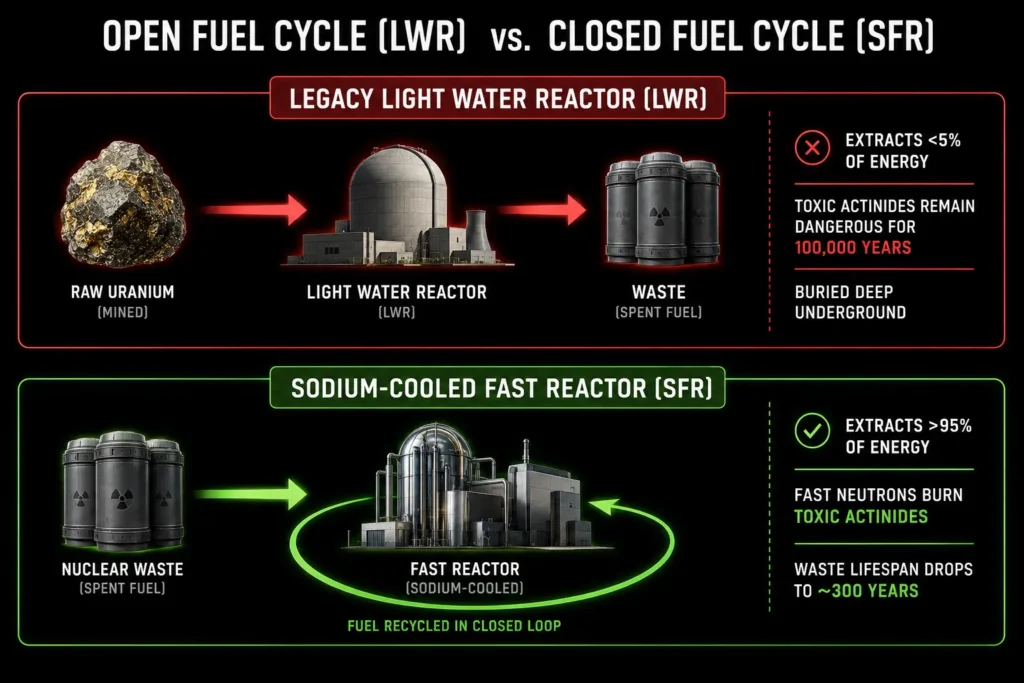
- Why it matters: Traditional nuclear reactors only extract about 1 to 5 percent of the energy in uranium, leaving behind highly toxic waste that lasts for 100,000 years. SFRs can theoretically extract 99 percent of the energy by recycling and “burning” that exact waste.
- Who uses it: Russia (BN-800 and upcoming BN-1200), India (the PFBR in Kalpakkam), and the United States via private ventures like TerraPower’s Natrium project in Wyoming.
- Biggest takeaway: SFRs eliminate the need for permanent, deep-geological nuclear waste dumps. By closing the nuclear fuel cycle, they transition nuclear energy from a linear extraction model into a near-infinite, self-sustaining renewable energy loop.
In Simple Words
In a traditional nuclear power plant, uranium atoms are split apart to create massive amounts of heat, which boils water to spin a turbine. However, the reactor cannot split all the uranium. After a few years, it gets “clogged” with heavy, highly radioactive leftovers. We pull this used fuel out, call it “nuclear waste,” and bury it underground for millennia.
Sodium-Cooled Fast Reactors solve this by operating like an incinerator for nuclear waste.
Instead of submerging the nuclear core in water, engineers submerge it in liquid sodium metal. Water naturally acts like a cushion, slowing down the subatomic particles (neutrons) flying around the reactor. Liquid sodium does not slow them down. Because the neutrons are traveling at incredibly fast speeds, they hit the “unburnable” nuclear waste so hard that it finally splits apart, creating even more heat. By continuously recycling old fuel through a fast reactor, we can power entire cities using the very radioactive trash we used to bury.
Why This Matters
The global energy transition has a massive baseload power problem. Wind and solar cannot reliably run heavy industry 24/7, and traditional nuclear power faces immense political opposition primarily due to the unresolved question of nuclear waste disposal.
Sodium-Cooled Fast Reactors neutralize the waste argument entirely. In April 2026, Russia successfully completed pilot trials proving their commercial BN-800 reactor can literally burn the most toxic, long-lived elements of nuclear waste (minor actinides). By destroying these elements, the remaining radioactive footprint drops from 100,000 years down to roughly 300 years—a timeframe easily manageable with human engineering.
Financially, this unlocks centuries of zero-carbon energy independence. The United States currently holds roughly 90,000 metric tons of commercial spent nuclear fuel. If fed into a fleet of SFRs, that “waste” holds enough untapped energy to power the entire country for over a century without ever mining another ounce of fresh uranium.
The Global Race for Gen IV Nuclear Reactors
The deployment of Generation IV nuclear technology represents a geopolitical race for the “Closed Fuel Cycle.”
For 70 years, the global nuclear industry operated on an “Open Fuel Cycle.” You mine uranium, burn a tiny fraction of it in a Light Water Reactor (LWR), and throw the rest away. Countries without domestic uranium mines were perpetually dependent on foreign suppliers.
The SFR breaks this dependency through a process called “breeding.” An SFR can be configured to produce (breed) more fissile fuel than it consumes. India, a country with limited uranium but massive thorium reserves, considers the SFR the vital “Stage 2” of its energy independence program. When India’s Prototype Fast Breeder Reactor (PFBR) reached first criticality in April 2026, it signaled the arrival of a closed-loop era where nations can theoretically generate sovereign, limitless power independent of global uranium commodity shocks.
How a Sodium-Cooled Fast Reactor Works
Extracting energy from nuclear waste requires manipulating subatomic physics while managing a highly reactive liquid metal. Here is the first-principles breakdown.
1. The Fundamental Problem: Thermal Neutrons and Waste
In legacy Light Water Reactors (LWRs), the water acts as a “moderator.” It slows down the neutrons emitted during fission. These slow (“thermal”) neutrons are excellent at splitting Uranium-235, but terrible at splitting Uranium-238 or the heavy toxic byproducts known as transuranics (plutonium, americium, neptunium). Consequently, the reactor chokes on its own waste and utilizes less than 5 percent of the fuel’s potential energy.
2. The Insufficiency of Geological Repositories
The traditional solution to this inefficiency has been to dig massive holes in stable rock formations (like the canceled Yucca Mountain project) to store the spent fuel. This is politically disastrous, economically burdensome, and fundamentally ignores the fact that 95 percent of the unburned fuel’s energy is still locked inside the rods.
3. The Core Mechanism: The Fast Neutron Spectrum
To split the heavier, unburnable isotopes, the neutrons must maintain their original, highly energetic speeds. Therefore, water—which slows them down—must be removed. Engineers replace the water with a liquid metal coolant, specifically sodium. Because sodium atoms are much heavier than hydrogen atoms in water, they do not absorb or slow down the neutrons. This maintains a “fast neutron spectrum,” allowing the neutrons to strike and violently split the heavy transuranic waste atoms.
4. Technical Depth: Transmutation and Breeding
When fast neutrons hit the fertile isotope Uranium-238 (which makes up over 90% of nuclear waste), the atom absorbs the neutron and transforms (transmutes) into Plutonium-239. Plutonium-239 is highly fissile—it can be burned as fuel. By carefully designing the core, an SFR can achieve a “breeding ratio” greater than 1.0. This means the reactor mathematically creates more fissile Plutonium-239 from the surrounding waste wrapper than it actually consumes to run, effectively manufacturing its own future fuel supply.
5. Real-World Consequences: Low-Pressure Safety and Actinide Burning
Aside from physics, sodium has profound engineering consequences. Water boils at 100°C, meaning legacy reactors must be pressurized to over 150 times atmospheric pressure to prevent the water from turning to steam. Liquid sodium boils at a staggering 883°C. This allows the entire SFR to operate at standard, ambient atmospheric pressure. If a pipe cracks, there is no massive high-pressure steam explosion; the liquid metal simply pours into a catch basin. The high heat capacity safely generates massive amounts of electricity, while the fast neutrons quietly incinerate the world’s most toxic long-lived actinides.
Real-World Applications
The SFR is no longer a theoretical laboratory experiment. By 2026, it has crossed into commercial and advanced prototype viability across multiple superpowers.
Russia’s Actinide Burning (BN-800): Russia operates the world’s most successful commercial fast reactor, the BN-800 in Beloyarsk. In April 2026, state nuclear company TVEL successfully completed a historic pilot trial involving fuel assemblies packed with americium and neptunium (the most radiotoxic, long-lived components of nuclear waste). The trial proved the commercial feasibility of “afterburning” minor actinides inside a power-generating reactor, a massive leap toward solving the environmental problem of radioactive waste.
India’s Three-Stage Program (PFBR): India possesses immense reserves of thorium but very little uranium. To bridge this gap, India requires Plutonium. In April 2026, India’s 500-megawatt Prototype Fast Breeder Reactor (PFBR) at Kalpakkam officially achieved its first criticality. This reactor burns a Mixed Oxide (MOX) fuel to breed excess plutonium, which India will eventually use to unlock its massive thorium reserves in the third stage of its national energy strategy.
TerraPower’s Natrium Reactor (United States): Backed by Bill Gates, TerraPower is building the Natrium reactor in Kemmerer, Wyoming, at the site of a retiring coal plant. In early 2026, the U.S. Nuclear Regulatory Commission (NRC) completed an expedited safety review, granting TerraPower a historic construction permit. Natrium pairs a 345-megawatt SFR with a molten salt thermal energy storage system, allowing the reactor to act like a giant battery—storing heat during the day and boosting electricity output to 500 megawatts during peak evening hours when solar power drops off.
Economic & Strategic Impact
The transition to Generation IV SFR technology is redefining the global nuclear supply chain and threatening Western energy security.
Currently, Russia completely dominates the commercial fast reactor market and holds a near-monopoly on the High-Assay Low-Enriched Uranium (HALEU) required to jump-start many advanced Western designs. If the West fails to commercialize its own SFRs (like TerraPower’s Natrium or Europe’s parallel initiatives), Russia and China will dictate the export market for the next century of closed-fuel-cycle technology.
Economically, SFRs transform nuclear liabilities into assets. Utilities currently pay billions in fees to governments to manage and eventually bury their spent nuclear fuel. By transitioning to a fast reactor ecosystem, that “waste” becomes a multi-trillion-dollar fuel reserve. The Levelized Cost of Energy (LCOE) for initial Gen IV reactors is high due to First-Of-A-Kind (FOAK) construction costs, but over a 60-year lifespan, the elimination of uranium mining costs and waste disposal fees fundamentally alters the macroeconomic viability of atomic power.
Advantages of Sodium-Cooled Fast Reactors
- Waste Consumption: SFRs can utilize spent nuclear fuel and depleted uranium tails as fuel, extracting 60 to 70 times more energy from the original mined uranium than current reactors.
- Ambient Pressure Safety: Because liquid sodium has an exceptionally high boiling point, the reactor operates at near-atmospheric pressure, eliminating the risk of a catastrophic, high-pressure loss-of-coolant steam explosion (like Chernobyl or Fukushima).
- Passive Safety (Natural Circulation): In the event of a total power loss, the extreme thermal conductivity of liquid sodium allows heat to naturally convect and radiate away from the core without the need for active, electrically driven cooling pumps.
- High Thermal Efficiency: The high operating temperatures (around 500°C to 550°C) allow for greater thermodynamic efficiency in generating electricity and provide high-grade industrial heat for chemical manufacturing or hydrogen production.
Limitations
- Sodium Reactivity: Liquid sodium reacts violently with water and burns when exposed to air. Managing this requires complex, double-walled piping systems and an intermediate sodium loop to ensure the radioactive primary sodium never comes near the steam-generating water turbines.
- Opaque Coolant: Unlike water, liquid sodium is completely opaque (it looks like liquid silver). Operators cannot visually inspect the fuel rods or internal components, requiring highly advanced, untested ultrasonic sensors for maintenance and refueling operations.
- High Capital Expenditure (CapEx): The complexity of safely handling liquid metal and manufacturing advanced Mixed Oxide (MOX) or metallic fuels makes SFRs significantly more expensive to build than traditional Light Water Reactors, presenting a steep barrier to entry for private utilities.
Common Misconceptions
Misconception: Fast reactors are “fast” because they generate electricity faster.
Reality: The word “fast” has nothing to do with the power output or the speed of construction. It refers entirely to the speed of the neutrons inside the core, which travel at thousands of kilometers per second because they are not slowed down by a water moderator.
Misconception: Fast Breeder Reactors can easily be used to build nuclear weapons.
Reality: While breeder reactors produce plutonium, extracting weapons-grade plutonium requires shutting down the reactor prematurely to harvest specific isotopes. Modern SFRs are designed to operate for years, causing the bred plutonium to become contaminated with other heavy isotopes that make it highly unstable and incredibly difficult to weaponize without detection.
Misconception: A sodium fire could cause a nuclear explosion.
Reality: A nuclear explosion is physically impossible in a commercial power reactor. While a sodium fire is an industrial hazard (similar to a chemical plant fire), modern SFRs utilize non-radioactive intermediate sodium loops. If a fire occurs, it is physically isolated from the radioactive core, preventing any release of nuclear material into the environment.
What Most People Miss
The integration of Thermal Energy Storage as a grid weapon.
Traditional nuclear reactors are “baseload” only—they run at 100 percent power all the time because turning them up and down is difficult and damages the fuel. This makes them economically vulnerable in grids flooded with cheap, intermittent solar power.
Modern SFR designs (like TerraPower’s Natrium) solve this by decoupling the nuclear core from the steam turbine. The fast reactor runs constantly at 100 percent, but instead of making electricity immediately, it dumps its heat into massive vats of molten salt. The molten salt acts as a thermal battery. When the sun sets and solar panels turn off, the plant unleashes the stored heat, instantly ramping up electricity generation to capture premium evening prices. This transforms the nuclear plant from a rigid baseload provider into a dynamic, highly profitable “peaker” plant.
Comparison Table
| Feature | Legacy Light Water Reactor (LWR) | Sodium-Cooled Fast Reactor (SFR) |
| Coolant / Moderator | High-Pressure Water | Ambient-Pressure Liquid Sodium |
| Neutron Spectrum | Thermal (Slow) | Fast (Highly Energetic) |
| Uranium Energy Utilization | ~ 1% to 5% | ~ 95% to 99% |
| Radioactive Waste Lifespan | Up to 100,000 years | Reduced to ~300 years (via transmutation) |
| Operating Pressure | Extreme (150+ atmospheres) | Near Atmospheric (Ambient) |
| Fuel Cycle Capability | Open (Burns and discards) | Closed (Breeds and recycles own waste) |
Case Study
Situation: Since the inception of its nuclear program by Homi J. Bhabha, India recognized a critical vulnerability: it possessed roughly 25 percent of the world’s thorium reserves, but barely 1 percent of global uranium. Thorium cannot sustain a nuclear chain reaction on its own; it requires a fissile “driver” like Plutonium-239.
Challenge: To unlock its thorium reserves, India needed a way to manufacture vast quantities of Plutonium-239 using the limited uranium it burned in its first-generation reactors.
Solution (The PFBR Milestone): India committed heavily to Stage 2 of its nuclear program by constructing the 500 MWe Prototype Fast Breeder Reactor (PFBR) at Kalpakkam. Managed by BHAVINI, the project faced years of complex delays due to the extreme difficulty of mastering liquid sodium coolant and manufacturing Mixed Oxide (MOX) fuel from spent nuclear waste.
Outcome: Overcoming severe engineering and supply chain hurdles, the PFBR officially attained first criticality on April 6, 2026. This monumental achievement established a self-sustaining fast neutron chain reaction. The reactor now operates by converting fertile Uranium-238 (packed in a blanket around the core) into weapons-grade-quality Plutonium-239 faster than it consumes its primary fuel.
Lessons Learned: The successful criticality of the PFBR proved that a developing economy could domestically master the closed nuclear fuel cycle. Despite massive cost overruns (eventually exceeding ₹8,181 crore), the strategic payoff is unparalleled: India is now mathematically capable of transitioning to Stage 3 of its program, leveraging its sovereign thorium reserves to guarantee centuries of carbon-free energy independence.
Future Outlook
Next 12–24 Months
The era of active construction and advanced trials. In the United States, TerraPower will break ground in Wyoming, pouring the foundational concrete for the first commercial advanced reactor in the West in decades. Simultaneously, Russia will extract its post-irradiation minor actinide MOX fuel from the BN-800 to finalize metallurgical studies, proving to the world that fast reactors can efficiently eradicate the most toxic elements of legacy nuclear waste.
Next 3–5 Years
The scaling of fuel fabrication infrastructure. The true bottleneck for SFRs is not the reactor, but the fuel. Operating a closed fuel cycle requires highly specialized reprocessing facilities capable of safely dissolving spent nuclear fuel and reforming it into MOX or metallic fuel pins. By 2030, Western nations will deploy massive CapEx toward domestic reprocessing and HALEU enrichment facilities to break the Russian supply chain monopoly and support the impending wave of Gen IV reactor deployments.
Next 10 Years
The deployment of micro-fast reactors and grid integration. As the technology matures, massive 500-megawatt reactors will be joined by 10-to-50-megawatt modular SFRs. These compact liquid-metal reactors will be deployed directly to power gigawatt-scale Artificial Intelligence data centers and remote mining operations. Their passive safety features and 20-year refueling cycles will make them the undisputed standard for off-grid, heavy-industrial baseload power.
Most Likely Scenario
Sodium-Cooled Fast Reactors will become the permanent technological bridge to a fully sustainable energy future. While traditional Light Water Reactors will continue to operate for decades, all future spent fuel will be legally mandated for reprocessing and incineration inside a global fleet of SFRs. The concept of “nuclear waste” will disappear from the environmental lexicon, replaced by the reality of an infinite, recycled atomic fuel loop powering the 21st century.
Key Takeaways
- Sodium-Cooled Fast Reactors (SFRs) replace water with liquid sodium, allowing high-energy “fast” neutrons to split unburnable uranium and toxic transuranic elements.
- By operating on a fast neutron spectrum, SFRs can extract up to 99 percent of the energy in nuclear fuel, compared to the 5 percent extracted by legacy reactors.
- SFRs act as nuclear waste incinerators. By transmuting long-lived minor actinides, they reduce the radioactive lifespan of nuclear waste from 100,000 years to roughly 300 years.
- Because liquid sodium boils at 883°C, SFRs operate safely at ambient atmospheric pressure, completely eliminating the risk of a high-pressure steam explosion.
- In April 2026, India’s Prototype Fast Breeder Reactor (PFBR) achieved first criticality, a historic milestone allowing India to breed the plutonium required for its thorium-based future.
- Modern SFR designs, like TerraPower’s Natrium, integrate molten salt thermal energy storage, allowing the nuclear plant to flex its electricity output to match fluctuating grid demand alongside solar and wind.
Glossary
Actinides (Minor Actinides): Highly toxic, long-lived radioactive elements (like americium and neptunium) that form inside nuclear fuel during operation. They are the primary reason nuclear waste remains dangerous for millennia.
Breeding Ratio: A measure of a reactor’s efficiency at creating new fuel. A ratio greater than 1.0 means the reactor creates more fissile fuel (from fertile surrounding material) than it consumes.
Closed Fuel Cycle: A nuclear architecture where spent nuclear fuel is not discarded, but rather reprocessed and fed back into fast reactors to extract remaining energy and destroy toxic waste.
Criticality: The point at which a nuclear reactor sustains a stable, continuous, and controlled nuclear chain reaction.
MOX Fuel (Mixed Oxide): A blend of uranium and plutonium oxides. It is often created by extracting plutonium from spent nuclear waste to be burned in fast reactors.
Transmutation: The physical process of converting one chemical element or isotope into another. In SFRs, fast neutrons transmute long-lived radioactive waste into shorter-lived, stable, or burnable isotopes.
Frequently Asked Questions
Is liquid sodium safe to use in a power plant?
Yes, when engineered correctly. While sodium reacts violently with water, modern SFRs use a dual-loop system. The radioactive primary sodium never comes into contact with the water used to generate steam. If a leak occurs, it happens in a non-radioactive secondary loop, preventing environmental contamination.
Can an SFR melt down like Chernobyl?
No. Chernobyl was a graphite-moderated, water-cooled design with a positive void coefficient (meaning when water boiled away, the reaction sped up). SFRs are designed with passive safety features; if the power fails, the high thermal conductivity of liquid sodium naturally absorbs and radiates the heat away, gracefully shutting the reactor down without human intervention.
Why don’t we already use these everywhere?
During the Cold War, uranium was cheap and reprocessing technology was expensive and raised proliferation concerns. Western nations opted for the simpler, cheaper Light Water Reactors (LWRs) and simply chose to bury the waste. Today, climate change and the lack of permanent waste repositories have forced a return to the fast reactor closed-loop design.
Do SFRs produce zero waste?
They do produce waste, but the type of waste is fundamentally different. Instead of leaving behind heavy transuranics that last for 100,000 years, the remaining fission products from a fast reactor are highly radioactive but decay incredibly quickly, dropping back to the radioactivity level of natural uranium ore in just a few hundred years.
How does this impact the price of electricity?
Initially, SFRs will produce more expensive electricity than natural gas or legacy nuclear due to the high costs of building First-Of-A-Kind (FOAK) infrastructure. However, once the fuel recycling supply chain is established, eliminating the costs of uranium mining and deep geological waste disposal will drastically lower the long-term Levelized Cost of Energy (LCOE).
Sources
- World Nuclear News: Pilot operation completed of fuel with minor actinides (April 2026)
- Nuclear Engineering International: BN-800 actinide trial complete (April 2026)
- Union of Concerned Scientists: NRC Approves Natrium Reactor Construction Permit Timeline (December 2025/2026 update)
- TerraPower: NRC Approves the Natrium Reactor Construction Permit (March 2026)
- Fissile Materials: India’s Prototype Fast Breeder Reactor reaches criticality (April 2026)