Advertisement
)

AT A GLANCE
- Concept: Liquid Vulnerability: Legacy batteries use flammable organic solvents that allow unrestricted lithium metal buildup.
- Concept: Dendrite Formation: Fast charging causes lithium ions to stack into microscopic, conductive needles that short-circuit cells.
- Concept: Crystalline Shielding: Sulfide glass-ceramics conduct ions as fast as liquids while acting as an impenetrable physical barrier.
- Concept: Stack Pressure: The architecture requires extreme mechanical compression to maintain physical contact at the atomic level.
HOW A SOLID-STATE SULFIDE ELECTROLYTE WORKS
Standard lithium-ion batteries shuttle ions between a graphite anode and a metal-oxide cathode using a liquid organic electrolyte. This liquid permits rapid ion movement, but it fundamentally restricts energy density.
To double the energy storage of a cell, engineers must replace the heavy, bulky graphite anode with pure metallic lithium. When a pure lithium-metal anode charges rapidly, the ions do not plate evenly across the surface.
They nucleate and grow into microscopic, branching metal spikes called dendrites. In a liquid electrolyte, these conductive dendrites grow unhindered, eventually piercing the porous plastic separator, touching the cathode, and triggering a catastrophic thermal runaway fire.
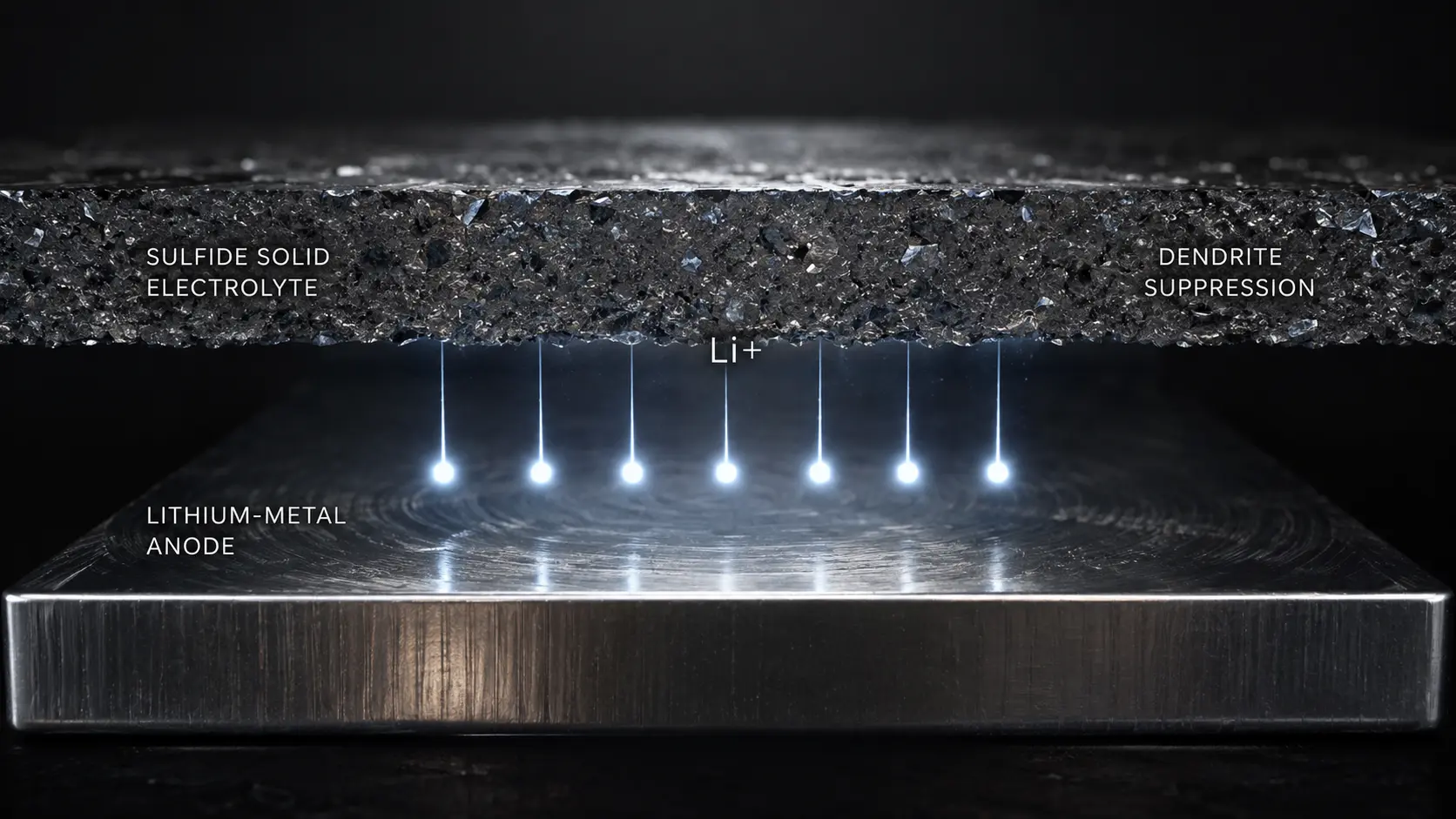
Solid-state architectures solve this mechanical vulnerability by replacing the liquid with a rigid, inorganic sulfide crystal, such as Li10GeP2S12. This sulfide structure possesses an extreme ionic conductivity 10 mS/cm, matching or exceeding traditional liquids.
However, its physical shear modulus is mathematically engineered to be stronger than lithium metal. When a dendrite attempts to grow, the dense crystalline lattice of the sulfide electrolyte acts as an impenetrable physical wall, forcing the lithium to deposit horizontally as a flat, uniform sheet rather than a vertical needle.
WHY IT MATTERS NOW
The physical limits of liquid lithium-ion chemistry dictate the current economic ceiling of global electrification. Standard cells cap out near 300 watt-hours per kilogram (300 Wh/kg and 500 Wh/kg), a density that makes electric aviation mathematically impossible and restricts consumer vehicles to heavy, inefficient chassis designs.
By successfully suppressing dendrites, sulfide solid-state electrolytes allow the safe integration of pure lithium-metal anodes. This material swap instantly pushes the energy density past 300 Wh/kg and 500 Wh/kg.
This energy profile dictates a structural shift in global manufacturing. Automakers like Toyota and battery conglomerates like QuantumScape are heavily financing sulfide supply chains because these cells can charge from zero to eighty percent in under ten minutes without degrading the battery chemistry.
Solid-state adoption creates a massive secondary consequence for thermal management infrastructure. Because sulfide cells lack flammable liquid solvents, automakers can completely strip heavy liquid-cooling loops out of the vehicle architecture, compounding the range extensions through massive weight reduction.
This technology determines who controls the next century of aerospace engineering. Electric vertical takeoff and landing (eVTOL) aircraft require the absolute maximum thrust-to-weight ratio, making the high-voltage discharge rates of dendrite-free solid-state cells the singular enabling hardware for commercial electric flight.
WHAT MOST PEOPLE MISS
Consumer tech media widely assumes that solid-state cells are structurally identical to standard batteries, substituting only a different internal powder. They entirely miss the severe, active mechanical force required to keep a solid-state battery functional.
Unlike a liquid that naturally conforms to any microscopic surface imperfection, a solid sulfide electrolyte requires absolute, continuous physical contact with the lithium anode. To prevent microscopic voids from forming as the lithium expands and contracts during charging, the battery pack must employ heavy, external clamping mechanisms that maintain constant stack pressures exceeding 2 megapascals (2 MPa).
This mechanical engineering requirement completely alters how a battery pack is built. The extreme external pressure apparatus frequently negates the internal weight savings of the cell itself, presenting a brutal packaging paradox that currently stalls mass commercial deployment.
THE TRAJECTORY
Next 12–36 Months: Premium automotive brands will launch limited-production flagship vehicles featuring hybrid solid-state cells. These early iterations will utilize high-silicon anodes and semi-solid gels to bypass the severe stack pressure requirements of pure lithium metal.
Next Five Years: The mass commercialization of argyrodite sulfide electrolytes. Chemical giants will scale the manufacturing of these sulfur-based powders, crashing unit costs and allowing the first true lithium-metal solid-state cells to achieve cost parity with high-nickel liquid cells.
Next Ten Years: The physical redesign of the electric vehicle chassis. Automakers will abandon the modular battery pack entirely, integrating highly compressed, fireproof solid-state cells directly into the structural load-bearing frame of the vehicle.
What Could Go Wrong: Toxic gas generation during manufacturing or collision. Sulfide solid-state materials react violently with ambient moisture in the air to produce hydrogen sulfide H2S, a highly toxic and corrosive gas. If a major vehicle collision ruptures the sealed cell architecture, the resulting gas leak poses a severe localized hazard to passengers and first responders.
Most Likely Outcome: Sulfide solid-state electrolytes will dominate the high-performance aerospace and heavy transport sectors. The extreme energy density justifies the complex mechanical engineering required to manage stack pressure and moisture sensitivity.
KEY TERMS
- Solid-State Electrolyte: A rigid, ion-conducting material that replaces the flammable liquid solvents used in traditional lithium-ion batteries.
- Lithium Dendrite: A microscopic, branching needle of lithium metal that grows rapidly during fast charging and physically short-circuits internal battery layers.
- Shear Modulus: A mathematical measure of a material’s rigidity and its physical ability to resist structural deformation under stress.
- Stack Pressure: The active mechanical force applied externally to a solid-state battery cell to maintain perfect atomic contact between its internal solid layers.
- Argyrodite: A specific class of sulfur-based crystal structures highly prized by battery engineers for their exceptional ability to conduct lithium ions at room temperature.
SOURCES
- Nature Energy — Design Principles for Solid-State Lithium Superionic Conductors
- Joule — Mechanical and Interfacial Degradation in Sulfide-Based Solid-State Batteries
- Argonne National Laboratory — Dendrite Suppression Kinetics in Lithium-Metal Architectures
- Department of Energy (DOE) — Solid-State Battery Roadmaps and High-Voltage Material Constraints