Advertisement
)

AT A GLANCE
- Concept: Geostationary Orbit: A high-altitude orbital path where a satellite perfectly matches Earth’s rotation, hovering over one fixed location.
- Concept: Microwave Transmission: Converting solar electricity into invisible radio waves to beam it through the Earth’s atmosphere without losing energy to clouds.
- Concept: Rectenna: A specialized ground-based “rectifying antenna” that catches the microwave beam and converts it back into usable grid electricity.
- Concept: Baseload Power: The minimum amount of electrical power needed to keep a city running, requiring energy sources that never turn off.
IN SIMPLE WORDS
Solar panels on Earth have a fatal flaw: they stop working when the sun sets or when it rains. To keep the power grid running at night, utility companies must rely on giant batteries or burn fossil fuels.
Space-based solar power moves the solar farm off the planet. In deep space, there is no nighttime, no winter, and no cloud cover. The sun shines with blistering intensity 24 hours a day, 365 days a year.
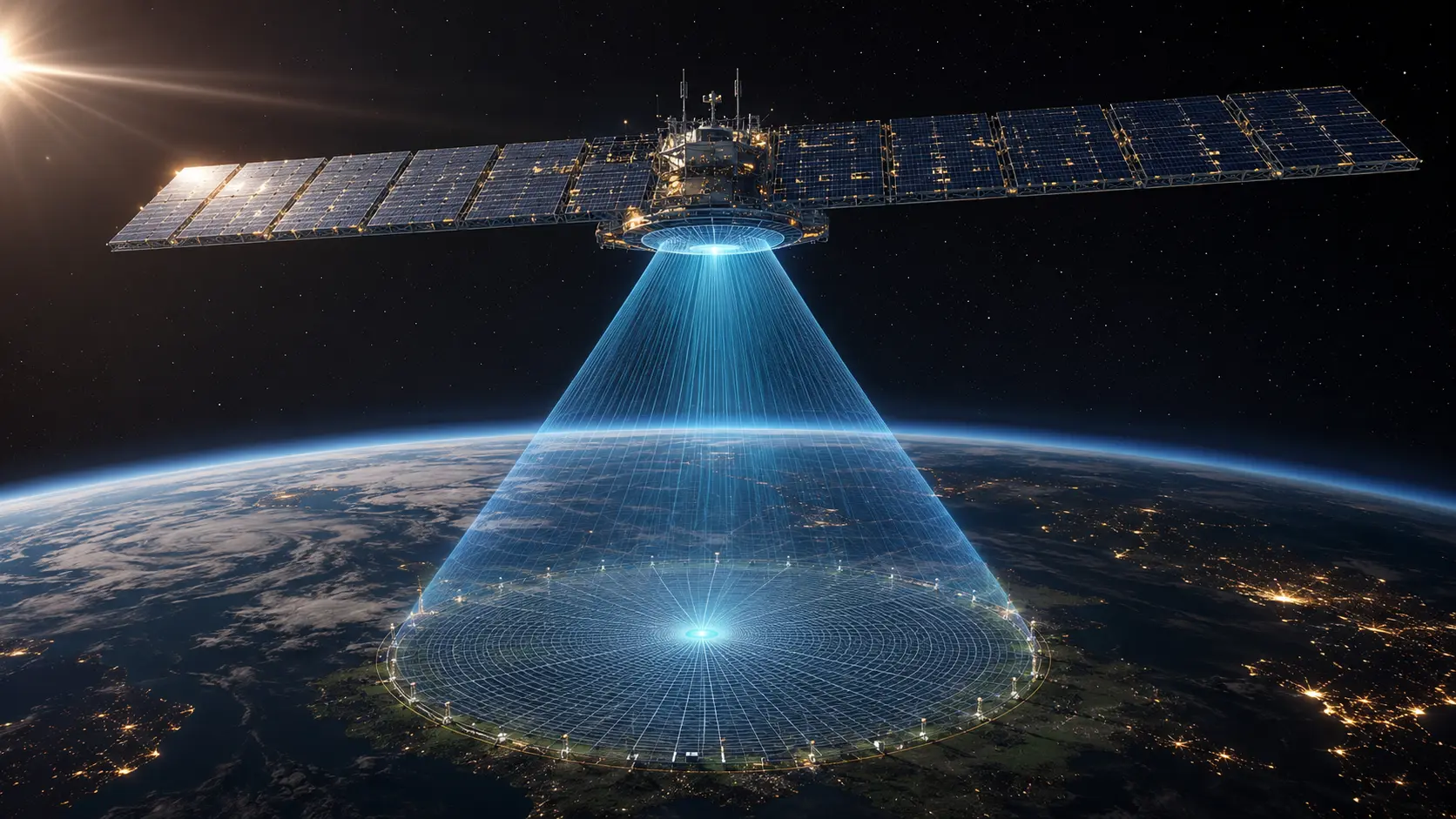
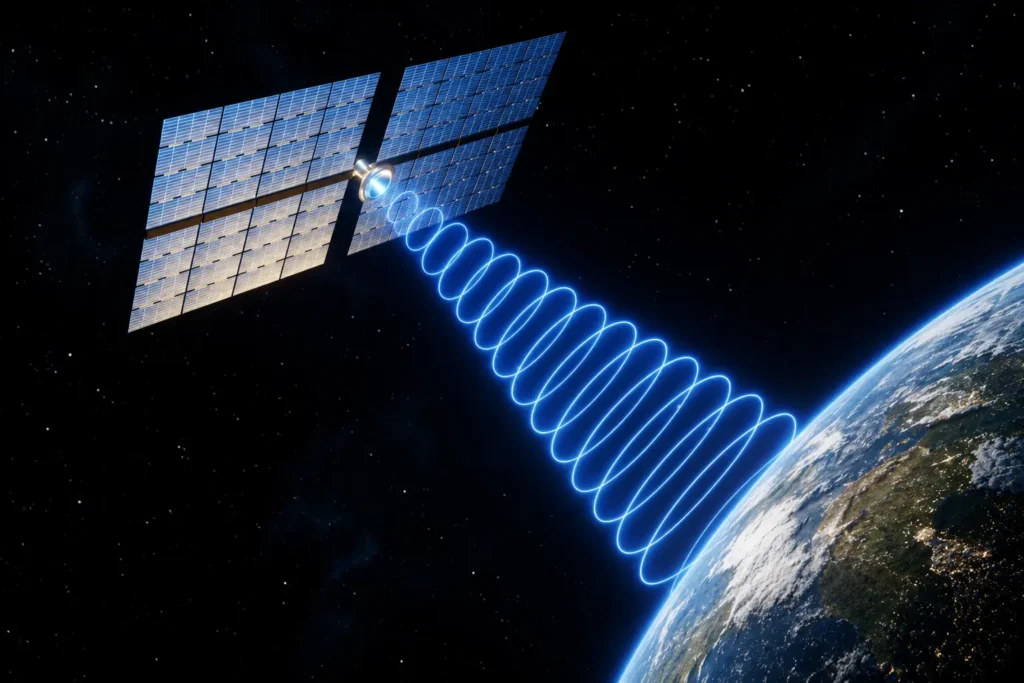
Engineers plan to launch massive arrays of solar panels into orbit. These orbital power plants will absorb the constant sunlight, convert it into an invisible microwave beam, and shine that beam down to a massive receiving net on Earth. This provides the holy grail of renewable energy: a clean power source that never stops generating electricity, regardless of the weather on the ground.
HOW SPACE-BASED SOLAR POWER WORKS
The architecture of Space-Based Solar Power (SBSP) requires extreme engineering across three distinct operational zones: orbital collection, wireless transmission, and ground reception.
The process begins in Geostationary Earth Orbit (GEO), roughly 36,000 kilometers above the equator. At this altitude, a massive solar satellite can remain perfectly locked over a single city. Because the satellite sits outside the Earth’s atmosphere, its photovoltaic panels receive unfiltered solar radiation, generating up to forty times more annual energy than a similarly sized solar farm on the ground.
Once the solar arrays generate Direct Current (DC) electricity, the system must transmit it across the vacuum of space. Running a physical wire is impossible. Instead, the satellite uses solid-state power amplifiers to convert the DC electricity into Radio Frequency (RF) microwaves, typically operating at 2.45 GHz or 5.8 GHz. These specific frequencies are chosen because they pass straight through Earth’s atmosphere, clouds, and heavy rain with virtually zero energy loss.
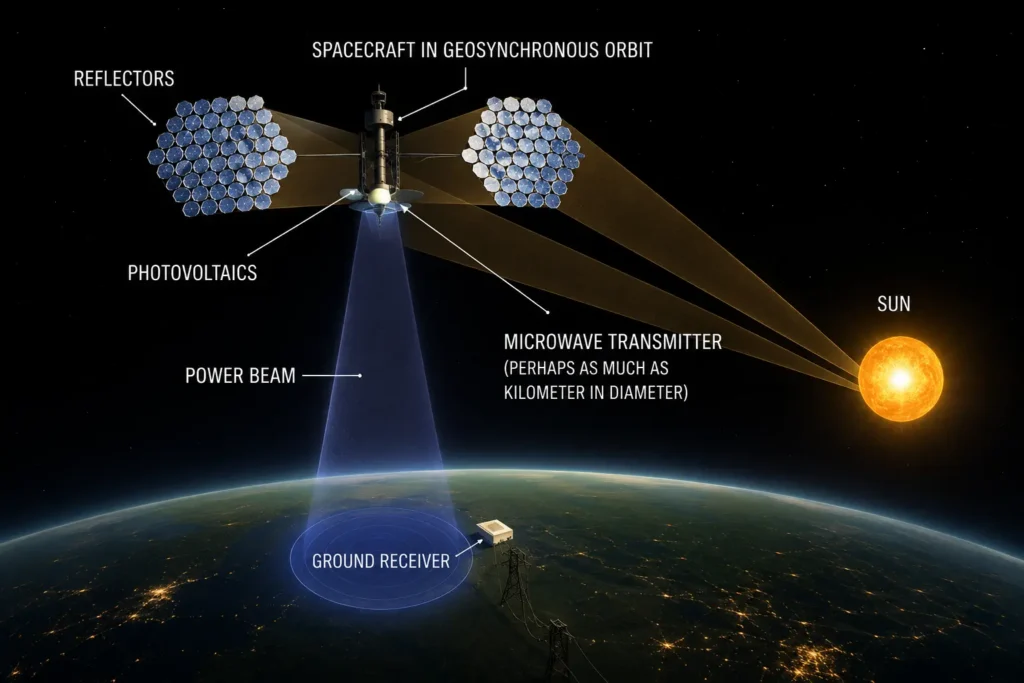
The satellite beams this microwave energy down to Earth using a phased array antenna. By electronically shifting the timing of the microwave signals, the satellite can perfectly steer and focus the beam without any moving mechanical parts.
On the ground, the microwave beam hits a rectenna (rectifying antenna). This is not a solid dish, but a massive, transparent net of specialized wire mesh stretching across several miles of open land. The rectenna catches the microwaves and instantly converts the electromagnetic waves back into DC electricity, which is then inverted to Alternating Current (AC) and fed directly into the local power grid.
REAL WORLD EXAMPLE
In 2023, the California Institute of Technology (Caltech) successfully executed the Space Solar Power Demonstrator (SSPD-1) mission. Operating in orbit, their MAPLE instrument achieved a historic engineering milestone: it successfully captured solar energy in space and wirelessly beamed a detectable amount of that power back to a receiver on the roof of a laboratory in Pasadena, California. This proved that the core physics of microwave power transmission through the Earth’s atmosphere are completely viable outside of theoretical computer models.
WHY IT MATTERS NOW
For fifty years, space-based solar power was dismissed as science fiction due to the astronomical cost of rocket launches. If it costs $10,000 to put a single kilogram of solar panels into space, the electricity generated will never pay for the launch.
The introduction of fully reusable heavy-lift rockets, specifically SpaceX’s Starship, is mathematically changing the equation. As launch costs plummet toward $100 per kilogram, launching the thousands of tons of hardware required to build a gigawatt-scale orbital power plant is suddenly becoming economically feasible for private infrastructure funds.
Simultaneously, the global electrical grid is under unprecedented strain. The explosion of artificial intelligence data centers and the transition to electric vehicles are causing power demand to skyrocket. Traditional renewables like wind and terrestrial solar are highly intermittent; they require massive, expensive lithium-ion battery parks to store power for the night.
Space-based solar power fundamentally solves the intermittency problem. It acts exactly like a nuclear power plant, providing continuous, uninterrupted baseload power, but with zero radioactive waste and zero meltdown risk. The nation that successfully commercializes this technology first will possess a virtually unlimited, exportable energy monopoly.
COMMON MISCONCEPTIONS
- “The microwave beam is a deadly space laser.” The transmission beam is heavily diffused. By the time the microwaves reach the ground, their energy density is roughly one-quarter the intensity of normal noon sunlight. It is completely safe for birds and airplanes to fly straight through the beam.
- “A single launch can put a power plant in space.” A commercial SBSP satellite will be miles wide. It cannot be launched in one piece. It will require hundreds of rocket launches to carry modular pieces into orbit, where autonomous robots will assemble the structure in the vacuum of space.
- “The rectennas will take up too much valuable land.” Because the rectenna is a transparent wire mesh, it does not block sunlight or rain. It can be built suspended over active agricultural farmland or positioned far offshore over the ocean.
WHAT MOST PEOPLE MISS
Energy analysts focus heavily on launch costs, but they overlook the geopolitical race for orbital real estate.
There are only a limited number of “slots” available in Geostationary Earth Orbit that perfectly align with major energy markets like the United States, Europe, or China. Because these massive solar arrays require significant physical space and cannot interfere with existing communication satellites, securing the international regulatory rights to the best orbital positions will soon trigger fierce diplomatic clashes at the United Nations.
THE ECONOMIC AND STRATEGIC IMPACT
The primary financial beneficiaries are heavy aerospace manufacturers, specialized orbital robotics startups, and deep-space logistics providers. Building a gigawatt-class solar station requires establishing an entire in-space supply chain, turning orbital assembly into a multi-trillion dollar industrial sector.
Strategically, SBSP completely alters energy security. Today, if a hostile nation cuts an underwater gas pipeline, a continent freezes. With space-based solar power, the energy source is thousands of miles above the planet, entirely immune to terrestrial sabotage, naval blockades, or geopolitical embargoes.
Furthermore, the power beam is electronically steerable. If a hurricane destroys the power grid in Florida, a space-based solar plant could instantly redirect its microwave beam away from New York and aim it at a backup rectenna in Miami, restoring power to the disaster zone at the speed of light.
THE TRAJECTORY
Next 12–36 Months: The launch of advanced low-earth orbit (LEO) prototypes. Organizations like the European Space Agency (SOLARIS program) and the UK Space Energy Initiative will deploy larger pathfinder satellites to test robotic assembly mechanisms and high-efficiency microwave transmitters in real space environments.
Next Five Years: The deployment of the first megawatt-scale orbital demonstrator. A state-backed consortium will successfully assemble a functional, small-scale power plant in orbit capable of providing continuous power to a remote military base or isolated island community, proving commercial viability.
Next Ten Years: The construction of the first gigawatt-class commercial array. Facilitated by daily, low-cost heavy rocket launches, autonomous drones will assemble a structure in geostationary orbit massive enough to power a medium-sized city 24 hours a day, marking the beginning of the orbital energy era.
What Could Go Wrong: A cascading space debris event, known as the Kessler Syndrome. Because these solar arrays are several miles wide, they have a massive physical footprint. A high-speed collision with a piece of rogue space junk could shatter the fragile solar panels, creating thousands of new pieces of debris that could tear the multi-billion dollar structure apart.
Most Likely Outcome: Space-based solar power will transition from a theoretical concept to the ultimate clean energy mega-project. While capital costs will initially relegate it to wealthy sovereign states and major aerospace consortiums, its ability to deliver infinite, clean baseload power will eventually make it the cornerstone of the post-carbon planetary grid.
KEY TERMS
- Space-Based Solar Power (SBSP): The concept of collecting solar power in outer space and wirelessly transmitting it to Earth.
- Geostationary Earth Orbit (GEO): A high orbit where a satellite moves at the exact same speed that the Earth rotates, allowing it to hover permanently over one location.
- Rectenna: A specialized “rectifying antenna” on the ground designed to absorb microwave energy and convert it into direct current electricity.
- Baseload Power: The minimum, constant level of electricity required to keep a power grid running smoothly, day and night.
- Phased Array Antenna: A transmission system that uses hundreds of small, synchronized antennas to steer and focus a radio beam without moving parts.
- Photovoltaic Cell: The technical term for a solar panel component that directly converts sunlight into electrical current.
BEGINNER FAQ
What is space-based solar power? It is a massive solar panel farm built in outer space. It gathers sunlight, turns it into a microwave beam, and shoots the energy down to Earth to generate electricity.
Why build it in space instead of on Earth? In space, there are no clouds, no storms, and no night. The sun shines constantly, meaning a space solar farm can generate massive amounts of power 24/7 without needing batteries.
Is it safe to beam microwaves down to Earth? Yes. The beam is spread out over a very large area. If you walked through it, it would feel roughly as warm as standing in the sun. It will not harm humans, birds, or airplanes.
How do we get something that big into space? We don’t launch it all at once. Rockets will carry the parts up in thousands of smaller trips, and robotic drones will snap the pieces together like LEGOs while in orbit.
What happens if a cloud gets in the way of the beam? Nothing. The specific frequency of microwaves used for the beam passes straight through clouds, rain, and snow without losing any power.
Who is working on this? Major space agencies like the ESA in Europe, JAXA in Japan, and private researchers at universities like Caltech are actively building and testing the technology right now.
Will this make electricity free? No. While the sunlight is free, launching rockets and building massive space stations costs billions of dollars. However, it could eventually provide very cheap, perfectly clean energy once the infrastructure is built.
Why hasn’t this been done before? For decades, rockets were too expensive. With the invention of reusable rockets by companies like SpaceX, it is finally becoming cheap enough to launch the heavy building materials into space.
SOURCES
- European Space Agency (ESA) — SOLARIS Initiative and Space-Based Solar Power Feasibility
- California Institute of Technology (Caltech) — Space Solar Power Project (SSPP) and MAPLE Demonstrator
- United Kingdom Department for Energy Security and Net Zero — Space Energy Initiative
- National Aeronautics and Space Administration (NASA) — Office of Technology, Policy, and Strategy: Space-Based Solar Power Report