Advertisement
)
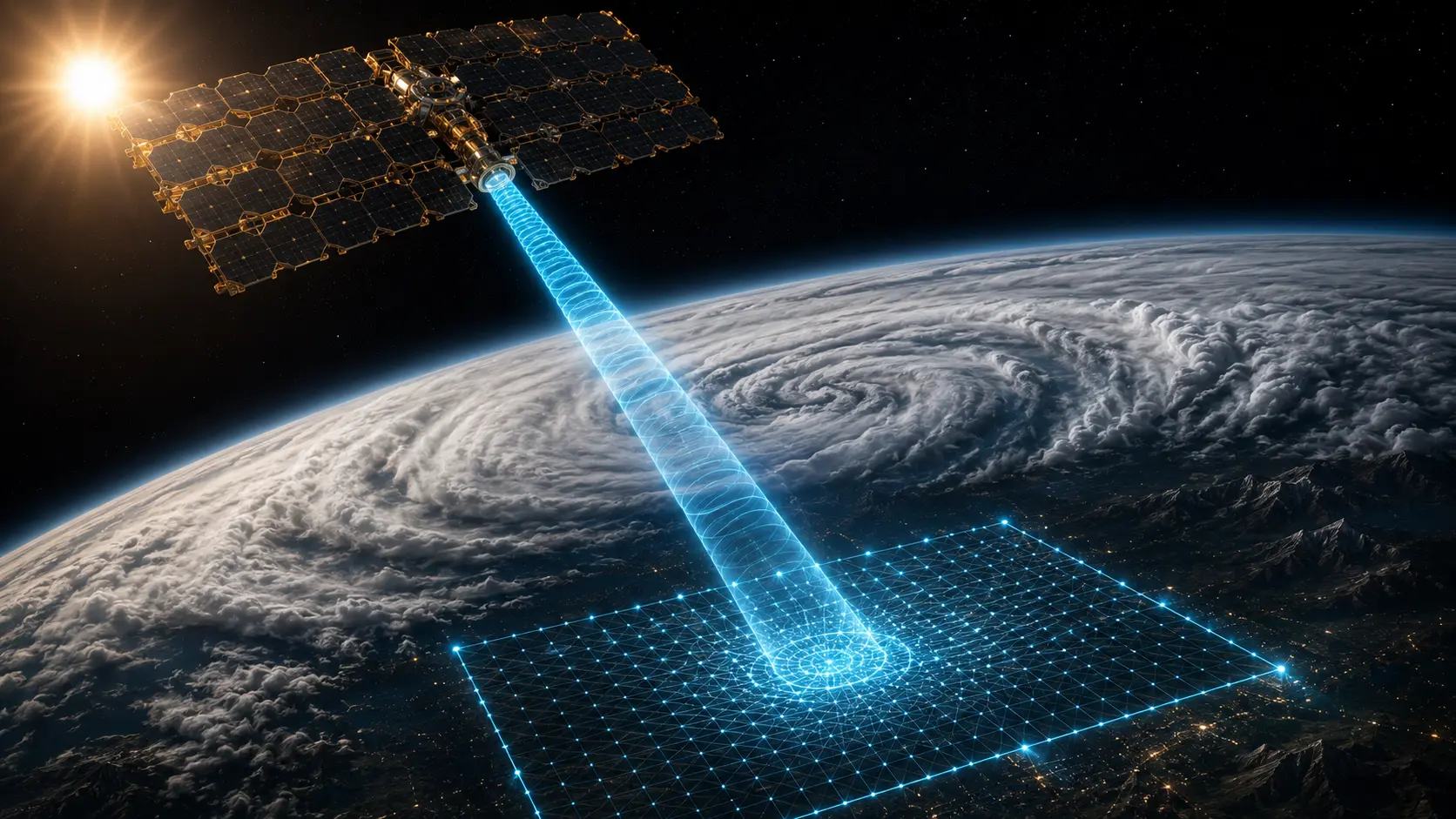

The global transition to renewable energy is mathematically bottlenecked by the rotation of the Earth. Terrestrial solar power is highly intermittent; it vanishes every night, drops drastically during winter, and is suffocated by heavy cloud cover. Furthermore, the Earth’s atmosphere reflects, absorbs, or scatters nearly 30% of incoming solar radiation before it ever hits a physical solar panel. To power heavy industry and hyperscale artificial intelligence data centers, the global grid requires 24/7 baseload power. Currently, bridging the “solar gap” requires multi-billion-dollar investments in chemical batteries, which degrade over time and rely on fragile, highly concentrated supply chains.
Why should you care right now? Because aerospace engineers are physically bypassing the Earth’s atmosphere to harvest uninterrupted sunlight. By deploying massive solar arrays in space, scientists can capture intense, unfiltered solar energy 24 hours a day, 365 days a year. This power is converted into invisible microwaves and beamed directly down to receiving antennas on the ground. Following the successful conclusion of Caltech’s Space Solar Power Demonstrator (SSPD-1) mission—which proved wireless power beaming in orbit is physically viable—and the aggressive advancement of the European Space Agency’s Solaris program, Space-Based Solar Power (SBSP) is transitioning from science fiction into a highly capitalized strategic imperative.
What is Space-Based Solar Power (SBSP)?
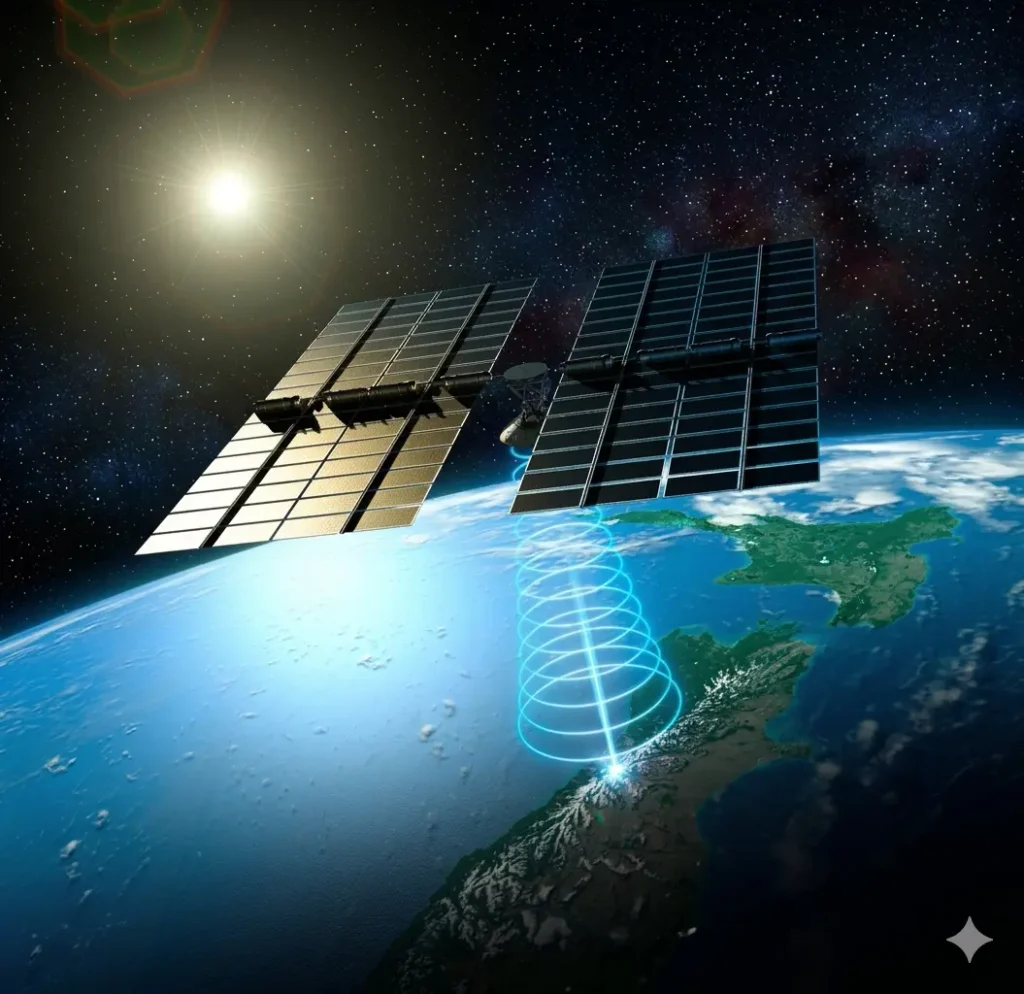
Space-Based Solar Power (SBSP) is an energy infrastructure concept where massive satellite constellations collect uninterrupted sunlight in outer space. The satellites convert this solar energy into high-frequency microwaves or lasers, wirelessly beaming the power down to a terrestrial rectifying antenna (rectenna), which converts it back into electricity for the terrestrial grid.
At a Glance
- Concept: Building a giant solar farm in outer space where the sun never sets, and sending the electricity down to Earth using invisible radio waves instead of wires.
- Why it matters: It completely solves the “intermittency” problem of renewable energy. It provides continuous, zero-carbon baseload power exactly like a nuclear plant, but without radioactive waste or fuel requirements.
- Who uses it: Research consortiums (Caltech SSPP), international space agencies (ESA, JAXA, NASA), and defense contractors exploring remote power logistics.
- Biggest takeaway: The microwaves used to beam the energy are harmless. They operate at the same frequency as your home Wi-Fi and are spread over a massive area, meaning flying through the beam is less dangerous than standing in the sun.
In Simple Words
If you want to power a city using solar panels, you have a massive problem: nighttime. When the sun goes down, your power plant stops working. You have to build giant, expensive batteries just to survive until morning.
Space-Based Solar Power (SBSP) solves this by putting the solar panels in Geostationary Orbit, 22,000 miles above the Earth. Up there, the satellite is high enough that the Earth’s shadow almost never touches it. It sits in permanent, blinding, unfiltered sunlight.
Because you cannot run a 22,000-mile-long copper wire down to the ground, the satellite uses a trick. It turns the electricity into a highly focused microwave beam (exactly like how a cell tower beams internet to your phone, just on a larger scale). On the ground, a massive net of wire antennas (a “rectenna”) catches the invisible microwaves, instantly turns them back into electricity, and feeds the city. It is an extension cord made of pure light.
Why This Matters
For Aerospace Engineers, Space Tech Investors, and Utility Executives, SBSP solves the Renewable Baseload Paradox.
Grid operators require “baseload”—power that never stops and does not fluctuate. Historically, only coal, natural gas, and nuclear power could provide baseload. Solar and wind are “variable” sources, forcing utilities to maintain expensive fossil fuel plants on standby just in case the wind stops blowing.
SBSP represents the holy grail of grid architecture: a 100% renewable energy source that acts exactly like a nuclear baseload plant. A single commercial SBSP satellite is projected to deliver 1 to 2 Gigawatts of continuous power. Because the power beam can be electronically steered in milliseconds, an SBSP satellite can beam power to Paris during their evening peak demand, and then instantly pivot the beam to London to cover their peak, offering unprecedented, frictionless energy routing across international borders.
The Economics of Launching Orbital Solar Arrays
The physics of wireless power transmission were patented by Nikola Tesla over a century ago, and the specific concept of SBSP was first detailed by Dr. Peter Glaser in 1968. For fifty years, the math worked perfectly, but the economics were impossible. Launching thousands of tons of heavy solar panels and copper wiring on expendable rockets would have cost trillions of dollars.
Today, the commercialization of heavy-lift, fully reusable rockets (like SpaceX’s Starship) has violently crashed the cost of launching mass into orbit. Simultaneously, advances in flexible, ultra-lightweight photovoltaics and solid-state phased array electronics have slashed the weight of the satellites themselves. The convergence of ultra-cheap launch economics and ultra-lightweight materials has forcefully reopened the window for orbital energy harvesting.
How SBSP Works: Microwave Power Beaming and Rectennas
Transmitting gigawatts of power through the Earth’s atmosphere without boiling the air or losing the energy requires an absolute mastery of electromagnetics and phased array optics. Here is the first-principles breakdown of the architecture.
1. The Fundamental Problem: Atmospheric Attenuation
If you try to beam power using visible lasers, a single cloud or heavy rainstorm will scatter the light, cutting off the city’s power. The transmission medium must be completely immune to weather.
2. The Core Mechanism: Microwave Frequencies
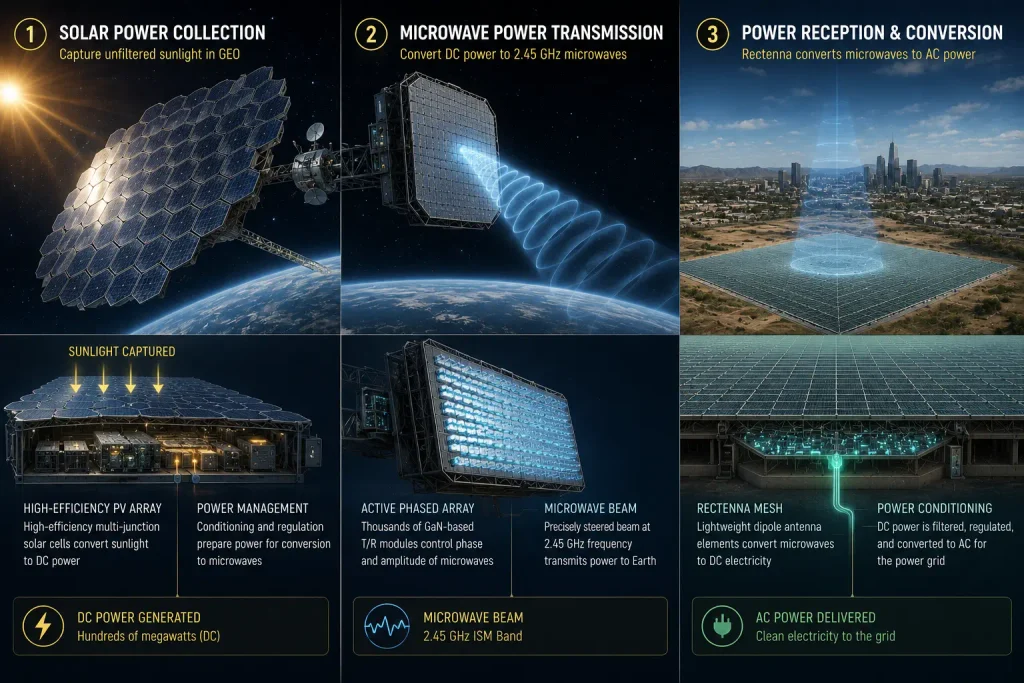
SBSP utilizes microwaves, specifically targeting the 2.45 GHz or 5.8 GHz Industrial, Scientific, and Medical (ISM) radio bands. At these specific wavelengths, the electromagnetic waves slide perfectly between the water molecules in the Earth’s atmosphere. The beam punches directly through Category-5 hurricanes and thick cloud cover with less than a 5% loss of energy.
3. Technical Depth: Active Phased Arrays
The satellite does not use a giant, moving parabolic dish to aim the beam; mechanical dishes break. Instead, the satellite uses an Active Phased Array. The underside of the satellite is covered in millions of tiny, solid-state microwave transmitters. By mathematically delaying the exact microsecond that each tiny antenna fires, the individual waves collide and combine (constructive interference), forming a highly focused, perfectly tight beam that can be steered purely by software, without any moving parts on the satellite.
4. Technical Depth: The Rectenna
On the ground, you do not use solar panels to catch the microwaves. You use a Rectifying Antenna (Rectenna). This is a massive, highly transparent mesh of simple dipole antennas combined with high-speed diodes. When the invisible microwave hits the mesh, it induces an alternating current (AC) in the wire. The diodes instantly “rectify” (convert) this into direct current (DC) electricity. Because the mesh is 80% transparent, rectennas can be built suspended over active farmland, allowing crops to grow underneath while the mesh catches power from space.
5. Real-World Consequences: The Retrodirective Pilot Beam
How do you ensure a laser beam from 22,000 miles away doesn’t accidentally wander off target and hit a neighborhood? You use a Retrodirective Pilot Beam. The ground station shines a specialized, low-power tracking beam up to the satellite. The satellite is physically incapable of transmitting power unless it detects this exact pilot signal. If the ground station loses power, or if the satellite drifts slightly out of alignment, the pilot signal breaks, and the space transmitter instantly, automatically shuts off.
Terrestrial vs. Space-Based Solar Power (SBSP)
Diurnal Intermittency vs. Continuous 24/7 Orbital Microwave Beaming
12:00 (Noon)
00:00 (Midnight)
12:00 (Noon)
24:00
Terrestrial Solar Output
1.00 GW (100%)
SBSP Rectenna Output
2.00 GW (Continuous)
Commercial Prototypes: Caltech SSPD-1 and ESA Solaris
SBSP has officially migrated from academic whitepapers into active orbital hardware testing and strategic military planning.
Caltech’s SSPD-1 and MAPLE Experiment: In 2023, the Caltech Space Solar Power Project launched the Space Solar Power Demonstrator (SSPD-1). It carried the MAPLE module (Microwave Array for Power-transfer Low-orbit Experiment). In a historic milestone, MAPLE successfully demonstrated the wireless transmission of energy in the vacuum of space, using custom, flexible, ultra-lightweight phased-array transmitters to steer power between different receivers without moving parts. The mission concluded successfully in 2024, validating the core electronics required for commercial scale.
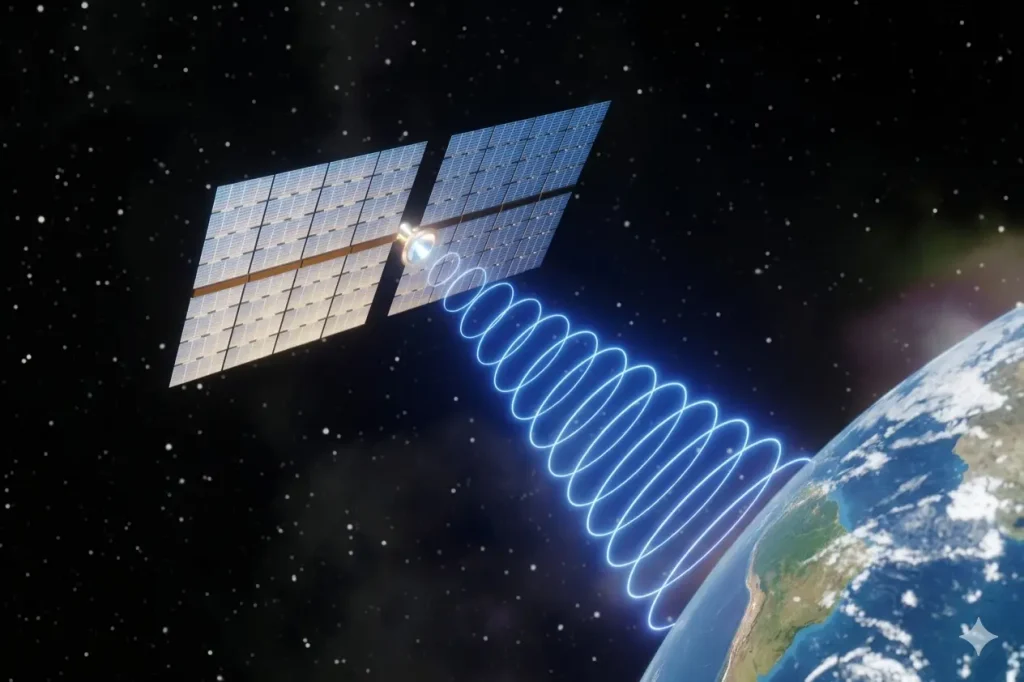
ESA Solaris Program: Recognizing the strategic vulnerability of European energy imports, the European Space Agency (ESA) initiated the SOLARIS program. SOLARIS is an aggressive preparatory program assessing the cost, technical feasibility, and regulatory framework for deploying a sovereign European SBSP constellation. By identifying SBSP as a potential key enabler for Europe’s 2050 Net-Zero targets, ESA has formalized the continent’s intention to secure orbital energy infrastructure.
Military Forward Operating Bases (FOBs): The U.S. Department of Defense is heavily invested in beamed power. Currently, supplying diesel fuel to remote military bases is deadly; fuel convoys are frequent targets for ambushes. SBSP provides “energy logistics without supply lines.” A military unit can unroll a lightweight, foldable rectenna net in a remote desert and instantly receive gigawatts of power beamed securely from a defense satellite, completely eliminating the need to transport explosive fossil fuels into war zones.
Economic & Strategic Impact
The core strategic consequence of SBSP is the Eradication of Geographic Energy Lotteries.
For the entirety of human history, national wealth has been dictated by geological luck. If your borders contained massive coal seams, oil reserves, or highly active geothermal vents, you held industrial leverage. If you lacked these, you were dependent on foreign imports.
SBSP completely untethers energy generation from terrestrial geography. A landlocked, resource-poor nation with zero domestic fossil fuels and terrible solar irradiance (like parts of Northern Europe or mountainous regions in Asia) can achieve absolute energy independence by simply erecting a rectenna field and leasing orbital bandwidth. SBSP transforms energy from a geographic commodity into a purely technological service, fundamentally rewriting the geopolitical balance of power.
Advantages
- 100% Capacity Factor: Generates power continuously, bypassing the extreme diurnal and seasonal drop-offs that financially cripple terrestrial solar and wind farms.
- No Grid Storage Required: Because the power is constant (baseload), the receiving nation does not need to invest trillions of dollars in massive, degrading lithium-ion battery parks to survive the night.
- Dynamic Energy Routing: The phased array beam can be instantly redirected. An orbital solar farm can sell power to Japan in the morning, and seamlessly redirect the beam to Australia in the afternoon, maximizing asset monetization.
- Zero Land-Use Conflict: Terrestrial solar farms require clearing thousands of acres of land. Rectennas are virtually transparent wire meshes that can be mounted above existing agricultural farmland or offshore platforms, causing zero terrestrial disruption.
Limitations
- Hyperscale Orbital Assembly: A 2-Gigawatt SBSP satellite cannot be launched in one piece. It must be launched in thousands of modular pieces and autonomously assembled in space by robotics. The failure rate of constructing kilometer-wide structures in zero gravity remains unknown.
- Thermal Management in a Vacuum: Satellites get incredibly hot. On Earth, air convection cools solar panels. In the vacuum of space, heat can only be shed via massive, heavy radiator fins through thermal radiation. Managing the immense waste heat generated during the DC-to-RF conversion is a massive engineering bottleneck.
- End-to-End Efficiency Losses: Collecting solar power, converting it to microwaves, beaming it through the atmosphere, catching it with a rectenna, and converting it back to AC electricity incurs compound thermodynamic losses. The “end-to-end” efficiency is historically low, requiring massive orbital arrays to make the final terrestrial output economically viable.
Common Misconceptions
Misconception: SBSP is a “Death Ray” that will incinerate birds and airplanes.
Reality: The microwave beam operates at incredibly low power densities (typically less than a quarter of the intensity of the midday sun). It is non-ionizing radiation. If an airplane flies through the beam, the passengers will notice absolutely nothing. If a bird flies through it, it might feel slightly warmer, but it will not be harmed.
Misconception: The microwave beam will fry local electronics.
Reality: The 2.45 GHz frequency is specifically chosen because it sits in the ISM band (the same frequency used by Wi-Fi routers and Bluetooth). The intensity is so dispersed over the multi-kilometer rectenna grid that it does not possess the concentrated energy required to cause an Electromagnetic Pulse (EMP) or fry consumer electronics.
Misconception: A hacker could hijack the beam and use it as a weapon.
Reality: Due to the physics of phased array optics, a 1-kilometer satellite dish simply cannot focus its beam tightly enough to be weaponized. Furthermore, the retrodirective pilot beam ensures that the satellite will instantly shut off its power transmission if the ground station signal is altered or interrupted in any way.
What Most People Miss
The disruptive capability of The LEO to GEO Migration.
When the public imagines SBSP, they picture the satellite immediately parked in Geostationary Orbit (GEO). What they miss is the logistics of the launch.
Lifting thousands of tons directly to GEO requires massive rocket fuel. Future SBSP architectures will likely launch the satellite components into Low Earth Orbit (LEO). Once the massive solar wings are autonomously assembled in LEO, the satellite will use its own generated solar electricity to power highly efficient ion thrusters. The satellite will slowly, autonomously spiral itself out from LEO up to GEO over several months. By using its own power to transport itself to its final destination, aerospace companies drastically cut the required rocket fuel, fundamentally changing the unit economics of the deployment.
Comparison Table
| Feature | Terrestrial Solar | Nuclear Fission | Space-Based Solar Power (SBSP) |
| Availability | Intermittent (15-25%) | Continuous (Baseload) | Continuous (Baseload) |
| Weather Dependency | Extreme (Clouds/Storms) | None | Minimal (Microwaves penetrate clouds) |
| Battery Storage Needs | Massive (To survive the night) | None | None |
| Land Footprint | Extremely High (Exclusionary) | Low | Low (Rectennas allow dual-use land) |
| Waste/End of Life | Panel recycling challenges | Radioactive Waste Storage | Orbital debris management |
Case Study
Situation: The concept of wireless power transmission in space had been theoretically sound for decades, but the underlying electronics required to make it feasible—specifically, ultra-lightweight, flexible microwave phased arrays—did not exist. Previous designs relied on heavy, rigid metal structures that would financially bankrupt any attempt to launch them on modern rockets.
Challenge: Engineer an end-to-end wireless power transfer system that was thin, flexible, and light enough to be folded into a tight rocket fairing, but robust enough to unfold in space, survive radical temperature swings, and electronically steer a microwave beam with absolute precision.
Solution (The Caltech SSPD-1 Mission): Backed by philanthropic funding, the Caltech Space Solar Power Project developed the Space Solar Power Demonstrator (SSPD-1).They abandoned rigid silicon panels and heavy wires, instead designing custom, ultra-lightweight flexible integrated circuits from scratch.The mission launched in early 2023 on a SpaceX rocket and deployed the MAPLE experiment in orbit.
Outcome: MAPLE successfully generated RF energy, steered the microwave beam to different onboard receivers, and proved that their flexible phased-array design could survive the violent launch and the thermal extremes of Low Earth Orbit.By intentionally stressing the array to measure degradation, Caltech scientists established the first empirical dataset for lightweight, space-based power beaming.
Lessons Learned: The SSPD-1 mission definitively proved that the physical mass bottleneck of SBSP is solvable. By shifting from heavy mechanical infrastructure to highly integrated, flexible microelectronics, Caltech validated that the core components of an orbital power station can be manufactured cheaply on Earth, folded like origami, and deployed autonomously in a vacuum.
Future Outlook
Next 12–24 Months
The era of Terrestrial Demonstrations and Regulatory Frameworks. Following the success of orbital prototypes, the immediate focus will shift to the ground. We will see massive, kilometer-scale terrestrial demonstrations where aerospace companies beam megawatts of power between mountain peaks to prove the biological safety and conversion efficiency of advanced rectennas. Simultaneously, international bodies like the ITU (International Telecommunication Union) will engage in fierce lobbying to dedicate and protect the 2.45 GHz and 5.8 GHz spectrums explicitly for orbital power beaming, preventing interference with growing terrestrial 5G/6G networks.
Next 3–5 Years
The scaling of In-Space Robotic Assembly. The primary barrier to commercial SBSP is constructing a multi-kilometer structure in orbit. Over the next five years, venture capital will flood into autonomous space robotics (companies developing “spider-bots” that crawl along carbon-fiber trusses, welding and snapping solar modules together). We will witness the first fully automated construction of a large-scale structure in LEO, proving that human astronauts are not required to assemble the megastructures of the future energy grid.
Next 10 Years
The Commercial Pilot Constellation. By the mid-2030s, fueled by the staggering drop in launch costs via next-generation super-heavy lift vehicles, the first commercial SBSP pilot plant will go online in Geostationary Orbit. It will likely target a remote, high-value client—such as an off-grid mining operation in the Australian outback or a military forward operating base. This pilot will validate the Levelized Cost of Energy (LCOE) for orbital power, sparking a geopolitical race between the US, Europe, and China to claim the most lucrative geostationary slots for the impending orbital energy boom.
Most Likely Scenario
Space-Based Solar Power is the inevitable endgame of the renewable transition. The Earth’s atmosphere is too chaotic and its rotation too restrictive to rely entirely on terrestrial solar. As heavy industry and AI data centers demand relentless, zero-carbon baseload power, the economics of launching solar panels into constant, unfiltered sunlight will overtake the cost of building massive, degrading chemical battery farms on Earth. SBSP will establish the ultimate high ground, cementing orbital infrastructure as the backbone of the 21st-century global grid.
Key Takeaways
- Terrestrial solar panels are inefficient because they stop working at night, during the winter, and when it rains. The Earth’s atmosphere also blocks nearly 30% of the sun’s energy.
- Space-Based Solar Power (SBSP) fixes this by putting massive solar farms in Geostationary Orbit (22,000 miles up), where the sun shines intensely 24/7/365 with zero weather interference.
- Because we cannot use wires, the satellite converts the electricity into invisible microwaves and beams them down to Earth.
- A giant, transparent wire mesh on the ground (a “Rectenna”) catches the microwaves and instantly turns them back into electricity for the city grid. Crops can even be grown underneath the mesh.
- The microwave beam is completely harmless to humans, birds, and airplanes. It is spread out over such a large area that it is less intense than standing outside in the midday sun.
- Caltech recently completed a historic mission (SSPD-1) that proved this wireless power beaming technology successfully works in the vacuum of outer space.
Glossary
Active Phased Array: An advanced antenna system made of thousands of tiny, solid-state transmitters. Instead of physically moving a dish to aim the signal, it uses software and timing to perfectly steer the microwave beam.
Baseload Power: The minimum, continuous amount of electricity that a power grid must produce to keep society running. Historically provided by coal and nuclear; SBSP provides a zero-carbon alternative.
Geostationary Earth Orbit (GEO): An orbit 22,236 miles above the Earth’s equator. Satellites here rotate at the exact same speed as the Earth, meaning they appear to hover perfectly still over one specific city.
Industrial, Scientific, and Medical (ISM) Band: Specific radio frequencies (like 2.45 GHz) reserved internationally for industrial and scientific use. SBSP uses these frequencies because they pass through clouds and rain without losing energy.
Rectenna (Rectifying Antenna): The ground-based receiver for an SBSP system. It is a massive mesh of wires and diodes that catches the microwave beam and converts the radio frequency (RF) back into direct current (DC) electricity.
Retrodirective Pilot Beam: A critical safety feature where the ground station shines a weak tracking signal up to the satellite. The satellite uses this signal to perfectly aim its power beam. If the signal breaks, the power shuts off instantly.
Sources
Caltech: Caltech to Launch Space Solar Power Technology Demo into Orbit
Caltech: Space Solar Power Project Ends First In-Space Mission with Successes and Lessons
European Space Agency (ESA): SOLARIS: Preparing for Space-Based Solar Power
Research and Markets: Space-Based Solar Power Market Report 2026
Fortune Business Insights: Space Based Solar Power Market Size, Share Report, 2034