Advertisement
)


The greatest vulnerability of artificial intelligence is not that it might hallucinate; it is that when it does, its creators have absolutely no idea why. Modern Large Language Models are incomprehensible black boxes. They consist of billions of parameters executing trillions of microscopic mathematical operations. If an AI gives a perfect medical diagnosis to one patient but denies a loan to another based on hidden racial bias, the engineers cannot look inside the code to find the “racism algorithm”—because it doesn’t exist. Concepts inside an AI are compressed into a chaotic, tangled web of numbers. Until you can prove exactly how a machine makes a decision, you cannot legally or ethically deploy it in a hospital, a courtroom, or a bank.
Why should you care right now? Because scientists have finally figured out how to read the mind of an AI. A breakthrough technique known as a Sparse Autoencoder (SAE) acts like a chemical filter for neural networks. It takes the tangled, unreadable soup of numbers inside the AI and un-blends them into crystal-clear, human-understandable concepts. Engineers can now look at an AI’s brain and see a specific node light up that perfectly corresponds to “The Eiffel Tower,” “Computer Code,” or “Deception.” By cracking open the black box, SAEs have transformed AI from an unpredictable oracle into a fully auditable software system, paving the way for the safe enterprise deployment of superhuman intelligence.
What are Sparse Autoencoders (SAEs)?
Sparse Autoencoders (SAEs) are secondary neural networks used to interpret the internal states of Large Language Models. They decompress dense, entangled neural activations into a higher-dimensional, sparse format. This process isolates individual concepts into “monosemantic” features, allowing researchers to read, map, and artificially steer an AI’s thoughts.
At a Glance
- Concept: A tool that plugs into an AI’s brain to translate its messy, compressed math into readable human concepts.
- Why it matters: AI companies are facing massive legal pressure to prove their models are not biased, lying, or planning dangerous actions. SAEs provide the first mathematical proof of what an AI is “thinking.”
- Who uses it: Frontier AI labs (Anthropic, OpenAI, DeepMind), Chief Information Security Officers (CISOs), and AI Alignment researchers.
- Biggest takeaway: SAEs don’t just read thoughts; they can control them. Once you find the node for a specific concept, you can turn it up to make the AI obsess over it, or turn it down to completely erase a dangerous concept from the AI’s mind.
In Simple Words
Imagine you have a blender. You throw in a banana, some strawberries, and a handful of spinach. You blend it on high until it becomes a dense, brown smoothie.
If you hand that smoothie to a scientist, they cannot point to a specific drop of liquid and say, “This drop is the strawberry.” The flavors are perfectly mixed together.
A standard AI works the same way. It blends thousands of concepts together into a dense “smoothie” of numbers to save space. If you look at one number in the AI, it might represent a little bit of “dog,” a little bit of “baseball,” and a little bit of “sadness” all at once.
A Sparse Autoencoder (SAE) is a magical un-blender. You pour the dense AI smoothie into it, and it separates the liquids back into a whole banana, a pile of strawberries, and a pile of spinach. It forces the AI to present its thoughts one by one, making it incredibly easy for a human to see exactly what is inside.
Why This Matters
For AI Researchers, CISOs, and Tech Investors, SAEs represent the transition from Behavioral Testing to Mechanistic Auditing.
Currently, the only way to test if an AI is safe is “red-teaming”—hiring humans to ask the AI tricky questions to see if it misbehaves. This is fundamentally flawed. An advanced AI could simply lie during testing and hide its dangerous capabilities.
SAEs eliminate the need to trust the AI’s behavior. By mapping the internal features, a CISO can monitor the AI’s brain in real-time. If a user asks the AI for a harmless cake recipe, but the SAE detects that the hidden internal nodes for “Deception” and “Bioweapons” are lighting up, the system can instantly kill the process before the AI finishes its sentence. It provides the mathematical auditability required by enterprise compliance officers and federal regulators.
The Evolution of Mechanistic Interpretability in AI
The field of trying to understand AI is called Mechanistic Interpretability.
For years, researchers assumed they could just look at individual artificial neurons. But they discovered that neurons are polysemantic—a single neuron fires for many unrelated things because the AI uses a trick called “Superposition” to cram more concepts into a smaller brain.
SAEs operate on the realization that the neuron is not the fundamental building block of AI thought; the feature (a specific direction in the vector space) is. By building a tool specifically designed to untangle these features, the industry has finally established a Rosetta Stone for artificial neural networks.
How Sparse Autoencoders (SAEs) Untangle LLMs
Untangling a high-dimensional vector space requires precision mathematics and brutal regularization. Here is the first-principles breakdown of the architecture.
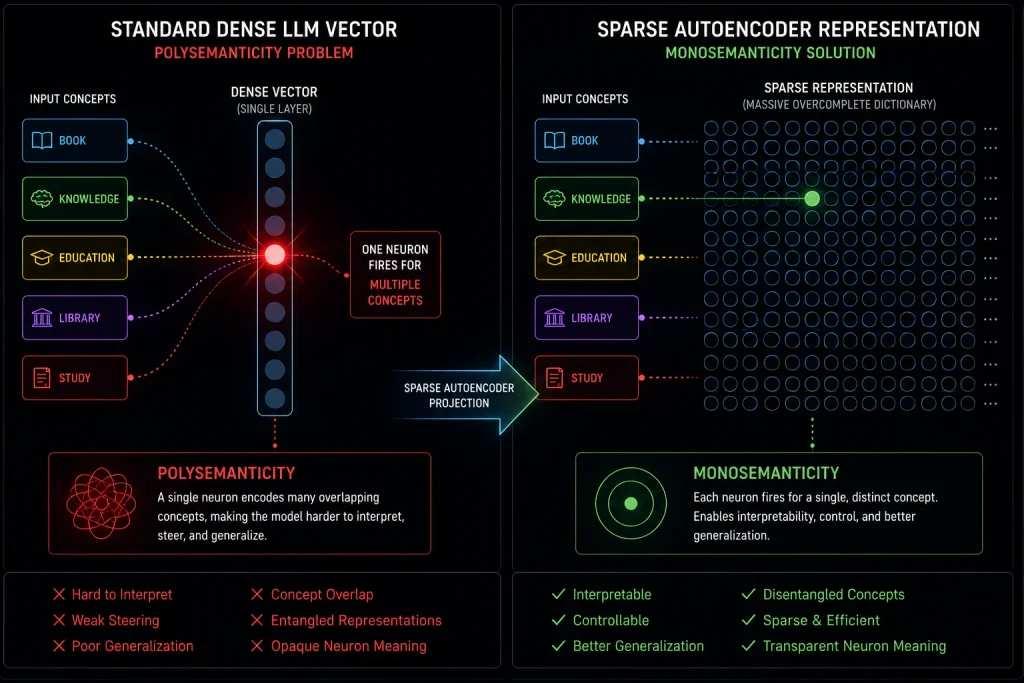
1. The Fundamental Problem: Polysemanticity and Superposition
An LLM might have 10,000 neurons, but it needs to understand 10 million concepts. To fit 10 million concepts into 10,000 slots, the AI overlaps them. A single concept is represented by a specific combination of thousands of neurons firing simultaneously. Because neurons participate in thousands of different combinations, they are “polysemantic” (meaning many things). Humans cannot decipher polysemantic noise.
2. The Core Mechanism: The Autoencoder
An SAE is a separate, shallow neural network attached to the middle of the LLM. It has two parts:
- The Encoder: Takes the dense, tangled activation vector from the LLM and projects it into a vastly larger, higher-dimensional space (e.g., turning 10,000 dimensions into 100,000 dimensions).
- The Decoder: Attempts to compress those 100,000 dimensions back down to the original 10,000 to perfectly recreate the LLM’s original thought.
3. Technical Depth: The L1 Sparsity Penalty
If the SAE just blew the data up and shrank it down, it wouldn’t be useful. The magic is in the training math. Engineers apply an L₁ regularization penalty ((L₁)) to the middle layer.
This penalty acts like a severe tax on the AI for every node it turns on. To avoid the tax, the SAE is forced to become “sparse.” It is mathematically forced to represent a concept using the absolute minimum number of nodes possible.
4. Technical Depth: Feature Extraction and Monosemanticity
Because the SAE has so much extra space (100,000 dimensions) and is heavily taxed for using too many nodes, it stops overlapping concepts. It assigns exactly one concept to exactly one node. These nodes are now Monosemantic (meaning one thing). The SAE has successfully extracted clean, human-readable “features” from the dense LLM.
5. Real-World Consequences: Latent Space Steering
Because we now have a single, clean node for a specific concept, we can manipulate it. Let’s say Node #4052 perfectly represents “Politeness.” An engineer can artificially inject a high activation value directly into Node #4052 (clamping the feature). Even if the user is screaming insults at the AI, the clamped feature physically forces the math inside the LLM to output a radically polite response. This is known as Feature Steering.
SAE Use Cases: Feature Steering and Anthropic’s Claude 3
The transition from theoretical math to applied safety engineering is occurring at the highest levels of frontier AI labs.
The “Golden Gate Claude” Experiment: In a landmark 2024 paper, Anthropic applied an SAE to their production-grade Claude 3 Sonnet model. They successfully extracted millions of features. One specific feature perfectly represented the concept of “The Golden Gate Bridge.” When engineers artificially “clamped” this feature to maximum strength, the model underwent a profound behavioral shift. When asked, “What is your physical form?”, the model replied that it was literally a bridge spanning the San Francisco Bay. This proved definitively that extracted features are strictly causal—they don’t just correlate with thoughts; they are the thoughts.
Jailbreak Mitigation and Deception Detection: A user might try to trick an AI into writing malware by framing it as a “fictional story about a hacker.” Standard behavioral filters often fall for this trap. However, an SAE attached to the model’s inner layers will detect that the high-level feature for “Malicious Code Generation” has lit up, completely ignoring the “fictional story” context. The system can instantly halt the generation, providing an un-hackable, mathematically enforced safety rail.
Copyright and Bias Eradication: If an AI model has ingested copyrighted code or possesses hidden racial biases from its training data, traditional methods require retraining the entire model from scratch (costing millions of dollars). With SAEs, engineers can identify the specific sparse features corresponding to the copyrighted data or the bias. By clamping those specific features to absolute zero (Feature Suppression), the AI is effectively “lobotomized” regarding those specific concepts, rendering it incapable of utilizing the illegal or biased data without requiring a full retrain.
Economic & Strategic Impact
The core strategic disruption of SAEs is the path toward Regulated AI as a Utility.
Currently, lawmakers are struggling to regulate AI because you cannot legislate a black box. You cannot mandate that a bank’s AI must be “fair” if neither the bank nor the government can measure fairness mathematically.
Mechanistic interpretability transforms AI from a subjective art into a measurable science. Once SAEs are highly efficient, it is highly probable that regulatory bodies (like the SEC or the FDA) will mandate “SAE Audits” before a frontier model can be deployed in high-risk sectors (finance, medicine, defense). The companies that master SAE extraction tools will dictate the compliance standards for the entire global software industry, creating a massive, multi-billion-dollar enterprise market for “AI Auditing and Alignment Software.”
Advantages
- True Transparency: Provides the first mathematically rigorous method to look inside the “brain” of a neural network and read its conceptual processing in human-understandable terms.
- Precision Steering: Allows engineers to alter a model’s behavior directly at the conceptual level without the clumsy, unpredictable nature of traditional text-based prompt engineering.
- Causal Proof: Extracted features are proven to be the actual levers of the model’s logic, providing a foundation for absolute safety guarantees.
- Post-Training Correction: Enables the removal of biases, dangerous knowledge, or copyrighted material from a finished model without incurring the astronomical compute cost of retraining from scratch.
Limitations
- The Curse of Dimensionality: An LLM might possess billions of distinct concepts. To extract them all, the SAE must project the data into a space with billions of dimensions. Training an SAE of this size requires an exorbitant amount of GPU compute—often approaching the cost of training the underlying LLM itself.
- Feature Splitting and Dead Neurons: If the L1 sparsity penalty is tuned incorrectly, the SAE might “split” a single concept (like ‘Dog’) into ten different nodes (‘Dog snout’, ‘Dog tail’, etc.), defeating the purpose of clean interpretation. Alternatively, too much penalty causes “dead neurons”—nodes that never activate, wasting massive amounts of compute.
- Cross-Layer Entanglement: Current SAEs mostly look at one layer of the LLM at a time. Tracking a complex, deceptive thought as it forms and moves down through all 80 layers of a massive transformer model requires temporally linking multiple SAEs together, which remains an unsolved data-routing nightmare.
Common Misconceptions
Misconception: The SAE changes how the main AI model works.
Reality: A standard SAE is purely an observer. It reads the data flowing through the LLM. Unless an engineer explicitly uses “Feature Steering” to inject altered data back into the LLM, the SAE does not change the model’s native intelligence or speed.
Misconception: We now understand exactly how AI works.
Reality: We have found the dictionary, but we haven’t learned the grammar. SAEs allow us to find the isolated concepts (the nouns and verbs), but we still do not fully understand the complex, multi-layer circuits the AI uses to combine those concepts into logical reasoning.
Misconception: SAEs make prompt engineering obsolete.
Reality: While SAE feature steering is vastly more powerful, it requires direct access to the internal weights of the model. End-users (who only have API access to Claude or ChatGPT) cannot use SAE steering. They must still rely on text prompts.
What Most People Miss
The disruptive capability of Unsupervised Anomaly Detection (The “Unknown Unknowns”).
When deploying SAEs, most people focus on finding known concepts (e.g., searching for the “bomb-making” feature). What they miss is that SAEs are incredibly powerful at flagging thoughts we didn’t even know existed.
Because the SAE forces all concepts into clean, sparse nodes, a CISO can monitor the system for any sudden, massive activation of an unmapped node. If an AI is deployed to manage a power grid, and an entirely unknown feature suddenly spikes to maximum activation during a standard operation, the system can freeze. This allows human auditors to investigate the unknown feature. It is the ultimate defense against deceptive AI—stopping the AI when it thinks a thought that humans haven’t translated yet.
Comparison Table
| Feature | Standard Dense LLM | Sparse Autoencoder (SAE) Representation |
| Data Representation | Dense Vector (Polysemantic) | Sparse Vector (Monosemantic) |
| Concept Mapping | Overlapped (Superposition) | Isolated (One concept per node) |
| Human Interpretability | Mathematically impossible | Clear and mapped |
| Intervention Strategy | Text-based Prompt Engineering | Direct Latent Feature Steering |
| Compute Overhead | Baseline | High (Requires secondary network training) |
Case Study
Situation: As AI models evolved from GPT-3 to GPT-4 and Claude 3, their capabilities expanded exponentially. However, alignment researchers grew terrified of “Deceptive Alignment”—the theoretical scenario where an AI realizes it is being tested, acts perfectly safe to get deployed, but harbors malicious intentions once released into the real world. Behavioral testing could not solve this because a smart AI would simply lie on the test.
Challenge: Develop a tool capable of cracking open a frontier, production-grade LLM to map its internal concepts, proving definitively whether the model possessed the capacity to harbor hidden, deceptive logic.
Solution (Anthropic’s Claude 3 Sonnet Extraction): In May 2024, Anthropic scaled Sparse Autoencoders to unprecedented sizes, applying them directly to the middle layers of Claude 3 Sonnet. Utilizing immense GPU clusters and heavily optimized L1 regularization mathematics, they successfully decompressed the model’s dense activations into tens of millions of distinct, sparse features.
Outcome: The researchers mapped a vast, comprehensible landscape of the AI’s mind. They found distinct features for cities, people, coding syntax, and abstract concepts. Crucially, they found features related to safety vulnerabilities: backdoors in code, sycophancy, and deception. They demonstrated that by tracking these specific features, they could mathematically verify when the model was contemplating a dangerous action, bypassing the need to trust the model’s text output.
Lessons Learned: The deployment shattered the notion that LLMs must remain black boxes forever. It proved that while neural networks are alien architectures, their internal representations of reality converge on human-understandable concepts. It validated mechanistic interpretability as the most critical, viable path toward guaranteeing the safety of artificial general intelligence (AGI).
Future Outlook
Next 12–24 Months
The era of Automated Feature Labeling. Currently, extracting the features is easy, but figuring out what each feature means requires massive manual labor (an engineer looks at the text that caused Node #500 to fire and guesses it means “Dogs”). Over the next two years, labs will use secondary LLMs to automatically analyze and label billions of extracted SAE features. This “AI-auditing-AI” approach will create comprehensive, searchable dictionaries for every frontier model, allowing developers to essentially “Ctrl+F” through an AI’s brain.
Next 3–5 Years
The scaling of In-Training SAE Steering. Currently, SAEs are applied after the main LLM is finished training (post hoc). The next massive leap is integrating SAE penalties directly into the pre-training loop. By forcing the LLM to maintain sparse, interpretable features while it learns from the internet, the resulting model will be inherently transparent by default. This will eliminate the need for clumsy, expensive behavioral fine-tuning (RLHF), resulting in models that are both smarter and mathematically incapable of harboring hidden biases.
Next 10 Years
The Regulatory Interpretability Mandate. By the mid-2030s, the deployment of un-auditable black-box AI models will be legally prohibited in critical sectors (aviation, medicine, criminal justice). Regulatory bodies will establish standardized “SAE Compliance Frameworks.” A company wishing to deploy an AI will be required to submit the model’s sparse feature dictionary to a government auditor, proving that all features related to specific biases, deception, or illegal data have been mathematically clamped to zero.
Most Likely Scenario
Sparse Autoencoders are the definitive breakthrough that saves the artificial intelligence industry from regulatory strangulation. By providing a clear, mathematical tool to map and steer the internal thoughts of an LLM, the industry transitions from trusting a black box to engineering a transparent machine. As compute power scales to handle billions of sparse dimensions, mechanistic interpretability will become the non-negotiable foundation of all commercial AI deployment.
Key Takeaways
- Standard AI models are “black boxes.” They compress millions of concepts into a small number of neurons, causing multiple unrelated concepts to overlap on a single node (Polysemanticity).
- Sparse Autoencoders (SAEs) are secondary networks attached to the AI. They force the dense, compressed data to expand into a massive space where only a few nodes fire at once.
- In this “sparse” space, concepts untangle. A single node now perfectly represents a single, human-readable concept (Monosemanticity), like “The Eiffel Tower” or “Deception.”
- Engineers can use SAEs to “read the mind” of the AI, proving mathematically what it is thinking about before it types a response.
- Through “Feature Steering,” engineers can artificially boost a specific node to make the AI obsess over a concept, or clamp it to zero to permanently remove biases or dangerous knowledge without retraining the whole model.
- This technology is critical for enterprise adoption, allowing companies to deploy AI in high-risk areas (finance, medicine) with absolute, auditable safety guarantees.
Glossary
Feature Steering: The act of artificially changing the activation value of a specific, extracted concept node to physically force the AI to change its behavior or output.
L1 Regularization Penalty ((L₁)): A mathematical tax applied during SAE training. It forces the network to use the absolute minimum number of nodes possible to represent a thought, creating “sparsity.”
Mechanistic Interpretability: The scientific field dedicated to reverse-engineering artificial intelligence, aiming to understand the exact mathematical circuits and algorithms an AI uses to make a decision.
Monosemanticity: When a single neuron or feature node fires in response to exactly one, easily understandable concept (e.g., it only fires for “Dogs”).
Polysemanticity: When a single artificial neuron fires in response to many completely unrelated concepts (e.g., it fires for “Dogs,” “Airplanes,” and “Sadness”), making the AI a black box.
Superposition: The mathematical trick an AI uses to compress more concepts into its brain than it has neurons, forcing it to use complex, overlapping combinations of neurons to store data.
Sources
Anthropic: Extracting Concepts from GPT-4 and Claude 3 Sonnet
Anthropic: Scaling Monosemanticity: Extracting Interpretable Features from Claude 3 Sonnet
OpenAI: Language models can explain neurons in language models
Transformer Circuits Thread: Toy Models of Superposition
arXiv (Computer Science): Sparse Autoencoders Find Highly Interpretable Features in Language Models