Advertisement
)


AT A GLANCE
- Concept: Asynchronous Compute: Circuits execute tasks only when data events occur rather than following clock ticks.
- Concept: Biological Spikes: Information transfers via discrete electrical signals, reducing continuous background energy consumption.
- Concept: Local Plasticity: Algorithms adjust synaptic connections directly on the silicon die without external memory access.
- Concept: Zero-Power Idle: Processing cores remain entirely dark until incoming sensor data triggers an active response.
HOW IT WORKS
Traditional computer chips rely on a global clock signal to synchronize operations. Every transistor cycles continuously on every clock tick, drawing a steady stream of electrical current even when the system processes no new data. This clock-driven mechanism causes massive energy waste in edge devices that monitor quiet environments.
Spiking neural network processors abandon the global clock entirely. They operate asynchronously, running on event-driven architectures that mirror human brain physics. In this architecture, individual silicon neurons remain completely dormant, drawing near-zero electrical current until an incoming sensor signal breaches a specific voltage threshold.
When the voltage threshold breaks, the silicon neuron emits a brief, discrete electrical pulse called a spike. Information travels across the chip not as a continuous stream of numbers, but as the precise timing and frequency of these individual spikes.

This temporal coding mechanism compresses the data stream dramatically. Traditional buses transfer wide packets of bits constantly, while event-driven routing networks transfer only the coordinate addresses of active neurons.
Learning occurs locally on the chip using Spike-Timing-Dependent Plasticity ($STDP$). This algorithm modifies the strength of connections between silicon neurons based on the exact millisecond arrival times of consecutive spikes.
Where $\Delta w$ represents the change in synaptic weight, $\Delta t$ is the arrival time difference between pre- and post-synaptic spikes, $A$ represents the scaling amplitudes, and $\tau$ dictates the time constants. This localized adjustment removes the need to transfer heavy data arrays to and from external memory modules.
WHY IT MATTERS NOW
The explosion of autonomous military hardware forces an immediate pivot toward extreme energy efficiency. Modern uncrewed aerial vehicles and remote tracking sensors must operate for months without battery swaps or grid connections. Standard graphics processors consume hundreds of watts, requiring heavy cooling systems that ruin the range and payload capacity of small edge units.
Neuromorphic silicon solves this weight-and-power constraint. By executing calculations locally on milliwatt budgets, these chips allow remote autonomous assets to analyze complex environments independently. Defense operators can deploy long-endurance stealth assets that monitor target zones indefinitely without emitting a hot thermal signature.
This shift redirects capital flows across the global semiconductor supply chain. Capital providers are funneling massive funding into specialized edge architectures like Intel’s Loihi and BrainChip’s Akida platforms. These firms bypass traditional cloud data centers, targeting the un-substitutable edge markets of defense logistics and industrial robotics.
The ongoing deployment of smart monitoring grids across national infrastructure underscores this shift. Remote border monitoring networks use neuromorphic chips to process continuous video feeds directly on solar-powered poles. The sensors filter out thousands of hours of empty desert footage locally, triggering satellite communications only when an active tracking event occurs.
Logistics networks also capture massive operational efficiencies from this transition. Smart sensors on industrial assembly lines predict component fatigue locally, avoiding the immense bandwidth costs of streaming raw sensor feeds to remote processing farms.
WHAT MOST PEOPLE MISS
Most technology analysts assume that artificial intelligence progress depends entirely on building increasingly massive data center facilities. They measure industry capability purely by tracking gigawatt-scale power purchase agreements and high-volume hardware procurement cycles.
They miss the physical structural limits of edge geography. A drone operating in a contested electronic warfare zone cannot stream sensor data back to a centralized cloud server because jamming signals instantly sever the link. Neuromorphic hardware provides a survival advantage by handling both inference and continuous learning completely offline, turning a vulnerable remote asset into a fully self-contained tracking unit.
THE TRAJECTORY
Next 12–36 Months: Defense prime contractors will integrate commercial neuromorphic co-processors directly into autonomous loitering munitions. These chips will process real-time infrared cameras to track targets through electronic jamming without draining the primary propulsion batteries.
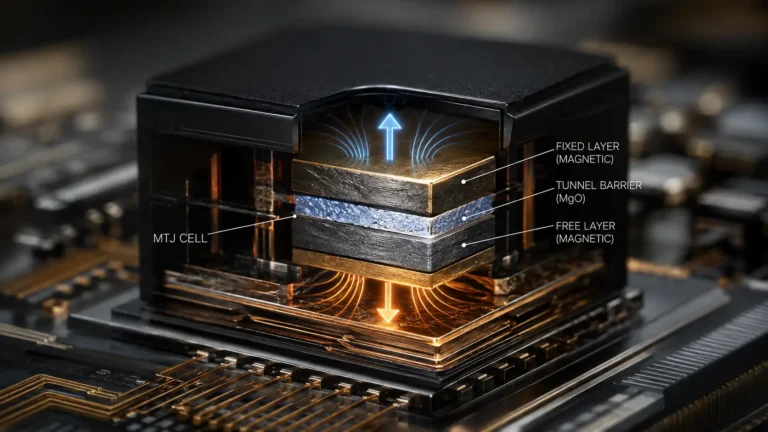
Next Five Years: Foundries will integrate non-volatile resistive random-access memory directly into the neuromorphic circuit grid. This physical union will place memory cells inside the silicon neurons themselves, mimicking biological synapses perfectly and eliminating the remaining physical separation between compute and storage.
Next Ten Years: Event-driven computing will dominate consumer electronics, extending smartphone battery lifespans from days to weeks. Devices will run sophisticated local behavioral models that sleep continuously, waking up only when touch, voice, or biometric triggers fire.
What Could Go Wrong: Developing software for asynchronous, clockless architectures requires a complete departure from traditional programming paradigms. If the software developer ecosystem fails to master non-linear training algorithms, these chips will remain confined to niche military assets, failing to achieve mainstream commercial volume.
Most Likely Outcome: Neuromorphic silicon will secure a permanent, dominant monopoly over low-power edge applications. Traditional cloud architectures will handle initial model pre-training, while event-driven spiking processors will control real-time execution across the autonomous physical world.
KEY TERMS
- Spiking Neural Network (SNN): An artificial neural network architecture that transmits information via discrete temporal events called spikes rather than continuous numerical values.
- Neuromorphic Computing: A hardware design methodology that physically models silicon circuits after the biological architecture of the human nervous system.
- Spike-Timing-Dependent Plasticity (STDP): A biological learning rule that adjusts the connection strength between silicon neurons based on the exact arrival timing of electrical pulses.
- Asynchronous Circuitry: A clockless semiconductor design where operations trigger dynamically via localized data changes rather than a centralized timing signal.
- Event-Driven Processing: A computing paradigm where hardware components consume energy and execute tasks only when specific, incoming data events occur.
SOURCES
- Intel Labs — Neuromorphic Computing Research and the Loihi Processor Architecture
- BrainChip Holdings — Akida Neuromorphic Technology Whitepaper and Event-Based Edge AI Applications
- Frontiers in Neuroscience — Benchmarking Energy Dissipation and Efficiency in Spiking Neural Networks
- IEEE Transactions on Electron Devices — Synaptic Weight Modulation Using Spike-Timing-Dependent Plasticity in Neuromorphic Systems