Advertisement
)

At a Glance
- Concept: A five-story-tall, multi-layered emergency braking system for deep-ocean oil wells.
- Why it matters: It is the absolute final line of defense preventing catastrophic marine environmental disasters and the loss of offshore drilling rigs.
- Who uses it: Global offshore drilling contractors, deepwater exploration firms, and marine safety regulators.
- Biggest takeaway: A BOP does not rely on the surface ship for power during an emergency; it utilizes its own localized, pre-pressurized hydraulic batteries to slice through solid steel pipes instantly.
In Simple Words
If you punch a hole into a pressurized aerosol can, the contents violently spray out. The Earth’s crust operates on the exact same principle. Deep beneath the ocean floor, oil and gas are trapped under millions of pounds of crushing rock. When an oil drill punches into that reservoir, the high-pressure fluid wants to erupt up the drill pipe and blast into the sky.
A subsea Blowout Preventer (BOP) is the mechanical cork that stops this from happening.
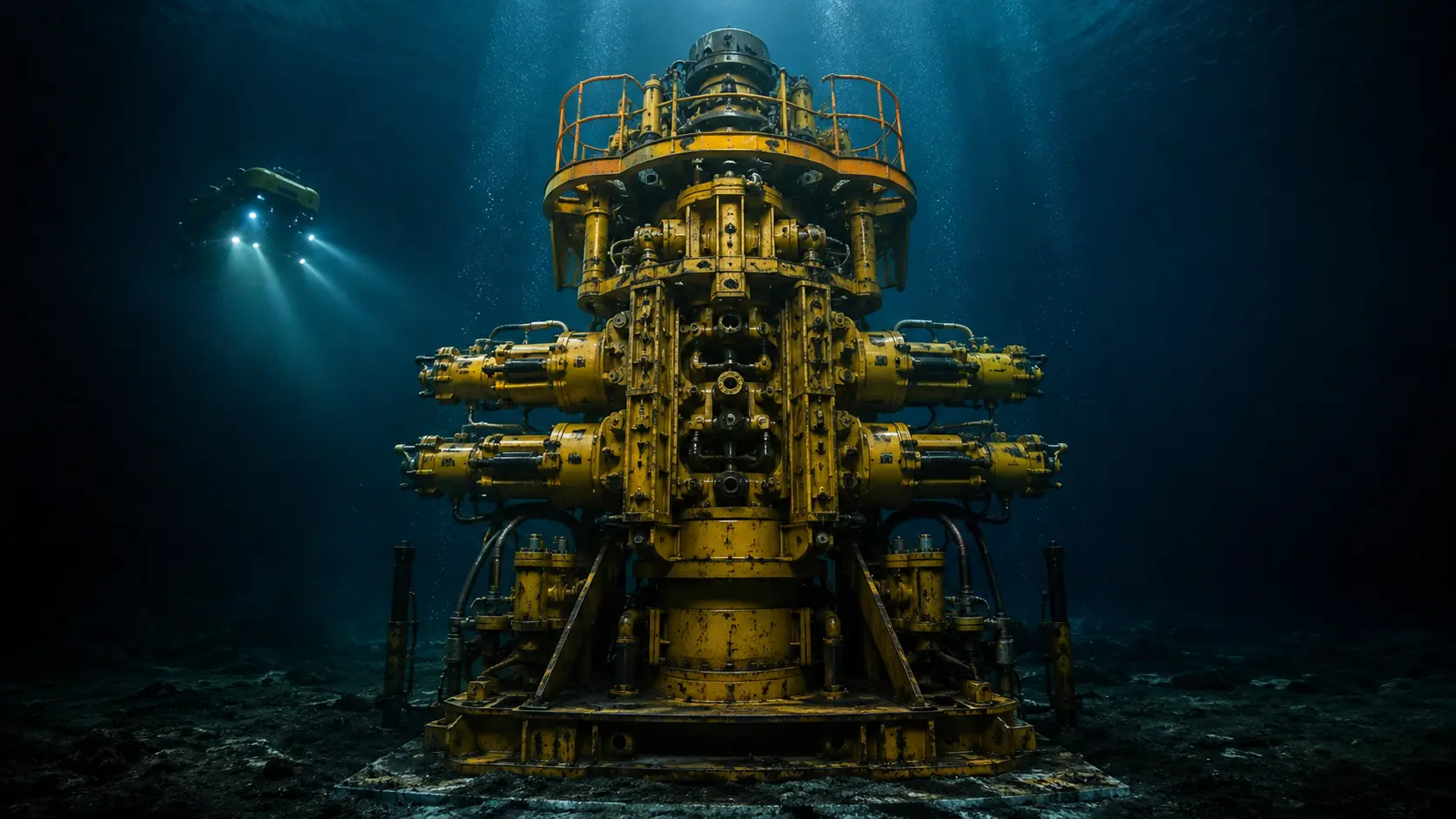
Sitting on the ocean floor, a modern BOP is the size of a five-story building and weighs over 400 tons. The drill pipe runs directly through the center of it. If the well pressure suddenly spikes and oil starts rushing up toward the surface ship, the human operators—or the machine’s automated logic—trigger the BOP.
Instantly, a series of massive hydraulic steel blocks slam shut around the pipe, choking off the flow. If the pressure is too high, the final failsafe activates: a pair of titanium-enforced steel blades act as a guillotine, physically slicing the thick steel drill pipe in half and crushing the hole completely shut, sealing the well forever.
Why This Matters
Extracting oil from deepwater environments is arguably the most hostile industrial operation on Earth, rivaling space exploration in its complexity.
The financial and environmental stakes are absolute. In 2010, the Deepwater Horizon disaster in the Gulf of Mexico proved exactly what happens when a BOP fails. A surge of explosive methane gas bypassed the rig’s defenses, and the BOP’s blind shear ram failed to cut the drill pipe cleanly. The resulting explosion killed 11 workers, sank a billion-dollar rig, and released millions of barrels of crude oil into the ocean, resulting in over $60 billion in liabilities and cleanup costs for BP.
That single event permanently altered global energy extraction. Today, the design, maintenance, and regulation of subsea BOPs dictate the insurance premiums and operational legality of offshore drilling. Environmental, Social, and Governance (ESG) risk analysts monitor BOP compliance fiercely.
As energy demand forces companies to drill in deeper, harsher environments—where water pressures are immense and reservoir temperatures can melt standard seals—the engineering inside the BOP is the only thing standing between stable global energy markets and an apocalyptic ecological crisis.
The Big Picture
Before discussing the mechanical rams, you must understand the invisible war of fluid dynamics happening at the bottom of the ocean.
A deepwater well is a battle between two forces: Formation Pressure (the natural force of the oil and gas trying to push up) and Hydrostatic Pressure (the weight of the drilling fluids pushing down).
To keep the oil safely in the ground while drilling, engineers pump a heavy, synthetic liquid called “drilling mud” down the pipe. The sheer weight of this mud pushing down is the primary defense system. It mathematically balances the upward pressure of the oil.
A BOP is not used during normal drilling. It is an emergency system that only activates when the primary defense fails—when the formation pressure suddenly exceeds the mud weight, causing highly flammable gas to invade the well. This dangerous imbalance is called a “kick.”
HOW SUBSEA BLOWOUT PREVENTERS WORK
Stopping a high-pressure kick under 10,000 feet of freezing ocean water requires a stacked hierarchy of brute mechanical force.
Here is the step-by-step anatomy and activation sequence of a modern subsea BOP stack.
1. The Annular Preventer (The Chokehold)
Located at the very top of the BOP stack, the annular preventer is the first line of mechanical defense. It contains a massive, donut-shaped rubber packer reinforced with steel ribs. When activated, hydraulic fluid forces a piston upward, squeezing the rubber donut inward until it tightly wraps around whatever is in the hole—whether it is a thick drill collar, a thin pipe, or just an empty wireline. It chokes the flow without damaging the equipment.
2. The Pipe Rams (The Mechanical Lock)
If the annular preventer cannot hold the pressure, the operator activates the pipe rams. These are two massive blocks of steel with semi-circular cutouts designed to fit a specific diameter of drill pipe. When fired, the two blocks slam together from opposite sides, perfectly sealing around the pipe like a steel collar, locking it in place and stopping the upward flow of oil.
3. The Blind Shear Ram (The Guillotine)
If the rig is on fire or the ship is being dragged off location by a hurricane, the crew must abandon the well. They activate the blind shear ram. These are two hardened steel blades. Driven by immense hydraulic force, they slam together, physically slicing through the thick steel drill pipe. As the blades pass each other, they crush the remaining pipe flat and permanently seal the wellbore, completely severing the connection to the surface ship.
4. Hydraulic Accumulator Banks
You cannot pump hydraulic fluid from a ship 10,000 feet down fast enough to close a massive steel valve in an emergency. The delay would be fatal. Therefore, the BOP carries its own power supply: Accumulator Banks. These are thick steel bottles pre-charged with highly compressed nitrogen gas and hydraulic fluid. When the “close” command is given, the compressed nitrogen acts like a coiled spring, instantly blasting the hydraulic fluid into the rams and slamming them shut in under 45 seconds.
5. Acoustic Telemetry and The Deadman Switch
If the drilling ship explodes, the physical cables connecting the ship to the BOP burn up. To account for this, modern BOPs are equipped with acoustic telemetry. Backup ships can drop a sonar device into the water and “ping” the BOP using sound waves to command it to close. Furthermore, the BOP has a localized computer logic board called an AMF (Autoshear/Deadman system). If the BOP detects that it has lost all communication, electrical power, and hydraulic pressure from the surface, it assumes the ship is gone and automatically fires the blind shear rams to seal the well.
Real-World Applications
The deployment of subsea BOPs is mandatory across the global offshore sector.
Ultra-Deepwater Exploration: In areas like the Gulf of Mexico, offshore Brazil, and the North Sea, drillships operate in water depths exceeding 10,000 feet. The BOP acts as the foundational anchor connecting the floating rig to the sea floor. Advanced dynamically positioned (DP) drillships rely on the BOP’s rapid-shear capabilities to instantly disconnect and drive away if the ship loses its GPS-guided station-keeping ability in heavy currents.
Capping Stacks and Emergency Response: Following the 2010 Macondo spill, the industry created rapid-response capping stacks. These are essentially modified, portable BOPs kept on standby globally. If a well’s primary BOP fails and a blowout occurs, specialized subsea robots (ROVs) deploy the capping stack, lower it onto the erupting wellhead, and bolt it down to choke the flow.
High-Pressure, High-Temperature (HPHT) Drilling: The newest frontier in offshore oil involves reservoirs where pressures exceed 20,000 pounds per square inch (psi) and temperatures melt standard elastomers. Manufacturers like Baker Hughes and NOV are deploying “20K BOPs,” utilizing advanced aerospace-grade metallurgy to withstand pressures that would instantly shatter traditional steel castings.
Economic & Strategic Impact
The financial burden of BOP compliance dictates the economics of offshore energy.
A modern subsea BOP stack costs between $30 million and $50 million to build. However, the true cost lies in its maintenance. Regulatory bodies, such as the Bureau of Safety and Environmental Enforcement (BSEE) in the United States, mandate that BOPs be pulled to the surface every few years for complete tear-downs and recertification.
Because renting an ultra-deepwater drillship costs upwards of $500,000 per day, pausing drilling for two weeks to pull a massive BOP to the surface for repairs costs operators millions of dollars in lost time.
Strategically, the engineering reliability of these devices determines national energy security. If a major blowout occurs, governments frequently institute multi-year drilling moratoriums (as seen in 2010), freezing billions of dollars in capital, crippling local maritime economies, and forcing nations to rely more heavily on foreign imported crude oil.
Advantages
- Absolute Well Control: Provides the only physical mechanism capable of stopping an uncontrolled flow of highly pressurized hydrocarbons in a deep-sea environment.
- Localized Power: Pre-charged hydraulic accumulators ensure the BOP can function flawlessly even if the surface ship loses all power or detaches.
- Multi-Tiered Redundancy: By stacking annulars, pipe rams, and shear rams, the system offers multiple backup methods to seal the well if a primary valve is damaged.
- Automated Fail-Safes: Deadman switches remove human error during catastrophic rig failures, ensuring the well is sealed autonomously.
Limitations
- Metallurgical Shearing Limits: Blind shear rams cannot cut through the thickest parts of a drill string, such as the heavy drill collars or tool joints. If a tool joint is accidentally positioned across the shear ram during an emergency, the blades will jam, and the well will not seal.
- Extreme Maintenance Complexity: Rubber seals (elastomers) degrade rapidly when exposed to 300°F oil and highly corrosive hydrogen sulfide gas, requiring frequent, expensive replacements.
- Acoustic Interference: In the event of a blowout, the roaring noise of escaping gas can create intense underwater acoustic interference, making it difficult for backup ships to trigger the BOP using sonar telemetry.
Common Misconceptions
Misconception: A BOP is just a large metal valve.
Reality: It is an immensely complex, robotic tower. A subsea BOP stack is often over 50 feet tall, weighs up to 400 tons, and contains millions of lines of software code, redundant hydraulic circuits, and specialized acoustic modems.
Misconception: The drilling crew on the ship powers the BOP closing sequence.
Reality: The crew only sends the signal to close. The physical power to move the massive steel rams comes directly from the pre-pressurized nitrogen accumulator bottles located down on the ocean floor alongside the BOP.
Misconception: Once a shear ram cuts the pipe, drilling can resume later.
Reality: Firing a blind shear ram is a destructive, apocalyptic event. It completely destroys the drill pipe, crushes the casing, and often ruins the BOP itself. It is only used when the total loss of the well is deemed acceptable to save human lives and the environment.
What Most People Miss
The physics of a “kick” is highly deceptive, which is why a rapid BOP response is critical.
When a bubble of explosive methane gas enters the bottom of a well at 10,000 feet, it is under immense pressure, so it is physically small. As that gas bubble travels up the pipe toward the surface, the ocean pressure decreases.
Because of Boyle’s Law, as pressure decreases, the gas expands. By the time the gas bubble reaches the surface rig, it expands violently, blowing the heavy drilling mud out of the way. If the crew waits until they see the gas at the surface, it is already too late. The BOP must be closed while the gas is still trapped deep underwater in its compressed state.
Comparison Table
| Feature | Annular Preventer | Pipe Ram | Blind Shear Ram |
| Sealing Mechanism | Heavy-duty rubber/elastomer packer. | Solid steel blocks with fitted cutouts. | Hardened steel cutting blades. |
| Primary Function | Seals around any shape (drill pipe, wire, or empty hole). | Seals around a specific, known diameter of pipe. | Slices through the pipe and crushes the hole completely shut. |
| Destructive? | No. | No. | Yes. Destroys the drill string. |
| Placement in Stack | Top (First line of defense). | Middle (Primary static seal). | Bottom/Middle (The ultimate failsafe). |
| Pressure Rating | Usually lower (up to 10,000 psi). | Extremely high (up to 20,000 psi). | Extremely high (up to 20,000 psi). |
Case Study
Situation: On April 20, 2010, the Deepwater Horizon drillship suffered a massive influx of pressurized methane gas (a blowout) from the Macondo well in the Gulf of Mexico.
Challenge: The drilling mud failed, and the gas bypassed the annular preventers. The rig caught fire and lost all power. The crew attempted to activate the BOP’s blind shear ram to cut the pipe and seal the well.
Solution (The Failure): The blind shear ram activated, but it failed to seal the well. Post-disaster forensic analysis revealed the extreme upward pressure of the erupting oil had caused the drill pipe to physically bow and buckle inside the BOP. Because the pipe was pushed off-center, the shear ram blades could not sever it cleanly. A gap remained, allowing millions of barrels of oil to blast into the ocean.
Outcome: The disaster fundamentally changed BOP engineering. Regulators realized that a single shear ram was an unacceptable risk.
Lessons Learned: The American Petroleum Institute (API) completely overhauled Standard 53. Today, modern deepwater BOPs are mandated to carry two shear rams (casing shear rams and blind shear rams) and utilize advanced centering mechanisms to ensure the pipe is physically forced into the perfect position before the blades fire.
Future Outlook
Next 12–24 Months
The deployment of 20,000 psi (20K) BOP systems will accelerate as oil majors unlock high-pressure reservoirs in the Gulf of Mexico (such as Chevron’s Anchor project). These systems require entirely new, heavier steel forgings and redesigned accumulator systems to generate the massive kinetic force required to close against 20K pressures.
Next 3–5 Years
BOPs will transition from strictly mechanical devices into fully digitized IoT platforms. Real-time condition monitoring sensors will be embedded directly into the rubber elastomers and steel rams. These sensors will stream wear-and-tear data back to the surface, allowing predictive AI models to calculate exactly when a rubber seal will fail, preventing the need to pull the BOP to the surface prematurely.
Next 10 Years
Subsea robotics will evolve to feature modular BOP stacks. Instead of pulling a 400-ton monolith to the surface for repairs, specialized heavy-lift Remote Operated Vehicles (ROVs) will be able to unbolt and replace a single faulty hydraulic valve or ram block directly on the ocean floor, saving operators millions of dollars in rig downtime while maintaining absolute environmental compliance.
Most Likely Scenario
Despite the global push toward renewable energy, the sheer demand for petroleum products will keep deepwater extraction viable for decades. The BOP will remain the apex engineering marvel of the offshore sector. However, as the physical limits of steel and hydraulics are reached in ultra-deep, ultra-hot environments, the industry will rely increasingly on digital twins and automated intervention logic to mitigate risks that humans can no longer react to fast enough.
Key Takeaways
- A subsea Blowout Preventer (BOP) is a massive emergency valve stack installed on the ocean floor to prevent oil spills.
- It only activates when the primary defense—the heavy weight of the “drilling mud”—fails and allows highly pressurized gas to enter the well (a “kick”).
- Annular preventers use rubber to choke the flow, while pipe rams use solid steel to lock the pipe in place.
- The blind shear ram is the ultimate failsafe; it physically slices the drill pipe in half and crushes the well shut.
- Because surface power takes too long to reach the ocean floor, BOPs use their own localized hydraulic accumulator bottles to instantly slam the rams shut.
- Modern BOPs contain deadman switches that automatically sever the pipe if the surface rig explodes or sinks.
- The failure of a single shear ram during the Deepwater Horizon disaster forced the industry to mandate double shear rams and advanced centering technology.
Glossary
Accumulator: Heavy steel bottles pre-charged with compressed nitrogen gas, used to store localized hydraulic power to instantly close the BOP rams in an emergency.
Annular Preventer: A large, donut-shaped rubber seal at the top of the BOP that can close around any size of pipe to choke off fluid flow.
Blind Shear Ram: The final failsafe in a BOP; hardened steel blades designed to cut completely through the drill pipe and seal the open hole.
Blowout: The catastrophic, uncontrolled eruption of oil, gas, or water from a wellbore.
Deadman Switch: An automated safety logic circuit that fires the blind shear rams if all communication, power, and hydraulics from the surface ship are lost.
Drilling Mud: A heavy, synthetic liquid pumped down the drill pipe. Its physical weight provides hydrostatic pressure to keep the oil and gas safely in the ground.
Hydrostatic Pressure: The downward pressure exerted by the weight of a fluid (such as ocean water or drilling mud).
Kick: The highly dangerous, unplanned entry of pressurized oil or gas into the wellbore when the formation pressure overcomes the mud weight.
Frequently Asked Questions
How big is a subsea BOP?
They are gigantic. A modern deepwater BOP stack can be over 50 feet (15 meters) tall and weigh between 300 and 400 tons.
How does it stay attached to the ocean floor?
It physically bolts onto the “wellhead,” a thick steel housing that is cemented thousands of feet into the bedrock beneath the ocean floor.
Can a BOP be reused after cutting a pipe?
The BOP structure itself can be reused, but the internal blind shear ram blades and the rubber seals must be replaced. Firing the shear ram is a highly destructive event that requires pulling the entire BOP back to the surface for an overhaul.
Why did the BOP fail during the Deepwater Horizon spill?
The extreme upward pressure of the gas caused the drill pipe to bend and buckle outward. The pipe moved off-center, causing the shear ram blades to only partially cut the steel, leaving a gap for the oil to escape.
How is a BOP controlled from the surface?
It is controlled via a thick cable called a MUX (Multiplex) line, which carries electrical signals and hydraulic fluid from the ship down to the control pods on the BOP.
What happens if the ship sinks and the cables snap?
The BOP detects the loss of the MUX lines. Its internal computer (the AMF/Deadman system) uses the stored energy in the accumulator bottles to automatically fire the shear rams, sealing the well before the ship hits the ocean floor.
Why not just put the BOP on the ship instead of underwater?
In shallow water, BOPs are sometimes placed on the rig (Surface BOP). In deep water, the rig is constantly moving with the waves. If a blowout happens and the rig must disconnect and drive away to avoid exploding, the valve must be physically located on the ocean floor to seal the well behind it.
Sources
- Bureau of Safety and Environmental Enforcement (BSEE): Blowout Preventer Systems and Well Control Rule
- American Petroleum Institute (API): Standard 53 – Blowout Prevention Equipment Systems
- National Commission on the BP Deepwater Horizon Oil Spill: Final Report on the Macondo Blowout
- Offshore Magazine: The Evolution of 20K Subsea Blowout Preventers