Advertisement
)


At a Glance
Concept: Machines generating high-quality practice material to train other machines.
Why it matters: The AI industry has nearly consumed all high-quality human text on the internet.
Who uses it: Tech giants like Microsoft and Meta, autonomous vehicle companies, and healthcare researchers.
Biggest takeaway: The next leap in artificial intelligence relies on machines learning from simulated logic rather than human history.
In Simple Words
Imagine a medical student preparing for their final exams. They buy every practice test available, study the answers, and eventually memorize every possible question.
To get smarter, the student needs new, highly complex questions. Because no more human-written tests exist, the student writes a computer program to generate millions of brand-new, biologically accurate medical questions. The student then studies those.
This is what is happening to artificial intelligence. Large language models (LLMs) like ChatGPT have already “read” the entire public internet. They have consumed every Wikipedia article, Reddit post, and digitized book. They have hit the Data Wall.
To continue getting smarter, AI companies are now using advanced models to generate synthetic data. They instruct one AI to generate billions of highly complex, mathematically perfect examples of computer code, logic puzzles, or financial scenarios. A newer, smaller AI then uses this clean, artificial data to train. It is the digital equivalent of an intelligence printing press.
Why This Matters
The global technology sector is facing an imminent resource shortage, and the missing resource is human text.
AI models improve through “scaling laws”—the principle that if you give a model ten times more computing power and ten times more data, it becomes exponentially smarter. However, researchers estimate that high-quality human text will be fully exhausted before the end of this decade. You cannot train the next generation of supercomputers by feeding them low-quality social media arguments; they require textbook-level reasoning.
Synthetic data solves this hard physical limit.
By generating its own training material, the AI industry detaches itself from the slow pace of human output. A company no longer needs to wait years for humans to write more books. A data center can generate a trillion words of flawless Python code over a weekend.
Furthermore, this shift drastically alters corporate economics. Historically, companies like Reddit, Twitter, and global news publishers held immense power because they owned the data AI companies needed. As tech giants shift to synthetic generation, these human data monopolies lose their leverage. The barrier to entry for building a world-class AI system shifts from owning data to simply owning computing power.
HOW SYNTHETIC DATA GENERATION WORKS
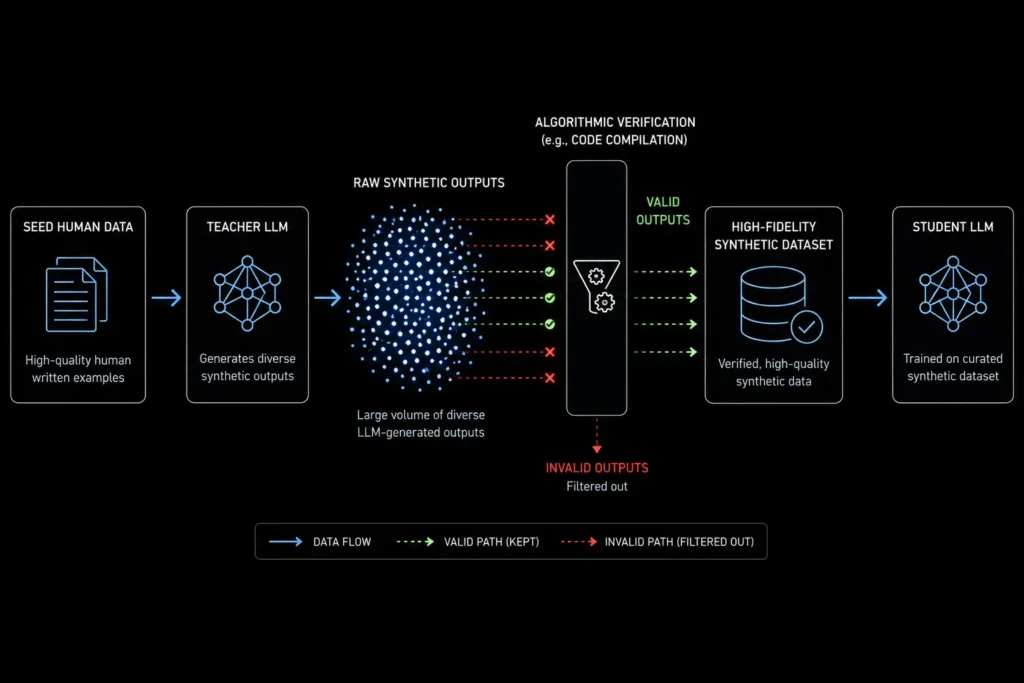
Creating data from scratch is not simply asking a chatbot to write a story. It requires a rigid, mathematically verifiable architecture to ensure the new data is statistically identical to reality.
Here is how the synthetic data engine operates.
1. The Seed Data and Prompting
The process begins with a small, pristine set of human data—often called the “seed.” Engineers feed this seed into an incredibly powerful “teacher” AI. They prompt the teacher to generate millions of variations. If the seed is a complex algebraic equation, the teacher AI generates a million new equations that follow the exact same logical rules but use different variables.
2. Generative Adversarial Networks (GANs)
To ensure the new data is flawless, engineers use Generative Adversarial Networks (GANs). This pits two neural networks against each other.
The Generator tries to create realistic fake data (like a simulated MRI scan). The Discriminator acts as a detective, analyzing the image to guess if it is real or fake. The two models battle millions of times. The Generator learns from every failure until it produces an MRI scan so biologically perfect that the Discriminator can no longer tell it was artificially created.
3. Differential Privacy Injection
When generating synthetic data for heavily regulated industries like healthcare or finance, privacy is paramount. Engineers apply Differential Privacy, a mathematical technique that injects “statistical noise” into the generation process.
This guarantees that the final synthetic dataset contains all the macro-patterns of the original human data (e.g., how a disease spreads in a population), but it is mathematically impossible to reverse-engineer the identity of any individual patient.
4. Self-Play and Alignment
For advanced reasoning, AI uses Self-Play. Instead of just generating text, the AI plays a logical game against itself.
It generates a complex coding problem, writes a solution, and then runs the code to see if it compiles. If the code works, it saves that exact interaction as a perfect, verified training example. The AI acts as both the student and the grader, generating a massive library of verified truths.
5. System Limitations: Model Collapse
The entire system carries a fatal risk known as Model Collapse.
If you take a photocopy of a document, it looks fine. If you take a photocopy of the photocopy, it degrades. If you repeat this one hundred times, you are left with illegible static.
If an AI trains exclusively on data generated by an older AI, the subtle errors and hallucinations of the original model are amplified. Over multiple generations, the new AI loses touch with the original human data distribution and collapses into producing repetitive, nonsensical garbage.
Key Insight: To prevent model collapse, engineers cannot rely entirely on synthetic data. They must continuously inject small, highly curated doses of genuine human data to keep the artificial system anchored to reality.
Real-World Applications
Synthetic data is quietly replacing raw human data across the most advanced technological sectors.
Autonomous Vehicles: Companies like Waymo and Tesla cannot physically drive enough miles to experience every rare, dangerous crash scenario. Instead, they use massive video game engines to create synthetic driving simulations. The AI practices driving through artificially generated blizzards, dodging synthetic pedestrians, allowing the car to learn how to react before it ever touches a real road.
Healthcare and Pharmaceuticals: Researchers need millions of patient records to train AI to detect rare cancers. Because of HIPAA privacy laws, sharing raw patient data is illegal. Hospitals now generate synthetic patient populations. The artificial patients exhibit the exact same biological markers as real people, allowing researchers to train cancer-detecting algorithms without violating privacy laws.
Financial Fraud Detection: Credit card companies struggle to train anti-fraud AI because actual fraud makes up less than 0.1% of all transactions. The AI simply does not see enough examples to learn. Banks generate synthetic fraudulent transactions, flooding their training models with millions of artificial attacks so the AI learns exactly what a stolen card looks like.
Economic & Strategic Impact
The transition to synthetic data permanently disrupts the artificial intelligence supply chain.
For enterprise companies, it democratizes AI development. Previously, only tech giants with decades of harvested user data could train frontier models. Today, a mid-sized financial firm can rent cloud computing power, generate a synthetic dataset specific to their industry, and train an expert-level AI without needing to purchase expensive third-party data.
For copyright law, synthetic data presents a massive legal loophole. Authors and publishers are currently suing AI companies for using copyrighted books as training material. If an AI company uses those books to learn how to generate synthetic data, and then trains its final commercial model entirely on the synthetic data, the copyright infringement chain is effectively broken. The final product never “read” the copyrighted material.
Strategically, the cost structure of artificial intelligence is shifting. Data is becoming a cheap, infinite commodity. The only true bottleneck remaining in the global tech race is the physical infrastructure: semiconductor foundries, power grids, and data center cooling systems.
Advantages
• Infinite Scalability: Data constraints disappear; an AI can generate specific training examples on demand.
• Absolute Privacy: Synthetic datasets contain zero real human information, neutralizing GDPR and HIPAA compliance risks entirely.
• Edge-Case Mastery: Engineers can intentionally generate data for extremely rare events (like a plane engine failure) that rarely occur in human history.
• Cost Efficiency: Generating data through cloud computing is exponentially cheaper than paying human experts to write complex training manuals.
Limitations
• Model Collapse: Training AI strictly on AI-generated data causes compounding errors, eventually destroying the model’s logic.
• Hallucination Amplification: If the “teacher” model holds a hidden bias or factual error, it will generate millions of synthetic examples reinforcing that exact error.
• Lack of Human Nuance: Synthetic data is highly logical but lacks the unpredictable, chaotic creativity inherent in genuine human culture and conversation.
• Extreme Compute Costs: Generating billions of high-quality synthetic examples requires massive upfront supercomputing power before the actual training even begins.
Common Misconceptions
Misconception: Synthetic data is just “fake data” that makes the AI lie.
Reality: While it is artificially generated, it is mathematically and statistically accurate. A synthetic physics equation still perfectly follows the laws of physics.
Misconception: AI is now fully self-aware because it teaches itself.
Reality: Generating synthetic data is an automated statistical process, not conscious thought. The AI is simply executing a complex math equation to identify missing patterns and filling the gaps.
Misconception: Human data is no longer needed at all.
Reality: Human data remains the vital “anchor.” Without occasional injections of fresh human culture, language, and logic, synthetic models eventually collapse into repetitive static.
What Most People Miss
Synthetic data acts as a reasoning filter, not just a knowledge base.
When an AI reads the public internet, it consumes profound human knowledge alongside toxic arguments, marketing spam, and poorly written code. The model wastes immense computing power learning the structure of garbage.
When tech companies generate synthetic data, they force the “teacher” AI to write perfectly formatted, textbook-style paragraphs. The resulting dataset is incredibly dense and entirely free of internet toxicity.
By training on this synthetic “textbook,” a much smaller, cheaper AI can actually outperform a massive AI trained on the raw internet. The quality of the data matters far more than the sheer volume.
Comparison Table
| Feature | Raw Human Data | Synthetic Data |
| Source | Internet scraping, books, user logs. | AI generating text, images, or logic via algorithms. |
| Privacy Risk | Extremely High (contains personal identifiers). | Zero (mathematically unlinked to real humans). |
| Volume Limit | Finite (we will run out by 2028). | Infinite (bound only by electricity and compute). |
| Data Quality | Variable (includes internet toxicity/errors). | Perfectly formatted, dense, “textbook” quality. |
| Cost to Acquire | High (licensing fees, scraping infrastructure). | Moderate (requires upfront computing power). |
| Primary Risk | Copyright lawsuits and privacy breaches. | Model collapse and hallucination loops. |
| Best Fit | Teaching an AI human culture and language. | Teaching an AI math, coding, and pure logic. |
Case Study
Situation: In 2023, Microsoft wanted to build a highly capable language model that was small enough to run on a standard smartphone, rather than requiring massive cloud supercomputers.
Challenge: Small models typically performed poorly because they could not hold the sheer volume of data contained in the raw internet. To make a small model smart, it required incredibly dense, high-quality educational data, which did not exist in sufficient quantities online.
Solution: Microsoft researchers pioneered an approach they called “Textbooks Are All You Need.” They used a massive frontier AI (similar to GPT-4) to generate a massive, completely synthetic dataset of highly structured coding tutorials and mathematical textbooks. They then trained a very small model, named Phi-1, exclusively on this synthetic textbook data.
Outcome: The tiny Phi-1 model dramatically outperformed models that were ten times larger and trained on raw human data. The synthetic data forced the model to learn pure reasoning rather than simply memorizing internet trivia.
Lessons Learned: The future of AI efficiency lies in data curation. A small brain fed perfectly structured synthetic logic will routinely defeat a massive brain fed chaotic human internet history.
Future Outlook
Next 12–24 Months
Major AI laboratories will launch frontier models trained on a hybrid ratio of 50% human data and 50% synthetic data. The focus will be on “synthetic reasoning traces”—forcing AI to generate millions of step-by-step problem-solving paths to train newer models how to think sequentially, rather than just generating facts.
Next 3–5 Years
The medical, financial, and insurance industries will completely ban the use of raw consumer data for internal AI training. Synthetic data generation will become a mandatory enterprise compliance standard. Companies will maintain internal “Digital Twin” databases that perfectly mirror their customer base without holding a single real name or social security number.
Next 10 Years
The concept of the “Data Wall” will be viewed as a temporary historical hurdle. AI systems will utilize advanced continuous self-play, running physics engines and mathematical simulations 24/7 to discover new scientific truths that humans never wrote down.
Most Likely Scenario
Synthetic data will permanently separate the capabilities of AI from the limits of human output. However, the premium placed on fresh, verified human data will skyrocket. The most valuable data on Earth will be highly creative, unpredictable human interactions, used sparingly as the critical “anchor” to prevent hyper-advanced synthetic models from collapsing.
Key Takeaways
• Synthetic data is artificially generated information used to train AI when high-quality human text runs out.
• It allows tech companies to bypass the “Data Wall” and scale AI systems infinitely using computing power.
• Generative Adversarial Networks (GANs) and self-play algorithms ensure the artificial data is mathematically perfect.
• Synthetic datasets carry zero privacy risk, eliminating GDPR violations and copyright lawsuits.
• Training an AI exclusively on synthetic data without human intervention causes fatal “Model Collapse.”
• Dense, synthetic “textbook” data allows small, cheap models to outperform massive, expensive models trained on raw internet data.
• The future of AI relies on machines generating their own logic puzzles to teach themselves how to reason.
Glossary
Data Wall: The theoretical limit where artificial intelligence companies consume all available, high-quality human text on the public internet.
Differential Privacy: A mathematical technique that injects random noise into a dataset, preserving broad statistical trends while making it impossible to identify any single individual.
Generative Adversarial Network (GAN): A system where two neural networks (a Generator and a Discriminator) compete against each other to create perfectly realistic synthetic data.
Model Collapse: A degenerative process where an AI trains on data generated by an older AI, causing errors to compound until the new model produces nonsensical output.
Scaling Laws: The observation in AI research that predictably increasing computing power and training data results in an exponentially smarter model.
Seed Data: The initial, small batch of high-quality human data used to teach an AI how to generate millions of synthetic variations.
Self-Play: An algorithmic training method where an AI generates a problem, solves it, and checks its own work to create verified training data.
Synthetic Data: Information that is artificially manufactured by computer algorithms rather than generated by real-world human events.
Frequently Asked Questions
Is synthetic data just an AI talking to itself?
Essentially, yes. A large “teacher” AI generates complex problems and answers, and a smaller “student” AI reads those interactions to learn the underlying logic.
Why don’t companies just use more human data?
They already have. AI companies have scraped nearly the entire public internet. There simply are not enough high-quality books, articles, or coding repositories left to satisfy the massive data appetite of next-generation models.
If an AI learns from AI data, doesn’t it just get dumber?
If done poorly, yes. This is called model collapse. Engineers avoid this by using algorithms to verify the synthetic data (like checking if generated code actually compiles) and by continuously mixing in fresh human data.
How does synthetic data protect my privacy?
If a hospital wants to train an AI on heart disease, raw data reveals patient names. Synthetic data generates a “fake” digital patient who has the exact mathematical markers of heart disease, but who does not actually exist in the real world.
Can synthetic data solve copyright issues?
It acts as a loophole. If a company trains an AI on synthetic data, that specific AI never directly ingested a copyrighted book. However, authors argue the original “teacher” AI still stole their work to learn how to generate the synthetic data.
Are fake images considered synthetic data?
Yes. Autonomous vehicle companies use massive video game engines to generate synthetic images of snowy roads or highly unusual car crashes to train their driving algorithms safely.
Will synthetic data make human writers obsolete?
No. Humans will become the ultimate premium resource. AI requires fresh, creative, unpredictable human thought to serve as the baseline “anchor” to prevent its models from drifting into logical static.
Why is textbook data better than internet data?
The internet is full of sarcasm, repetitive marketing, and poor grammar. An AI wastes compute learning that noise. A synthetic “textbook” is 100% pure reasoning, allowing the AI to become significantly smarter using far less data.
Sources
• Massachusetts Institute of Technology (MIT) Computer Science and Artificial Intelligence Laboratory: Studies on Model Collapse
• Microsoft Research: “Textbooks Are All You Need” (Phi-1 Model Documentation)
• Stanford University: The Physics of Generative Adversarial Networks
• Open Data Institute: The Economics of Synthetic Data in Enterprise Architecture