Advertisement
)


Wall Street just made the stock market twice as fast, but in doing so, it fractured the hidden plumbing of global finance. When you buy a stock, the cash and the shares do not swap hands instantly; they settle later. By cutting this settlement window from two days to one day (T+1), regulators intended to reduce systemic risk by shrinking the time a trade is left hanging in limbo. However, they accidentally triggered a massive traffic jam in the $14 trillion repurchase agreement (repo) market—the shadow banking system where hedge funds and banks lend each other cash and collateral overnight.
Why should you care right now? Because forcing stock trades to settle in 24 hours means foreign investors are waking up with only hours to secure billions of dollars in foreign exchange (FX) funding before the U.S. market closes. If an institution has lent out its bonds to make extra yield, it now has less than a day to recall that collateral to settle a new trade. If they fail to locate the cash or recall the assets in time, the trade “fails to deliver.” This operational squeeze is turning the boring, back-office mechanics of custodial banks into a high-stakes, intraday liquidity trap that threatens to seize up the global cost of capital.
What is T+1 Settlement Latency?
T+1 settlement latency refers to the extreme operational time compression in financial markets when the gap between executing a trade and officially exchanging the cash and assets is reduced to a single business day. This 24-hour window severely squeezes the time institutions have to recall collateral, secure foreign exchange funding, and prevent trade failures.
At a Glance
- Concept: Slashing the time back-office accountants have to verify and fund a multi-billion-dollar trade from 48 hours to 24 hours.
- Why it matters: If the cash doesn’t arrive on time, the trade fails. If trades fail en masse, brokers restrict trading, freezing market liquidity exactly when investors need it most.
- Who uses it: The Depository Trust & Clearing Corporation (DTCC), global custodian banks (State Street, BNY Mellon), macro hedge funds, and foreign institutional investors.
- Biggest takeaway: The stock market now settles in 1 day (T+1), but the global currency market still settles in 2 days (T+2). This mismatch forces foreign buyers to scramble for emergency, same-day U.S. dollars just to pay for their American stocks.
In Simple Words
Imagine you buy a house on Monday.
Under the old rules (T+2), the seller gives you until Wednesday to physically hand over the cash and sign the deed. This gives you two full days to call your bank, sell some other investments, transfer money from a foreign account, and get everything perfectly lined up.
Under the new rules (T+1), the seller demands the cash and the signature by Tuesday morning.
Suddenly, you don’t have time to wait for a standard bank transfer. If your money is tied up in a foreign currency, or if you temporarily lent your cash to a friend (the repo market), you have to frantically call them on Monday afternoon and demand the money back immediately. If your friend doesn’t answer the phone because they live in a different time zone, you default on the house. T+1 turns a casual two-day administrative process into a frantic, 24-hour sprint that punishes anyone who isn’t operating with perfect, automated speed.
Why This Matters
For Institutional Traders, Treasurers, and Macro Economists, T+1 fundamentally destroys the “End-of-Day Batch Processing” model.
For decades, the back offices of massive asset managers operated in batches. Traders would execute thousands of trades all day, and at 5:00 PM, the back office would run a single, massive computer batch to match the trades, calculate the total cash needed, and arrange the funding for two days later. T+1 eliminates this luxury. To meet the new 9:00 PM affirmation deadlines on Trade Date (T+0), treasurers must fund trades intraday, in real-time. This forces asset managers to maintain much larger, idle pools of “pre-funded” cash on their balance sheets just in case a trade executes late in the day, mathematically dragging down their overall portfolio yield.
The Meme-Stock Catalyst for T+1 Compression
The push for T+1 was catalyzed by the January 2021 meme-stock crisis.
When retail traders flooded into stocks like GameStop, clearinghouses (like the DTCC) faced massive risk. During a T+2 settlement cycle, the clearinghouse guarantees the trade for 48 hours. Because the stock prices were wildly volatile, the clearinghouse demanded billions of dollars in emergency margin from brokers like Robinhood to cover the 48-hour risk window. Robinhood couldn’t pay the margin and was forced to halt trading. By cutting the window to T+1, regulators mathematically cut the risk window in half, drastically reducing the margin clearinghouses demand from brokers during extreme volatility. Regulators traded back-office operational risk for front-office systemic safety.
How T+1 Settlement Strains Repo and FX Markets
Bridging the gap between a digital trade execution and the physical movement of trillions of dollars requires flawless infrastructural plumbing. Here is the first-principles breakdown of the architecture.
1. The Fundamental Problem: Counterparty Risk
When a fund buys $1 billion of U.S. Treasuries, the trade is a promise. Until the cash and the bonds physically swap accounts at the custodian bank, there is counterparty risk. If the buyer goes bankrupt during the waiting period, the seller is left holding a devalued asset. Regulators want to compress this waiting period to zero.
2. The Core Mechanism: T+1 Compression
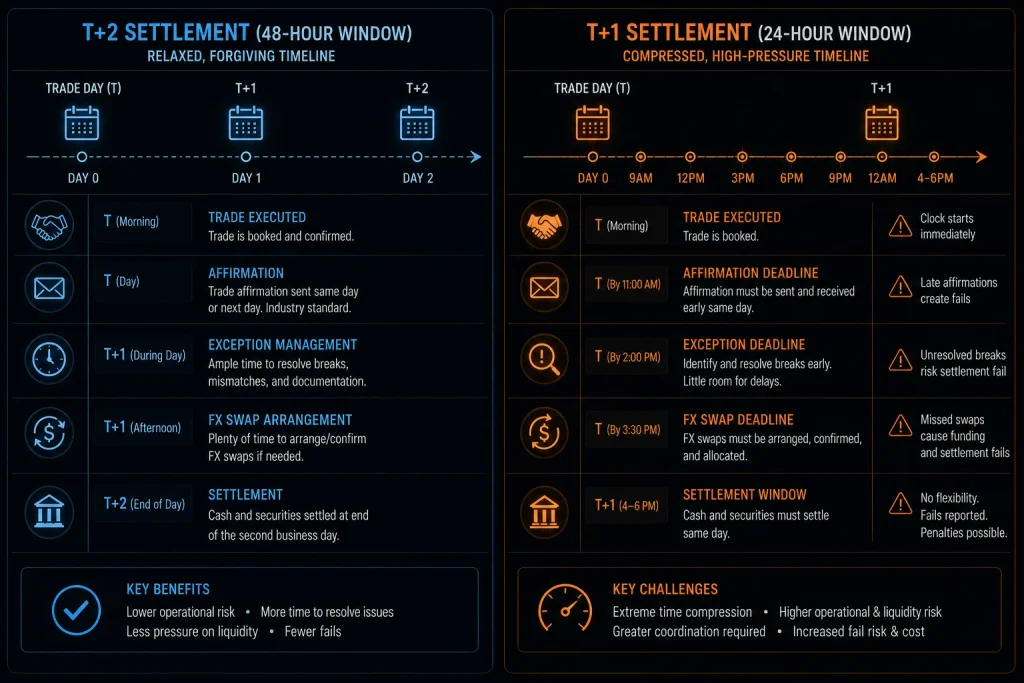
The timeline forces everything to happen faster. A trade executes on Monday (T+0). Under SEC rules, the broker and the fund must complete “Affirmation”—agreeing on the exact price, quantity, and account details—by 9:00 PM EST on Monday. The actual settlement (the movement of cash and assets via the DTCC) occurs on Tuesday (T+1).
3. Technical Depth: The Repo Collateral Recall Squeeze
Institutions rarely let their massive bond portfolios sit idle; they lend them out to short-sellers for a fee (Securities Lending). If an institution sells a bond on Monday, they must deliver it on Tuesday. Therefore, they must issue a “Recall Notice” to the short-seller on Monday afternoon.
The short-seller must then scramble into the Repo market to find a replacement bond to return to the institution. Because the window to find a replacement bond is now halved, any slight scarcity in the specific bond triggers an aggressive spike in repo borrowing rates, causing localized liquidity crunches.
4. Technical Depth: The FX Funding Mismatch
If a European pension fund buys a U.S. stock, they must pay in U.S. Dollars (USD). The standard settlement for Foreign Exchange (FX) trades is T+2.
If the fund buys the stock on Monday (settling Tuesday), but buys the USD on Monday (settling Wednesday), they will not have the cash in time. To survive, the European fund must execute expensive, specialized T+1 or T+0 (same-day) FX swaps. This pushes massive trading volumes outside of the highly secure Continuous Linked Settlement (CLS) system, increasing raw settlement risk between foreign banks.
5. Real-World Consequences: Fails to Deliver (FTDs)
If the collateral recall is too slow or the FX funding misses the cutoff time, the DTCC registers a “Fail to Deliver.” The trade remains unsettled. While the market tolerates a baseline fail rate of roughly 2%, a sudden spike in FTDs during a market panic acts as a contagion, tying up balance sheet capital and forcing dealers to freeze lines of credit to their buy-side clients.
Deploying Straight-Through Processing (STP) for T+1
The operational squeeze of T+1 is forcing a massive technological overhaul across the middle and back offices of global finance.
Straight-Through Processing (STP): To meet the 9:00 PM T+0 affirmation deadline, asset managers are abandoning manual spreadsheets and emails. They are implementing Straight-Through Processing (STP)—connecting their order management systems directly to the DTCC’s Institutional Trade Processing (ITP) platforms (like CTM). A trade must flow from the portfolio manager’s click, through the compliance checks, and into the clearinghouse entirely untouched by human hands.
Custodial Pre-Funding Models: Because foreign asset managers cannot secure FX funding fast enough, global custodian banks (like State Street and BNY Mellon) are stepping in. They offer “pre-funding” or automated overnight overdraft facilities. The custodian essentially lends the U.S. dollars to the foreign client for 24 hours to settle the U.S. stock trade, absorbing the risk while waiting for the client’s T+2 FX trade to clear the next day.
Automated Repo Optimization: Quantitative hedge funds running highly leveraged basis trades are deploying AI-driven collateral optimization engines. These systems predict exactly which Treasuries will be recalled under the T+1 squeeze and proactively substitute collateral across their tri-party repo accounts hours before the physical recall notice arrives, avoiding the punitive rates of same-day borrowing.
Economic & Strategic Impact
The core strategic shift is the Weaponization of Operational Alpha.
Historically, “alpha” (beating the market) was generated purely by the front-office portfolio managers making smart investment decisions. The back office was just a cost center.
T+1 transforms the back office into a source of competitive advantage. If Fund A has perfectly automated T+1 plumbing, they can keep their cash fully invested, earning yield until the absolute last second. If Fund B has slow, manual plumbing, they must keep 5% of their portfolio in idle cash (pre-funding) just to guarantee they don’t fail settlements. Over a year, Fund A will mathematically outperform Fund B simply because their operational plumbing is faster, establishing “Operational Alpha” as a critical differentiator for institutional capital allocators.
Advantages
- Systemic Risk Reduction: Slicing the settlement window in half drastically reduces the amount of time clearinghouses are exposed to a broker defaulting, significantly lowering the aggregate margin requirements forced upon the industry.
- Capital Efficiency for Brokers: Because clearinghouses demand less margin to cover a 24-hour window versus a 48-hour window, broker-dealers free up billions of dollars in trapped regulatory capital, which can be deployed to provide more market liquidity.
- Modernization Catalyst: The brutal deadlines of T+1 force archaic financial institutions to finally retire 1990s-era legacy mainframe systems and adopt cloud-based, real-time API infrastructure.
Limitations
- The Mismatch Penalty: Because U.S. equities moved to T+1 but global FX and many foreign stock markets remain at T+2, multinational funds are forced to manage split-timing portfolios, increasing the raw cost and complexity of cross-border investing.
- Time Zone Disparities: An asset manager in Tokyo or Sydney executing a U.S. trade on Friday afternoon (their time) faces a brutal deadline. By the time the U.S. market closes and requires affirmation, it is the middle of the night in Asia, forcing foreign firms to staff expensive, 24-hour U.S.-based operational desks.
- Loss of Netting Efficiency: In a T+2 environment, an institution had two days to buy and sell the same asset, allowing the clearinghouse to “net” the trades out and only settle the final difference. T+1 compresses this window, reducing netting efficiency and forcing more total gross capital to physically move between banks.
Common Misconceptions
Misconception: T+1 means the trade settles instantly when you click “Buy.”
Reality: Instant settlement is T+0 (or Atomic Settlement). T+1 still relies on an overnight batch process. You execute the trade today, the computers tally everything up tonight, and the cash moves tomorrow morning.
Misconception: The new rules only affect the stock market.
Reality: While targeted at equities, it directly impacts the bond and repo markets. Corporate bonds also moved to T+1. Because institutions use bonds as collateral to fund their stock purchases, the entire ecosystem is structurally tethered to the new deadline.
Misconception: T+1 makes trading cheaper for retail investors.
Reality: Retail investors rarely notice the difference, as their brokers usually front the cash immediately. T+1 is entirely about protecting the clearinghouses (the DTCC) from massive institutional defaults during periods of extreme market volatility.
What Most People Miss
The disruptive impact on Exchange-Traded Fund (ETF) Creations and Redemptions.
Most analysts focus on single-stock trades. What they miss is the plumbing of the $8 trillion ETF market.
An ETF is a basket of underlying stocks. If a U.S. ETF contains European stocks, the underlying European stocks settle on T+2, but the U.S. ETF wrapper now settles on T+1. When an Authorized Participant (a mega-bank) tries to create new shares of that ETF, they must deliver the European stocks to the fund manager. Because the European stocks won’t arrive for two days, the bank is forced to post massive amounts of extra cash collateral to cover the 24-hour “gap.” This friction increases the cost of creating ETFs, which subtly widens the bid-ask spreads for everyday investors buying international ETFs on U.S. exchanges.
Comparison Table
| Feature | T+2 Settlement (Legacy) | T+1 Settlement (Current U.S.) | T+0 / Atomic Settlement (Future) |
| Time to Settle | 48 Hours | 24 Hours | Instantaneous |
| Clearinghouse Risk | High (2 days of price volatility) | Moderate (1 day of volatility) | Zero (No waiting period) |
| Margin Requirements | Massive (Traps broker capital) | Reduced (~25% lower margin) | Eliminated (Pre-funded only) |
| Netting Efficiency | Excellent (Maximum offset) | Reduced | Zero (Every trade is gross) |
| FX Funding Window | Ample (Aligns with T+2 FX) | Mismatched (Requires same-day FX) | Requires Central Bank Digital Currency |
Case Study
Situation: Following the chaotic trading halts of the 2021 meme-stock frenzy, the SEC mandated a transition to T+1 settlement for U.S. equities, corporate debt, and unit investment trusts by May 28, 2024. The global financial industry had roughly two years to prepare for a transition that halved their operational processing time.
Challenge: European and Asian asset managers, who execute roughly 30% of all U.S. equity trades, faced a severe time-zone and FX funding crisis. They had to execute FX trades, recall lent securities, and affirm millions of trades by 9:00 PM EST on Trade Date, all while their local staff were asleep or while their local FX markets were closed.
Solution (The May 2024 Transition): The industry heavily deployed Straight-Through Processing (STP) algorithms via the DTCC’s CTM platform, driving same-day affirmation rates from roughly 70% in early 2024 to over 94% by the implementation date. Global custodians extended their cut-off times for continuous FX liquidity, and prime brokers pre-positioned massive pools of intraday liquidity to absorb the shock of mismatched cross-border trades.
Outcome: The actual transition in May 2024 was widely considered a structural success. The DTCC reported that clearing fund margin requirements dropped by roughly $3 billion (a 23% reduction) on the very first day, achieving the SEC’s primary goal of systemic risk reduction. While Fails to Deliver (FTDs) saw a slight, transient uptick during the first week, catastrophic gridlock was avoided.
Lessons Learned: The transition proved that the global financial system can adapt to extreme time compression, provided there is enough advanced warning to automate legacy manual systems. However, it also cemented the reality that global capital markets are no longer forgiving; institutions that failed to invest heavily in API-driven, real-time plumbing are now permanently penalized with higher funding costs and fail fees.
Future Outlook
Next 12–24 Months
The era of Global Alignment and the UK/EU Pivot. The U.S., Canada, and Mexico have transitioned to T+1. The immediate consequence is a fragmented global market, where Europe and the UK remain on T+2. Over the next two years, the friction of operating split-settlement portfolios will force the European Union and the United Kingdom to announce their own aggressive mandates to transition to T+1. This alignment is critical to unifying the global FX and collateral markets, eliminating the T+1/T+2 arbitrage that currently plagues multinational asset managers.
Next 3–5 Years
The scaling of Continuous Linked Settlement (CLS) Upgrades. The global FX market is secured by CLS, a utility that prevents one party from defaulting on a currency swap. Currently, CLS operates on rigid batch schedules built for a T+2 world. As T+1 becomes the global standard, CLS will be forced to upgrade its infrastructure to support same-day, continuous settlement batches. This upgrade will fundamentally alter how central banks provide intraday liquidity to the global banking system.
Next 10 Years
The DLT Transition to T+0 (Atomic Settlement). By the mid-2030s, the concept of an “overnight batch” will be completely obsolete. T+1 is merely a stepping stone. The ultimate destination is T+0, or Atomic Settlement, facilitated by Distributed Ledger Technology (DLT) and blockchain infrastructure. In a T+0 world, a tokenized share of Apple stock and a tokenized U.S. Digital Dollar will swap instantly via a smart contract. While this completely eliminates clearinghouse risk, it destroys the ability to “net” trades, requiring the industry to invent entirely new mechanisms for algorithmic intraday liquidity provisioning.
Most Likely Scenario
T+1 settlement latency acts as the final stress test for legacy financial plumbing. It ruthlessly exposes institutions relying on manual processes and forces the total automation of the back office. While it successfully lowers the systemic risk of clearinghouse defaults, it fundamentally transfers that risk into the intraday liquidity and repo markets, making the flawless execution of collateral management the most critical operational function on Wall Street.
Key Takeaways
- The U.S. stock market has cut the time it takes to settle a trade from two days (T+2) down to one day (T+1), forcing the financial plumbing to move twice as fast.
- This was done to protect clearinghouses. The shorter the wait time, the less risk there is of a broker going bankrupt before the cash arrives, which significantly lowers the margin fees brokers must pay.
- This creates a massive squeeze on the Repo and Securities Lending markets. If a fund lent out a bond, they now have less than 24 hours to demand it back so they can use it to settle a new trade.
- Foreign investors are the hardest hit. They must buy U.S. stocks on a T+1 schedule but often trade their currencies on a T+2 schedule, forcing them to scramble for emergency, same-day U.S. dollars.
- To survive, banks and hedge funds are completely abandoning human-operated spreadsheets and relying on automated Straight-Through Processing (STP) to confirm and fund trades in real-time.
- T+1 is a stepping stone. The ultimate goal of regulators is T+0 (Atomic Settlement), where cash and assets swap instantly via digital ledgers, completely eliminating the waiting period.
Glossary
Affirmation: The critical step where the buyer and seller officially agree on the exact details (price, quantity, account) of a trade. Under T+1, this must be done by 9:00 PM on the day the trade is made.
Atomic Settlement (T+0): The theoretical future of finance where the execution of the trade and the settlement of the cash/assets happen simultaneously, often using blockchain technology.
Continuous Linked Settlement (CLS): The global utility that settles massive foreign exchange (FX) trades, ensuring that if you send Euros, you are guaranteed to get Dollars in return.
Fails to Deliver (FTD): When one party in a trade fails to hand over the cash or the asset by the settlement deadline.
Repurchase Agreement (Repo): A short-term loan where a party sells a security (like a Treasury bond) and agrees to buy it back the next day. It is the primary way Wall Street borrows cash overnight.
Straight-Through Processing (STP): An automated system where a trade is executed, processed, and settled entirely by computers, without any manual human intervention or data entry.
Sources
Securities and Exchange Commission (SEC): SEC Adopts Rules to Reduce Risks in Clearance and Settlement
Depository Trust & Clearing Corporation (DTCC): T+1 Settlement: Industry Implementation and Impact
SIFMA: T+1 Industry Playbook and Command Center
Bank for International Settlements (BIS): The implications of T+1 settlement for global FX markets
Risk.net: T+1 settlement brings collateral squeeze for securities lending