Advertisement
)


AT A GLANCE
- Logical Mapping: Translates logical block addresses from software into physical locations across silicon memory.
- Write Amplification: Rewriting a single file forces the system to erase and copy entire blocks.
- Garbage Collection: Firmware background sweeps continuously consolidate scattered valid data to free up empty blocks.
- Latency Spikes: Internal recycling cycles block incoming read-write queues, creating sudden, unpredictable cloud bottlenecks.
HOW IT WORKS
NAND flash memory cannot overwrite existing data. To change a single file, a solid-state drive (SSD) must write the new version to an entirely clean physical space and mark the old version as obsolete.
Flash memory writes data in small units called pages, but can only erase data in massive units called blocks. A single block typically contains hundreds of individual pages.
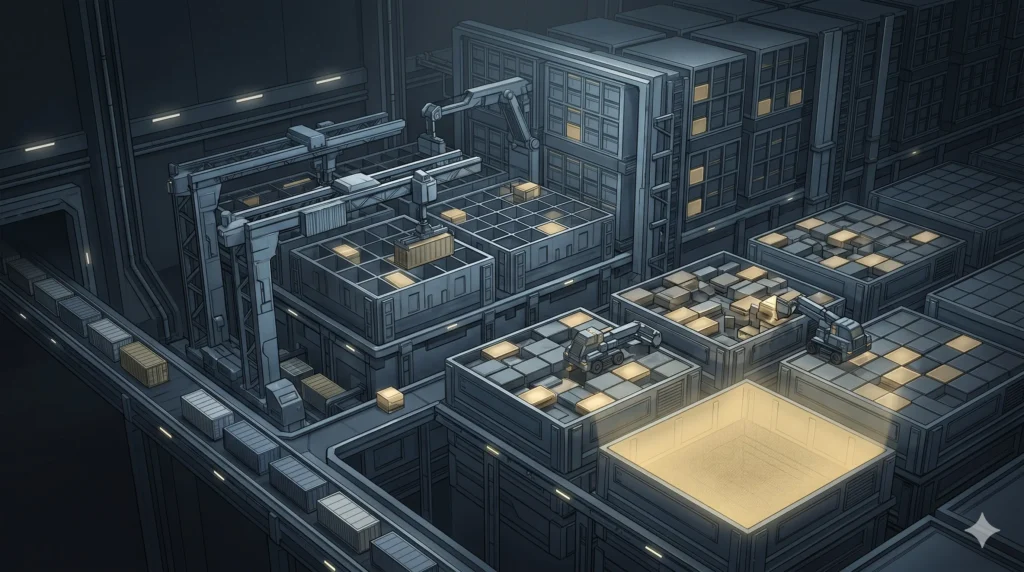
The Flash Translation Layer (FTL) manages this physical asymmetry. It uses an internal logical-to-physical mapping table to track where valid data actually resides on the silicon dies.
When a block fills up with obsolete pages, the FTL garbage collection algorithm activates. The controller copies any remaining valid pages from that block to a completely fresh block.
The system then completely erases the old block, restoring it to a clean state. This constant background recycling introduces the Write Amplification Factor ($WAF$).
The formula for $WAF$ dictates the physical lifespan of the drive:
$$WAF = \frac{\text{Data Written to Flash Memory}}{\text{Data Written by Host Operating System}}$$
If the FTL must write three pages of background data just to commit one page of user data, the $WAF$ equals four. This process rapidly wears out the underlying silicon.
Flash Translation Layer (FTL) Simulator
Observe how background garbage collection algorithms generate physical Write Amplification and trigger enterprise cloud latency spikes.
Optimal Performance
80%
Higher capacity forces FTL to recycle fragmented blocks continuously.
10%
Hidden reserve space dedicated to background GC buffering.
50% Random
Random writes shatter block contiguity, forcing massive WAF penalties.
Write Amp (WAF)
1.0x
Average Latency
0.06 ms
Drive Lifespan (Endurance)
10.0 YRS
Physical Writes vs Host Writes
HOST I/O
NAND I/O
RED indicates FTL Garbage Collection Tax
WHY IT MATTERS NOW
Modern cloud scalability relies entirely on absolute latency consistency. High-frequency financial trading systems, real-time ad exchanges, and distributed databases cannot tolerate milliseconds of delay.
Hyperscale cloud providers run massive distributed storage pools across thousands of individual enterprise NVMe drives. If a single drive experiences an internal garbage collection spike, it slows the entire database cluster down.
Amazon Web Services and Microsoft Azure purchase millions of enterprise SSDs annually. The hardware specifications of these drives are less important than the specific FTL code running on their controllers.
Custom FTL design has become a highly consolidated competitive arena. Phison and Marvell manufacture the physical controller chips, but cloud giants increasingly write proprietary FTL firmware. This custom code allows them to bypass standard garbage collection behaviors and synchronize drive maintenance schedules directly with cloud workloads.
WHAT MOST PEOPLE MISS
Most enterprise buyers assume that acquiring faster PCIe Gen 5 SSDs solves cloud storage bottlenecks. They focus on peak read-write speeds advertised in product brochures.
The true bottleneck is the write amplification penalty under sustained random write workloads. As an SSD nears full capacity, the FTL must perform aggressive, continuous garbage collection.
This internal data shuffling causes write speeds to crash by up to ninety percent. The safety mechanisms of the drive end up choking the incoming network queues, creating systemic latency spikes that cripple application performance.
THE TRAJECTORY
Next 12–36 Months: Enterprise data centers will aggressively shift to Zoned Namespaces (ZNS). This architecture allows host operating systems to write data sequentially into pre-defined physical zones on the SSD, completely bypassing the FTL mapping layer and reducing the Write Amplification Factor to near one.
Next Five Years: Enterprise SSD controllers will deploy dedicated neural network accelerators directly on the silicon. These localized models will predict upcoming write patterns, scheduling garbage collection cycles during idle periods to prevent real-time performance degradation.
Next Ten Years: Emerging non-volatile memory architectures, like Phase Change Memory or Magnetoresistive RAM, will scale to challenge traditional NAND flash. These technologies support byte-addressable write-in-place operations, ultimately rendering the entire FTL and garbage collection concept obsolete.
What Could Go Wrong: If a firmware bug corrupts the FTL mapping tables, an entire storage array can experience silent, systemic data loss. Reconstructing physical data without the FTL translation matrix is mathematically impossible, resulting in permanent catastrophic failures.
Most Likely Outcome: The standard, self-managed SSD will vanish from the enterprise cloud. Hyperscale providers will demand bare-metal storage devices, taking direct software control over physical silicon layout to ensure absolute latency consistency across global operations.
KEY TERMS
- Flash Translation Layer (FTL): The integrated device firmware that maps logical software addresses to physical memory locations on a flash storage chip.
- Write Amplification Factor (WAF): The ratio of physical data written to the flash memory compared to the logical data sent by the host computer.
- Garbage Collection: An automated firmware background process that consolidates valid data from fragmented blocks to free up clean blocks for new writes.
- Over-Provisioning: The practice of allocating a hidden reserve of physical storage space inside an SSD to assist the FTL during write and recycling cycles.
- Zoned Namespaces (ZNS): A storage interface standard that organizes data sequentially into dedicated physical zones to eliminate internal firmware mapping.
SOURCES
- Phison Electronics — Enterprise SSD Architecture and Flash Translation Layer Optimization
- Marvell Technology — Controller Firmware Design for Hyperscale Cloud Storage
- USENIX Conference on File and Storage Technologies — Operating System Level Control of Flash Translation Layers
- Non-Volatile Memory Express (NVMe) — Zoned Namespaces (ZNS) Command Set Specification