
AT A GLANCE
- Taq Polymerase: The heat-resistant enzyme that physically assembles new DNA strands.
- Magnesium Chloride: The essential chemical cofactor that dictates enzyme binding accuracy.
- Custom Primers: Synthetic sequences designed to target and attach to specific pathogen DNA.
- Supply Choke: A handful of global chemical foundries control the synthesis of these reactive proteins.
HOW IT WORKS (THE MECHANISM)
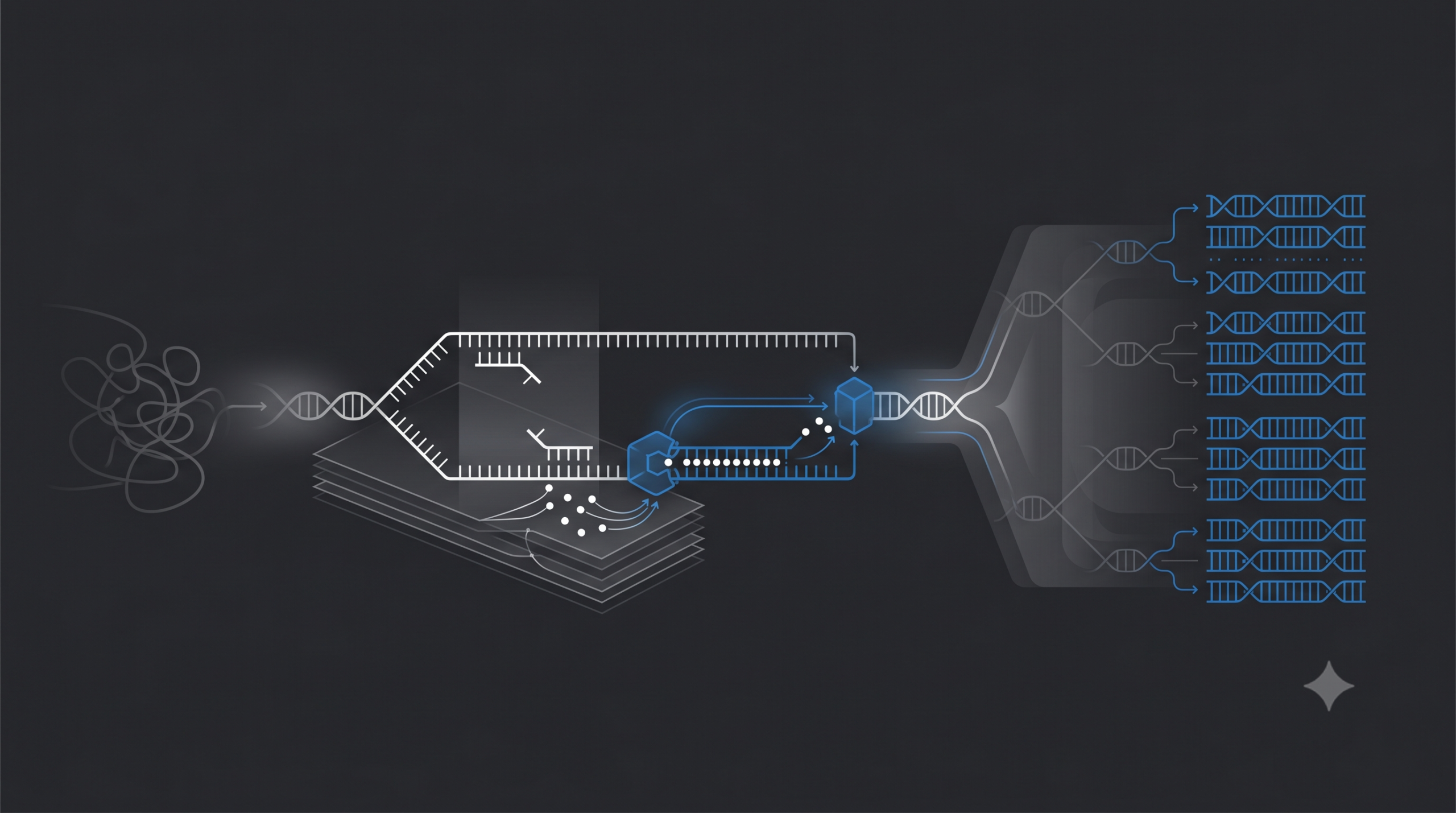
Polymerase Chain Reaction (PCR) forces DNA to replicate artificially. The process requires a master mix. This solution contains a carefully calibrated blend of enzymes, raw nucleotides, and chemical buffers.
The system operates through extreme temperature shifts. Heat melts the double-stranded DNA apart. As the temperature drops, synthetic primers bind to the specific genetic sequence of the target pathogen.

The magnesium chloride concentration controls the physical limits of this reaction. Magnesium ions neutralize the negative charge of the DNA backbone. This chemical shielding allows the primers to physically attach to the target string.
In multiplex assays, engineers search for multiple pathogens simultaneously. This requires extreme chemical precision. If the magnesium concentration sits too high, primers bind to the wrong sequences, creating false positives. If the concentration drops, the polymerase enzyme stalls completely.
WHY IT MATTERS NOW (THE HUMAN IMPACT)
Global bio-defense networks rely entirely on continuous access to this exact fluid. Without the master mix, thermal cycler machines become useless pieces of plastic and metal.
During a viral outbreak, diagnostic laboratories instantly burn through millions of liters of reagents. They need custom primers synthesized immediately to match the specific mutation of the new pathogen.
This creates a brutal industrial bottleneck. Designing the primer takes a few hours on a computer. Synthesizing the physical nucleotides at an industrial scale requires massive chemical foundries.
Only a few highly consolidated corporations possess this manufacturing capacity. When borders close or supply lines fracture, nations lacking domestic enzyme production immediately lose their ability to diagnose disease and track infection rates.
WHAT MOST PEOPLE MISS
The public views diagnostic testing strictly as a hardware problem. They assume building more PCR machines scales global testing capacity automatically.
The true vulnerability lies securely in the cold-chain logistics of the high-fidelity enzymes. Taq polymerase degrades rapidly at room temperature. The global diagnostic network relies completely on dry ice and specialized cryogenic shipping containers to keep these proteins structurally intact across international borders.
THE TRAJECTORY (12–36 MONTHS)
Over the next thirty-six months, diagnostic manufacturers will aggressively pivot to full lyophilization. Engineers will freeze-dry the liquid master mix into highly stable, solid pellets.
This physical process completely bypasses the cryogenic supply chain. Lyophilized reagents survive for months at ambient temperatures. This chemistry permits bio-defense agencies to stockpile vast reserves in standard, non-climate-controlled warehouses.
Simultaneously, algorithmic synthesis will automate multiplex optimization. Artificial intelligence models will accurately predict the exact magnesium chloride ratios needed to prevent primer-dimer collisions. This computational foresight reduces assay development timelines from months down to a few days.
KEY TERMS
- Taq Polymerase: A heat-stable enzyme extracted from hot spring bacteria used to physically build new DNA strands during thermal cycling.
- Multiplex Assay: A specialized PCR test designed to amplify and detect multiple different pathogen DNA sequences in a single reaction tube.
- Primer: A short, custom-synthesized strand of nucleic acid that serves as the exact starting point for DNA replication.
- Lyophilization: A specific freeze-drying process that removes water from biological reagents to radically extend their shelf life at room temperature.
- Nucleotide (dNTP): The individual chemical building blocks the polymerase uses to construct the new DNA sequence.
SOURCES
- National Center for Biotechnology Information — Optimization of Multiplex PCR for Pathogen Detection
- World Health Organization — Laboratory Testing Strategy and Reagent Supply Chain Constraints
- BioTechniques — Magnesium Chloride Optimization in Real-Time PCR Assays
- Thermo Fisher Scientific — PCR Master Mix Formulation and Storage Guidelines